A Critical Assessment of Supply Chain Intrusion Vectors
Joe Slowik (Threat Intelligence and Detections Lead · Gigamon)
BruCON 0x0D · Day 2
Overview
In this insightful BruCON presentation, Joe Slowik, Threat Intelligence and Detections Lead at Gigamon, delivers a comprehensive analysis of supply chain intrusions, a topic that has commanded significant attention in the cybersecurity landscape. Slowik, drawing on extensive experience in critical infrastructure and industrial control systems, unpacks the complexities of these sophisticated attack vectors, emphasizing the critical distinction between an "intrusion" (gaining unauthorized access) and an "attack" (disruptive, destructive events). His research, spanning nearly two years and continuously updated by real-world events like SolarWinds, aims to dispel common misconceptions about the ease and effectiveness of such operations.
Key moments
- 2:10 Understanding the "supply web" and subverting trust
- 12:40 SolarWinds (Sunburst): Sophisticated software build compromise
- 18:30 Cloud Hopper: Leveraging Managed Service Providers for access
- 24:00 Adversary choices: control versus targeting continuum
- 34:50 Debunking "attacker only needs one success" myth
- 38:30 Layering defenses across network profiles (Purdue model)
- 43:00 Essential prerequisites for robust supply chain defense
- 47:50 Future challenges: traffic visibility, zero trust, BYOD
A Critical Assessment of Supply Chain Intrusion Vectors
Speakers: Joe Slowik, Threat Intelligence and Detections Lead, Gigamon
Conference: BruCON
YouTube: https://www.youtube.com/watch?v=CXcaR8jU2Zc
Overview
In this insightful BruCON presentation, Joe Slowik, Threat Intelligence and Detections Lead at Gigamon, delivers a comprehensive analysis of supply chain intrusions, a topic that has commanded significant attention in the cybersecurity landscape. Slowik, drawing on extensive experience in critical infrastructure and industrial control systems, unpacks the complexities of these sophisticated attack vectors, emphasizing the critical distinction between an "intrusion" (gaining unauthorized access) and an "attack" (disruptive, destructive events). His research, spanning nearly two years and continuously updated by real-world events like SolarWinds, aims to dispel common misconceptions about the ease and effectiveness of such operations.
The talk provides a critical assessment of how adversaries execute supply chain intrusions, the inherent difficulties they face, and, crucially, the often-overlooked advantages defenders possess in detecting and mitigating these threats. Slowik challenges the pervasive narrative that attackers only need to be right once, arguing instead that the intricate nature of supply chain compromises presents numerous opportunities for detection and disruption by well-prepared defenders. This article delves into the various facets of supply chain intrusions, from product-based hardware and software compromises to services-based leveraging of trusted third-party relationships, offering both historical context and actionable defensive strategies.
Background
▶ Watch: Understanding the "supply web" and subverting trust (2:10)
The concept of a supply chain in a modern enterprise is far from a simple linear flow; it is, as Slowik aptly describes, a complex supply web. This intricate network involves a multitude of interdependencies, from hardware vendors and operating system providers to open-source projects, third-party software, and even building control systems. Each link in this web represents a trust relationship, where an organization places faith in its suppliers, partners, and service providers to operate securely and without compromise. This inherent trust, while necessary for business operations, creates a powerful vector for adversaries.
Slowik is careful to distinguish between a vulnerability and a supply chain intrusion. A vulnerability, such as the "Oh My God" flaw in Microsoft Azure, is merely a potential means to an end, not the intrusion itself. A true supply chain intrusion requires two key factors: first, the deliberate modification or subversion of trust within a supply chain relationship, and second, the direction of that subversion towards end-users or ultimate targets. The initial compromised entity is not the adversary's final target; rather, it serves as a conduit to leverage existing relationships to reach deeper into desired environments. Slowik categorizes these intrusions into two primary mechanisms: product-based (involving hardware or software) and services-based (leveraging third-party service providers). This foundational understanding is crucial for appreciating the diverse tactics and challenges associated with these highly impactful threats.
Key Findings
▶ Watch: Cloud Hopper: Leveraging Managed Service Providers for access (18:30)
Joe Slowik's core argument revolves around a critical re-evaluation of the perceived invincibility of supply chain adversaries. He contends that while supply chain intrusions are indeed sophisticated and concerning, they are not insurmountable, and adversaries face significant inherent difficulties. The talk's key findings can be summarized as follows:
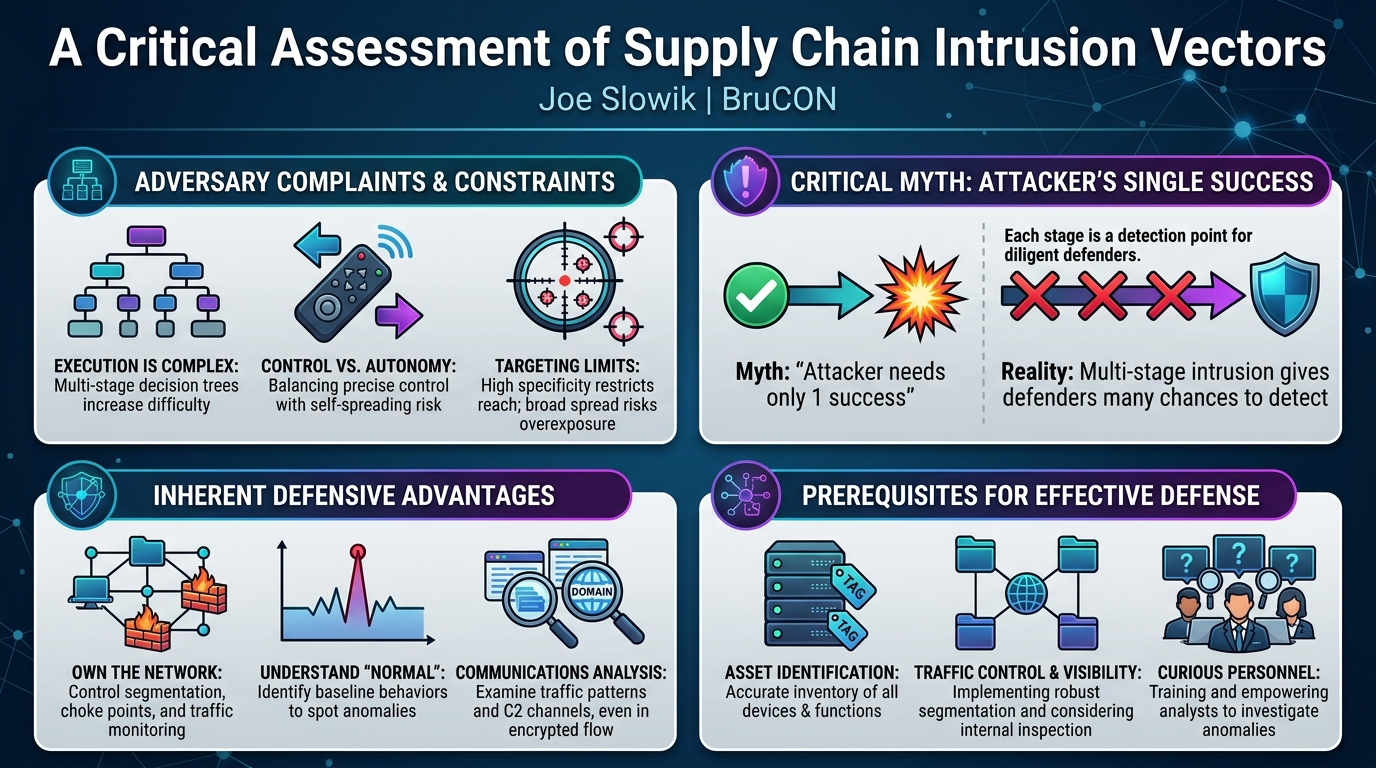
- Complexity for Adversaries: Executing a supply chain intrusion is not a simple, single-step process. It involves a complex decision tree where adversaries must identify vulnerable relationships, define objectives (espionage, monetization), select specific entities to compromise, and then maintain control over their deployed capabilities to reach the ultimate target. Each of these steps represents a potential point of failure or detection.
- Adversary Constraints and Choices: Adversaries operate within a continuum of control and targeting. They must choose between deploying highly autonomous capabilities (which are difficult to develop and maintain control over post-deployment) and manual, interactive controls (which require continuous command and control, creating detection opportunities). Similarly, they balance specific targeting (minimizing collateral damage but limiting reach) against general distribution (broader impact but higher risk of detection and overspread).
- The "Attacker Must Be Right Once" Fallacy: Slowik directly challenges the widely held belief that attackers only need one success while defenders must be perfect. He argues that in a multi-stage, complex intrusion like a supply chain event, the adversary must be "right" at multiple phases – from initial compromise to delivery, C2, and operational execution. Conversely, defenders, through diligent root cause analysis and continuous monitoring, only need to be "right once" at any point in the adversary's chain to unravel the entire operation.
- Inherent Defensive Advantages: Defenders, despite the sophistication of these threats, possess fundamental advantages. They own the network, which provides inherent visibility and control. Understanding "normal" network behavior allows for the detection of anomalies. Robust communications analysis (e.g., NetFlows, egress monitoring) can expose adversary C2. Furthermore, leveraging network segmentation, choke points, and layered defenses significantly impedes lateral movement and limits the impact of an initial breach.
- Importance of Fundamentals and Personnel: Effective defense against supply chain intrusions ultimately relies on strong cybersecurity fundamentals: asset identification, traffic visibility (including challenging discussions around SSL/TLS inspection), traffic control (network segmentation, east-west monitoring), and, critically, trained, enabled, and curious personnel. Human analysts who ask "why" and are empowered to investigate anomalies are often the ultimate key to detecting sophisticated threats that automated systems might miss.
These findings collectively shift the narrative from one of inevitable compromise to one of strategic defense, highlighting that while supply chain intrusions are a serious threat, they are not without their weaknesses and exploitable pain points for defenders.
Technical Deep Dive
▶ Watch: Debunking "attacker only needs one success" myth (34:50)
Supply chain intrusions manifest through various technical vectors, broadly categorized as product-based and services-based. Slowik provides numerous examples, illustrating the diverse methodologies employed by adversaries.
Product-Based Intrusions
These involve the subversion of hardware or software components before they reach the end-user.
- Hardware and Devices: While often sensationalized, concrete examples of hardware-based supply chain intrusions are rare.
- Proven Examples: Slowik cites the NSA's "router shop" operations, where network appliances were allegedly intercepted in transit, modified with additional functionality, and then delivered to targets. The Crypto AG incident, involving US and German intelligence, saw cryptographic equipment subverted to weaken encrypted communications. These examples highlight highly sophisticated, state-sponsored capabilities.
- Unproven Myths: The infamous "Big Hack" reported by Bloomberg, alleging Chinese intelligence inserted rice-sized chips onto Supermicro motherboards, is presented as an unproven myth. Slowik points out the significant targeting control problem: adversaries wouldn't know where a specific modified motherboard would end up. No evidence has ever substantiated these claims, yet they continue to influence perceptions. Similarly, a controversial incident involving a Chinese-built electric transformer in the US, despite lacking proof of modification, led to an executive order banning critical infrastructure devices from China.
- Software and Codebases: This category has seen more frequent and impactful incidents.
- ShadowHammer (ASUS): Disclosed by Kaspersky, this sophisticated attack inserted malicious code into the ASUS Live Update utility for motherboards. The malware profiled machines and only delivered its payload to a few hundred specific targets out of thousands of potentially infected systems, demonstrating highly tailored execution.
- CCleaner: A widely used IT management tool, CCleaner (owned by Avast), was compromised, leading to a backdoor being inserted into its distribution. The ultimate purpose and full implications of this intrusion were never fully clarified, but its widespread use made it a significant threat.
- Berserk Bear / Dragonfly (ICS): In a campaign dubbed "Palmetto Fusion" (in the US government), this actor group targeted industrial control systems (ICS). Rather than compromising build environments, they repackaged legitimate ICS software (like network monitoring tools for industrial environments) with additional functionality using Nullsoft installers or self-extracting archives. The adversary compromised distribution portals, took the original binaries, and re-packaged them with malware, highlighting that access to source code or build environments isn't always necessary for effective software supply chain compromise. These modified files were broadly available, even on platforms like the Internet Archive.
- SolarWinds / Sunburst: This is presented as the "most current example" and "most successful event." The adversary gained access to the build environment for the SolarWinds Orion network monitoring software. They then inserted a backdoor directly into the Orion software at the moment of compilation. This was a highly impressive feat, not just for the access, but for the ability to add malicious functionality without breaking the software, which is a significant technical challenge. The Sunburst malware used sophisticated DNS profiling (e.g.,
avsvmclouddomains) in its early stages for tailored victim selection.
Services-Based Intrusions
These leverage trusted relationships with third-party service providers to gain access to target environments.
- Target Breach (HVAC Contractor): In the early 2010s, a major US retailer, Target, was breached not directly, but through a small HVAC contractor responsible for building control systems. The intruders leveraged the connectivity between the building management systems and Target's point-of-sale (POS) network, leading to the theft of thousands of credit card numbers. This underscored the risk posed by relationships with smaller, less secure vendors.
- Cloud Hopper (APT10): Attributed to APT10 (linked to Chinese intelligence), this campaign involved compromising numerous Managed Service Providers (MSPs). MSPs often have administrative-level access to their clients' networks. By subverting an MSP, adversaries gained powerful, remote, administrator-level access to a wide variety of government, defense, and industrial base organizations, enabling significant espionage operations.
- Palmetto Fusion (Berserk Bear): As mentioned earlier, this campaign by Berserk Bear (also known as Energetic Bear, Crouching Yeti, Dragonfly) initially targeted small contractors (e.g., a 20-person digging company) that had relationships with larger energy utilities. The adversary then compromised legitimate email accounts of these contractors to send phishing messages to the ultimate utility targets, leveraging the existing trust between contractor and customer to obtain credentials and gain access.
Adversary Challenges and Constraints
Slowik illustrates that adversaries face a complex "decision tree" with trade-offs:
- Control vs. Autonomy:
- Autonomous capabilities (e.g., early Sunburst DNS profiling, NotPetya's self-spreading via MS17-010) are powerful but risk losing adversary control and spreading indiscriminately.
- Manual, interactive control (e.g., traditional Remote Access Tools (RATs), Palmetto Fusion's credential reuse) offers precision but requires continuous C2, creating detection opportunities.
- Specific vs. General Targeting:
- Specific targeting (e.g., ShadowHammer, Sunburst) minimizes collateral damage and detection risk but limits the number of potential victims.
- General distribution (e.g., NotPetya, Dragonfly's publicly available repackaged software) maximizes reach but increases the likelihood of detection and operational security (OPSEC) compromise.
Slowik maps specific campaigns onto this matrix:
- Sunburst: Highly autonomous, fairly tailored. Expensive to develop.
- NotPetya: Highly autonomous, general distribution. Spread beyond intended targets (Ukraine) due to lack of control, impacting Maersk, Merck, Mondelez, etc.
- Dragonfly: Manual control, general distribution. Repackaged ICS software was publicly downloadable, limiting OPSEC.
- Palmetto Fusion: Manual control, tailored victim selection. Relied on capturing and reusing credentials.
Adversaries must manage risks like overspread (as seen with WannaCry and NotPetya), inadvertent loss of Command and Control (C2) (e.g., victims changing vendors or applying updates that remove implants), and the possibility of capabilities simply not working (especially in complex, specific environments like ICS). These "pain points" for adversaries are precisely the opportunities for defenders.
Demo / Proof of Concept
▶ Watch: Layering defenses across network profiles (Purdue model) (38:30)
This presentation focused on a critical assessment and analysis of supply chain intrusion vectors and defensive strategies, rather than demonstrating a specific exploit or proof of concept. The speaker, Joe Slowik, provided numerous real-world examples and theoretical frameworks to illustrate his points.
Defensive Implications
▶ Watch: Future challenges: traffic visibility, zero trust, BYOD (47:50)
Slowik emphasizes that defenders possess significant, often underutilized, advantages against supply chain intrusions. The key is to leverage these inherent strengths through robust cybersecurity fundamentals and a proactive mindset.
- Own the Network: Defenders control their own infrastructure. This means having the ability to segment networks, define choke points, and establish monitoring stations. Even if an adversary breaches an initial perimeter via a supply chain compromise, a well-segmented network can limit their lateral movement and contain the damage.
- Understand "Normal": While anomaly detection can be controversial, when applied intelligently and informed by threat intelligence, understanding baseline network behavior is crucial. Unusual activities, such as a SolarWinds Orion server making DNS requests to a previously unseen domain like
avsvmcloud, should immediately flag as suspicious. - Communications Analysis: The mantra "packets or it didn't happen" holds true. Unless an adversary deploys a truly autonomous, air-gapped capability (like a theoretical Stuxnet 2.0 without any C2), they must communicate. Defenders can analyze network traffic, including NetFlows, transmission/receipt ratios, and domain requests, even without full SSL/TLS inspection, to identify C2 channels.
- Enhance Defensive Posture:
- Segmentation and Access Controls: Implement strong enclave separation and access controls within the network. This means moving beyond flat networks where any host can talk to any other. Restricting RDP access, enforcing two-factor authentication, and ensuring users don't run as local administrators are critical.
- Choke Points and Monitoring: Establish choke points and monitoring points for inter-network (east-west) communication. This includes deploying sensors at network boundaries and using jump boxes or bastion hosts for access to sensitive environments.
- Layered Defenses (Purdue Model): For critical infrastructure and OT environments, Slowik advocates for a layered defense strategy, often illustrated by the Purdue Reference Architecture. This involves:
- Ingress/Egress Visibility: Monitoring all traffic entering and leaving the network for suspicious C2 patterns.
- Enclave Separation: Significantly impeding an intruder's ability to move laterally from an initial access point.
- Process Monitoring and Baselining: In deeply embedded systems and ICS/OT, having visibility into process variables and baselining normal operations can detect deviations (e.g., centrifuges over-pressurizing as in Stuxnet).
- Engineering Controls and Physical Safeguards: Even if cyber defenses fail, physical and engineering safeguards (e.g., blowout valves, emergency shutdowns) can prevent a cyber-physical attack from escalating into a catastrophic event, turning a crisis into an inconvenience.
Prerequisites for Effective Defense
Implementing these strategies requires foundational capabilities:
- Asset Identification: Knowing what devices are on the network, what their purpose is, and what "normal" looks like for them (e.g., distinguishing a SolarWinds server from a generic device).
- Traffic Visibility: This is a contentious area. Slowik acknowledges the need for encrypted communications but also suggests that organizations need to have serious internal conversations about SSL/TLS inspection for internal traffic to gain critical visibility into adversary C2 and activity that is increasingly wrapped in encrypted protocols.
- Traffic Control (Segmentation): Moving from flat networks to segmented architectures with controls and visibility for both north-south (external) and east-west (internal) communications.
- Trained, Enabled, Curious Personnel: This is perhaps the most critical prerequisite. Automation and blinky boxes are not enough. Organizations need to invest in people who are empowered to ask questions, investigate anomalies, and follow leads. The detection of major incidents like SolarWinds and Stuxnet often came down to a curious analyst pursuing an unusual observation.
By focusing on these fundamentals, organizations can transform adversary pain points into defensive opportunities, making the attacker's life significantly more difficult and increasing the likelihood of detection and mitigation.
Key Takeaways
- Supply Chain Intrusions are Complex: Adversaries face numerous technical and operational challenges in executing, controlling, and targeting supply chain compromises, belying the common perception of their ease.
- Defenders Have Inherent Advantages: Network ownership, visibility, segmentation, and continuous monitoring provide powerful tools for detecting and mitigating even sophisticated supply chain threats.
- "Attacker Must Be Right Once" is a Myth: Due to the multi-stage nature of these intrusions, adversaries must succeed at multiple points, providing defenders with numerous opportunities to intervene.
- Fundamentals are Paramount: Strong asset identification, traffic visibility (including considering SSL/TLS inspection), robust network segmentation, and effective access controls are non-negotiable.
- Human Element is Critical: Empowering and training curious security personnel to investigate anomalies and ask "why" is often the most effective defense against advanced threats.
- Layered Defense is Essential: From ingress/egress monitoring to deep process controls and physical safeguards, a layered approach significantly reduces the impact of a successful breach.
About the Speaker(s)
Joe Slowik is the Threat Intelligence and Detections Lead at Gigamon, based in the United States. His extensive background in cybersecurity includes prior roles as a cyber threat researcher at Dragos and DomainTools, where he specialized in critical infrastructure and industrial control systems (ICS). Before his work in the private sector, Slowik held significant government experience, including running incident response operations at Los Alamos National Laboratory and working for the U.S. Navy, where he began his career in information security. His diverse experience across government, critical infrastructure, and threat intelligence makes him a recognized expert in understanding and countering sophisticated cyber threats.
Reviews
- Heather Calloway (CISO) — MUST SEE ★★★★★