DNS as Critical Infrastructure: Do You Know Where Your Domain Is?
Barry Irwin
BruCON 0x0E · Day 2
Overview
In this compelling talk at BruCON, Barry Irwin, a seasoned security professional with over three decades of internet experience, delves into the often-overlooked yet critically foundational role of the Domain Name System (DNS). Titled "DNS as Critical Infrastructure: Do You Know Where Your Domain Is?", the presentation highlights the alarming fragility and significant risks associated with the global DNS ecosystem. Irwin underscores that despite its fundamental importance to nearly all internet operations, DNS remains profoundly misunderstood and under-resourced, leading to widespread vulnerabilities.
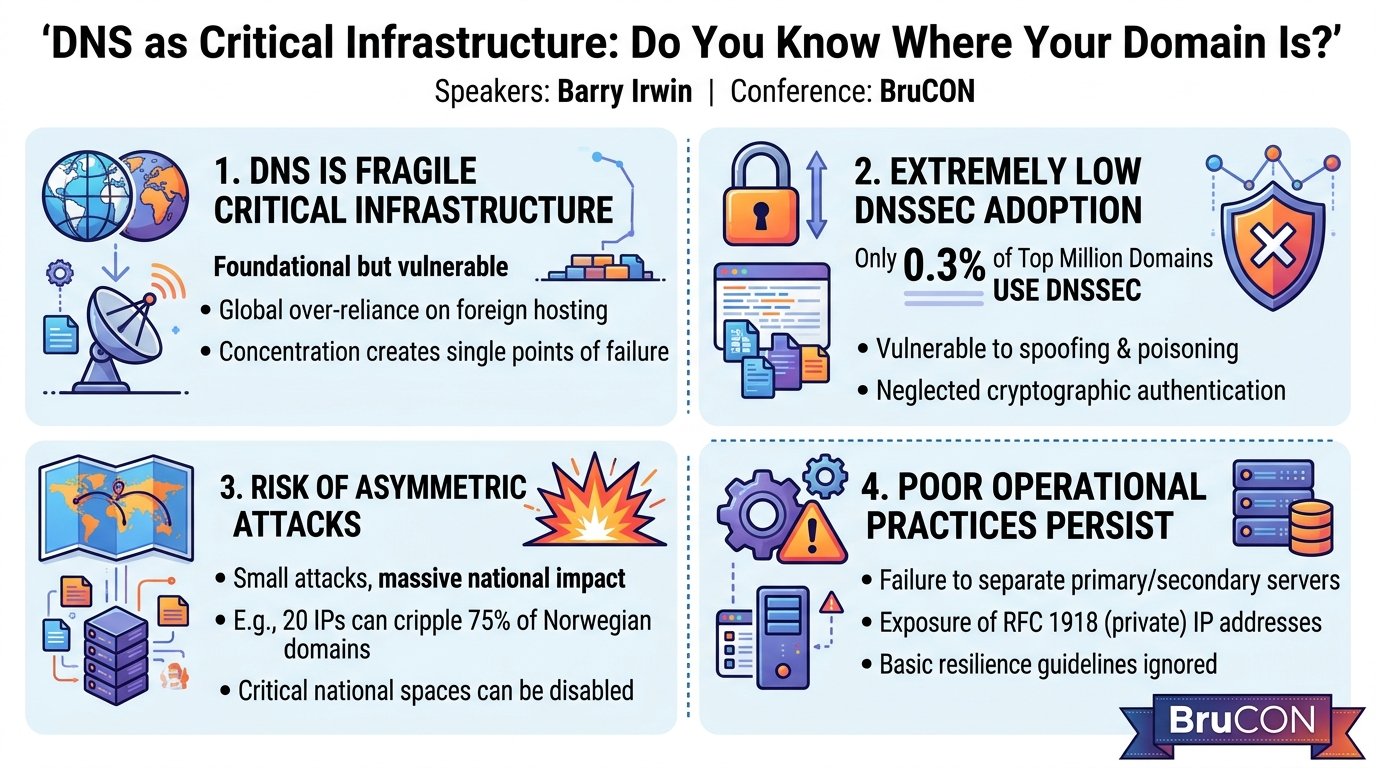
Key moments
- 2:09 Why DNS is critical infrastructure
- 10:30 Challenges in gathering comprehensive DNS data
- 25:40 Alarmingly low DNSSEC adoption rates globally
- 31:20 Geographic concentration of national DNS servers (e.g., Australia)
- 38:30 Asymmetric warfare: few targets, massive impact on national domains
- 44:15 The critical need for DNS threat modeling guidelines
- 51:50 Audience shares tip for obtaining .es domain list
DNS as Critical Infrastructure: Do You Know Where Your Domain Is?
Speakers: Barry Irwin
Conference: BruCON
YouTube: https://www.youtube.com/watch?v=zXmvlKiWaQs
Overview
In this compelling talk at BruCON, Barry Irwin, a seasoned security professional with over three decades of internet experience, delves into the often-overlooked yet critically foundational role of the Domain Name System (DNS). Titled "DNS as Critical Infrastructure: Do You Know Where Your Domain Is?", the presentation highlights the alarming fragility and significant risks associated with the global DNS ecosystem. Irwin underscores that despite its fundamental importance to nearly all internet operations, DNS remains profoundly misunderstood and under-resourced, leading to widespread vulnerabilities.
The core of Irwin's research, sparked by geopolitical events such as the conflict in Ukraine, investigates the geographic distribution and resilience of national top-level domains (TLDs) and the global "Majestic Million" list. His findings reveal a concerning over-reliance on foreign-hosted DNS infrastructure, particularly in the United States, for many countries' critical domain name resolution. This geographic concentration, coupled with poor adoption of essential security protocols like DNSSEC and CAA records, exposes nations to significant risks, including potential large-scale denial-of-service attacks and foreign control over national digital assets.
Irwin's work serves as a stark warning and a call to action for national regulators, DNS operators, and cybersecurity professionals. By meticulously analyzing data from approximately 10 million domains, he demonstrates how a relatively small number of strategic attacks could cripple entire national internet spaces. The presentation advocates for a re-evaluation of DNS as critical national infrastructure, urging for improved resilience, geographic diversification, and a deeper understanding of the "unknown unknowns" inherent in our global naming system.
Background
▶ Watch: Why DNS is critical infrastructure (2:09)
The premise of Barry Irwin's talk begins with a widely circulated security adage: "It was not DNS. There's no way it was DNS. It was DNS." This humorous, yet deeply insightful, observation encapsulates the underappreciated and often-blamed nature of DNS. While universally assumed to be a robust, always-on service, Irwin stresses that DNS is, in fact, "critical infrastructure" (02:15). When DNS fails, everything built upon it — from web browsing and email to secure communications and high-availability systems — inevitably breaks.
Despite its foundational role, DNS is rarely given the attention it deserves in academic curricula or operational practices. Many network professionals and system administrators possess only a superficial understanding of its inner workings. This knowledge gap contributes to a systemic lack of adherence to well-established best practices for DNS resiliency. Irwin points to long-standing recommendations, such as diversifying DNS servers geographically, hosting them on separate Autonomous System Numbers (ASNs), and utilizing distinct IPv4 blocks (04:30). He laments that while some operators have implemented these protections, a vast majority either ignore them or are unaware of their importance, sometimes placing both primary and secondary DNS servers on the same hypervisor or even within the same network block, creating single points of failure. The BIND Operators Guide, a foundational text for DNS management, is highlighted as a resource that, if more widely read and understood, could significantly improve global DNS posture (05:45).
The motivation for this extensive research was partly spurred by geopolitical tensions. Specifically, the conflict in Ukraine and the subsequent sanctions against Russia prompted the Russian government to direct its entities to relocate DNS infrastructure back inside Russia (10:00). This event underscored the potential for global isolation and the weaponization of internet infrastructure, echoing Russia's earlier national experiment to isolate itself from the global internet. Irwin's initial work on DNSSEC uptake in the Norwegian top-level domain (.no) evolved into a broader investigation into the diversity and geographic distribution of DNS servers for various country code top-level domains (ccTLDs) and the wider internet (08:00). He notes that the data collected is "imperfect" and reverse-engineered due to the inherent difficulty in obtaining full zone files from national registrars, but it is sufficiently representative to draw significant conclusions about the fragility of global DNS infrastructure (06:15, 11:00).
Key Findings
▶ Watch: Alarmingly low DNSSEC adoption rates globally (25:40)
Barry Irwin's comprehensive analysis of approximately 10 million domains across various ccTLDs and the Majestic Million list yielded several alarming key findings, painting a picture of a globally fragile and vulnerable DNS infrastructure.
Firstly, the adoption rates for critical DNS security protocols like DNSSEC remain woefully low. Despite being conceived in 1999 and mandated by ICANN for new TLDs since 2013, DNSSEC, which provides cryptographic authentication of DNS data and authenticated denial of existence, sees minimal deployment. Irwin's study found that only 0.3% of the top million domains utilize DNSSEC. While some exceptions exist – such as Belgium at 27% and .co.uk at 2% – these are outliers, with South Africa's .co.za domain showing a mere 0.1% adoption (26:00). This widespread neglect is attributed to a "chicken and egg" scenario, where operators see little incentive to implement DNSSEC if client resolvers do not validate it (26:00).
Secondly, the newer Certification Authority Authorization (CAA) records, designed to allow domain owners to explicitly state which Certificate Authorities (CAs) are authorized to issue certificates for their domain, also suffer from low adoption. While slightly better than DNSSEC, only 3.7% of the Majestic Million domains have CAA records, with Belgium again showing a relatively higher, though still modest, 1% adoption (29:00). This suggests that many organizations, even those involved in e-commerce, are not leveraging this mechanism to prevent the issuance of fraudulent certificates.
The most critical finding, however, relates to the alarming geographic concentration and lack of diversity in DNS server hosting. Irwin's data reveals a heavy reliance on foreign-hosted infrastructure, particularly in the United States, for critical domain resolution across numerous countries:
- For Australian domains (
.au), 63% of name servers are hosted in the US, with a total of 67% in North America. Only 20% are located within Australia (31:30). - South Africa's
.co.zadomain sees 63% of its name servers in North America and 19% in Western Europe, with only 14% residing in South Africa (33:30). - The UK's
.co.ukdomain, representing 4.5 million domains, has 40% of its name servers in the US and 43% in North America, with just 20% nominally located in Great Britain (34:30). - Belgium's
.bedomain shows a mere 4% of its name servers actually located in Belgium, with 47% in Western Europe (35:45). - Norway's
.nodomain has 56% of its name servers in North America and 29% in Western Europe (36:45). - Even for the Russian Federation (
.ru), which has been actively trying to nationalize its internet infrastructure, 49% of its resolving name servers are still located in Western Europe (37:30). - Globally, for the Majestic Million domains, 40% of name servers are in the US, followed by Germany at 7% (38:00).
This extreme concentration creates significant points of failure and makes national digital assets vulnerable to asymmetric warfare. Irwin highlights the chilling statistic that an attack on just 20 IP addresses could potentially take out 75% of the Norwegian domain space. Similarly, an attack on the top five providers for .co.uk could render 10% of its domains (approximately 440,000) unreachable, and for Belgium, the top five providers could take out 20% of its domains (39:00). Furthermore, the study uncovered instances of RFC 1918 addresses (private IP ranges) being exposed as publicly accessible name servers, indicating a fundamental lack of understanding or adherence to basic networking principles among smaller DNS providers (14:00, 41:00).
Technical Deep Dive
▶ Watch: Geographic concentration of national DNS servers (e.g., Australia) (31:20)
The technical foundation of Irwin's research involved a robust data collection and analysis methodology designed to overcome the inherent challenges of surveying global DNS infrastructure without privileged access to zone files. The speaker explicitly noted that "nobody's been kind enough to hand over the DNS records for the whole world," necessitating a reverse-engineering approach (06:15).
Data Gathering and Scope:
The initial hurdle was to compile comprehensive lists of domain names. This required sourcing data from various public and semi-public repositories, including GitHub dumps, scraped web pages, and previously compiled domain lists (11:30). Irwin candidly acknowledges that this process introduced imperfections, but with approximately 10 million domains ultimately analyzed, the dataset was statistically significant and representative (12:00, 14:30). A key distinction was made between hostnames and domain names, and the analysis accounted for different ccTLD structures: some, like South Africa (.co.za), Australia (.com.au), and the UK (.co.uk), have clearly structured second-level domains, while others, such as Russia (.ru), Belgium (.be), and Norway (.no), are much flatter (12:30). During the collection process, roughly 8% of queries reliably returned NXDOMAIN (no such domain), indicating typical domain churn, while less than 1% resulted in timeouts or refused connections after multiple retries over several months (13:00). The study specifically focused on .no, .be, .ru, .co.uk, .com.au, and .co.za, complemented by the Majestic Millions list, representing the top one million domains on the internet (14:00).
Processing Tools and Methodology:
Early attempts at processing the vast number of domains using traditional bash scripting proved prohibitively slow, taking up to three days for 600,000 domains. A subsequent attempt with Python reduced this to 18 hours, but it was still inefficient (18:00). The breakthrough came with the adoption of zdns, a highly optimized, massively multi-threaded DNS scanner written in Go by the same team behind zmap. zdns dramatically improved performance, enabling the processing of 600,000 domains in about 38 minutes, and later, one million domains in as little as 12 minutes for NS record queries (18:30). DNSSEC queries for a million domains took around 12 minutes, and CAA queries approximately 30 minutes per million domains (19:00).
To ensure ethical conduct and minimize negative impact on public DNS servers, Irwin maintained query levels well below 1500 queries per second, adhering to guidelines published by Google for public DNS usage (19:30). Efficiency was further boosted by deploying custom caching infrastructure on VPS hosts and structuring queries to leverage in-memory data, reducing redundant lookups (20:00).
The raw input data presented significant "cleaning" challenges, including expired domains, upstream connectivity issues, timeouts, and unexpected characters like semicolons in hostnames (17:30, 20:00). The transition to zdns, which outputs data in JSON format, facilitated subsequent processing. Analyzing the resulting large JSON files (some runs exceeding 10GB compressed) was efficiently handled using command-line tools like JQ, a powerful JSON processor, typically completing analysis scripts in 10 to 15 minutes on modern machines (22:30). Other essential tools included bash, sed, awk, grep, netcat, and for data enrichment, the whois service from Team Cymru and MaxMind geolocation systems for IP address-to-country and ASN mapping (21:00). The entire data collection spanned several months, with a 72-hour retry window for failed queries to account for temporary internet fluctuations (22:00). The speaker also mused about the potential future need for a relational database to manage the ever-growing dataset (23:30).
Analysis of Security Protocols:
The study specifically examined the adoption of two key DNS security protocols:
- DNSSEC (Domain Name System Security Extensions): Introduced in 1999, DNSSEC uses strong cryptography to provide authentication of DNS data and authenticated denial of existence (24:00). This means that not only can the authenticity of a DNS record be verified, but it can also be cryptographically proven that a requested domain or record does not exist. Despite its critical role in preventing DNS spoofing and cache poisoning, adoption remains very low, largely due to a "chicken and egg" problem where client resolvers often do not perform DNSSEC validation (26:00).
- CAA Records (Certification Authority Authorization): A newer record type, adopted around 2019, CAA allows domain owners to explicitly declare which CAs are authorized to issue SSL/TLS certificates for their domain (27:00). This mechanism helps to mitigate the risk of fraudulent certificate issuance, especially with the proliferation of free certificate providers like Let's Encrypt. The analysis found that while CAA adoption was higher than DNSSEC, it was still modest, and records often contained "garbage" or irrelevant information, indicating a lack of clear understanding in their implementation (50:30).
Demo / Proof of Concept
▶ Watch: The critical need for DNS threat modeling guidelines (44:15)
This technical article is based on a research talk that focuses on large-scale data analysis and findings rather than a live demonstration or proof of concept. The speaker, Barry Irwin, presented the methodology and results of his extensive study of DNS infrastructure, rather than showcasing a specific tool or exploit. Therefore, there was no "Demo / Proof of Concept" section in the presentation itself.
Defensive Implications
▶ Watch: Audience shares tip for obtaining .es domain list (51:50)
The findings presented by Barry Irwin carry significant defensive implications for a wide range of stakeholders, from national governments to individual organizations. The fragility and geographic concentration of DNS infrastructure demand a proactive and coordinated response.
For National Regulators and Governments:
- DNS as Critical Infrastructure: Governments must formally recognize DNS as critical national infrastructure (43:00). This designation should trigger specific policies and mandates regarding its resilience and security.
- Geographic Sovereignty: National regulators should assess where the DNS servers for critical national domains (e.g., government, defense, finance, energy) are located. Consideration should be given to mandating that these servers reside within national borders or in politically stable, allied nations, mitigating risks from foreign control or geopolitical tensions (35:00, 43:30).
- Threat Modeling DNS: There is an urgent need to develop specific threat models for DNS infrastructure (43:00). Irwin noted the absence of such comprehensive models, which are crucial for identifying vulnerabilities and designing robust defenses against asymmetric attacks.
- Awareness Campaigns: Regulators should collaborate with national registrars to raise awareness among domain holders and DNS operators about the risks highlighted in this study (48:30).
For DNS Operators (ISPs, Hosting Providers, Enterprises):
- Adhere to Best Practices: Operators must strictly follow established guidelines for DNS resilience, including geographically separating primary and secondary DNS servers, placing them on different ASNs and IP blocks, and avoiding single points of failure (04:30). The BIND Operators Guide remains a vital resource (05:45).
- Correct Configuration: Eliminate the exposure of RFC 1918 (private) IP addresses as publicly accessible name servers (14:00, 41:00). This fundamental misconfiguration indicates a severe lack of operational security.
- Implement DNSSEC: Despite the "chicken and egg" problem, operators should implement DNSSEC for their domains. Widespread adoption is necessary to create a more trustworthy internet (24:00).
- Implement CAA Records: Utilize CAA records to explicitly state authorized Certificate Authorities, reducing the risk of fraudulent certificate issuance (27:00).
- Diversify Providers: Avoid excessive reliance on a single DNS provider, especially if that provider's infrastructure is heavily concentrated in a single geographic region or controlled by a single entity (39:00).
For Organizations and Domain Holders:
- Audit DNS Infrastructure: Regularly audit the location and providers of your domain's name servers. Understand the underlying infrastructure supporting your digital presence.
- Understand Risk: Recognize that economic incentives for cheap hosting (e.g., in the US) often come with geopolitical and resilience risks (44:00).
- Prepare for the Unexpected: Develop contingency plans for DNS outages or compromises, understanding that DNS forms the backbone for trust on networks (44:30, 47:30).
- Foster Competency: Invest in training and expertise for DNS management within the organization, acknowledging that it's "not a problem until it's not working, in which case it's a really big problem" (46:00).
Ultimately, the core defensive implication is to shift the collective mindset: DNS is not a set-it-and-forget-it service. It requires continuous vigilance, adherence to best practices, and strategic planning to counter the evolving landscape of digital threats and geopolitical realities.
Key Takeaways
- DNS is a globally fragile critical infrastructure: Despite its foundational role, global DNS infrastructure is remarkably fragile, with significant geographic concentration of name servers, particularly in the US, creating single points of failure for many nations.
- Widespread neglect of security protocols: Essential security mechanisms like DNSSEC (0.3% adoption for top million domains) and CAA records (3.7% adoption) are largely ignored, leaving domains vulnerable to spoofing and fraudulent certificate issuance.
- Asymmetric warfare potential: A small number of strategic attacks (e.g., targeting 20 IP addresses) can cripple large portions of national domain spaces (e.g., 75% of Norwegian domains), highlighting DNS as a prime target for nation-state actors.
- Poor operational practices persist: Many DNS operators, especially smaller ones, fail to adhere to basic best practices, such as avoiding RFC 1918 addresses in public DNS records, further exacerbating vulnerabilities.
- Urgent need for national strategy: Governments and national regulators must formally recognize DNS as critical infrastructure, assess the location of national domain servers, and develop specific threat models and policies to ensure resilience and sovereignty.
- Economic incentives outweigh security: The pursuit of cheap hosting, often found in the US, frequently overshadows critical security and resilience considerations, contributing to the global concentration of DNS infrastructure.
About the Speaker(s)
Barry Irwin is a highly experienced cybersecurity professional and academic with a career spanning over 32 years in the internet space. He began his journey as a firewall engineer, building firewalls and rolling out networks before transitioning into academia around two decades ago. For much of that time, he has been based in South Africa, training the next generation of security experts, and more recently, he has relocated to Norway.
Throughout his career, Irwin has consulted extensively for various sectors, including defense, telecoms, finance, and other consultancies, gaining valuable insights into real-world security challenges. He describes himself as passionate about "packets," believing that "applications lie, TCP dump seldom lies," and prefers command-line tools over GUI interfaces, having used Unix for over 30 years. He is a strong advocate for open-source technologies, especially those related to networking. His prior work includes developing a 3D packet visualization tool, affectionately known as the "spinning cube of Doom," with his students. Beyond his technical prowess, Irwin also has a unique hobby: murder iconology, the study and collection of wooden woodworking planes.