A Black-Box Security Evaluation of the SpaceX Starlink User Terminal
Lennert Wouters
BruCON 0x0E · Day 2
Overview
In this compelling talk at BruCON, Lennert Wouters presents a comprehensive security evaluation of the SpaceX Starlink user terminal, commonly known as "Dishy." The presentation details a successful voltage fault injection attack that bypasses the secure boot mechanism of the device, ultimately granting root access to the underlying Linux system. This research is significant as it targets a critical component of Starlink's rapidly expanding global satellite internet constellation, demonstrating a sophisticated physical attack against a device designed with robust security measures.
Key moments
- 0:00 Introduction to Starlink and research focus
- 4:04 Initial access attempts and disabled serial input
- 9:00 Firmware extraction methods (in-circuit and chip-off)
- 18:50 Voltage fault injection technique explained
- 23:00 Achieving first root shell via fault injection
- 39:30 Developing a custom mod chip for automated attacks
- 42:00 Adapting attack after SpaceX blew UART e-fuse
- 53:00 Successful live demo: Gaining root during Q&A
A Black-Box Security Evaluation of the SpaceX Starlink User Terminal
Speakers: Lennert Wouters
Conference: BruCON
YouTube: https://www.youtube.com/watch?v=810Nr3b5_Lk
Overview
In this compelling talk at BruCON, Lennert Wouters presents a comprehensive security evaluation of the SpaceX Starlink user terminal, commonly known as "Dishy." The presentation details a successful voltage fault injection attack that bypasses the secure boot mechanism of the device, ultimately granting root access to the underlying Linux system. This research is significant as it targets a critical component of Starlink's rapidly expanding global satellite internet constellation, demonstrating a sophisticated physical attack against a device designed with robust security measures.
Wouters, an academic researcher, embarked on this project due to the inherent challenge of attacking a complex, black-box system without documentation or development kits. His work highlights the lengths to which determined attackers might go to compromise high-value targets, even those with strong secure boot implementations. The findings provide invaluable insights for both Starlink's security team and the broader embedded systems security community, illustrating practical vulnerabilities in well-engineered systems and the innovative techniques required to exploit them.
The talk is particularly notable for its meticulous methodology, starting from initial hardware teardowns and firmware extraction to the development of a custom "mod chip" capable of automating the fault injection process. This research underscores the importance of considering physical attacks, even against seemingly tamper-resistant devices, and offers concrete recommendations for improving the resilience of such systems against advanced adversaries.
Background
▶ Watch: Introduction to Starlink and research focus (0:00)
The Starlink system comprises a space segment of low Earth orbit (LEO) satellites, some equipped with laser links for inter-satellite communication, and an earth segment including user terminals and gateways connected to the internet. Wouters’ research focused on the user terminal, the device consumers purchase to connect to the satellites. Initial attempts to interact with the terminal via its exposed UART connector quickly revealed that serial input was disabled, and a "development login enabled: no" prompt blocked root access, indicating a strong secure boot implementation.
Prior public research provided a foundation for Wouters' efforts. Early teardowns by Mike on Space and SignalPad detailed the physical components and RF architecture. Subsequent work by Offensive Security and Dan Murray explored destructive teardowns and initial fault injection experiments. Wouters also noted the rapid evolution of Starlink hardware, identifying multiple revisions of the circular, rectangular, and high-performance user terminals, as well as a new transceiver unit. His specific target was an F2 Polo 2 Terminal (later an F2 Polo 4), featuring a custom quad-core ARM Cortex A53 SoC codenamed Gatson, manufactured by STMicroelectronics, alongside a secure element, a 4GB eMMC chip, and DDR3 memory. The presence of an integrated heat spreader on the SoC and the lack of public datasheets or development kits confirmed the black-box nature of the target.
The secure boot process, as inferred from the open-source u-boot code released by SpaceX, relies on e-fuses and cryptographic verification at multiple boot stages. Modifying the eMMC contents directly would be detected, rendering simple firmware replacement ineffective. This robust security model necessitated a more advanced attack vector, leading Wouters to explore physical fault injection techniques.
Key Findings
▶ Watch: Firmware extraction methods (in-circuit and chip-off) (9:00)
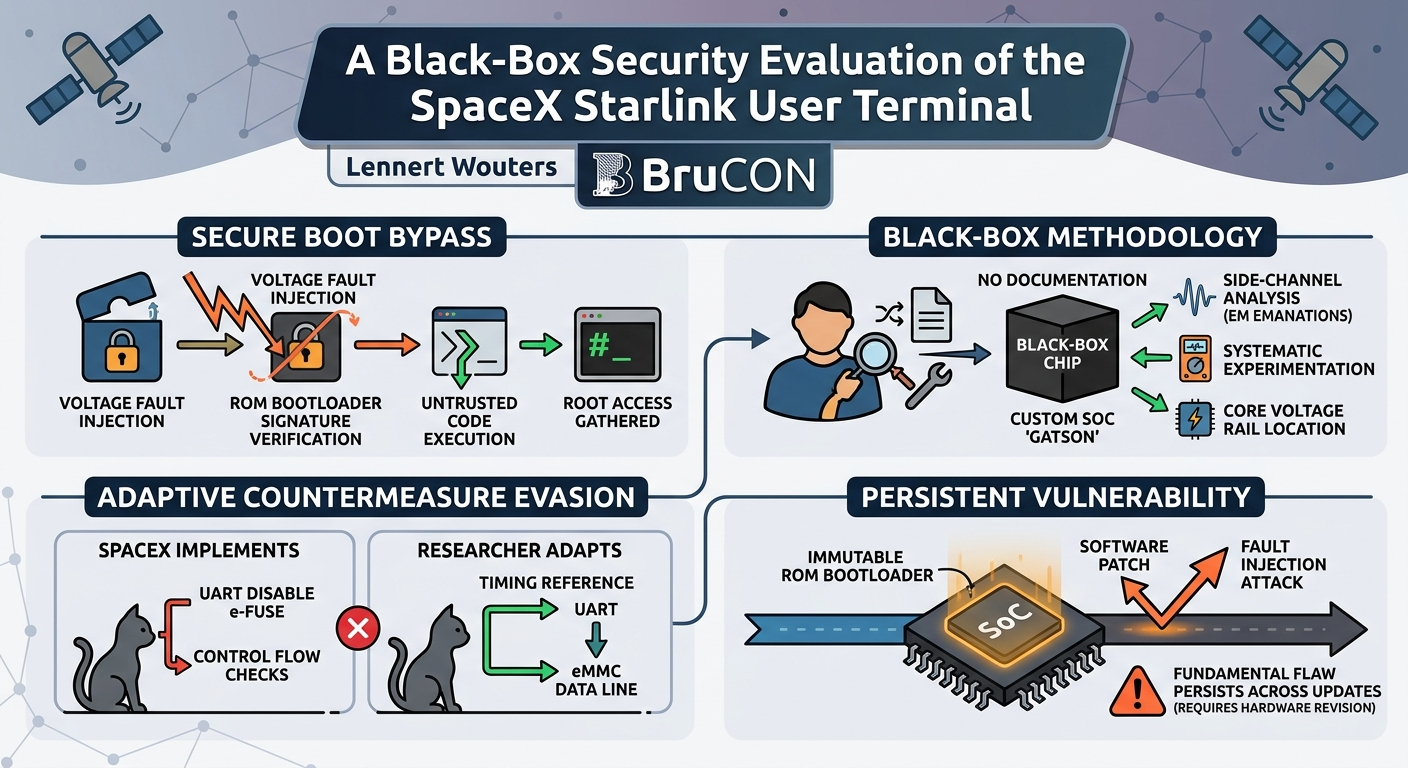
The central discovery of this research is the successful bypass of the Starlink user terminal's secure boot mechanism through voltage fault injection targeting the ROM bootloader. This allowed Wouters to execute arbitrary code and gain root access to the device, even in a completely black-box scenario without schematics or public documentation for the custom STMicroelectronics SoC.
Key findings include:
- Secure Boot Bypass: The core vulnerability lies in the ROM bootloader's signature verification process. By precisely glitching the core voltage supply at the exact moment this verification begins, Wouters was able to skip the entire signature check. This allowed the system to accept and execute an untrusted, modified second-stage bootloader.
- Black-Box Attack Methodology: Wouters demonstrated that sophisticated physical attacks are feasible even without any prior knowledge of the target chip's internals. He relied on educated guesses, side-channel analysis (EM emanations), and systematic experimentation to identify the core voltage rail, optimal glitch parameters, and precise timing.
- Adaptive Countermeasure Evasion: SpaceX implemented several hardware and software countermeasures, including control flow checks within the ROM bootloader and later, blowing an e-fuse to disable UART output. Wouters successfully bypassed these by identifying the specific countermeasure (e.g., magic value checks) and adapting his fault injection strategy (e.g., switching from UART to eMMC data line as a timing reference).
- Persistent Vulnerability: The discovered vulnerability resides in the immutable ROM bootloader. While SpaceX can implement software countermeasures in later boot stages or disable debugging features, the fundamental flaw cannot be patched without a hardware revision, making the attack persistent across firmware updates.
- Practical "Mod Chip" Development: To automate and stabilize the attack, Wouters designed and open-sourced a custom "mod chip" using a Raspberry Pi Pico (later an RP2040 microcontroller). This chip precisely controls the voltage glitches and capacitor banks, transforming a complex lab setup into a compact, in-system solution for repeatable root access.
Technical Deep Dive
▶ Watch: Achieving first root shell via fault injection (23:00)
The technical journey began with firmware extraction. The eMMC chip contained the firmware, but direct reading required desoldering wires to test points (clock, command, data zero) or, for newer revisions without test points, a chip-off method involving removing, re-balling, and reading the chip with an external socket. Wouters initially used in-circuit reading with a level shifter, but recommended a low-voltage eMMC adapter or chip-off for reliability, noting the instability of forensic tools like Easy JTAG and Octopus Pro.
Analyzing the raw eMMC dump was challenging due to custom error correcting codes (ECC) applied by SpaceX. Each 255-byte block of data contained 32 bytes of ECC, presumably to protect firmware in harsh satellite environments. After removing the ECC, the firmware revealed insights into thermal management, RF channels (uplink/downlink frequencies, laser frequencies), and hidden web pages for regulatory testing. Crucially, the firmware also contained telemetry code revealing SpaceX's monitoring capabilities, such as tracking high acceleration, altitude, or unauthorized use of development hardware outside defined geofences.
The core of the attack targeted the development login enabled prompt. This prompt's behavior indicated a check for "production hardware" within a 2-millisecond gap. The goal was to disrupt this check using fault injection to make the system believe it was development hardware, thus enabling the root login with password "Falcon." Given the large PCB size (60cm diameter), traditional laser or EM fault injection was impractical. Wouters opted for voltage fault injection.
The principle of voltage fault injection involves briefly shorting the core voltage supply to ground via a MOSFET. This causes a temporary voltage drop, inducing glitches in the CPU's operation. Challenges included:
- Locating the core voltage rail: Achieved through educated guessing and multimeter measurements.
- Decoupling capacitors: These stabilize voltage. For initial, later-stage glitches, leaving them on was sufficient. For early bootloader glitches, removing them was necessary to increase susceptibility.
- MOSFET selection: Critical for fast switching.
- Glitch parameters: Precise timing (glitch offset) from a timing reference (UART output, EM side channel, eMMC data zero line) and duration (glitch width) were crucial.
Initial attempts targeting the "production hardware check" while the system was fully booted (all four cores running at high frequency) were slow (12 seconds per attempt) and often resulted in system crashes. To accelerate the process, Wouters aimed for the ROM bootloader, which executes earlier on a single core at a lower clock frequency. The ROM bootloader's function is to load and verify the second-stage bootloader from eMMC. It verifies a certificate's signature (custom STMicroelectronics format) and then the hash of the loaded firmware against a digest in the certificate.
Without documentation, Wouters employed "tricks of the trade" for black-box analysis:
- Booting with invalid second stages: Observing differences in boot flow to pinpoint verification stages.
- Glitching a valid signature to fail: Confirming the effectiveness of glitch parameters.
- Side-channel analysis: Using an EM probe to capture electromagnetic emanations from the CPU. This was critical for precise timing, as the EM trace revealed that signature verification began before the UART output indicated it.
The breakthrough was discovering that a precisely timed voltage glitch could skip the entire signature verification in the ROM bootloader. This allowed the system to load and execute an unsigned, modified second-stage bootloader. Wouters confirmed that SpaceX had implemented countermeasures in the ROM bootloader, specifically control flow checks using "magic values" set and verified at different stages. However, these countermeasures were based on a fault model (e.g., single instruction skip) that didn't account for the observed multi-instruction skips from voltage fault injection on a seven-stage pipeline processor. The glitch could bypass these checks by skipping the instruction that reset the magic value, thus preserving the initial correct state.
To make the attack repeatable and stable, especially after removing decoupling capacitors for early boot glitches (which made the system too unstable to boot fully), Wouters developed a system to dynamically enable and disable capacitor banks. This involved using reverse orientation N-channel MOSFETs as high-side switches, driven by a 12V MOSFET driver, and larger capacitors (47 microfarad and 100 microfarad) for better effect.
When SpaceX later blew an e-fuse to disable UART output, removing the primary timing reference, Wouters adapted by using the eMMC data zero line (which shifts the certificate data) as the new timing reference, again leveraging side-channel analysis to identify the corresponding EM pattern. This allowed him to maintain the attack despite the countermeasure.
Demo / Proof of Concept
▶ Watch: Developing a custom mod chip for automated attacks (39:30)
Wouters demonstrated the full attack path, from the initial lab setup to a refined, portable "mod chip." The initial glitching attempts targeting the development login enabled prompt were slow, taking around 12 seconds per boot cycle. By moving the target earlier in the boot chain to the ROM bootloader, the attack speed significantly improved to approximately one second per attempt.
The "mod chip" represents the culmination of the proof of concept. Initially prototyped with a Raspberry Pi Pico, it evolved into a custom-designed PCB based on the RP2040 microcontroller, overclocked to 250 MHz. This chip integrates the necessary MOSFETs and capacitor bank controls, using programmable I/O (PIO) modules for precise glitch generation and timing. The mod chip is soldered directly onto the Starlink user terminal's PCB, connecting to the core voltage rail, the capacitor banks, the voltage regulator's enable pin for power cycling, and the eMMC data zero line (or UART, depending on the firmware revision) for timing.
During the live demo at the conference, Wouters showcased the mod chip in action. The Python control script on a laptop orchestrated the power cycling, glitch parameter settings, and arming of the glitch. The serial output from the user terminal (which had the UART fuse blown, thus showing no output until success) displayed the eventual development login enabled: yes prompt. After a few minutes of attempts, the demo successfully achieved a root shell with the username root and password Falcon, demonstrating complete control over the device. This confirmed the ability to dump the ROM bootloader, access e-fuses, and modify subsequent boot stages.
Once rooted, Wouters could download firmware images, analyze network traffic (which predominantly uses mutually authenticated TLS over IPv6 with the SD safe secure element handling client-side authentication), and even integrate SD safe support into TLS light NG for custom firmware updates.
Defensive Implications
▶ Watch: Successful live demo: Gaining root during Q&A (53:00)
Wouters acknowledges that Starlink is a well-designed product from a security standpoint, contrasting it with many IoT devices where root access is trivially achieved. However, the successful fault injection attack highlights critical areas for improvement. SpaceX has a responsive bug bounty program and has even released a six-page PDF detailing their security posture in response to this research.
Wouters provided several recommendations for how SpaceX (or any embedded device manufacturer) could make such attacks significantly more difficult:
- Disable UART Output from the Start: Blowing the UART e-fuse during manufacturing would eliminate an early, convenient timing reference and reduce information leakage.
- Encrypt eMMC Contents: Encrypting the entire eMMC would prevent static analysis of firmware and configuration files, denying attackers valuable insights into the system's operation, such as RF channels, telemetry, and hidden web pages.
- React to Fault Detections: While countermeasures exist (e.g., control flow checks using magic values), they could be more aggressive. Upon detecting a fault, the system could blow an additional e-fuse, increment a monotonic counter, or trigger a remote report to backend servers, potentially disabling the compromised device.
- Insert Random Delays: Introducing non-deterministic delays in critical operations, especially around signature verification, would disrupt precise timing attacks, making it much harder for attackers to hit the correct glitch window consistently.
- Implement Lockstep Execution: Running critical code (like the ROM bootloader) on two processors simultaneously and comparing their outputs can detect single-event upsets caused by glitches. If a discrepancy is found, the system could halt or trigger a secure shutdown.
Wouters emphasizes that none of these mitigations are foolproof against a determined attacker, but they significantly raise the bar, potentially making the effort required too high for most, including himself, to pursue other targets. The fact that getting a root shell was challenging and subsequent steps (like network exploration) remained difficult underscores the overall robust design, but the immutable nature of the ROM bootloader vulnerability remains a long-term concern.
Key Takeaways
- Physical Fault Injection is a Viable Threat: Even highly secure, black-box embedded systems like the Starlink user terminal are susceptible to sophisticated physical attacks, specifically voltage fault injection.
- ROM Bootloader Vulnerabilities are Persistent: Flaws in immutable boot ROMs are extremely difficult to patch without hardware revisions, making them high-impact and long-lasting vulnerabilities.
- Black-Box Analysis is Achievable: Through systematic experimentation, side-channel analysis (EM emanations), and educated guessing, attackers can reverse-engineer complex systems without documentation or development kits.
- Countermeasures Require Robust Fault Models: Security countermeasures, such as control flow checks, must anticipate a wide range of fault types and effects (e.g., multi-instruction skips) rather than relying on simpler fault models (e.g., single bit flips or instruction skips).
- Open-Source Tools Empower Research: The creation and open-sourcing of a custom "mod chip" (based on RP2040) significantly lowers the barrier for others to reproduce and further explore vulnerabilities in the Starlink system and similar devices.
- Hardware and Software Security are Intertwined: Effective security requires a holistic approach, considering not just cryptographic implementations but also the physical security of the device and its resilience against fault injection.
About the Speaker(s)
Lennert Wouters is an academic researcher with a deep specialization in hardware security and fault injection techniques. His presentation style and detailed technical explanations reveal a strong background in embedded systems, microcontrollers, and low-level hardware interactions. Throughout the talk, Wouters demonstrates expertise in physical attack methodologies, reverse engineering, and the development of custom tools for hardware exploitation. His ability to navigate a completely black-box target and iteratively refine complex fault injection attacks underscores his proficiency in this niche but critical area of cybersecurity research. His work bridges the gap between theoretical hardware security concepts and practical, real-world exploitation.
Reviews
- Dr. Zero (Offensive Security Researcher) — MUST SEE ★★★★★
- Heather Calloway (CISO) — MUST SEE ★★★★★