INCONTROLLER: New Malware Developed to Target Industrial Control Systems
Daniel Zafra (Technical Analysis Manager · Mandiant)
BruCON 0x0E · Day 2
Overview
In a compelling talk at BruCON, Daniel Zafra, a Technical Analysis Manager from Mandiant's Cyber Physical Team, unveiled details about INCONTROLLER, a newly discovered and highly sophisticated malware framework designed to target Industrial Control Systems (ICS). This presentation highlighted the rarity and complexity of such threats, drawing parallels to infamous predecessors like Stuxnet and Industroyer. Mandiant’s swift response to its discovery underscores the critical importance of understanding and mitigating this new generation of Operational Technology (OT)-specific malware.
Key moments
- 0:00 Introduction and ICS malware history
- 5:00 Incontroller's three core components and attack architecture
- 12:00 Incontroller's key characteristics: reusable, extensible, operated
- 20:00 CoDeSys: CODECALL's widespread targeting potential
- 30:00 Attribution and parallels with Industroyer v2
- 32:00 Incontroller's attack scenarios: disruption, sabotage, physical destruction
- 44:00 Hunting for unusual Python activity in OT environments
INCONTROLLER: New Malware Developed to Target Industrial Control Systems
Speakers: Daniel Zafra (Technical Analysis Manager)
Conference: BruCON
YouTube: https://www.youtube.com/watch?v=Whp8so-wwYQ
Overview
In a compelling talk at BruCON, Daniel Zafra, a Technical Analysis Manager from Mandiant's Cyber Physical Team, unveiled details about INCONTROLLER, a newly discovered and highly sophisticated malware framework designed to target Industrial Control Systems (ICS). This presentation highlighted the rarity and complexity of such threats, drawing parallels to infamous predecessors like Stuxnet and Industroyer. Mandiant’s swift response to its discovery underscores the critical importance of understanding and mitigating this new generation of Operational Technology (OT)-specific malware.
INCONTROLLER stands out due to its modular design, reusability, and extensibility, indicating a significant evolution in ICS attack capabilities. Unlike single-use malware, INCONTROLLER comprises a suite of tools that can be adapted to various industrial environments and attack objectives, ranging from reconnaissance to potential physical destruction. The discovery of INCONTROLLER, while not yet observed in active deployment against a known victim, serves as a stark warning to critical infrastructure operators worldwide.
The talk provided an in-depth technical analysis of INCONTROLLER's components, its targeted protocols and devices, and, crucially, Mandiant's recommendations for detection and defense. Given the significant resources required for its development and the specialized knowledge needed for its operation, INCONTROLLER is strongly suspected to be state-sponsored, representing a persistent and evolving threat to global industrial processes.
Background
▶ Watch: Introduction and ICS malware history (0:00)
The landscape of Industrial Control Systems (ICS) security has historically been punctuated by a few, yet highly impactful, malware incidents. These events are rare because developing malware capable of interacting with and disrupting physical industrial processes requires immense technical expertise, deep knowledge of proprietary protocols, and significant financial resources. When such a threat emerges, it immediately captures the attention of the cybersecurity community due to its potential for wide-ranging and severe consequences, from production outages to environmental damage and even loss of life.
The history of ICS-specific malware is short but storied. The earliest and perhaps most famous example is Stuxnet (2010), a sophisticated worm that targeted Iranian nuclear centrifuges, demonstrating the potential for cyber-attacks to cause physical damage. Following Stuxnet, increased research into ICS vulnerabilities led to the discovery of other notable threats. Industroyer (2016), also known as CrashOverride, was responsible for blackouts in Ukraine, showcasing capabilities to directly manipulate power grid components. Later, Triton (2017), or TRISIS, targeted safety instrumented systems (SIS) in a Saudi Arabian petrochemical plant, marking a terrifying escalation by aiming to disable crucial safety mechanisms.
These previous incidents established a pattern: ICS malware is typically complex, highly targeted, and often linked to state-sponsored actors. The challenge for defenders lies not only in the technical sophistication of these threats but also in their rarity, making detection difficult. Many OT environments lack the extensive logging and monitoring capabilities common in IT networks, further complicating efforts to identify initial compromise or anomalous behavior. The emergence of INCONTROLLER in 2022 continues this trend, presenting new challenges with its modularity and broad targeting capabilities across different industrial sectors and device types. Its design suggests an evolution towards more flexible and reusable attack frameworks, moving beyond the single-purpose nature of some earlier threats, and demanding a proactive, behavior-based defensive posture.
Key Findings
▶ Watch: Incontroller's key characteristics: reusable, extensible, operated (12:00)
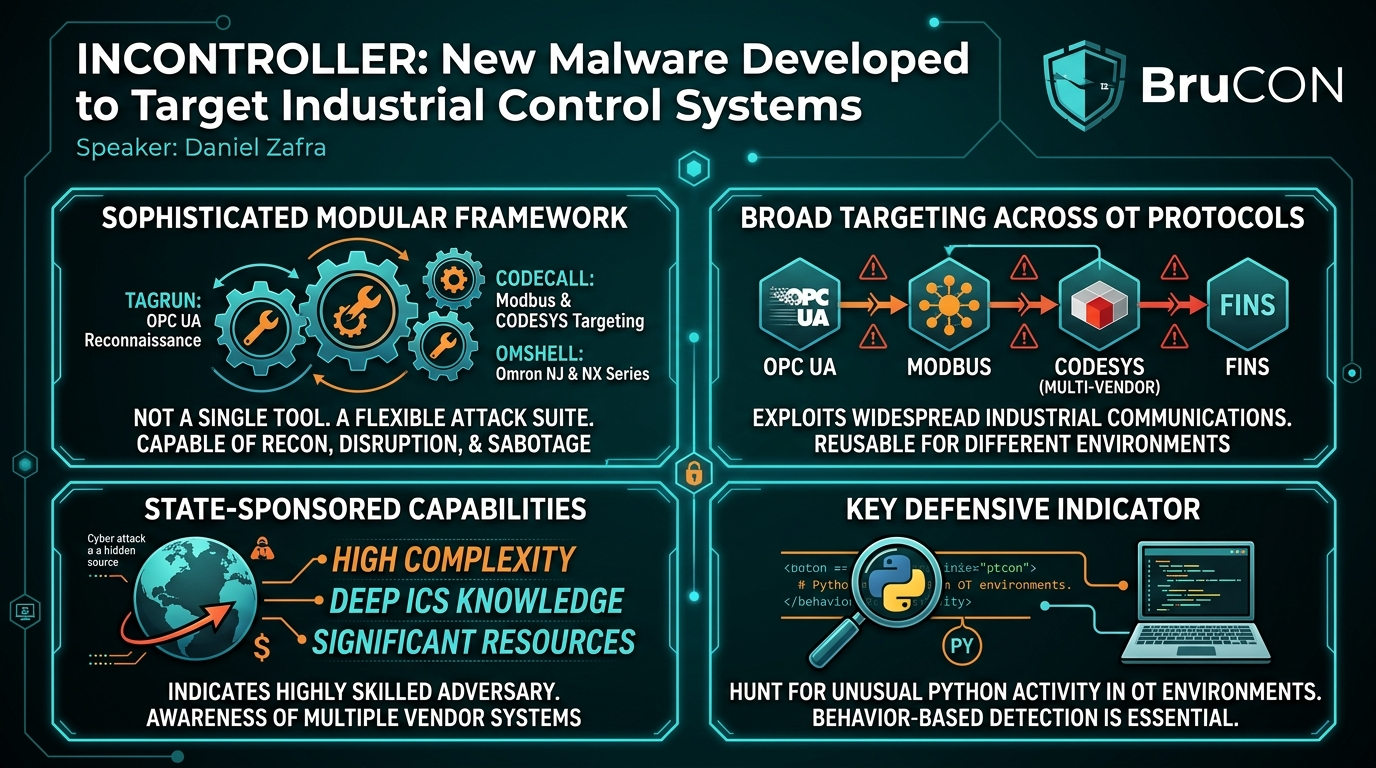
The discovery of INCONTROLLER by Mandiant represents a significant development in the realm of Industrial Control Systems (ICS) malware. The primary finding is that INCONTROLLER is not a single piece of malware but rather a sophisticated set of three core tools, designed to target specific industrial protocols and devices. These tools are: TAGRUN, CODECALL, and OMSHELL, each fulfilling distinct roles within a potential attack chain, from reconnaissance to direct manipulation of industrial processes.
A crucial characteristic of INCONTROLLER is its modularity, reusability, and extensibility. Unlike some prior ICS malware that was highly specialized for a single target, INCONTROLLER's components can be deployed independently or together, adapted to different victim environments, and potentially expanded with additional modules in the future. This design philosophy significantly increases its potential threat landscape and complicates traditional signature-based detection methods. The malware is also "operator-dependent," meaning it requires skilled human intervention and deep knowledge of both IT and OT environments to deploy and execute effectively, distinguishing it from fully automated worms.
Mandiant’s analysis strongly suggests INCONTROLLER is state-sponsored. This attribution is based on the malware's extreme complexity, the extensive resources required for its development, and the specialized knowledge of various industrial protocols and vendor devices embedded within its code. While no specific victim has been publicly identified, the malware's capabilities point to objectives such as disruption, sabotage, and potentially physical destruction across diverse industries that utilize the targeted automation devices, including energy, manufacturing, and oil and gas. The fact that similar modular and reusable characteristics were observed in the second version of Industroyer (Industroyer2), also seen in 2022, highlights a potential trend in advanced persistent threat (APT) development for OT environments.
Technical Deep Dive
▶ Watch: CoDeSys: CODECALL's widespread targeting potential (20:00)
INCONTROLLER is an intricately designed framework comprising three primary modules, each tailored to interact with specific industrial protocols and vendor devices. Mandiant's analysis reveals a sophisticated understanding of Operational Technology (OT) environments, enabling a wide range of attack capabilities from initial reconnaissance to direct physical process manipulation.
TAGRUN: The Reconnaissance Module
The first core component, TAGRUN, primarily functions as a reconnaissance tool. It specifically targets the OPC UA (Open Platform Communications Unified Architecture) protocol. OPC UA is widely used in industrial environments to facilitate secure and reliable data exchange between diverse devices, applications, and systems. TAGRUN's capabilities include:
- Scanning for IP addresses to discover OPC UA servers within a target network.
- Identifying and querying OPC UA tags, which represent specific data points or parameters within an industrial process (e.g., temperature, pressure, valve status).
- Gathering detailed information about the process and assets running on the network.
- The ability to modify some of these tags, suggesting potential for data manipulation or disruption even at the reconnaissance phase.
This module is critical for an attacker to understand the victim's industrial process and identify critical points for subsequent attacks. Mandiant compared TAGRUN's reconnaissance focus to Peace Pipe (HAVX), an earlier OPC-targeting tool from 2014, highlighting its role as the initial, less sensitive but foundational step in a larger attack.
CODECALL: Targeting Schneider Electric Devices via Modbus and CODESYS
The second module, CODECALL, is designed for more direct interaction and attack against Schneider Electric devices, particularly those leveraging the EcoStruxure Machine Expert software suite. This module primarily uses the Modbus protocol, one of the most prevalent communication protocols in industrial automation.
- Device Targeting: CODECALL specifically references Schneider Electric's TM251 and TM258 controllers. Interestingly, analysis revealed hardcoded credentials intended for the TM258, which were associated with an older version of the TM251, suggesting the attackers might have developed or tested the malware in a specific lab environment or encountered a unique target configuration.
- CODESYS Integration: A significant aspect of CODECALL is its interaction with CODESYS, a widely used, vendor-independent software suite for industrial automation development. CODESYS serves as a development environment for programming PLCs (Programmable Logic Controllers) and other industrial controllers. The fact that CODECALL is built to interact with CODESYS-based systems means its potential impact extends far beyond just Schneider Electric devices, as "several million compatible devices" across various vendors utilize CODESYS. This broad compatibility makes CODECALL highly versatile and potentially effective against a vast array of industrial equipment.
- Attack Capabilities: CODECALL can mimic an engineering workstation, allowing it to connect to PLCs, gather and push information, and execute code. Its disruptive capabilities include:
- Breaking the "envelope service": This likely refers to disrupting internal communication or control mechanisms within the PLC.
- Deleting data: Erasing critical operational data.
- Denial-of-Service (DoS): Disrupting the normal functioning of the targeted PLC.
These capabilities demonstrate an intent to not only control but also to disrupt or damage the targeted industrial processes.
OMSHELL: Omron Devices, FINS, HTTP, and Telnet
The third core module, OMSHELL, focuses on Omron brand controllers, a less common target for high-profile ICS malware compared to Siemens or Schneider Electric. OMSHELL employs a combination of proprietary and common IT protocols for its operations.
- Protocol Usage:
- FINS (Omron FINS): OMSHELL uses Omron's proprietary FINS protocol for initial reconnaissance and discovery of PLCs. It actively pulls devices using FINS and specifically queries based on MAC addresses to identify targeted controllers.
- HTTP and Telnet (Port 23): Once specific Omron devices are identified, OMSHELL enables capabilities to connect via standard HTTP and activate Telnet (on Port 23) access. This provides a common and potentially less conspicuous channel for interaction and control, which is unusual for direct PLC communication in secure industrial environments.
- Device Targeting: OMSHELL targets specific Omron NJ 501 and NX1P2 series controllers. Mandiant's research indicates that the malware likely targets the full series of these controllers, as only these ranges were found to support HTTP communication, a key feature leveraged by OMSHELL.
- Servo Control: A particularly interesting capability is OMSHELL's ability to read and write data to a Servo motor, specifically referencing the R8HD I 1 SN10F model. Servo motors are used for precise motion control in automated systems. Targeting a specific version among 22 variants of the R8HD suggests a highly specific victim or a meticulously controlled lab environment for development, indicating a precise attack objective.
Related IT Malware Components
The INCONTROLLER bundle also contained two additional, possibly related, IT malware components. These were described as a regular backdoor and a module exploiting a vulnerable driver. While not the primary focus of the OT analysis, their inclusion suggests that the attackers would likely use conventional IT compromise techniques to gain initial access and establish a foothold within the victim's network before deploying the specialized OT tools. This highlights the critical intersection of IT and OT security in industrial environments.
In summary, INCONTROLLER's technical architecture demonstrates a profound understanding of multiple industrial protocols and vendor-specific implementations. Its modularity, coupled with the ability to leverage both proprietary OT communications and common IT protocols, makes it a formidable and adaptable threat.
Demo / Proof of Concept
▶ Watch: Incontroller's attack scenarios: disruption, sabotage, physical destruction (32:00)
While the talk meticulously detailed the functionalities and technical specifications of each INCONTROLLER module, TAGRUN, CODECALL, and OMSHELL, it did not feature a live demonstration or a visual proof of concept. The speakers presented Mandiant's findings through analysis of the malware's code, diagrams illustrating potential attack flows, and detailed descriptions of its interaction with targeted industrial devices and protocols.
Defensive Implications
▶ Watch: Hunting for unusual Python activity in OT environments (44:00)
The emergence of INCONTROLLER presents significant challenges and necessitates a proactive, behavior-based defensive strategy for Industrial Control Systems (ICS) environments. Given its modularity, extensibility, and reliance on operator skill, traditional signature-based detection methods alone are insufficient.
Who Should Care
- Asset Owners: Any organization operating industrial facilities that utilize Schneider Electric (specifically EcoStruxure Machine Expert, TM251, TM258 controllers) or Omron (NJ 501, NX1P2 series controllers, R8HD servo motors) devices, or environments heavily reliant on OPC UA, Modbus, or FINS protocols, should prioritize understanding and defending against INCONTROLLER.
- Security Researchers and Threat Hunters: The unique characteristics of INCONTROLLER provide a rich area for research, encouraging the development of new detection methodologies applicable to a broader range of OT malware.
Challenges for Detection
- Multi-Tool Nature: INCONTROLLER is not a single executable but a suite of three distinct tools that can be used together or separately, at different levels of the Purdue model, making a unified detection strategy complex.
- IT/OT Convergence: The malware likely leverages conventional IT tooling for initial access and movement, meaning defenders must monitor both IT and OT networks for coordinated attack chains.
- Python Execution: A significant challenge is that INCONTROLLER's components are developed in Python. Python code can be deployed and executed in various ways (command line, embedded scripts), making it difficult to detect based on file hashes alone. Defenders must focus on the behavior of Python processes rather than just their presence.
- Dynamic Nature: The malware's extensibility means attackers can easily modify or expand its capabilities, rendering static signatures quickly obsolete.
Defensive Recommendations
- Behavior-Based Threat Hunting:
- Establish "Tripwires": Implement detection mechanisms for "lazy steps" often taken by attackers during initial reconnaissance. For example, ping sweeps in OT segments are highly unusual and should trigger alerts. While common in IT, such activity in an ICS network is a strong indicator of malicious intent.
- Monitor for Anomalous Python Activity: Python is not commonly found or used in most industrial control environments. Any execution of Python scripts or presence of Python interpreters on OT assets, especially those communicating with controllers, should be immediately investigated. This is a critical indicator that could signal INCONTROLLER or similar threats.
- Focus on Key Systems: Prioritize monitoring and logging on critical controllers, HMIs (Human-Machine Interfaces), and engineering workstations that directly interact with the physical process.
- Embedded Device Forensics and Incident Response (DFIR Framework):
- Mandiant recommends adopting a structured DFIR framework for embedded OT systems. This framework emphasizes preparation:
- Identify Interaction Tools: Know precisely how to access and interact with each OT device in your environment (e.g., specific vendor tools, cables, software suites).
- Collaborate with Equipment Manufacturers: Work closely with vendors (Schneider Electric, Omron, etc.) to understand their devices' internal workings, logging capabilities, and recommended forensic procedures.
- Data Identification and Collection: Establish baselines for normal operational data and logs from critical devices. Understand what data can be pulled, how it looks, and what changes signify anomalies. This is crucial for detecting modifications to controller logic or parameters.
- Specific Detection Points:
- OPC UA Monitoring: Look for unusual modifications to OPC UA tags, unexpected network traffic patterns on OPC UA ports, or unauthorized clients attempting to connect to OPC UA servers.
- Modbus/EcoStruxure Traffic: Monitor for unauthorized or anomalous Modbus communications to Schneider Electric controllers. Pay attention to connections from unexpected client IPs or unusual commands.
- Omron FINS/HTTP/Telnet Activity: Detect any FINS-based scanning activity, unusual HTTP connections, or attempts to enable/use Telnet (Port 23) on Omron controllers. Monitor user agents in HTTP traffic for Python-related strings.
- Log Analysis: While often challenging due to proprietary formats, analyze logs from industrial devices for unexpected restarts, configuration changes, or error messages. This often requires collaboration with OT engineers who understand the context of these logs.
- General OT Mitigations:
- Network Segmentation: Strictly segment IT and OT networks, and further segment critical zones within OT, to limit lateral movement.
- Robust Logging: Enable comprehensive logging on all possible OT devices and network components, forwarding logs to a centralized security information and event management (SIEM) system.
- Allow Listing (Whitelisting): Implement allow listing for applications and network communications on critical OT assets, permitting only known and authorized processes and connections.
- Secure Remote Access: Enforce multi-factor authentication and strict access controls for any remote access to OT networks.
By combining these proactive measures, organizations can build a more resilient defense against sophisticated threats like INCONTROLLER, moving beyond reactive responses to anticipate and neutralize threats before they cause significant damage.
Key Takeaways
- INCONTROLLER is a Highly Sophisticated, Modular ICS Malware: It's a three-part framework (TAGRUN, CODECALL, OMSHELL) designed for reconnaissance, disruption, sabotage, and potential physical destruction of industrial processes.
- Targets Diverse Industrial Protocols and Vendors: The malware specifically targets OPC UA for reconnaissance, Modbus/CODESYS for Schneider Electric devices, and proprietary FINS combined with HTTP/Telnet for Omron controllers.
- Reusable, Extensible, and Operator-Dependent: INCONTROLLER's design allows it to be adapted to various environments and expanded with new capabilities, requiring skilled human operators for deployment, indicating a long-term threat.
- Strong Indication of State-Sponsored Origin: The complexity, specialized knowledge required, and significant development resources point towards a state-level adversary.
- Python Activity is a Critical Indicator in OT: The use of Python in INCONTROLLER makes its presence or execution on OT assets a significant anomaly and a key tripwire for early detection.
- Behavior-Based Detection and OT-Specific DFIR are Essential: Traditional signature-based defenses are insufficient; organizations must focus on detecting anomalous behaviors, implementing robust logging, and having a structured DFIR framework for embedded OT systems.
About the Speaker(s)
Daniel Zafra is a Technical Analysis Manager in Mandiant's Cyber Physical Team. His work focuses on understanding and responding to threats against industrial control systems and operational technology. In this talk, he presented Mandiant's detailed research into the INCONTROLLER malware, highlighting its technical intricacies and the broader implications for critical infrastructure security. He acknowledged the significant contributions of his team, including Ken Proska, a star analyst from the Cyber Physical Team, who was instrumental in building the research for the detection and threat hunting recommendations.