The Story Continues: Hacking Some More Secure Portable Storage Devices
Matthias Deeg (IT Security Consultant · SySS)
BruCON 0x0E · Day 2
Overview
In this BruCON 2022 presentation, "The Story Continues: Hacking Some More Secure Portable Storage Devices," Matthias Deeg, an I.T. security consultant, delved into the alarming state of security in commercially available "secure" USB flash drives and external SSDs. Deeg, who has a long history of researching these devices dating back to 2009, revealed that many modern products continue to suffer from fundamental security flaws that were identified over a decade ago. His research highlights a persistent gap between marketing claims of "military-grade" encryption and the reality of easily exploitable vulnerabilities.
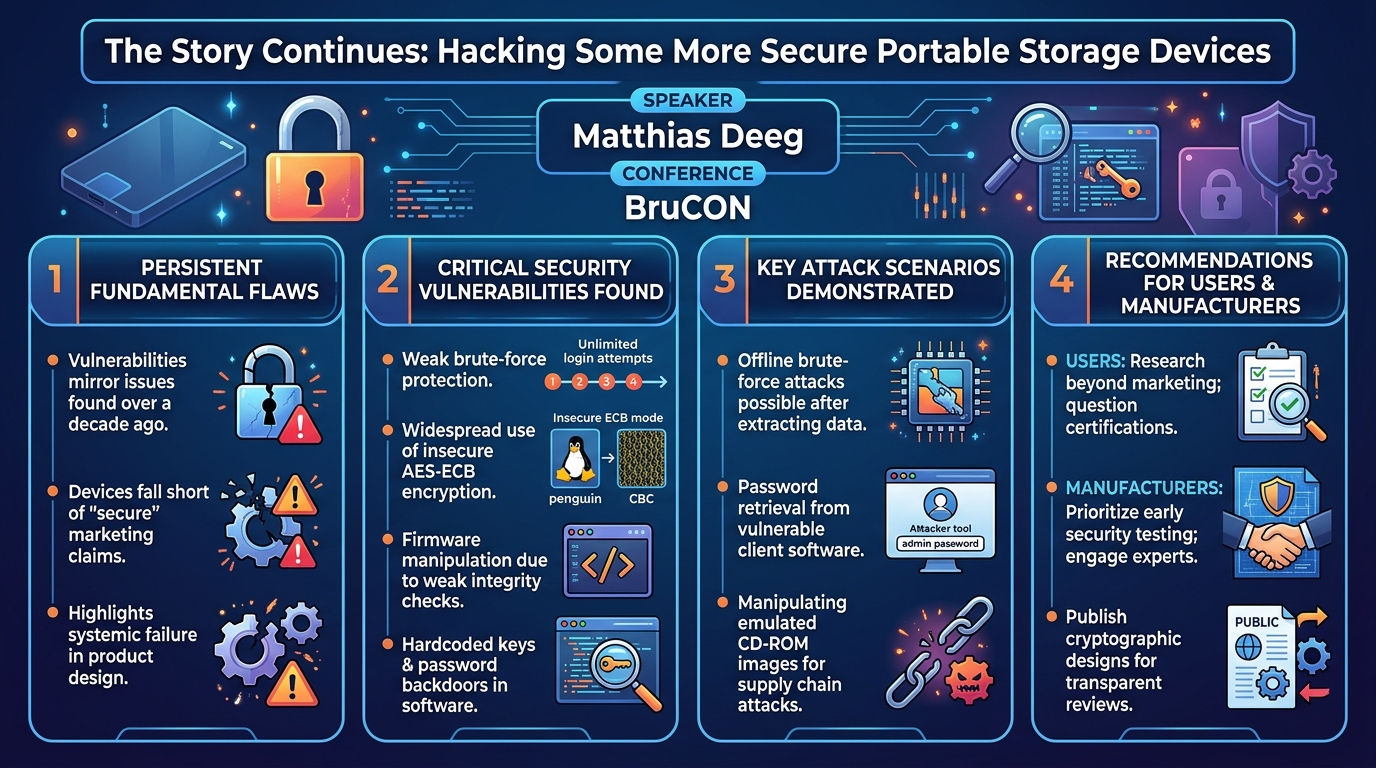
Key moments
- 0:00 Introduction, speaker background, and talk agenda
- 4:00 Desired secure properties for crypto USB drives
- 12:00 Verbatim Keypad Secure: Brute-force protection mechanism fails
- 25:00 Breakthrough: Identifying the PIN hash function
- 28:00 Live demo: Brute-forcing the Verbatim Keypad Secure
- 35:30 Verbatim Fingerprint Secure: Admin password retrieval vulnerability
- 53:30 Key conclusions and recommendations for device security
The Story Continues: Hacking Some More Secure Portable Storage Devices
Speakers: Matthias Deeg, I.T security consultant
Conference: BruCON
YouTube: https://www.youtube.com/watch?v=1Em5XMCuQGM
Overview
In this BruCON 2022 presentation, "The Story Continues: Hacking Some More Secure Portable Storage Devices," Matthias Deeg, an I.T. security consultant, delved into the alarming state of security in commercially available "secure" USB flash drives and external SSDs. Deeg, who has a long history of researching these devices dating back to 2009, revealed that many modern products continue to suffer from fundamental security flaws that were identified over a decade ago. His research highlights a persistent gap between marketing claims of "military-grade" encryption and the reality of easily exploitable vulnerabilities.
Deeg's talk meticulously detailed his methodology for hardware, firmware, and software analysis, applying these techniques to several devices, primarily from Verbatim, but also including a Chinese-manufactured drive. He demonstrated how a combination of reverse engineering, protocol analysis, and cryptographic weaknesses could lead to full authentication bypass and data exfiltration. The presentation served as a stark reminder that despite advancements in cryptographic standards, the implementation on consumer-grade secure hardware often remains critically flawed, exposing sensitive user data to determined attackers.
The significance of Deeg's work lies in its practical implications for both users and manufacturers. For users, it underscores the critical need for skepticism regarding security product claims and emphasizes the importance of thorough pre-purchase research. For manufacturers, it exposes a systemic failure to integrate robust security practices into product design and development, urging them to engage with cryptographic experts and publish transparent security designs rather than relying on security through obscurity or outdated encryption modes.
Background
▶ Watch: Introduction, speaker background, and talk agenda (0:00)
Matthias Deeg's journey into hacking secure portable storage devices began over a decade ago, with initial findings published in 2009 concerning USB flash drives from Kingston, Verbatim, and SanDisk. His continued research in 2011 further solidified his expertise in this niche, making this 2022 talk a continuation of a long-standing investigation into device security. This historical context is crucial, as many of the vulnerabilities discovered in 2022 mirror those found in earlier generations of devices, indicating a lack of progress in addressing fundamental design flaws.
The problem persists because many manufacturers prioritize cost-effectiveness and rapid deployment over rigorous security validation. They often rely on off-the-shelf components, sometimes with shared firmware code across different vendors, without fully understanding or hardening their cryptographic implementations. This results in devices that claim to offer "256-bit AES Hardware Encryption" but fall short in critical areas like key derivation, authentication mechanisms, and resistance to physical attacks.
Deeg outlined several desired secure properties for such devices:
- Secure Data Encryption: All user data should be securely encrypted, making it impossible to infer plaintext information from ciphertext patterns.
- Authorized Access Only: Only legitimate users should access sensitive data.
- Authentication Bypass Prevention: User authentication processes should be robust and unbypassable.
- Online Brute-Force Protection: Authentication attempts against the live device should be limited, with devices resetting or locking after a specific number of failed attempts.
- Device Integrity Protection: The device's integrity should be protected by secure cryptographic means.
- Offline Brute-Force Resistance: While preventing offline brute-force attacks entirely is challenging, devices should make it extremely difficult and expensive for attackers to perform these attacks after extracting necessary data.
Deeg's research process, initiated by a customer request in December 2021, involved a systematic approach comprising hardware analysis, firmware analysis, and software analysis. Hardware analysis involved disassembling devices, identifying chips (NAND flash, USB bridge controllers, memory controllers, keypad/fingerprint sensor controllers, SPI flash for firmware), finding documentation, and using tools like logic analyzers and JTAG debuggers. Firmware analysis focused on dumping firmware from SPI flash memory, reverse engineering it using static code analysis tools like Ghidra, and understanding the instruction sets (e.g., Arc Compact). Software analysis involved static and runtime analysis of client software components for Windows or macOS, often revealing communication protocols and hardcoded keys.
The attack surface for these devices is primarily limited to physical access. Attacks can occur at two critical points:
- Before legitimate user deployment (Supply Chain Attack): An attacker could tamper with a device before it reaches the user, for example, by flashing malicious firmware.
- After legitimate user deployment (Lost/Stolen Device or Temporary Access): An attacker gains permanent or temporary physical access to a device containing sensitive data and attempts to bypass its security. This scenario formed the basis for most of Deeg's demonstrated attacks.
Key Findings
▶ Watch: Verbatim Keypad Secure: Brute-force protection mechanism fails (12:00)
Matthias Deeg uncovered a series of significant security vulnerabilities across multiple "secure" portable storage devices, demonstrating that many fundamental security principles are still being overlooked. His findings led to the assignment of seven CVE IDs, highlighting the severity and breadth of the issues.
- Verbatim Keypad Secure (CVE-2022-35805, CVE-2022-35806, CVE-2022-35807):
- Broken Brute-Force Protection: Despite marketing claims of locking and initializing after 20 failed passcode attempts, the device did not lock even after 50 consecutive incorrect entries. This made online brute-force attacks feasible, albeit slow.
- AES-ECB Encryption Mode: The device used Electronic Codebook (ECB) mode for AES encryption of user data. This mode is notoriously insecure for data with repeating patterns (like bitmaps), as identical plaintext blocks result in identical ciphertext blocks, allowing an attacker to infer information about the plaintext from the ciphertext (e.g., the Tux penguin pattern).
- Firmware Manipulation: The firmware stored on the SPI flash memory chip was protected only by a simple CRC16 (Xmodem) checksum. This allowed Deeg to dump, modify, and re-flash custom firmware, enabling debug code injection, runtime analysis, and the potential for persistent malicious firmware.
- Offline Brute-Force Vulnerability: Through reverse engineering the firmware and proprietary SPI communication protocol, Deeg was able to reconstruct the PIN-to-key derivation process, including a specific integer hash function (Thomas Wang's h32 shift 2002) and the location of the encrypted authentication block. This allowed for a highly efficient offline brute-force attack.
- Verbatim Executive Fingerprint Secure (CVE-2022-35808, CVE-2022-35809, CVE-2022-35810):
- Password Retrieval Backdoor: The Windows client software, upon startup, communicated with the device using AES-encrypted SCSI pass-through commands. Deeg discovered that the device would transmit the currently set administrative password in decrypted form to the client software via a specific USB command. This effectively acted as a backdoor, allowing anyone with temporary physical access to retrieve the password and unlock the device.
- AES-ECB Encryption Mode: Similar to the Keypad Secure, this device also utilized AES-ECB for user data encryption, exposing it to the same pattern leakage issues.
- Firmware Manipulation: Like its keypad counterpart, the firmware on this device was also vulnerable to manipulation due to weak integrity checks.
- Leapting KP001 (CVE-2022-35811):
- Chip Swapping Attack: This device, marketed with "military-grade" security, was vulnerable to a chip swapping attack. Deeg demonstrated that by desoldering the authentication chip from a target device and replacing it with an attacker-controlled chip (from another identical device with a known PIN), the device could be unlocked, revealing that the key derivation was not tied to the user's input in a robust manner.
- Suspicious Recovery Feature: The device advertised a "passcode recovery" feature via email with a serial ID, which Deeg found highly suspicious and failed to get a response from, suggesting potential weaknesses or lack of support.
- General Data Authenticity Issues: For devices with an emulated CD-ROM drive (containing client software), Deeg found that the ISO image for this drive was stored in hidden sectors on the SSD and could be easily manipulated. This opens the door for supply chain attacks, where an attacker could inject malware into the client software or device drivers, which would then be executed on the user's computer upon connection.
These findings collectively paint a grim picture of "secure" portable storage, where fundamental cryptographic principles are ignored, implementation flaws are rampant, and marketing claims far outstrip actual security.
Technical Deep Dive
▶ Watch: Breakthrough: Identifying the PIN hash function (25:00)
The core of Deeg's research involved a meticulous technical dissection of the target devices, combining hardware, firmware, and software reverse engineering.
Verbatim Keypad Secure Analysis
- Hardware Overview: The device consists of a NAND flash memory-based m.2 SSD, a USB-to-SATA bridge controller (specifically an Inic controller), a memory controller, a keypad for PIN entry, a keypad controller (SW611), and a SPI flash memory chip (128KB in size) storing the Inic controller's firmware. The m.2 SSD was removable, facilitating external analysis.
- Firmware Analysis (Inic Controller):
- Dumping and Reverse Engineering: Deeg used a T56 universal programmer to dump the SPI flash memory. The Inic controller used the Arc Compact instruction set, for which no public data sheets or programming manuals were available. Deeg relied on prior research (e.g., Julian Lenoir and Rafael's work on the Inic 3607) and a Ghidra add-on by Nicholas EOS to disassemble and decompile the firmware.
- CRC16 Bypass and Debugging: The firmware's integrity was protected only by a simple CRC16 (Xmodem configuration) checksum. By calculating and patching the CRC after modification, Deeg could inject custom Arc Compact assembly code. This allowed him to perform runtime analysis, explore the internal workings of the AES engine, and dump memory contents via the SPI communication lines, which were originally used for communication between the keypad controller and the Inic controller.
- Shared Code and Artifacts: The firmware contained interesting artifacts, such as a "magic signature" used for PIN verification, which was also found in devices by other manufacturers, suggesting shared codebases. A leftover Pi byte sequence (3.1415...) was also found, which in other devices served as an initial AES encryption key.
- Proprietary SPI Protocol Analysis:
- Sniffing Communication: Deeg analyzed the SPI communication between the keypad controller and the Inic controller. The protocol supported six commands (initialize, unlock, lock, change password, and two unknown) with a consistent message format: length, command ID, payload, and a CRC16 checksum.
- Payload Structure and Hashing: For PIN entries (5-12 digits), the payload was always 32 bytes, with the last 16 bytes consistently
FF(hexadecimal). The first 16 bytes showed clear patterns. Deeg observed that repeating input digits (e.g., "1111") resulted in repeating 4-byte patterns in the payload (e.g., "0AC91F2F"). - Identifying the Hash Function: Initial attempts to physically brute-force the keypad controller to generate a lookup table failed due to complexities in simulating the "unlock" key. A subsequent web search for the hash output of "0000" (which resulted in
4636...) led Deeg to Thomas Wang's h32 shift 2002 integer hash function. This function correctly mapped the 4-digit PIN blocks to the observed 4-byte patterns in the SPI payload.
- Key Derivation and Offline Brute-Force:
- Authentication Block: By analyzing changes in the SSD content after setting different passcodes, Deeg located a specific encrypted block storing authentication information. This block, when correctly decrypted, contained the previously identified "magic signature" at a specific offset.
- AES Key Identification: The AES key used by the hardware engine was determined to be the full 32-byte payload sent from the keypad controller via SPI. A crucial detail was the need to reverse the byte order for each 16-byte block of the key before feeding it to the AES engine.
- Brute-Forcer Implementation: With the hash function, key derivation logic, and authentication block structure understood, Deeg could implement an offline brute-force tool. The search space for 5-12 digit PINs, combined with the efficient hash function and AES decryption, made the attack practical.
Verbatim Executive Fingerprint Secure Analysis
- Hardware Overview: Similar to the Keypad Secure, it featured NAND flash (m.2 SSD), SPI flash for firmware, and a memory controller. Instead of a keypad, it had a fingerprint sensor and a fingerprint sensor controller, for which no public data was available.
- Software Analysis (Windows Client):
- USB Communication: The Windows client software communicated with the device using IOCTL SCSI pass-through commands. This communication was AES encrypted.
- Hardcoded AES Keys: Using a software debugger (specifically x64dbg) and exploiting the presence of meaningful symbol names related to AES encryption within the client software, Deeg was able to set breakpoints and extract hardcoded AES encryption keys used for device communication.
- Password Retrieval Backdoor: Analysis of the decrypted communication revealed a critical flaw: before the administrative login dialog even appeared, the device would transmit the currently set administrative password to the client software in a decrypted form via a specific USB command. This effectively acted as an unintentional (or intentional) backdoor.
Leapting KP001 Analysis
- Hardware Overview: This device's PCB showed a high-speed analog switch connected to the USB data lines and an unmarked chip responsible for PIN input.
- Chip Swapping Attack (CVE-2022-35811): The presence of the analog switch and an opaque authentication chip suggested a different key management approach. Deeg demonstrated that by acquiring two identical devices (one attacker-controlled, one target), he could set a known PIN on the attacker's device, then desolder the authentication chip from both devices and swap the attacker's chip onto the target device. This successfully unlocked the target device, indicating that the cryptographic key was either stored directly on this chip or was derived in a way that didn't sufficiently incorporate the user's PIN, allowing the chip itself to serve as the authentication token. This bypasses any user-set PIN.
These detailed technical analyses underscore that the vulnerabilities stem from a combination of poor cryptographic choices (AES-ECB), weak firmware integrity, reliance on security through obscurity (proprietary protocols, black box chips), and critical implementation flaws (hardcoded keys, plaintext password transmission).
Demo / Proof of Concept
▶ Watch: Verbatim Fingerprint Secure: Admin password retrieval vulnerability (35:30)
Matthias Deeg prepared two live demonstrations to showcase the practical impact of his findings, targeting the Verbatim Keypad Secure and the Verbatim Executive Fingerprint Secure. Although the live demos encountered technical difficulties with the virtual machine's USB passthrough, Deeg had recorded video backups that successfully illustrated the attacks.
- Verbatim Keypad Secure - Offline Brute-Force Attack:
- Initial State: Deeg demonstrated that when the Verbatim Keypad Secure was connected to a computer, it remained locked and did not appear as a storage device until the correct PIN was entered. Attempts with incorrect PINs yielded no response.
- Attack Steps:
- The m.2 SSD was removed from the Verbatim Keypad Secure enclosure and placed into an external SSD enclosure.
- This external enclosure was connected to a Windows virtual machine.
- Deeg ran a custom tool (a "Keypad Secure Cracker") that read the hidden sectors of the SSD containing the encrypted authentication block.
- The tool then performed the offline brute-force attack, applying the identified Thomas Wang hash function to all possible 5-12 digit PINs, deriving the AES key, and attempting to decrypt the authentication block to find the "magic signature."
- After approximately seven seconds on his test machine, the tool successfully retrieved the correct PIN.
- Verification: The SSD was reinserted into the original Verbatim Keypad Secure enclosure. When the retrieved PIN was entered on the device's keypad, the device successfully unlocked, and its secure partition became accessible on the computer. The video backup confirmed the successful unlock and access to sensitive data.
- Verbatim Executive Fingerprint Secure - Password Retrieval Backdoor:
- Initial State: The Verbatim Executive Fingerprint Secure was connected, presenting an emulated CD-ROM drive containing the client software. When the
Verbatim Secure.exewas launched, it presented a login dialog for the administrator password. Entering an incorrect password failed authentication. - Attack Steps:
- Deeg ran a simple command-line tool named "Verbatim Fingerprint Secure Password Retriever."
- Upon clicking "Retrieve Password," this tool sent a specific USB command to the connected device.
- The device responded by transmitting its administrative password, which the tool then displayed and automatically copied to the clipboard.
- Verification: The retrieved password was pasted into the administrative login dialog of the
Verbatim Secure.exe. This successfully authenticated the attacker, granting access to the administrative interface where new fingerprints could be registered, existing ones deleted, and the secure partition of the device unlocked. The video backup clearly showed this process, including the successful unlock and the appearance of the "Verbatim HD" partition.
These demonstrations served as compelling proof that the theoretical vulnerabilities could be practically exploited with relatively simple tools and techniques, often requiring only temporary physical access to the device. The fallback to video backups ensured that the audience could still grasp the full impact of the attacks despite the live demo challenges.
Defensive Implications
▶ Watch: Key conclusions and recommendations for device security (53:30)
Matthias Deeg's research provides critical insights for both users and manufacturers to enhance the security posture of portable storage devices. The fact that many vulnerabilities identified are "forever bugs" due to fundamental hardware design flaws underscores the difficulty of patching certain issues.
Manufacturer Actions and Unfixed Issues:
Verbatim, in response to Deeg's findings, released security updates at the end of July. However, these updates were partial:
- Verbatim Keypad Secure:
- Fixed: The AES-ECB encryption mode was replaced with AES-XTS, a more secure mode suitable for storage devices. The PIN code verification mechanism was also changed, making the original offline brute-force attack non-functional for updated devices.
- Unfixed: Firmware manipulation is still possible. While the specific offline brute-force attack was addressed, Deeg notes that a new one could likely be developed by reverse-engineering the new PIN verification mechanism. Crucially, the advertised brute-force protection (device lock/reset after 20 attempts) remained unfixed; new devices tested still failed to lock after 20, 30, or even 40 incorrect entries. This means online brute-force attacks, though slow, are still viable.
- Verbatim Executive Fingerprint Secure:
- Fixed: The password retrieval backdoor (CVE-2022-35808) was patched; the specific USB command to retrieve the password is no longer supported by the firmware.
- Unfixed: Alarmingly, the AES-ECB encryption mode (CVE-2022-35809) for user data was not fixed on this device, despite being fixed on the Keypad Secure. Firmware manipulation (CVE-2022-35810) also remains a vulnerability.
The release of Windows updater tools for firmware updates also introduces a new potential attack vector: BadUSB devices. If an attacker can reverse engineer the update process, they might be able to program malicious firmware via software, bypassing the need for physical programmers.
Recommendations for Users:
- Choose Wisely and Research Thoroughly: Do not trust marketing claims like "military-grade" or "unhackable." Conduct extensive online research, looking for independent security reviews and penetration testing reports, not just manufacturer-provided certifications.
- Question Certifications and Scope: Understand that certifications (e.g., FIPS, FCC) often cover specific aspects (e.g., radio communication, overall product safety) and may not guarantee robust cryptographic security. Always inquire about the scope of any security testing performed.
- Be Skeptical of "Black Box" Security: Devices that do not publish their cryptographic design or rely on undocumented, proprietary chips should raise red flags. Transparency, within reason, is often a sign of confidence in a security design.
Recommendations for Manufacturers and Vendors:
- Prioritize Security Testing Early: Integrate security testing into the product development lifecycle, ideally at the prototype stage, before mass production. Engage knowledgeable IT professionals and security researchers.
- Hire Cryptographers: For any product involving cryptography, consult and hire actual cryptographers. Relying on general engineers without specialized crypto expertise often leads to fundamental design flaws.
- Publish Crypto Design: Be transparent about the cryptographic design, algorithms, key derivation processes, and implementation details. This allows for public scrutiny and helps identify weaknesses before products reach the market.
- Holistic Security Approach: Consider the entire product ecosystem – hardware, firmware, and client software – as a single attack surface. Vulnerabilities in any component can compromise the whole.
- Refrain from False Marketing Claims: Avoid misleading terms like "military-grade" or "unhackable." Provide accurate and substantiated security claims based on rigorous testing.
- Address "Forever Bugs": Recognize that some hardware-level flaws may be impossible to fix via firmware updates. Manufacturers must be transparent about these limitations and, if necessary, discontinue or recall affected products.
Deeg's work serves as a powerful call to action for the industry to move beyond superficial security measures and embrace rigorous, transparent, and expert-driven security engineering for portable storage devices.
Key Takeaways
- Persistent Vulnerabilities: Many "secure" portable storage devices sold today suffer from fundamental security flaws that have been known for over a decade, indicating a lack of progress in security implementation.
- Misleading Marketing: Users should be highly skeptical of marketing claims like "military-grade" or "unhackable." Independent security research is crucial before trusting such devices with sensitive data.
- AES-ECB is Still a Problem: The use of AES-ECB encryption mode in "secure" devices remains a critical flaw, leading to pattern leakage and allowing attackers to infer plaintext information from ciphertext.
- Physical Access is Paramount: Most sophisticated attacks on these devices, including firmware manipulation and offline brute-force, require physical access, highlighting the importance of physical security for data.
- Importance of Holistic Security: Security flaws can originate from hardware design (e.g., chip swapping, unfixed brute-force protection), firmware implementation (e.g., weak checksums, incorrect key derivation), or client software (e.g., hardcoded keys, password transmission). A comprehensive security approach is vital.
- Manufacturer Responsibility: Manufacturers must invest in rigorous security testing from the prototype stage, hire cryptographic experts, and consider publishing their cryptographic designs to ensure robust, transparent security.
About the Speaker(s)
Matthias Deeg is an I.T. security consultant with extensive experience dating back to 2007. He has a long-standing history of researching the security of portable storage devices, having published findings and given talks on the topic as early as 2009. His expertise lies in hardware hacking, firmware analysis, and reverse engineering, particularly focused on identifying and exploiting vulnerabilities in "secure" USB flash drives and external SSDs. His work consistently highlights the discrepancies between marketing claims and the actual security posture of these devices.