Understanding the Discipline to Optimize Cyber Defense Collaboration
John Doyle (Intelligence Consultant · Mandiant)
BruCON 0x0E · Day 2
Overview
In this insightful BruCON presentation, John Doyle, an Intelligence Consultant at Mandiant, delves into the critical, yet often misunderstood, discipline of Cyber Threat Intelligence (CTI). Titled "Understanding the Discipline to Optimize Cyber Defense Collaboration," Doyle’s talk aims to demystify CTI for cybersecurity professionals, fostering a clearer understanding of its roles, deliverables, and immense value in a collective defense strategy. He introduces the Mandiant CTI Analyst Core Competencies Framework, a robust model designed to define the essential knowledge, skills, and abilities required for CTI analysts, thereby enabling more effective collaboration across an organization’s security functions.
Key moments
- 2:00 Talk agenda and speaker introduction
- 6:30 Cyber Threat Intelligence's role and the OODA Loop
- 11:00 Understanding strategic, operational, and tactical CTI stakeholders
- 22:00 Introducing the CTI Analyst Core Competencies Framework
- 35:00 Pillar 3: Technical literacy for CTI analysts
- 40:00 Pillar 4: Cyber threat proficiencies (CTI's bread and butter)
- 46:00 Visualizing complex adversary operations for clarity
- 48:30 Key takeaways and advice for CTI collaboration
Understanding the Discipline to Optimize Cyber Defense Collaboration
Speakers: John Doyle, Intelligence Consultant, Mandiant
Conference: BruCON
YouTube: https://www.youtube.com/watch?v=p14hVY2-xV8
Overview
In this insightful BruCON presentation, John Doyle, an Intelligence Consultant at Mandiant, delves into the critical, yet often misunderstood, discipline of Cyber Threat Intelligence (CTI). Titled "Understanding the Discipline to Optimize Cyber Defense Collaboration," Doyle’s talk aims to demystify CTI for cybersecurity professionals, fostering a clearer understanding of its roles, deliverables, and immense value in a collective defense strategy. He introduces the Mandiant CTI Analyst Core Competencies Framework, a robust model designed to define the essential knowledge, skills, and abilities required for CTI analysts, thereby enabling more effective collaboration across an organization’s security functions.
Doyle, drawing from his extensive experience in digital forensics, CTI, and a decade at the CIA, emphasizes that CTI acts as a service organization, providing timely, relevant, and actionable insights to inform risk exposure decisions and cyber defense actions. The core message is that by clarifying CTI’s capabilities and requirements, security teams—from Security Operations Centers (SOC) and Incident Response (IR) to C-suite executives and risk managers—can better leverage intelligence to outpace adversaries. The framework serves as a common lexicon, empowering organizations to build stronger, more integrated defense mechanisms.
The presentation highlights that effective collaboration, underpinned by a shared understanding of CTI’s contribution, is paramount for bolstering prevention, detection, and remediation efforts. Doyle articulates how CTI enables organizations to run through the OODA Loop (Observe, Orient, Decide, Act) more rapidly than their adversaries, creating a significant strategic advantage. This talk is a call to action for improved inter-team communication and a structured approach to CTI, vital for any organization striving for mature and resilient cyber defenses.
Background
▶ Watch: Talk agenda and speaker introduction (2:00)
The landscape of cybersecurity has evolved dramatically, moving from "Information Assurance" to "Information Security" and now to "Cyber Security," each iteration bringing increased complexity and specialization. Within this evolution, Cyber Threat Intelligence has emerged as a crucial, yet frequently misinterpreted, discipline. John Doyle identifies a pervasive misunderstanding among various cybersecurity teams regarding what CTI professionals actually do and how their work can best be leveraged. This gap in understanding often leads to suboptimal collaboration, underutilization of CTI capabilities, and ultimately, a less effective overall defense posture.
Doyle traces the roots of CTI professionals to two primary tracks: traditional intelligence analysis (e.g., military, economic, signals intelligence) and deep technical cybersecurity expertise (e.g., incident response). While traditional intelligence analysts excel as generalists with strong analytical and communication skills, cybersecurity professionals bring profound technical understanding. The modern CTI analyst is an amalgam of these two, capable of translating complex technical information into contextualized, actionable insights for diverse stakeholders. However, the varied backgrounds and the broad mission mandate of CTI often contribute to internal communication challenges.
The speaker highlights existing frameworks like the NIST NICE Cybersecurity Workforce Framework and SANS mappings that attempt to categorize cybersecurity roles, knowledge, skills, and abilities. Yet, these often don't fully capture the nuanced and evolving nature of CTI. The problem is exacerbated by the diverse needs of CTI's "customers" or "stakeholders," who fall into strategic, operational, and tactical categories. Each requires intelligence tailored to their specific decision-making processes, from C-suite risk assessments to SOC detection signature creation. Without a clear definition of CTI competencies and a mechanism for structured engagement, organizations struggle to align CTI efforts with broader organizational goals, hindering collective defense and resource optimization.
Key Findings
▶ Watch: Understanding strategic, operational, and tactical CTI stakeholders (11:00)
John Doyle's presentation elucidates several key findings that are critical for optimizing cyber defense collaboration through a better understanding of CTI.
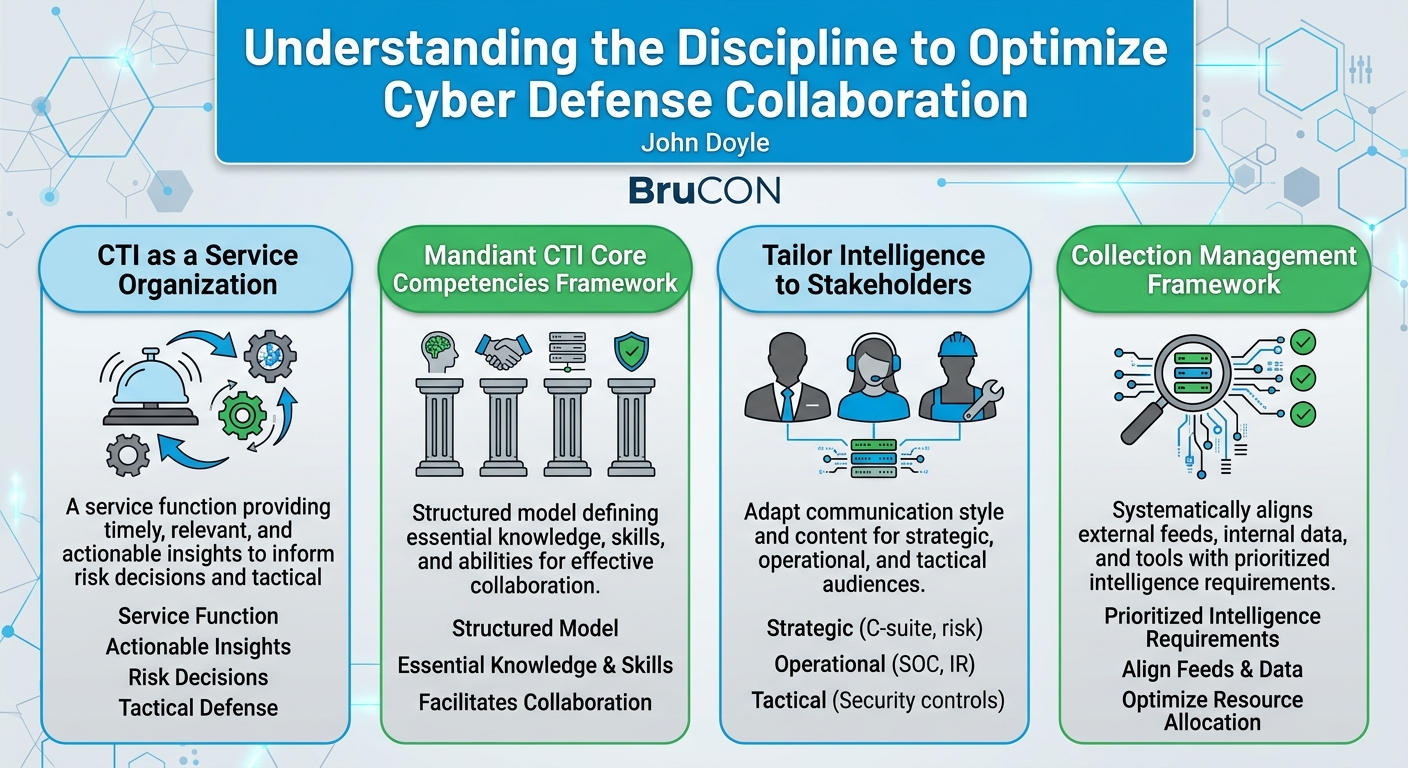
Firstly, CTI’s fundamental role is defined as a service organization dedicated to providing timely, relevant, actionable insights on threat actors, capabilities, and motivations. This intelligence is crucial for informing both risk exposure decisions at the executive level and direct cyber defense actions by practitioners. Doyle stresses that CTI is not merely a function of cyber defense, but a holistic enabler for organizational resilience against threats.
Secondly, the central contribution of the talk is the introduction of the Mandiant CTI Analyst Core Competencies Framework. This framework is a structured articulation of the essential knowledge, skills, and abilities (KSAs) required for CTI professionals today. It aims to solve three core problems: providing a clear understanding of what CTI analysts do, enabling better collaboration during investigations and incident response, and serving as a roadmap for developing the CTI workforce. By establishing a common language and set of expectations, the framework facilitates more effective engagement between CTI and other security teams.
Thirdly, the presentation underscores the necessity of tailoring intelligence products to specific stakeholder types: strategic (C-suite, risk management), operational (SOC, incident responders), and tactical (security controls, detection engineers). Recognizing these distinct needs allows CTI to deliver maximum impact by adapting communication style and content, whether it's a high-level risk assessment or granular Indicators of Compromise (IOCs).
Finally, Doyle highlights the critical, yet often overlooked, function of a collection management framework or plan within CTI. This framework systematically enumerates and aligns external vendor feeds, internal data sets, and various CTI tools with specific intelligence requirements. It provides a tangible basis for evaluating the effectiveness of resources, identifying gaps, making joint justifications for tool purchases, and ensuring that finite resources are invested in a way that directly supports organizational priorities, such as tracking specific nation-state actors or industry-specific threats.
Technical Deep Dive
▶ Watch: Pillar 3: Technical literacy for CTI analysts (35:00)
The core of John Doyle's technical deep dive revolves around the Mandiant CTI Analyst Core Competencies Framework, a comprehensive model designed to articulate the diverse skill sets required for effective threat intelligence. This framework, published by Mandiant, is the result of extensive introspection and industry collaboration, aiming to provide a full enumeration of capabilities expected from CTI analysts. It is structured around four main pillars, each comprising three distinct competencies:
- Problem Solving: This pillar emphasizes the innate abilities and mindset crucial for CTI.
- Critical Thinking: The ability to arrive at sound conclusions, identify biases, and understand the utility and limitations of various data sets and indicators of compromise (IOCs). It involves knowing when to enrich data and how to piece disparate information together.
- Research and Analysis: Proficiency in mining and interpreting stored data, pivoting on findings, and understanding existing mental models and data schemas. This is about systematic investigation and information synthesis.
- Investigative Mindset: A natural curiosity and passion, akin to Sherlock Holmes, constantly asking "why" and determining the next logical step in an investigation, even when faced with incomplete information. This drives the creation of novel solutions when existing ones are insufficient.
- Personal Effectiveness: These competencies focus on the human and organizational aspects of CTI.
- Communication: The paramount ability to adapt communication style and content to resonate with diverse stakeholders (e.g., C-suite executives, risk professionals, technical practitioners). This ensures maximum impact of intelligence by translating complex information into terms relevant to the audience, often using a "common operating picture" framework.
- Teamwork and Emotional Intelligence: Understanding the interplay between CTI and other security functions like vulnerability management, incident response, and risk. It involves self-awareness, social awareness, and maintaining self-control, crucial for navigating conflict and fostering collaborative environments.
- Business Acumen: Aligning CTI efforts with the overall organization's missions, goals, and specific industry context. For instance, an analyst in the financial sector must understand fintech architecture, not just general IT security. This includes understanding core dependencies and specific systems used by the organization.
- Technical Literacy: This pillar addresses the foundational technical knowledge expected of CTI analysts.
- Enterprise IT Networks: Understanding how systems and networks are architected, including hybrid solutions (on-premise, off-premise). This enables CTI to assess the adversary's attack surface variations and the techniques they might employ based on the environment.
- Cyber Security Ecosystem: Comprehension of the broader cybersecurity framework, roles, responsibilities, and terminology. This helps bridge the gap for analysts transitioning from traditional intelligence backgrounds into cyber.
- Roles and Responsibilities: Familiarity with concepts like Service Level Agreements (SLAs) and RACI matrices (Responsible, Accountable, Consulted, Informed). Doyle specifically notes creating modified RACI matrices for clients to improve cross-functional collaboration between IR, vulnerability management, enterprise protection, and risk teams, ensuring information is consumed effectively and workflows are initiated correctly.
- Cyber Threat Proficiency: This is highlighted as the "bread and butter" of the CTI profession, encompassing approximately two and a half to three pages of the framework's total nine pages.
- Drivers of Offensive Operations: Understanding the motivations behind cyber operations, whether nation-state (espionage for economic, political, or military benefit) or criminal. This includes comprehending the strategic use of cyber as an asymmetric tool, reasons for destructive attacks, and anti-forensic techniques. Analysts should be able to define roles within an offensive cyber program and assess the overall capability and resilience of an adversary.
- Threat Concepts and Frameworks: Proficiency with ubiquitous frameworks like MITRE ATT&CK for standardizing adversary TTPs, as well as others such as the Diamond Model of Intrusion Analysis and the Lockheed Martin Cyber Kill Chain. Understanding why these frameworks exist and how to apply them to characterize and define threat groups is critical.
- Threat Actors and TTPs: Detailed knowledge of specific actor groups (nation-state, criminal), their composition, and their common tactics, techniques, and procedures (TTPs), such as credential dumping or multi-stage malware. This enables CTI to contextualize observed adversary operations, identify top threats, and guide the testing of security controls.
Underpinning these pillars, CTI operations are guided by the intelligence cycle (planning, collection, processing, analysis, dissemination) and intelligence requirements provided by stakeholders. Doyle emphasizes the CTI team's responsibility for creating collection management frameworks to prioritize and align diverse data sources and tools (e.g., vendor feeds, internal logs) to these requirements, ensuring resources are effectively directed to gain a deliberate view of the threat picture (e.g., enumerating vendors covering specific Russian threat groups with a binary "yes/no" or confidence score).
Demo / Proof of Concept
▶ Watch: Pillar 4: Cyber threat proficiencies (CTI's bread and butter) (40:00)
While John Doyle's talk does not feature a live code demonstration or a traditional software proof of concept, he effectively demonstrates a crucial aspect of CTI's value proposition: the ability to translate complex adversary operations into easily digestible and highly communicative visual models.
Doyle presents a diagram he personally created, designed to help clients understand the intricate mechanics of adversary operations. This conceptual model illustrates the journey of a "hacker" or "bad guy" through "gray space" and "middleware infrastructure" before ultimately landing on their "targets." This diagram serves as a powerful mental model or "framework onto itself," designed to facilitate discussion and understanding.
He explains how such a visual aid can be used to unpack complex concepts, such as identifying different hosting providers, various operational security measures employed by adversaries (like cutouts and rings), and the specific servers used for exfiltration versus remote command and control. Doyle recounts using this diagram with a client's incident response team, leading to a 30-minute discussion covering intricacies like the number of points of presence an adversary typically establishes or the systems used for staging.
This "demonstration" highlights CTI analysts' critical skill in taking abstract or highly technical data and transforming it into a compelling, coherent narrative that resonates with diverse audiences, from technical responders to senior executives. It proves the concept that effective visualization and conceptual frameworks are indispensable tools for CTI professionals to educate, inform, and drive strategic conversations, ultimately enhancing collective understanding and response capabilities.
Defensive Implications
▶ Watch: Key takeaways and advice for CTI collaboration (48:30)
The insights presented by John Doyle carry significant defensive implications for any organization striving for a robust and adaptive cybersecurity posture. By understanding and implementing the principles outlined, particularly through the Mandiant CTI Analyst Core Competencies Framework, defenders can dramatically enhance their capabilities.
- Improved Collaboration and Communication: A clear definition of CTI roles and deliverables, facilitated by the framework, bridges communication gaps between CTI and other security functions like SOC, Incident Response (IR), Vulnerability Management, and Risk. When CTI analysts understand stakeholder needs (strategic, operational, tactical) and adapt their communication, intelligence becomes more actionable and impactful. This fosters a more cohesive "collective defense force" where teams can "run around the OODA loop a lot quicker together."
- Enhanced Detection and Response: CTI provides critical context for observed threats. By understanding adversary TTPs, motivations, and capabilities, security teams can proactively refine detection signatures, prioritize alerts, and develop more effective incident response playbooks. The framework's emphasis on "Cyber Threat Proficiency" directly translates into better-informed security controls and faster, more accurate responses to breaches.
- Strategic Resource Allocation and Risk Management: The collection management framework enables organizations to make data-driven decisions about security investments. By aligning tools, vendor feeds, and internal data with prioritized intelligence requirements, organizations can justify spending, identify gaps in coverage, and ensure finite resources are directed towards the most pressing threats. This informs strategic risk exposure decisions for C-suite executives, allowing for better prioritization and investment in areas of highest impact.
- Workforce Development and Optimization: The CTI Analyst Core Competencies Framework serves as a powerful tool for building and maturing a CTI team. It helps in identifying strengths and weaknesses within existing teams, developing growth roadmaps for individual analysts, and structuring hiring processes to ensure a balanced skill set. Recognizing that "unicorns exist but they're rare," organizations can build composite teams where individual strengths complement each other, rather than expecting every analyst to excel in all areas.
- Proactive Defense and Adversary Outpacing: By deeply understanding the "Drivers of Offensive Operations" and "Threat Actors and TTPs," CTI enables organizations to move beyond reactive defense. Intelligence helps anticipate adversary moves, understand their resilience, and even identify ways to "impose pain upon them." This proactive stance, informed by frameworks like MITRE ATT&CK and the Diamond Model, allows defenders to test security controls against likely attack scenarios, thereby hardening defenses before an attack occurs.
- Establishing Feedback Loops: Doyle stresses the importance of continuous feedback between CTI and its stakeholders. Regular meetings and insights into the daily workflows of other teams allow CTI to refine its intelligence products and services, ensuring they remain relevant and impactful. This proactive engagement helps CTI tailor its support and overcome "unspoken rules and expectations" that can hinder collaboration.
Ultimately, the comprehensive understanding of CTI, as articulated by Doyle, transforms it from a siloed function into an integrated, strategic asset, empowering organizations to build a more resilient, responsive, and collaborative cyber defense ecosystem.
Key Takeaways
- CTI as a Service Organization: Cyber Threat Intelligence is a critical service function within an organization, dedicated to providing timely, relevant, and actionable insights to inform both strategic risk decisions and tactical cyber defense actions.
- The Mandiant CTI Analyst Core Competencies Framework: This framework provides a structured, common understanding of the diverse knowledge, skills, and abilities required for CTI analysts, thereby facilitating improved communication and collaboration across all security teams.
- Tailored Intelligence for Diverse Stakeholders: Effective CTI necessitates adapting intelligence products and communication styles for strategic (C-suite, risk), operational (SOC, IR), and tactical (security controls) audiences to maximize impact and relevance.
- Strategic Resource Management: Implementing a collection management framework to align CTI tools, vendor feeds, and internal data with prioritized intelligence requirements is crucial for optimizing security investments, performing gap analysis, and making data-driven resource allocation decisions.
- Blend of Analytical and Technical Expertise: The most effective CTI analysts possess a powerful combination of traditional intelligence analysis skills (critical thinking, communication, business acumen) and deep technical cybersecurity literacy (network architecture, threat frameworks, TTPs).
- Continuous Collaboration and Feedback: Proactive engagement, shared understanding (e.g., using RACI matrices), and continuous feedback loops between CTI and other security teams are essential for refining intelligence products, fostering a collaborative defense culture, and collectively outpacing adversaries.
About the Speaker(s)
John Doyle is an Intelligence Consultant at Mandiant, bringing a wealth of experience and expertise to the field of cybersecurity. With approximately 15 years in digital forensics and cyber threat intelligence, Doyle has a deep understanding of the evolving threat landscape. His career includes a significant decade-long tenure at the CIA, where he specialized in nation-state cyber programs, with a particular focus on adversaries such as North Korea and Russia.
Beyond his direct intelligence and consulting roles, Doyle is a dedicated educator. He has served as an instructor for SANS and taught at academic institutions, demonstrating a strong commitment to mentoring and developing the next generation of cybersecurity professionals. At Mandiant, he has held various positions, including strategic consultant, where he evaluated and built security programs, and currently as an intelligence consultant, where he helps clients uplift their CTI capabilities and integrate intelligence effectively. John Doyle is notably the lead architect and author of the Mandiant CTI Analyst Core Competencies Framework, a significant contribution to standardizing and clarifying the CTI discipline. His diverse background, combining high-level strategic intelligence with practical technical understanding, makes him a highly respected voice in the industry.