In Curation We Trust: Generating Contextual & Actionable Threat Intelligence
Michel Coene (Head of Incident Response and Threat Intelligence · NVISO), Robert Nixon (Head of Threat Intelligence Department · NVISO)
BruCON 0x0E · Day 2
Overview
In this insightful BruCON presentation, "In Curation We Trust: Generating Contextual & Actionable Threat Intelligence," Michel Coene and Robert Nixon from NVISO tackle a pervasive challenge in cybersecurity: the overwhelming influx of low-quality, unactionable threat intelligence. As heads of Incident Response and Threat Intelligence, respectively, Coene and Nixon share their practical, battle-tested methodology for transforming raw, often noisy, threat data into reliable, context-rich intelligence that defenders can genuinely use. Their talk is a critical guide for any organization struggling with false positives, irrelevant indicators, or a lack of context in their threat intelligence feeds.
Key moments
- 3:00 The problem of bad threat intelligence
- 7:00 Their Misp ecosystem architecture (Edge, Central, CERT, SOC)
- 10:00 Practical curation: removing false positives, adding context
- 16:00 Automated curation via ZMQ scripts and warning lists
- 22:00 Statistics: events processed, blacklisted organizations
- 30:00 New Misp Workflows feature demonstration for automation
- 34:00 Key lessons learned: tooling, documentation, communication
- 38:30 Future roadmap: Misp workflows, open sourcing scripts
In Curation We Trust: Generating Contextual & Actionable Threat Intelligence
Speakers: Michel Coene (Head of Incident Response and Threat Intelligence, NVISO); Robert Nixon (Head of Threat Intelligence Department, NVISO)
Conference: BruCON
YouTube: https://www.youtube.com/watch?v=BMSgHUnejiY
Overview
In this insightful BruCON presentation, "In Curation We Trust: Generating Contextual & Actionable Threat Intelligence," Michel Coene and Robert Nixon from NVISO tackle a pervasive challenge in cybersecurity: the overwhelming influx of low-quality, unactionable threat intelligence. As heads of Incident Response and Threat Intelligence, respectively, Coene and Nixon share their practical, battle-tested methodology for transforming raw, often noisy, threat data into reliable, context-rich intelligence that defenders can genuinely use. Their talk is a critical guide for any organization struggling with false positives, irrelevant indicators, or a lack of context in their threat intelligence feeds.
The core problem addressed is the "garbage in, garbage out" dilemma inherent in many threat intelligence programs. Without a robust curation process, security operations centers (SOCs) are inundated with false alarms, leading to analyst fatigue, wasted resources, and a diminished trust in the intelligence itself. Coene and Nixon present a structured, multi-layered approach that combines architectural design, automation, and human expertise to systematically refine incoming threat data. Their discussion highlights the importance of understanding stakeholder needs, embracing continuous improvement, and leveraging platforms like MISP (Malware Information Sharing Platform) to build a trustworthy and effective threat intelligence ecosystem.
This talk is particularly relevant for threat intelligence analysts, SOC managers, incident responders, and security architects who seek to optimize their threat intelligence operations. It provides not just theoretical concepts but concrete examples, architectural blueprints, and practical lessons learned from their journey of building a resilient and high-fidelity threat intelligence pipeline. By focusing on removing false positives, adding crucial context, and ensuring the relevance of indicators, NVISO's methodology offers a clear path toward achieving truly actionable threat intelligence, thereby enhancing an organization's defensive posture and incident response capabilities.
Background
▶ Watch: The problem of bad threat intelligence (3:00)
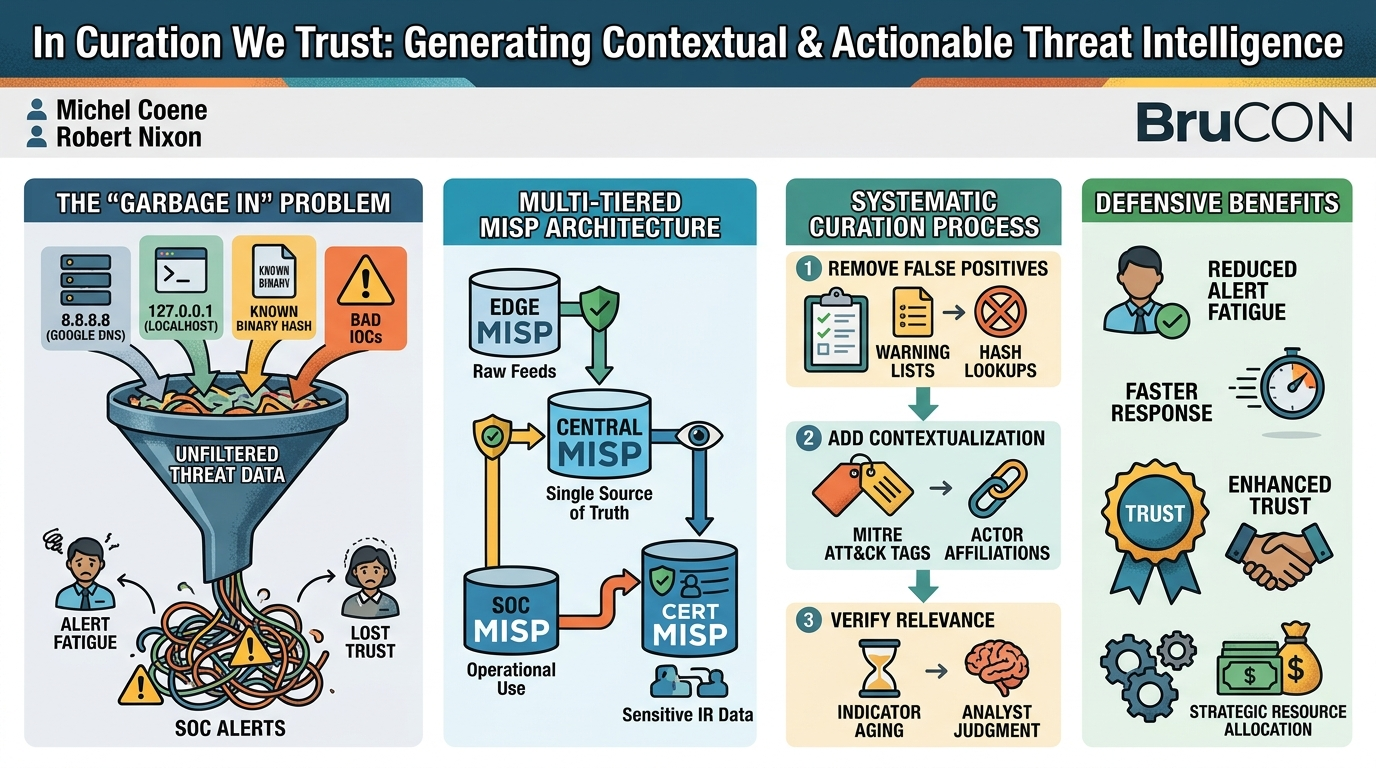
The proliferation of threat intelligence feeds, both open-source and commercial, has brought a wealth of data to security teams. However, this abundance often comes with a significant downside: a lack of quality control. As Coene and Nixon vividly illustrate, it's common to receive indicators of compromise (IOCs) such as 8.8.8.8 (Google DNS) or 127.0.0.1 (localhost) within threat intelligence feeds. These seemingly innocuous, yet highly problematic, entries generate "hundreds of incident tickets" and lead to a state the speakers humorously dub an "inflating balloon of garbage" – enriched, correlated, and sighted garbage that ultimately provides no real value.
The genesis of this problem lies in the varying quality of sources and the lack of standardized processes for intelligence production and sharing. Many organizations consume threat intelligence without adequate filtering, leading to a cascade of issues downstream. When bad intelligence enters a system, it contaminates subsequent enrichment and correlation efforts, triggering false positives that distract security analysts from genuine threats. This erosion of trust in threat intelligence feeds can render an entire program ineffective, as analysts become desensitized to alerts or spend excessive time triaging non-issues.
To counter this, NVISO established a systematic approach centered around MISP, a powerful, open-source threat intelligence platform. MISP, originally created in Belgium and now maintained by CIRCL, serves as a central repository for storing and sharing indicators, malware information, and financial fraud data. Its capabilities for event management, attribute correlation, and flexible tagging make it an ideal foundation for a robust curation process. NVISO's internal structure, comprising MDR (Managed Detection and Response), CERT (Computer Emergency Response Team), and their dedicated Threat Intelligence team, further complicated the intelligence flow, as each team acts as both a producer and consumer of intelligence, with distinct requirements and sensitivities. This complex interplay underscored the necessity of a stringent curation framework to ensure that all internal consumers receive high-quality, relevant, and actionable intelligence tailored to their operational needs.
Key Findings
▶ Watch: Practical curation: removing false positives, adding context (10:00)
The central finding of Coene and Nixon's work is the development and implementation of a comprehensive threat intelligence curation procedure designed to combat the "garbage in, garbage out" problem. This procedure is built upon three fundamental pillars:
- Removing False Positives: This is the foundational step, aimed at eliminating indicators that are either benign, internal, or otherwise irrelevant. NVISO leverages MISP warning lists, both community-maintained (e.g., RFC 1918 IPs, Cloudflare IPs, Alexa top 100,000) and custom-created lists. The custom lists are particularly important, as they capture false positives identified by their own SOC, ensuring that a "bad thing" that slipped through once "will never end up within our MISP infrastructure again." This proactive feedback loop, combined with analyst judgment, significantly reduces alert fatigue.
- Adding Contextualization: Raw IOCs often lack the necessary context for effective defensive action. The curation process emphasizes enriching events and attributes with critical information. This includes applying MITRE ATT&CK tags to pinpoint where an activity fits within the kill chain, identifying specific threat actors (e.g., ransomware groups, nation-state actors, hacktivists), and adding details about targeted countries or sectors, and malware types. Standardized TLP (Traffic Light Protocol) tagging (e.g., TLP:White, TLP:Clear) is also enforced to ensure consistent handling by automated systems. This contextualization transforms mere data points into actionable intelligence.
- Verifying Relevance and Actionability: Beyond just being clean and contextualized, intelligence must be relevant to current threats and practically actionable by defenders. This involves evaluating whether an event, such as one with "80,000 IP addresses," is truly useful for a firewall blocklist, or if an event describing a phishing email from 2019 is still pertinent. Analyst judgment plays a crucial role here, assessing the timeliness and practical utility of the intelligence. The goal is to ensure that the intelligence delivered to the SOC enables specific, appropriate defensive actions rather than overwhelming them with noise.
A significant architectural finding is the implementation of a MISP ecosystem comprising four instances: an Edge MISP (the "trash can" where all raw feeds enter), a Central MISP (the "single source of truth" for curated data), a dedicated CERT MISP (for sensitive incident response data), and a SOC MISP (for operational consumption). This tiered architecture allows for stringent quality control at the Edge, ensuring only cleaned and contextualized data propagates to the Central and operational MISPs, thereby protecting downstream consumers from low-quality intelligence.
Technical Deep Dive
▶ Watch: Statistics: events processed, blacklisted organizations (22:00)
NVISO's threat intelligence curation relies on a sophisticated, multi-layered technical architecture and a suite of automated processes built around MISP. The core of their system is the MISP ecosystem, consisting of four interconnected MISP instances:
- Edge MISP: This acts as the ingress point for all external threat intelligence feeds, including open-source and commercial sources. It's designed to be the "trash can" where raw, uncurated data first lands.
- Central MISP: This is the "single source of truth" for NVISO's curated threat intelligence. Only events that have passed the full curation process are published here.
- SOC MISP: This instance consumes curated intelligence from the Central MISP, providing clean, actionable IOCs directly to the MDR team for monitoring, alerting, and automated responses. The SOC also feeds back identified false positives, which are used to refine the custom warning lists.
- CERT MISP: A separate instance dedicated to the CERT team, allowing them to manage sensitive incident response data that cannot be shared with the broader organization or other clients.
The curation process begins at the Edge MISP, where automation plays a critical role. When an event enters the Edge MISP, a ZMQ pub/sub message system is triggered. Custom scripts subscribe to this ZMQ stream, performing several immediate actions:
- Unpublishing Events: Newly ingested events are automatically unpublished to prevent them from being synced to other MISP instances before curation.
- Initial Tagging: Events are marked with a
workflow incompletetag, signaling to analysts that manual curation is required. The source organization and original creator are also tagged for traceability. - Sanitization: Scripts ensure that tags are in a standard format to support subsequent automation. The speakers note that with TLP 2.0 (e.g., "white" to "clear," "amber" to "strict"), their scripts require updates to maintain consistency.
False Positive Removal is systematically addressed:
- MISP Warning Lists: NVISO utilizes both the community-maintained warning lists (e.g., RFC 1918 IPs, Alexa Top 100,000, Cisco Umbrella, Florian Roth's hash lists for known binaries) and their own custom warning lists. These custom lists are dynamically synced from the SOC MISP, ensuring that any false positive identified by the MDR team is immediately added to the list and prevents future alerts. An attribute matching a warning list is flagged within MISP, allowing analysts to easily filter and disable problematic IOCs.
- Hash Lookup Service (HLU): For unpublished events in the Edge MISP, a Cron job runs daily (around 3-4 AM) to extract all hashes. These hashes are then matched against CIRCL's Hash Lookup Interface (HLU), which includes the NSRL (National Software Reference Library) database and known malicious hashes. If a hash is found in the NSRL Legacy database, its
to_idsflag in MISP is automatically disabled, preventing it from triggering alerts if it were to be published. The attribute is also taggednsrlfor transparency, allowing manual re-evaluation if needed. - Organizational Blocklist: To address consistently poor intelligence sources, NVISO implemented a "tracker for bad organizations." If an organization provides "five bad events," their UUID is added to an organizational blocklist. Events from blocklisted organizations are no longer extractable via the MISP API, effectively cutting off their intelligence flow to the SOC. This blocklist is synced across all MISP instances. Over a year and a half, out of 607 unique organizations, only 16 (2.6%) were blocklisted, indicating generally good community quality but highlighting the need for such controls.
Contextualization and Relevance:
- Manual Enrichment: While automation handles initial tagging, analysts manually add crucial context such as MITRE ATT&CK techniques, threat actor affiliations, targeted countries or sectors, and malware types. This ensures that if an IOC fires, the SOC analyst has immediate, rich context to decide on the appropriate action.
- Indicator Aging: To maintain relevance, indicators are subject to strict aging policies based on their
last_seendate: 14 days for IPs, 30 days for domains, and 60 days for URLs. MISP also offers decaying models, an advanced feature allowing for dynamic aging based on tagging levels (e.g., a "phishing" event with a NATO Admiralty Code of "B" for trustworthiness could have a specific decay formula). - Web Scraper: To proactively gather intelligence from blogs and other web sources, NVISO utilizes a custom web scraper. Given an RSS feed or URL, it scrapes the page, converts HTML to Markdown, extracts IOCs (IPs, hashes, URLs, domains, registry keys) using regex, and automatically applies tags based on keyword matches (e.g., "T1076" for a MITRE ATT&CK technique). The original article is stored as an event report within the MISP event. This significantly reduces manual collection and initial tagging efforts, allowing analysts to focus on validation and publishing.
Data Management:
- Bulk Deletion: A custom script allows for the bulk deletion of events based on specific criteria (attribute, date range, organization). This is crucial for cleaning up databases, especially when commercial feed licenses expire and data needs to be removed from all connected MISP instances.
Demo / Proof of Concept
▶ Watch: New Misp Workflows feature demonstration for automation (30:00)
The speakers provided a live demonstration of MISP Workflows, a relatively new, beta-stage feature in MISP designed to bring SOAR-like automation capabilities directly into the platform. This feature allows organizations to define automated actions based on specific triggers and conditions, enhancing the curation process and enforcing operational playbooks.
The demo illustrated the creation of a simple workflow rule:
- Trigger: The workflow is configured to activate whenever an event is published.
- Condition: The workflow checks if the event does NOT have the
workflow completetag. This tag is part of theworkflowtaxonomy maintained by CIRCL and is used by NVISO to signify that an event has passed all necessary curation steps. - Actions (if condition met):
- Add the tag
workflow:to do:add tagging. This tag acts as a clear instruction for the analyst regarding what needs to be done. - Add the tag
workflow:rejected. This tag immediately signals that the publication attempt failed due to incomplete curation. - Stop execution of the workflow. This prevents the event from being published until the condition is met.
The demonstration then showed the workflow in action:
- Attempted Publication (Incomplete): An event was created with only a
TLP:Cleartag, intentionally missing theworkflow completetag. When the speaker attempted to publish it, MISP's workflow engine intervened. After a brief processing delay, the event was not published, and theworkflow:to do:add taggingandworkflow:rejectedtags were automatically added to the event. This visually confirmed that the workflow successfully blocked publication and provided immediate feedback to the analyst. - Successful Publication (Complete): The speaker then removed the
workflow:rejectedandworkflow:to dotags, and manually added theworkflow completetag. Upon attempting to publish the event again, the workflow was triggered, but this time, the condition (absence ofworkflow complete) was not met. As a result, the workflow was satisfied, and the event was successfully published to the MISP instance.
This demonstration effectively showcased how MISP Workflows can enforce curation standards and act as a built-in quality gate. The speakers highlighted that this is a simple example, and workflows can be significantly more complex, incorporating multiple triggers (e.g., enrichment triggers), conditions, and modules to perform various actions like sending notifications via webhooks to platforms like Slack or Microsoft Teams. This capability is poised to further automate and streamline the threat intelligence lifecycle within MISP.
Defensive Implications
▶ Watch: Future roadmap: Misp workflows, open sourcing scripts (38:30)
The detailed curation process and architectural decisions presented by NVISO offer several critical defensive implications for organizations aiming to enhance their threat intelligence capabilities:
- Reduced Alert Fatigue and Improved SOC Efficiency: By systematically removing false positives through custom warning lists and automated hash lookups, SOC analysts are less burdened by irrelevant alerts. This allows them to focus on genuine threats, reducing burnout and improving the overall efficiency of detection and response efforts.
- Context-Driven Incident Response: The emphasis on adding rich context (MITRE ATT&CK, threat actors, malware types) to IOCs empowers incident responders. Instead of merely knowing an IP is "bad," they understand why it's bad, who is behind it, and what stage of an attack it represents. This enables more precise, appropriate, and timely defensive actions, moving beyond generic playbooks.
- Enhanced Trust in Threat Intelligence: A consistent process for delivering high-quality, relevant intelligence rebuilds trust among consumers (SOC, IR teams). When analysts know the intelligence they receive is reliable, they are more likely to act upon it promptly and effectively, leading to a stronger overall security posture.
- Proactive Threat Hunting: Well-curated and contextualized intelligence is invaluable for threat hunting. Analysts can use MITRE ATT&CK tags or threat actor profiles to proactively search for specific TTPs or indicators within their environment, identifying threats that might otherwise go undetected.
- Strategic Resource Allocation: By identifying and blocking consistently poor intelligence sources (the 2.6% of blocklisted organizations), defenders can strategically allocate their threat intelligence budget and analyst time to more reliable and valuable feeds. This ensures a better return on investment for threat intelligence programs.
- Automated Quality Gates: Leveraging MISP's ZMQ scripts and, more recently, MISP Workflows, allows organizations to build automated quality gates into their intelligence pipeline. This ensures that curation standards are enforced before intelligence reaches operational systems, minimizing human error and maintaining data integrity.
- Scalable and Resilient Architecture: The tiered MISP ecosystem (Edge, Central, SOC, CERT) provides a robust and scalable architecture. It segregates raw data from curated intelligence, protects sensitive information, and allows for tailored intelligence delivery to different internal stakeholders, making the overall system more resilient to noisy inputs.
- Agile Adaptation to New Threats: The ability to rapidly ingest and curate intelligence from web scrapers and other sources, combined with flexible tagging and aging policies, allows organizations to quickly adapt their defenses to emerging threats and evolving attack campaigns.
- Continuous Improvement: The feedback loop from the SOC (through custom warning lists) and the roadmap for open-sourcing tools and contributing back to the community fosters a culture of continuous improvement in threat intelligence processes.
In essence, NVISO's approach transforms threat intelligence from a potential source of noise and confusion into a clear, actionable signal, directly contributing to more effective and efficient cybersecurity operations.
Key Takeaways
- Threat intelligence curation is paramount: The "garbage in, garbage out" principle dictates that raw, unfiltered threat intelligence is detrimental, leading to false positives, analyst fatigue, and a loss of trust. A systematic curation process is essential for generating truly actionable intelligence.
- A multi-tiered MISP architecture enhances control: Implementing an Edge MISP for raw data ingestion, a Central MISP as the single source of truth, and dedicated SOC/CERT MISPs allows for robust quality control, data segregation, and tailored intelligence delivery to different organizational consumers.
- Automation is key, but analyst judgment remains vital: While ZMQ scripts, hash lookups (e.g., NSRL), warning lists, and web scrapers automate much of the initial curation, human analysts are indispensable for adding nuanced context, verifying relevance, and making final decisions on actionability.
- Context makes intelligence actionable: Beyond merely identifying indicators, enriching them with MITRE ATT&CK tags, threat actor attribution, and other contextual details transforms data into actionable intelligence, enabling more informed and effective defensive responses.
- Proactive quality assurance prevents problems downstream: Implementing custom warning lists based on internal false positives and maintaining an organizational blocklist for consistently poor sources are crucial steps to prevent bad intelligence from ever reaching operational systems.
- MISP Workflows offer powerful built-in automation: The new MISP Workflows feature provides SOAR-like capabilities within the platform, allowing organizations to define automated quality gates, enforce curation policies, and streamline processes for publishing, tagging, and notifications.
- Documentation and communication are non-negotiable: Thorough documentation of the architecture, workflows, and curation procedures ensures continuity and scalability. Continuous communication with stakeholders is critical to understand their needs, gauge the value of delivered intelligence, and foster collaborative improvement.
About the Speaker(s)
Michel Coene is the Head of Incident Response and Threat Intelligence at NVISO. In addition to his leadership role at NVISO, Michel is also an instructor for SANS, specifically for the SEC599 course, which focuses on purple teaming. His expertise spans both the proactive and reactive aspects of cybersecurity, bringing a comprehensive understanding of how threat intelligence is produced, consumed, and applied in real-world incident response scenarios.
Robert Nixon serves as the Head of the Threat Intelligence Department at NVISO, working alongside Michel Coene. Robert's focus is on leading the strategic development and operational execution of threat intelligence initiatives, ensuring that NVISO's intelligence capabilities are robust, relevant, and directly support the company's defensive operations and client services. His practical experience in building and refining threat intelligence processes is central to the insights shared in their presentation.