Inside the Biggest Hacks and Facts of the Past Year
Dieter Van Den Bosch (Founder · Threat Exposure)
BruCON 0x0F · Day 1
Overview
In this insightful BruCON 2023 presentation, "Inside the Biggest Hacks and Facts of the Past Year," Dieter Van Den Bosch delivers a comprehensive retrospective on the most significant cybersecurity events and trends from the preceding twelve months. Driven by a personal desire to address the overwhelming volume of daily security news, Van Den Bosch curates a dynamic overview, making sense of the chaos for security professionals who often feel they are missing crucial developments. The talk serves as an essential recap, highlighting critical vulnerabilities, major breaches, evolving attacker tactics, and the responses of both defenders and law enforcement.
Key moments
- 0:00 Overview of the past year's security events
- 3:15 ProxyNotShell: Microsoft Exchange zero-day saga
- 11:40 Ragnar Locker leaks Belgian police investigation data
- 16:30 LastPass breach contradicts zero-knowledge claims
- 29:00 Cl0p's MoveIT Massacre: The year's biggest hack
- 38:00 Trickbot/Conti: The evolution of cybercrime organizations
- 40:30 Q&A: Resources to stay updated on vulnerabilities
Inside the Biggest Hacks and Facts of the Past Year
Speakers: Dieter Van Den Bosch
Conference: BruCON
YouTube: https://www.youtube.com/watch?v=_TfSLqH-odU
Overview
In this insightful BruCON 2023 presentation, "Inside the Biggest Hacks and Facts of the Past Year," Dieter Van Den Bosch delivers a comprehensive retrospective on the most significant cybersecurity events and trends from the preceding twelve months. Driven by a personal desire to address the overwhelming volume of daily security news, Van Den Bosch curates a dynamic overview, making sense of the chaos for security professionals who often feel they are missing crucial developments. The talk serves as an essential recap, highlighting critical vulnerabilities, major breaches, evolving attacker tactics, and the responses of both defenders and law enforcement.
Van Den Bosch, founder of the external attack surface management company Threat Exposure, leverages his specialized expertise in identifying and responding to zero-day vulnerabilities to provide a grounded, actionable perspective. His company's focus on rapidly emerging threats underscores the urgency and relevance of the incidents discussed. This presentation is more than just a historical account; it's a strategic analysis designed to arm attendees with a clearer understanding of the threat landscape, allowing them to prioritize risks and bolster their defenses against the most prevalent and impactful cyberattacks.
The talk is particularly important for anyone struggling to keep pace with the relentless onslaught of security incidents. It offers a structured way to absorb key lessons from high-profile events, ranging from state-sponsored espionage and sophisticated ransomware campaigns to critical infrastructure compromises and the ethical complexities of new cyber laws. By distilling a year's worth of headlines into a coherent narrative, Van Den Bosch provides invaluable context for understanding the current state of cybersecurity and anticipating future challenges.
Background
▶ Watch: Overview of the past year's security events (0:00)
The cybersecurity landscape is characterized by its relentless pace and ever-increasing complexity. Security professionals frequently express a feeling of being overwhelmed, struggling to stay abreast of the daily influx of new vulnerabilities, attack techniques, and high-profile breaches. This "fear of missing out" (FOMO) on critical intelligence can leave organizations exposed to known threats, as vital information is lost in the noise. Dieter Van Den Bosch articulates this challenge clearly, recalling his own desire for a consolidated security recap, a need he now fulfills with this presentation.
A significant portion of the past year's events built upon prior attack methodologies and unresolved issues. The talk opens by revisiting the persistent saga of Microsoft Exchange Server vulnerabilities. Preceding the discussed period, ProxyLogon (2021) and ProxyShell (August 2021) had already demonstrated the critical risk posed by unpatched or inadequately patched Exchange servers, leading to mass exploitation by state-sponsored APTs, notably Chinese groups. These prior events set the stage for the emergence of ProxyNotShell, a new variant that exploited the same underlying issues, highlighting a recurring pattern of incomplete fixes and subsequent bypasses that plague complex enterprise software.
Beyond Exchange, the broader context includes the professionalization of cybercrime, particularly ransomware groups like Cl0p, which operate with sophisticated business models and actively invest in acquiring zero-day exploits. The increasing involvement of state-sponsored advanced persistent threat (APT) groups from nations like China and Russia, targeting critical infrastructure and intellectual property, further complicates the defensive posture. These groups often leverage zero-day vulnerabilities in widely used network edge devices, demonstrating a clear strategic shift towards exploiting supply chain weaknesses. The constant evolution of these threats underscores the necessity for continuous learning, proactive threat intelligence, and robust incident response frameworks—precisely the gaps this comprehensive recap aims to fill.
Key Findings
▶ Watch: Ragnar Locker leaks Belgian police investigation data (11:40)
The past year witnessed a diverse array of cybersecurity events, revealing several critical trends and persistent challenges. A primary finding highlighted the ongoing struggle with Microsoft Exchange Server vulnerabilities, specifically the ProxyNotShell and OWA SSRF exploits. These incidents underscored Microsoft's difficulties in issuing complete and timely patches, leading to repeated bypasses of mitigations and significant real-world impact on organizations like Rackspace and the City of Antwerp. This pattern demonstrated that even widely publicized vulnerabilities can remain exploitable for extended periods.
Another significant trend was the overhype of certain critical bugs, exemplified by the OpenSSL v3 vulnerability. Initially feared to be a "Heartbleed-level" threat, it was later downgraded to high severity and deemed almost impossible to exploit, causing unnecessary panic and resource diversion. Conversely, the talk revealed the immense and growing threat posed by ransomware groups like Cl0p, which have perfected a "never change a winning formula" approach. They repeatedly exploited zero-day vulnerabilities in Managed File Transfer (MFT) solutions (Accellion, SolarWinds Serv-U, GoAnywhere, MOVEit), leading to massive data breaches affecting thousands of organizations and millions of individuals, generating tens of millions of dollars in illicit profits. This highlights a critical supply chain vulnerability that attackers are actively leveraging.
State-sponsored APT activity remained a dominant force, with numerous Chinese and Russian groups conducting sophisticated cyber espionage and destructive attacks. This included the exploitation of Citrix NetScaler/ADC and Fortinet devices, as well as the compromise of Microsoft signing keys by Chinese APTs, demonstrating a persistent focus on network edge devices and core identity infrastructure. The geographical targeting observed in some attacks (e.g., no web shells in US/Canada/Russia for Citrix exploits) suggests politically motivated selectivity.
Finally, the talk noted an important shift in law enforcement tactics, moving towards more offensive operations. This included the takedown of sophisticated malware like Snake (operated by Russia's FSB) and proactive measures such as the UK's National Crime Agency running fake "details for hire" sites to gather intelligence on the criminal underground. This signals an increasingly active role for governmental agencies in disrupting cybercrime and espionage, though the overall threat landscape continues to expand in complexity and scale.
Technical Deep Dive
▶ Watch: LastPass breach contradicts zero-knowledge claims (16:30)
The technical details of the past year's security incidents reveal sophisticated attack vectors and persistent vulnerabilities across critical infrastructure.
The saga of Microsoft Exchange Server vulnerabilities continued with ProxyNotShell, a zero-day exploit emerging in late 2022. This vulnerability, initially dubbed "ProxyNotShell" by Kevin Beaumont due to its resemblance to previous ProxyLogon/ProxyShell issues, leveraged an HTTP request pattern that bypassed earlier patches. Microsoft's initial mitigation involved blocking specific HTTP request patterns, but this was quickly bypassed by researchers within days. Subsequent bypasses followed, highlighting a fundamental flaw in the patching strategy. This ultimately led to the widespread exploitation of an OWA SSRF (Server-Side Request Forgery) vulnerability. This SSRF allowed attackers to bypass the mitigation, gain unauthorized access, and execute remote code, impacting major entities like Rackspace and the City of Antwerp, with the latter reportedly suffering €70 million in damages.
OpenSSL v3 garnered significant attention in late 2022 due to a critical vulnerability initially feared to be on par with Heartbleed. However, after extensive analysis, the bug was downgraded to a "high" severity, not "critical," and proved to be extremely difficult to exploit in real-world scenarios, primarily affecting specific memory configurations. This served as a cautionary tale against premature panic in the face of initial vulnerability disclosures.
Citrix NetScaler/ADC/Gateway devices became a prime target for state-sponsored groups. A zero-day in December 2022 was exploited by a Chinese state-sponsored hacking group. More recently, in July 2023, Fox-IT discovered web shells on approximately 2,000 Citrix systems worldwide, indicating widespread compromise. Notably, no web shells were found in Canada, the US, or Russia, suggesting a deliberate targeting strategy. The attackers leveraged these vulnerabilities to gain persistent access to corporate networks, often exploiting weaknesses in the ADC (Application Delivery Controller) and Gateway systems.
LastPass faced a significant breach, challenging its "zero-knowledge architecture" claims. While direct evidence of a breach allowing decryption of customer vaults was circumstantial, the theft of over $35 million in crypto from more than 150 confirmed victims, all of whom had used LastPass, strongly suggested a compromise that undermined its security guarantees. The attackers likely targeted master passwords or other authentication factors, bypassing the purported zero-knowledge design.
An Outlook zero-day emerged in March 2023, allowing attackers to remotely obtain victims' NTLM hash passwords simply by sending a specially crafted email. This was a targeted attack attributed to APT28 (Fancy Bear / Strontium / Unit 26165), a group associated with Russia's GRU military intelligence. While Microsoft issued a patch, it was bypassed by May 2023, necessitating a second patch. This highlights the dangers of client-side vulnerabilities and the sophistication of state-sponsored phishing attacks.
Barracuda Email Security Gateway (ESG) devices suffered a zero-day that remained undetected for at least seven months. Discovered in May 2023, the vulnerability allowed Chinese state-sponsored APT group UNC4841 to maintain persistent access. The attackers demonstrated exceptional persistence, deploying new malware to maintain control even after Barracuda released patches. This led to the unprecedented recommendation from Barracuda that all affected ESG appliances, even patched ones, be immediately replaced, turning thousands of expensive devices into "doorstops."
The Cl0p ransomware group executed the "massive MOVEit Massacre," a series of highly successful attacks leveraging zero-day vulnerabilities in Managed File Transfer (MFT) solutions. Following prior exploits in Accellion (December 2020), SolarWinds Serv-U (July 2021), and GoAnywhere (January 2023), Cl0p targeted MOVEit Transfer appliances in June 2023. The attacks exploited a remote code execution (RCE) vulnerability, allowing data exfiltration from thousands of organizations, including governments, financial institutions (Deutsche Bank, ING), and major corporations (Shell, EY, PWC, BBC, British Airways, American Airlines, Sony). This breach affected 56 million individuals, stealing highly sensitive data, including health diagnoses and social security numbers. Cl0p's preparation was extensive, with scanning observed as early as March 2023. Their operational scale was so vast that they resorted to using new leak sites and torrents to manage the sheer volume of stolen data, earning an estimated $75-100 million.
Fortinet experienced a challenging year, with five zero-day vulnerabilities disclosed since the previous BruCON, often impacting their SSL VPN servers. These were frequently exploited by Chinese state-sponsored APT groups, reinforcing the trend of targeting widely deployed network edge devices.
The compromise of Microsoft signing keys by Chinese cyber espionage group Storm-558 was a significant revelation. The group reportedly found the signing keys in a crash dump, allowing them to forge authentication tokens and access sensitive government emails. This incident underscored the critical importance of secure key management and the potential for deep system compromises by advanced adversaries.
Finally, the MobileIron zero-day exposed a fundamental security oversight: an admin API was accessible to anyone without authentication. This allowed unauthorized access to critical mobile device management functions, highlighting the ongoing prevalence of basic configuration errors even in security-conscious products.
Demo / Proof of Concept
▶ Watch: Trickbot/Conti: The evolution of cybercrime organizations (38:00)
This technical article is based on a conference talk that provides a recap of cybersecurity events, rather than demonstrating specific exploits or tools. Therefore, the talk itself did not feature a live demo or proof of concept in the traditional sense. Instead, Dieter Van Den Bosch meticulously described the mechanisms and impacts of numerous real-world exploits, providing detailed accounts of how vulnerabilities like ProxyNotShell, OWA SSRF, and the MOVEit RCE were leveraged by threat actors. The presentation functioned as a comprehensive overview of how these attacks unfolded in practice, drawing from public reports and the speaker's own expertise in tracking zero-day vulnerabilities.
Defensive Implications
▶ Watch: Q&A: Resources to stay updated on vulnerabilities (40:30)
The past year's cyberattacks offer crucial lessons for defenders, emphasizing the need for proactive, multi-layered security strategies:
- Aggressive Patch Management and Validation: The repeated bypasses of Microsoft Exchange patches (ProxyNotShell, OWA SSRF) highlight that simply applying a patch isn't enough. Defenders must validate that patches are fully effective and monitor for subsequent bypasses. Prioritize critical vulnerabilities, especially those in internet-facing systems and widely used platforms like Exchange, Citrix, and Fortinet.
- External Attack Surface Management (EASM): As demonstrated by the speaker's company, Threat Exposure, and the constant targeting of edge devices (Citrix, Fortinet, Barracuda ESG), understanding and continuously monitoring an organization's external attack surface is paramount. Rapid identification and remediation of newly disclosed zero-days are critical to prevent mass exploitation.
- Supply Chain Security: The "MOVEit Massacre" and other MFT compromises by Cl0p underscore the extreme risk posed by third-party software and service providers. Organizations must rigorously vet the security of their supply chain, enforce strong security requirements for vendors, and understand the data flows to and from these external entities. Assume that if your vendor has sensitive data, it's a potential target.
- Zero-Trust Architecture: The LastPass breach, despite its "zero-knowledge" claims, serves as a reminder that no single security control is foolproof. Implement zero-trust principles, verifying every access request regardless of origin. This includes strong, multi-factor authentication (MFA) everywhere, least privilege access, and continuous monitoring of user and device behavior.
- Enhanced Threat Intelligence and Monitoring: Stay informed about current threat actor tactics, techniques, and procedures (TTPs), especially those of state-sponsored APTs (Chinese groups targeting Citrix/Fortinet, Russian GRU/FSB) and prolific ransomware gangs (Cl0p). Monitor for indicators of compromise (IoCs) related to known campaigns. The ability to distinguish between overhyped threats (OpenSSL v3) and genuinely critical ones is also vital for efficient resource allocation.
- Incident Response Preparedness: The Barracuda ESG incident, where attackers deployed new malware to maintain persistence even after initial remediation, highlights the need for robust and adaptable incident response plans. Assume breach, prepare for advanced persistence, and practice incident scenarios to ensure rapid detection, containment, eradication, and recovery.
- Secure Coding and Configuration: The MobileIron zero-day (unauthenticated admin API) illustrates that fundamental security flaws still exist. Developers must adhere to secure coding practices, and administrators must ensure secure configurations, especially for administrative interfaces and network devices.
- Employee Awareness and Training: The Outlook zero-day (hash theft via email) and the physical USB bomb incident emphasize the ongoing need for comprehensive security awareness training. Employees are often the first line of defense against targeted social engineering and physical threats.
- Understand Legal and Ethical Boundaries: For organizations considering active defense measures or vulnerability research, understanding evolving laws, such as Belgium's new ethical hacking law, is crucial to avoid legal repercussions.
Key Takeaways
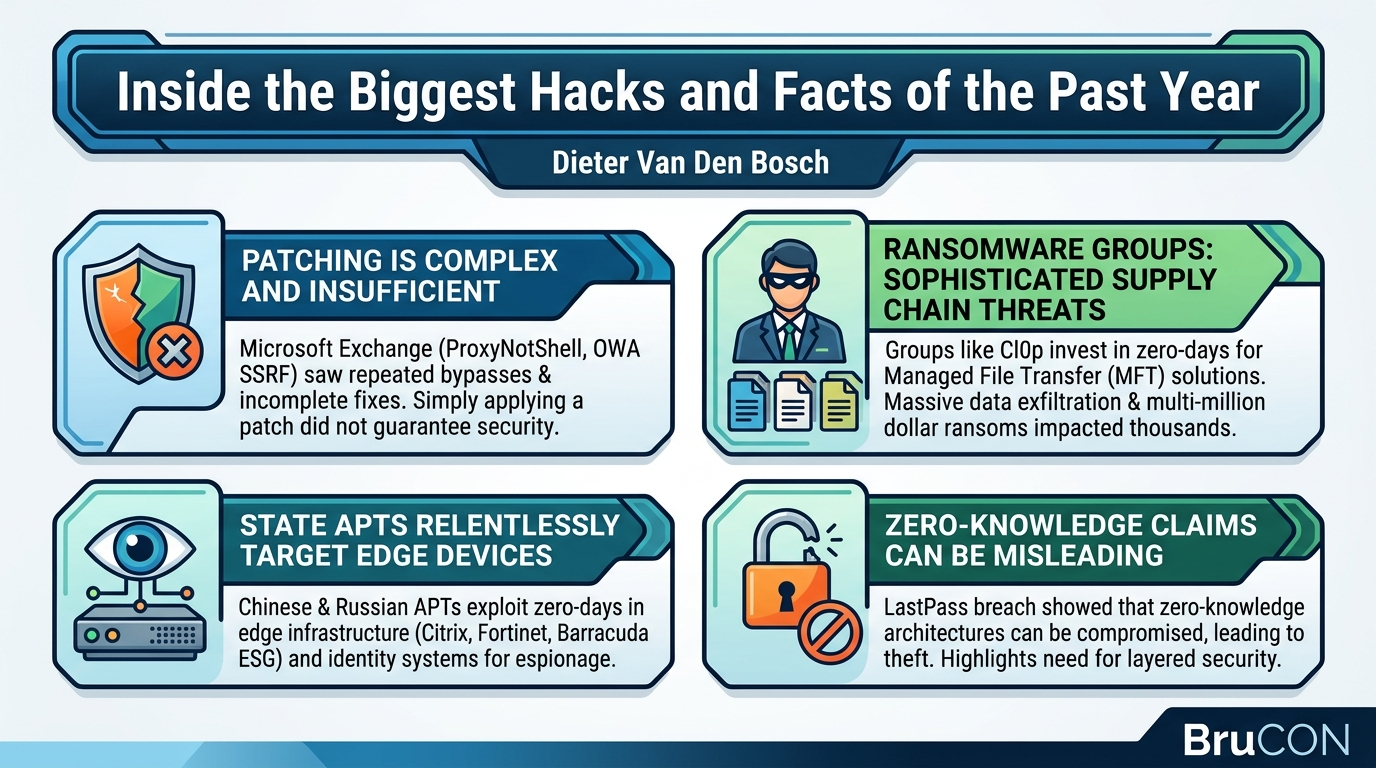
- Patching is Complex and Insufficient: Simply applying patches does not guarantee security, as seen with Microsoft Exchange's ProxyNotShell and OWA SSRF vulnerabilities, which experienced repeated bypasses and incomplete fixes, leading to significant breaches.
- Ransomware Groups are Sophisticated Supply Chain Threats: Groups like Cl0p operate like businesses, actively investing in zero-days to target widely used Managed File Transfer (MFT) solutions, resulting in massive data exfiltration and multi-million dollar ransoms, impacting thousands of organizations and millions of individuals.
- State-Sponsored APTs Relentlessly Target Edge Devices: Chinese and Russian APTs consistently exploit zero-day vulnerabilities in network edge infrastructure (Citrix, Fortinet, Barracuda ESG) and critical identity systems (Microsoft signing keys) for espionage and persistent access.
- Zero-Knowledge Claims Can Be Misleading: The LastPass breach demonstrated that even architectures claiming "zero-knowledge" can be compromised, leading to the theft of sensitive data and crypto assets, underscoring the need for layered security beyond architectural promises.
- Law Enforcement is Becoming More Offensive: Governments are increasingly engaging in active defense, including malware takedowns (Snake) and intelligence-gathering operations (UK's fake dark web sites), shifting towards a more proactive stance against cybercrime.
- External Attack Surface Management is Critical: Continuous monitoring and rapid response to emerging zero-days in internet-facing systems are essential to mitigate the risk of mass exploitation by advanced threat actors.
About the Speaker(s)
Dieter Van Den Bosch is a seasoned cybersecurity professional with a deep passion for all things "geeky." His journey in security began in 2019, working for a financial services company with 42,000 employees, where he was instrumental in establishing their Security Operations Center (SOC). He has held roles as a Threat Intelligence Analyst and Global Lead in External Attack Surface Management. Currently, Dieter is the founder of Threat Exposure, a company specializing in external attack surface management with a particular focus on identifying and responding to zero-day vulnerabilities. His expertise lies in rapidly assessing critical vulnerabilities as they emerge, often being on the phone with IT teams within 15 minutes of a zero-day disclosure to advise on immediate mitigation strategies. His commitment to keeping the security community informed stems from his own experience of the difficulty in tracking the fast-paced world of cybersecurity, a sentiment he first expressed in a BruCON feedback form over a decade ago.