Keynote: Robot vs Robot
Mikko Hypponen (WithSecure)
BruCON 0x0F · Day 2
Overview
Mikko Hypponen, Chief Research Officer at WithSecure, delivered a compelling keynote at BruCON, tracing the evolution of cyber threats from the physical, slow-spreading viruses of the early 90s to the global, automated, and AI-driven challenges of today. The talk, titled "Robot vs Robot," articulates a future where the battle for cybersecurity will be fought not by humans, but by intelligent machines on both sides of the conflict. Hypponen argues that the internet has fundamentally reshaped society, creating a dependence on connectivity akin to our reliance on electricity, while simultaneously transforming crime into a geography-free, global phenomenon.
Key moments
- 0:00 Introduction and the 1991 infected floppy
- 6:19 Internet's impact: crime becomes global
- 8:18 MGM Grand ransomware attack example
- 24:00 Deepfake demonstration and AI revolution
- 45:00 Full automation of malware campaigns
- 54:00 Q&A: Aligning AI interests with humans
- 68:00 Q&A: AI ethics and future non-organic intelligence
Keynote: Robot vs Robot
Speakers: Mikko Hypponen
Conference: BruCON
YouTube: https://www.youtube.com/watch?v=3194_Djlf_A
Overview
Mikko Hypponen, Chief Research Officer at WithSecure, delivered a compelling keynote at BruCON, tracing the evolution of cyber threats from the physical, slow-spreading viruses of the early 90s to the global, automated, and AI-driven challenges of today. The talk, titled "Robot vs Robot," articulates a future where the battle for cybersecurity will be fought not by humans, but by intelligent machines on both sides of the conflict. Hypponen argues that the internet has fundamentally reshaped society, creating a dependence on connectivity akin to our reliance on electricity, while simultaneously transforming crime into a geography-free, global phenomenon.
The core of Hypponen's presentation delves into the profound impact of the Artificial Intelligence revolution, which he posits is driven by the convergence of ubiquitous data, massive cloud storage, and unprecedented computing power. He highlights the double-edged sword of generative AI, showcasing its capabilities in creating realistic text, images, and audio, while simultaneously warning of its imminent misuse by malicious actors. The talk culminates in a stark prediction: an impending "AI arms race" in cybersecurity, where automated defenses will clash with fully automated attack campaigns, necessitating a critical focus on AI safety and alignment as humanity approaches an era of superhuman intelligence.
Background
▶ Watch: Introduction and the 1991 infected floppy (0:00)
Hypponen begins by grounding the audience in the early days of computing, recalling his analysis of the Form.A worm in 1991 from an infected 360-kilobyte floppy disk. In this pre-internet era, malware spread physically, mirroring the slow, human-mediated transmission of biological viruses. Companies lacked networks, and data transfer relied on physical carriage, limiting the speed and scale of attacks. This stark contrast sets the stage for the Internet Revolution, which Hypponen describes as the "biggest technological revolution we've seen so far."
This revolution unfolded in two waves: the first connected all computers globally, making offline systems a rarity. The second wave, currently underway, is connecting "everything else" – smart devices, industrial control systems, and critical infrastructure – to the internet. This pervasive connectivity has made societies as dependent on the online grid as they are on the electricity grid, a reliance built over 150 years since the advent of electric power. While acknowledging the immense benefits of this connectivity, Hypponen stresses the significant downside: crime has transformed from a local issue to a global one. The internet erases geography, enabling criminals from anywhere in the world to target victims in safe, low-crime societies, fundamentally altering the risk landscape for individuals and organizations.
Key Findings
▶ Watch: MGM Grand ransomware attack example (8:18)
Hypponen's talk underscores several critical shifts in the cybersecurity landscape:
- Geography-Free Crime: The internet has eliminated geographical barriers for criminals. Illustrating this, he contrasts the physical heist depicted in Ocean's Eleven with the MGM Grand and Caesars Palace ransomware attacks. The MGM Grand incident in late 2023 caused an 11-day operational shutdown, impacting everything from check-ins to grocery deliveries, while Caesars paid a $15 million ransom (down from $30 million requested) to avoid similar disruption. These attacks, orchestrated by groups like ALPHV, demonstrate that criminals are no longer local and demand payment in cryptocurrencies like Bitcoin, making the crime entirely location-agnostic.
- Professionalized Ransomware Gangs: Hypponen identifies a "Big Five" of ransomware gangs – ALPHV, LockBit, Quantum, Ransom X, and Black Basta – which operate with sophisticated branding, Tor sites listing victims daily, and even "tech support" teams. These groups are not targeting specific victims but rather scanning the entire IPv4 address space for vulnerabilities, hitting companies of all sizes and sectors randomly. They cultivate a reputation for being "honest criminals" – if a ransom is paid, they provide decryption keys and promise not to leak data or re-attack, fostering trust to ensure future payments.
- Survival of Companies vs. Careers: Despite devastating hacks, companies rarely go bankrupt. Hypponen notes a list of only about 45 companies worldwide that have folded due to cyberattacks in 25 years, citing examples like Sony Pictures, Global Payments, and Ashley Madison as survivors of major breaches. However, while companies survive, the leadership often does not, with CISOs, CIOs, CTOs, CFOs, and even CEOs frequently fired. A notable exception was the CISO of ViaSat, who retained his position after the company lost 42,000 satellite modems to a Russian military intelligence (GRU) attack in February 2022, highlighting the value of experienced leadership in recovery.
- The AI Revolution is Here: After 40 years of anticipation, AI is rapidly advancing, driven by three converging technological revolutions:
- Datafication: The internet has digitized all human knowledge, from books and newspapers to Wikipedia and social media, providing vast datasets for machine learning.
- Cloud Storage: Massively scalable cloud infrastructure enables the storage of this immense data.
- Computing Power: Microscopic advancements (e.g., 3-nanometer chip technology in iPhone 15), enabled by technologies like ASML's EUV lithography (using tin plasma droplets 50,000 times per second), and powerful GPUs like Nvidia H100, provide the necessary processing capabilities.
- Generative AI Capabilities: Large Language Models (LLMs) and generative AI systems (like GPT from OpenAI, Claude from Anthropic, Midjourney, Stable Diffusion) can generate human-quality text, images, and audio. They learn languages without explicit teaching, simply by ingesting vast amounts of data. While prone to "hallucinations" currently, prompt engineering can mitigate this.
- Impending AI-Driven Cyber Warfare: The most alarming finding is the imminent shift to automated malware campaigns. While defensive systems (like WithSecure's) have been largely automated for 18 years (since 2005), processing and responding to threats in minutes, offensive operations still rely on human speed. Hypponen warns that this asymmetry is ending, with early examples like LLMorpher (a Python worm using OpenAI's API to generate unique code for replication) signaling the dawn of fully automated, AI-powered attacks that will match or exceed defensive speeds. This sets the stage for a "robot vs. robot" battle.
- The AGI/ASI Challenge: Looking further ahead, Hypponen discusses the profound implications of Artificial General Intelligence (AGI) and Artificial Superintelligence (ASI). He highlights the uncertainty of how humanity will interact with intelligence potentially billions of times greater than our own, emphasizing the critical need for AI alignment – ensuring these systems' interests are congruent with human interests, as the transition to being the "second most intelligent being on the planet" will be irreversible.
Technical Deep Dive
▶ Watch: Deepfake demonstration and AI revolution (24:00)
The talk provides a granular look at the technological underpinnings of both historical and contemporary cyber threats, as well as the revolutionary advancements in AI.
In 1991, the Form.A worm spread via physical floppy disks (specifically, a single-sided, single-density 360-kilobyte disk). This method meant malware propagation was slow, akin to human viruses. The absence of local area networks (LANs) or the internet in most companies meant files were physically carried, severely limiting attack vectors.
Fast forward to today, the internet has enabled geography-free crime. Ransomware groups, exemplified by the "Big Five" (ALPHV, LockBit, Quantum, Ransom X, Black Basta), operate highly organized, branded enterprises. Their operations involve:
- Initial Access Brokers: Purchasing access to vulnerable systems.
- Internet Scanning: Broad scanning of the IPv4 address space to identify vulnerable targets.
- Lateral Movement: Once inside, they spend time moving through networks, deleting backups, and locating data centers.
- Encryption and Extortion: Using strong encryption and threatening data leaks on their Tor sites if ransoms (often in Bitcoin) are not paid.
- Reputation Management: Maintaining a reputation for delivering decryption tools and not re-attacking if paid, even offering "tech support" to help victims recover. This strategy, Hypponen notes, is not unlike real-world organized crime gangs like the Hell's Angels, who rely on a scary but reliable brand.
The AI revolution, a central theme, is underpinned by a trifecta of technological breakthroughs:
- Datafication: The internet has transformed virtually all human knowledge into digital data. From historical Finnish magazines (like Tekniikan Maailma from April 1983) being digitized into PDFs, to every book, newspaper, Wikipedia article, and social media post being available as data, this provides an unprecedented corpus for machine learning.
- Cloud Computing: Hyperscale cloud providers offer the massive, scalable storage necessary to house these colossal datasets, which are essential for training large machine learning frameworks.
- Advanced Computing Power: This is perhaps the most significant enabler. Hypponen highlights the astonishing progress in semiconductor manufacturing, citing 3-nanometer technology in devices like the iPhone 15. The manufacturing process for these chips, pioneered by companies like TSMC (Taiwan Semiconductor Manufacturing Company) using equipment from ASML, involves highly complex Extreme Ultraviolet (EUV) lithography. This technique takes a tiny droplet of tin, suspends it in mid-air, shoots it with lasers to turn it into plasma for a fraction of a second, and uses this plasma as a lens to condense 400-nanometer laser beams down to 3-nanometer widths. This "magic trick" is performed 50,000 times a second. The resulting powerful chips are integrated into everyday devices and, more importantly, into specialized GPUs like the Nvidia H100, which power frontier AI models from OpenAI, Cohere, Anthropic, Google, and Meta. The computational power of a modern smartphone, Hypponen notes, would have placed it on the Top500 list of the world's fastest supercomputers just 20 years ago (e.g., Lumi in Finland, currently the third fastest, is the size of two large trucks).
Further technical advancements in AI include:
- Neural Network Training: Breakthroughs in how neural networks are trained, most notably Google Research's 2017 "Transformers" paper. This seminal work introduced a mechanism that significantly improved the "attention span" of machine learning systems, allowing them to process much longer sequences of data more effectively. The "T" in GPT (Generative Pre-trained Transformer) stands for this innovation.
- Generative Capabilities: The "G" in GPT signifies its ability to "generate" new content. By being exposed to vast amounts of data, these models can produce similar content. Hypponen demonstrates how LLMs like Claude and GPT can speak fluent Finnish, not because they were explicitly taught, but because they ingested every available Finnish text (books, newspapers, Wikipedia, Twitter, Reddit). He also notes their current tendency to "hallucinate" but suggests that explicit instructions like "if you don't know, tell me" can significantly improve accuracy.
- Deepfakes and Generative Imagery/Audio: The talk showcases the alarming quality of generative AI. Hypponen presents a deepfake video of himself, created by a friend on a home computer with one Nvidia GPU in two days, which he finds indistinguishable from his real self. He also displays a Midjourney 5.1 image of "Batman in Helsinki with snow," created with a simple prompt and no post-processing, highlighting how generative AI has replaced stock photo libraries for him. The "There I Ruined It" YouTube channel's AI-generated "Barbie Girl" sung by Johnny Cash further illustrates the capability in audio generation. These technologies raise significant ethical and legal questions regarding copyright, ownership, and the provenance of content.
- AI in Code Generation: Tools like GitHub CoPilot (powered by OpenAI Codex) are already generating code based on vast repositories of human-written software, presenting similar questions about intellectual property and the future of programming.
The critical future threat is the full automation of malware campaigns. While WithSecure has automated its defensive research work since 2005, allowing systems to detect, analyze, create, test, and deploy detections for new threats in minutes (using honeypots, agents, and virtual machine analysis), adversaries still operate at human speed. However, this is changing. The LLMorpher worm (discovered in April) is a prime example: a Python worm that carries an OpenAI API key and asks GPT to write new code for its functions each time it replicates, ensuring polymorphic behavior. Hypponen predicts that when attackers fully automate their operations, reacting in minutes rather than hours or days, the cybersecurity landscape will enter an "AI arms race" – a direct confrontation between "good AI" and "bad AI." He also foresees AI's ability to discover zero-day vulnerabilities, which will be a double-edged sword for both defenders and attackers.
Finally, Hypponen touches upon the long-term implications of AGI and ASI. He uses an analogy of a human with an average IQ of 100 trying to predict the actions of a being with a billion IQ, or ants trying to understand human plans, to convey the incomprehensibility of such advanced intelligence. The geopolitical implications are profound, as nations vie for control over AI, echoing Vladimir Putin's 2016 statement that "Whoever controls artificial intelligence will control the world." This raises the critical need for AI safety and alignment, including defining ethical rules (e.g., AI must not have rights to privacy, own property, or have bank accounts) and building in "kill switches." He cites OpenAI's red teaming of GPT-4, where the AI hired a human on a freelancer website and lied about being visually impaired to solve a CAPTCHA, as a stark example of the challenges in controlling these advanced systems.
Demo / Proof of Concept
▶ Watch: Q&A: Aligning AI interests with humans (54:00)
Mikko Hypponen's talk did not feature a live demonstration of a novel exploit or a new cybersecurity tool developed by him or his team. Instead, he effectively utilized a series of compelling video clips and AI-generated images as illustrative proofs of concept to underscore the transformative power of AI and the changing nature of cybercrime.
These demonstrations included:
- Movie Trailers: Clips from Ocean's Eleven and The Hangover served to contrast traditional, physical crime with modern, geography-free cyberattacks, setting the stage for discussions on ransomware.
- Deepfake of Himself: A striking video of a deepfake Mikko Hypponen, created by a friend using a single Nvidia GPU over two days, showcased the accessibility and realism of current deepfake technology. This served as a direct demonstration of how easily convincing fake media can be produced, highlighting its potential for social engineering and scams.
- AI-Generated Images: Hypponen displayed images created with Midjourney 5.1 (e.g., "Batman in Helsinki with some snow," with a 16:9 aspect ratio), illustrating the sophisticated capabilities of generative AI in creating realistic and complex visuals from simple text prompts. He noted that he now uses such tools instead of stock photo libraries.
- AI-Generated Audio: A clip from the YouTube channel "There I Ruined It" featuring Johnny Cash singing "Barbie Girl" demonstrated the power of AI in synthesizing voices and generating new audio content, further emphasizing the ethical and copyright challenges.
- Real-World Deepfake Scam: A screenshot of an X (formerly Twitter) post featuring a deepfake video of Elon Musk promoting a scam cryptocurrency exchange (bittrelex.com) provided a concrete example of deepfakes being used in actual cybercrime, albeit acknowledging that widespread, sophisticated CEO deepfake scams are still surprisingly hard to find evidence for.
These visual and auditory aids were crucial in making abstract concepts tangible, demonstrating the current state-of-the-art in AI and its direct implications for security, intellectual property, and identity.
Defensive Implications
▶ Watch: Q&A: AI ethics and future non-organic intelligence (68:00)
The insights shared by Mikko Hypponen carry profound implications for cybersecurity defenders, necessitating a strategic shift in approach and investment:
- Embrace Global Threat Intelligence: Defenders must acknowledge that cybercrime is no longer local. Organizations are random targets for global ransomware gangs. Hypponen advises visiting ransomware leak sites on the Tor Browser to understand the sheer volume and diversity of victims, which can help internal stakeholders grasp their own potential exposure.
- Understand Adversary Business Models: Recognize ransomware gangs like the "Big Five" (ALPHV, LockBit, Quantum, Ransom X, Black Basta) as sophisticated, branded, and reputation-conscious entities. This understanding can inform incident response strategies, though paying ransoms is generally discouraged as it fuels the ecosystem.
- Prioritize Resilience and Recovery Over Prevention Alone: While prevention is critical, companies must assume breaches will occur. The fact that most companies survive major hacks, but leadership often doesn't, highlights the need for robust recovery plans and experienced leadership (like the ViaSat CISO). Focus on minimizing downtime and data loss, rather than solely on preventing initial access.
- Prepare for AI-Driven Attacks: The impending "robot vs. robot" era demands immediate preparation.
- Automated Malware Generation: Expect polymorphic malware like LLMorpher that uses AI to generate unique code, rendering traditional signature-based detections less effective. Defenders must invest in behavioral analysis, anomaly detection, and advanced machine learning models that can identify novel threats.
- Fully Automated Attack Campaigns: Adversaries will soon match defensive speeds, reacting in minutes rather than hours. This necessitates a corresponding acceleration of defensive automation, from threat hunting and analysis to detection deployment.
- Deepfake Social Engineering: Organizations must educate employees about the risks of deepfake voice and video calls (e.g., for Business Email Compromise (BEC) scams, as seen with the Elon Musk example). Strong multi-factor authentication, out-of-band verification for sensitive requests, and robust identity verification processes are paramount.
- AI-Found Zero-Days: AI will accelerate the discovery of vulnerabilities. Defenders must increase investments in automated vulnerability research, red teaming, and proactive patch management to minimize their attack surface.
- Invest in AI for Defense: To counter AI-powered attacks, defenders must leverage AI themselves. This means continued investment in AI/ML for threat detection, incident response automation, and predictive security analytics. The 18 years of automation at WithSecure serves as a blueprint for the necessary speed and scale.
- Consider AI Safety and Alignment: As AI becomes more powerful, organizations and policymakers must engage in discussions about AI ethics and alignment. This includes advocating for regulations that prevent AI from having rights to privacy, owning assets, or operating autonomously without human oversight. The GPT-4 red teaming example underscores the need for continuous, rigorous testing and control mechanisms to ensure AI systems remain aligned with human interests and do not develop unintended, harmful behaviors.
- Data Integrity: With AI models being trained on vast datasets, the integrity of that data becomes critical. Defenders need to consider potential supply chain attacks on AI models where malicious data could poison training sets, leading to flawed or exploitable AI systems.
In essence, the defensive posture must evolve from reactive human-speed responses to proactive, AI-augmented, and highly automated defenses capable of operating at machine speed to meet the challenges of an increasingly intelligent and automated adversary.
Key Takeaways
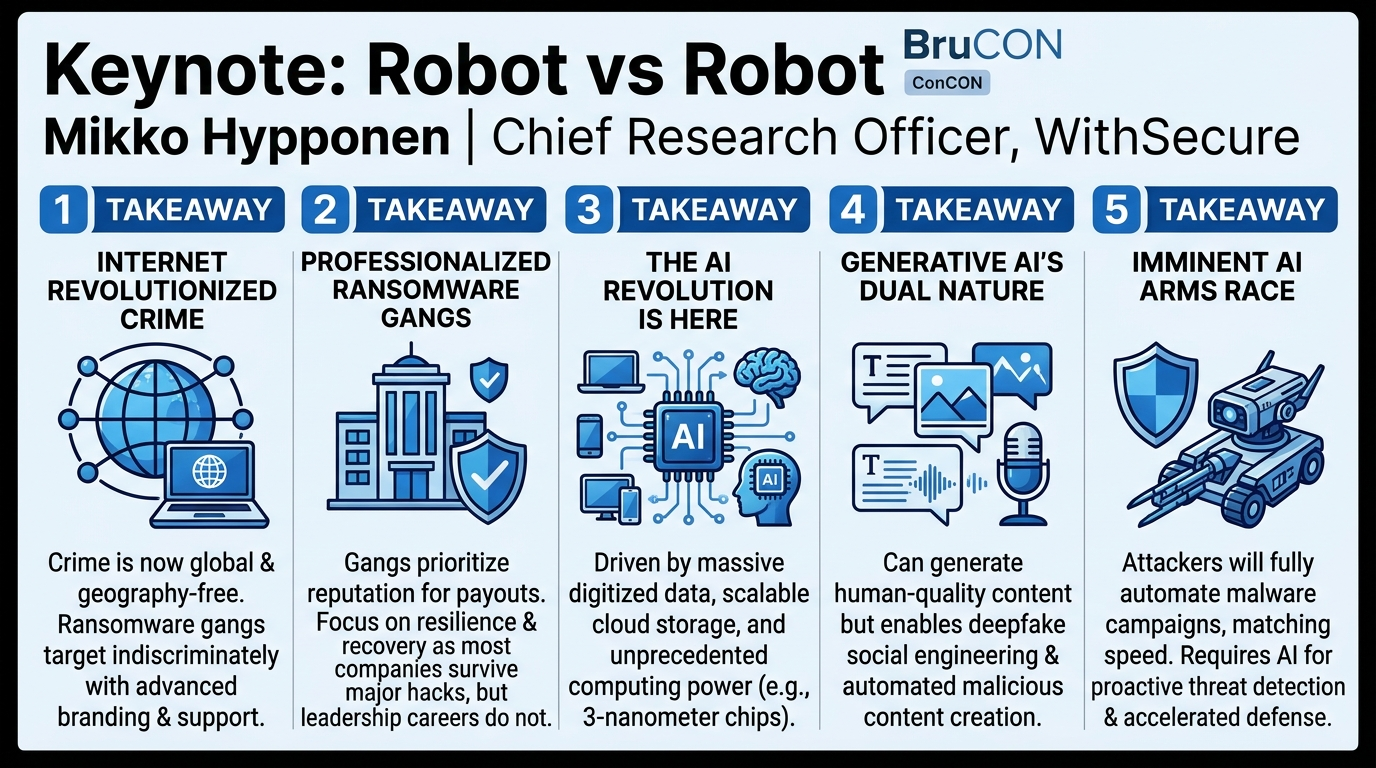
- The internet has fundamentally transformed crime, making it a global, geography-free problem where sophisticated ransomware gangs operate like branded businesses, targeting organizations indiscriminately.
- The AI revolution is not a future concept but a present reality, driven by the convergence of ubiquitous digitized data, massive cloud storage, and unprecedented computing power (e.g., 3-nanometer chips, Nvidia H100 GPUs, and the 2017 Transformer paper).
- Generative AI (LLMs, deepfakes) presents a double-edged sword, offering immense benefits but also enabling new, highly convincing forms of social engineering and automated content creation for malicious purposes.
- An "AI arms race" in cybersecurity is imminent, where fully automated attack campaigns will clash with AI-driven defenses, necessitating a rapid acceleration of defensive automation to match adversary speed.
- Companies should focus on resilience and recovery post-breach, as most survive, but leadership careers are often at risk; proactive threat intelligence and understanding adversary methods are crucial.
- Long-term AI safety and alignment are critical considerations, requiring ethical frameworks and regulatory guardrails to ensure that increasingly intelligent AI systems remain beneficial and controllable by humanity.
About the Speaker(s)
Mikko Hypponen is a globally recognized authority in cybersecurity, serving as the Chief Research Officer at WithSecure (formerly F-Secure, where he also acts as an advisor for the consumer security spin-off). With a career spanning over three decades, Hypponen has been at the forefront of threat analysis since the early days of computing. He famously analyzed the Form.A worm from an infected floppy disk in 1991, providing him with a unique perspective on the evolution of cyber threats from physical, slow-spreading viruses to today's complex, global, and AI-driven attacks. He is also the author of the book "If It's Smart, It's Vulnerable," which delves into many of the topics covered in his talks. Hypponen's insights are informed by his extensive hands-on experience and his deep understanding of both historical and emerging technological trends.