Critical Evaluation and Historical Context of the Vulkan Leaks
Joe Slowik (Huntress)
BruCON 0x0F · Day 2
Overview
In this insightful BruCON presentation, Joe Slowik, a seasoned CTI and OT consultant with Huntress and Paralis LLC, delves into the Vulkan Files (also known as Vulkan Leaks), a trove of documents offering an unprecedented look into Russian state-sponsored cyber operations. Slowik argues that these leaks, despite their profound implications, did not receive the widespread attention they deserved upon their release. He emphasizes their critical importance for understanding the evolution of cyber warfare, particularly in 2023, by revealing the detailed technical specifications, requirements, and contracting processes for tools used by high-end state actors.
Key moments
- 2:00 Introduction to the leaked Vulkan files
- 5:00 Scan-V: Automated exploitation for infrastructure acquisition
- 10:00 Amezit: Information operations and data interception platform
- 14:00 NTC Vulkan's role in outsourced Russian cyber development
- 35:30 US parallels: Snowden leaks and automated exploitation systems
- 45:30 Anticipating future offensive cyber: AI-driven automation
- 52:00 Defenders must automate to counter evolving adversary capabilities
- 64:00 Q&A: State vs. private defense and government intervention
Critical Evaluation and Historical Context of the Vulkan Leaks
Speakers: Joe Slowik (CTI and OT Consultant, Huntress)
Conference: BruCON
YouTube: https://www.youtube.com/watch?v=QrIW5dvJ32k
Overview
In this insightful BruCON presentation, Joe Slowik, a seasoned CTI and OT consultant with Huntress and Paralis LLC, delves into the Vulkan Files (also known as Vulkan Leaks), a trove of documents offering an unprecedented look into Russian state-sponsored cyber operations. Slowik argues that these leaks, despite their profound implications, did not receive the widespread attention they deserved upon their release. He emphasizes their critical importance for understanding the evolution of cyber warfare, particularly in 2023, by revealing the detailed technical specifications, requirements, and contracting processes for tools used by high-end state actors.
Slowik positions the Vulkan Files as a significant historical event in cyber operations, akin to the Snowden or Vault 7 leaks, due to the unredacted nature and depth of the disclosed information. The talk meticulously unpacks the contents of the leaks, exploring the programs developed by the Russian firm NTC Vulkan for various intelligence agencies, and critically evaluates their technical capabilities. Furthermore, Slowik draws parallels with similar operations conducted by other nation-states, including China and the United States, to contextualize the Russian advancements within the broader landscape of sophisticated cyber capabilities. The presentation serves as a wake-up call for defenders, urging them to adapt to an increasingly automated and scalable threat landscape.
Background
▶ Watch: Introduction to the leaked Vulkan files (2:00)
The Vulkan Files emerged approximately 18-24 months prior to the talk, leaked by an anonymous individual reportedly "distraught and dismayed" by the resumption of hostilities in Ukraine. This individual provided hundreds of pages of internal documents from NTC Vulkan to German journalists Hannes Munzinger and Hakan Tanriverdi, whose subsequent reporting in Der Spiegel, the Washington Post, Le Monde, and The Guardian brought the leaks to international attention. Security firms like Mandiant and Dragos also provided their analyses, underscoring the leaks' significance from a practitioner's perspective.
NTC Vulkan, founded in 2010 by former Russian military personnel, operated as a government contractor, undertaking classified and sensitive work for the Russian government. The leaked documents detailed three primary programs:
- Scan-V: A sophisticated platform for network scanning, enumeration, and exploitation. This program is the central focus of Slowik's analysis due to its advanced capabilities for infrastructure acquisition.
- Amezit: An information operations and data interception platform, designed for both collection and manipulation of communication streams.
- Crystal-2V: Described as an OT pen-testing and evaluation suite. Slowik notes that this program appeared less "sexy" and was primarily for testing, not direct use in victim networks, hence it received less attention in his presentation.
Slowik highlights the surprisingly muted public response to the Vulkan Files compared to other major leaks like Snowden's revelations or the Vault 7 disclosures. He attributes this potentially to various external factors or a failure to grasp the profound implications of the detailed technical and procurement information contained within, which offers a rare, unredacted glimpse into a state-sponsored adversary's operational framework.
Key Findings
▶ Watch: Amezit: Information operations and data interception platform (10:00)
The Vulkan Files reveal several critical insights into the structure and capabilities of Russian state-sponsored cyber operations. A standout finding is NTC Vulkan's unique position as a contractor working concurrently with multiple, often rivalrous, Russian intelligence agencies. The documents link Scan-V to the GRU's field post 74455 (known as Sandworm), Amezit to the FSB's Radio Research Institute, and even the MiniDuke payload (associated with the SVR's APT29) to Vulkan developers, as corroborated by Google's Threat Analysis Group (TAG). This cross-agency collaboration is unusual, suggesting NTC Vulkan is a highly trusted and capable entity within Russia's military and intelligence complex.
Slowik emphasizes that NTC Vulkan is part of a broader, well-established ecosystem of outsourced cyber development in Russia. He cites examples such as TsNIIKhM (linked to XENOTIME/Triton) and the contractor behind the FSB-associated Fronton botnet, demonstrating that Russian agencies, much like their Western counterparts, increasingly rely on specialized private and public-private organizations for tool development and, in some cases, even operations. This model allows for greater specialization and efficiency than purely in-house capabilities.
The core revelation regarding Scan-V is its design for automated acquisition and tasking of infrastructure at scale. It's not just about exploiting individual victims but creating vast networks of compromised third-party systems—referred to as Operational Relay Boxes (ORBs) in US/UK intelligence parlance—to serve as deniable command-and-control (C2) infrastructure for subsequent offensive actions. This capability provides operational security, scalability, and geographic diversity, allowing attackers to blend in with legitimate traffic and conduct widespread campaigns with reduced direct attribution.
Amezit, on the other hand, highlights Russia's ambition in mobile information operations. It's a platform designed for both intercepting and injecting into communication streams (SMS, MMS, social media like Twitter, LiveJournal, Facebook, VKontakte) by deploying physical hardware into mobile networks. This provides a mobile, active manipulation capability beyond static surveillance programs like Russia's domestic Sorm system, enabling potential population control in occupied or contested areas.
Ultimately, the Vulkan Files underscore a significant shift towards scalability and efficiency in state-sponsored cyber operations. The disclosed programs suggest a move away from reliance on individual "rockstar" hackers to automated, programmatic systems that can execute widespread exploitation and data collection. Slowik provocatively points out that these capabilities are not unique to Russia, drawing parallels with China's Great Cannon and the US/5-Eyes Quantum Insert and Turbine programs revealed in the Snowden leaks, indicating a dangerous proliferation of advanced offensive methodologies across major cyber powers.
Technical Deep Dive
▶ Watch: US parallels: Snowden leaks and automated exploitation systems (35:30)
The Scan-V program, as detailed in the Vulkan Files, presents a highly sophisticated and distributed architecture designed for mass exploitation and infrastructure acquisition. The system operates across multiple classification layers, including an internet-facing component, an internal network, an analysis environment, and a classified air-gapped environment. Data transfer to the air-gapped systems is explicitly described as occurring via USB and CD-ROM drives, highlighting the stringent security measures in place for sensitive intelligence.
Scan-V's operational flow is largely automated. It begins by compiling a comprehensive catalog of vulnerabilities, encompassing both publicly known flaws (including "plus-one days" like those affecting FortiGate, NetScaler, and Barracuda ESG products) and non-public, potentially zero-day vulnerabilities. This catalog is then leveraged in conjunction with various scanning sources, including publicly available services like Shodan, commercial vulnerability data, and private intelligence channels, to identify vulnerable nodes across the internet. Once identified, the system moves to exploitation, aiming to achieve remote code execution (RCE) and gain access to victim infrastructure.
The ultimate purpose of Scan-V is not merely to hack individual targets, but to build out a vast network of compromised systems, referred to as Operational Relay Boxes (ORBs). These ORBs serve as deniable intermediary nodes for follow-on offensive actions, such as C2 proxying, data exfiltration, or launching distributed denial-of-service (DDoS) attacks. The documentation explicitly links Scan-V to the GRU's field post 74455, commonly known as Sandworm, an actor notorious for its reliance on compromised third-party infrastructure in campaigns like the 2015/2016 Ukraine power grid attacks, XMail exploitation (2020), and Citrix ADC/NetScaler vulnerabilities (2021). Scan-V effectively automates and scales the infrastructure acquisition process that Sandworm has historically employed, making it significantly more efficient than manual operations.
The Amezit program focuses on information operations and communication interception. Its capabilities include the collection of various communication types, from SMS and MMS messages to interactions on popular social media platforms like Twitter, LiveJournal, Facebook, and VKontakte. Crucially, Amezit is also designed for injection into these communication streams, enabling adversaries to manipulate narratives, influence public opinion, or conduct "false flag" operations by inserting payloads into Twitter threads or altering blog posts. This is achieved by deploying physical hardware into mobile network infrastructure at adversary-controlled access points, allowing for inline decryption and injection of data. Slowik notes its potential for both foreign and domestic targeting, citing its utility in pacification operations in regions like the Caucasus or for population control in occupied areas, such as parts of Ukraine, by rerouting and manipulating local communications. Amezit builds upon the concepts of Russia's domestic Sorm surveillance program (active since 2012), but adds mobility and active manipulation capabilities to passive collection.
Slowik highlights that these Russian capabilities are not isolated. He draws direct comparisons to China's Great Cannon, disclosed in 2015, which leverages the deep packet inspection infrastructure of the Great Firewall to inject malicious JavaScript into traffic streams, building a network of exploited nodes from passive collection. Even more striking are the parallels with US/5-Eyes capabilities revealed in the Snowden leaks from the early 2010s. Programs like Quantum Insert (analyzed by Fox-IT) operated as midpoint exploitation systems, identifying specific traffic flows and injecting exploit payloads to win race conditions against legitimate communications. These exploited nodes were then managed by an automated system called Turbine. The striking similarities across these state-level programs suggest a convergence in advanced CNO methodologies, potentially driven by independent discovery or, as Slowik suggests, a proliferation of tradecraft inspired by public disclosures like the Snowden leaks.
Demo / Proof of Concept
▶ Watch: Anticipating future offensive cyber: AI-driven automation (45:30)
While the Vulkan Files did detail a program named Crystal-2V, described as a pen-testing suite for OT systems, the speaker noted that this particular program was primarily designed for "testing and evaluation" purposes rather than active deployment in victim networks. Furthermore, the speaker explicitly stated that there was limited detailed information available on Crystal-2V within the leaked documents he reviewed, and as such, it was not a focus of the presentation due to time constraints and its comparative lack of "sexiness" next to Scan-V and Amezit. Therefore, no live demonstration or detailed proof of concept of any of the leaked tools was presented during the talk, nor were any such demonstrations described within the leaked documents themselves.
Defensive Implications
▶ Watch: Q&A: State vs. private defense and government intervention (64:00)
The insights from the Vulkan Files and the broader context of state-sponsored cyber operations present profound challenges for defenders. Joe Slowik asserts that adversaries are in a state of constant evolution, rendering a static threat landscape a dangerous misconception. Consequently, legacy defensive techniques and tradecraft are increasingly failing. Reliance on traditional methods like deny-listing specific IP addresses, domains, or file hashes, or even basic syn-holing, becomes ineffective when adversaries compromise legitimate, "blameless" third-party infrastructure at scale. These Operational Relay Boxes (ORBs), often consisting of home routers, small office/home office (SOHO) networking devices, or even switches in a dentist's office, have no inherent intelligence value but become crucial means to an end for adversaries to masquerade their activities.
Slowik advocates for a fundamental shift towards behavioral analysis and identifying anomalies in traffic. Instead of focusing on individual indicators of compromise (IOCs), defenders must profile network infrastructure and connections to detect deviations from expected behavior. An example provided is identifying an authentication attempt from a server hosted in a VPS environment when such activity should logically originate from an internal or trusted external source, irrespective of the specific IP address. This requires enriching individual observations with broader context, such as ASN information and server type, to build a more robust understanding of legitimate versus anomalous activity.
To effectively counter the escalating scale and automation of offensive cyber operations, defenders must embrace defensive applications of machine learning and artificial intelligence. Slowik stresses that this is not merely a buzzword but a necessity. The traditional approach of "throwing bodies" (i.e., hiring more SOC or IR analysts) at the problem is unsustainable. Instead, organizations must scale their defensive capabilities through automation to match the efficiency and prolific nature of adversaries. Failure to do so will inevitably lead to defenders being overwhelmed.
For red teams, the implications are equally significant. The talk highlights that state-level adversary operations are moving beyond human-driven, one-hacker-one-op scenarios. To accurately emulate these sophisticated threats, red teams must evolve beyond conventional methodologies like phishing, deploying Cobalt Strike beacons, and lateral movement with PSExec and Mimikatz. Instead, they need to design engagements that reflect the distributed, automated, and deniable infrastructure acquisition, exploitation, and tasking capabilities observed in programs like Scan-V. This evolution will not only enhance the realism of security assessments but also provide a critical "demand signal" to defenders, pushing them to develop and deploy more advanced detection and response capabilities.
Ultimately, Slowik concludes that while the challenges are immense, they are not insurmountable. Defenders must co-evolve with adversaries, leveraging advanced analytics and automation to detect and mitigate intrusions. This requires ongoing investment in sophisticated tools and a strategic shift in defensive philosophy, recognizing that there is no "magic bullet" and that continuous adaptation is the only path to resilience in an ever-changing threat landscape.
Key Takeaways
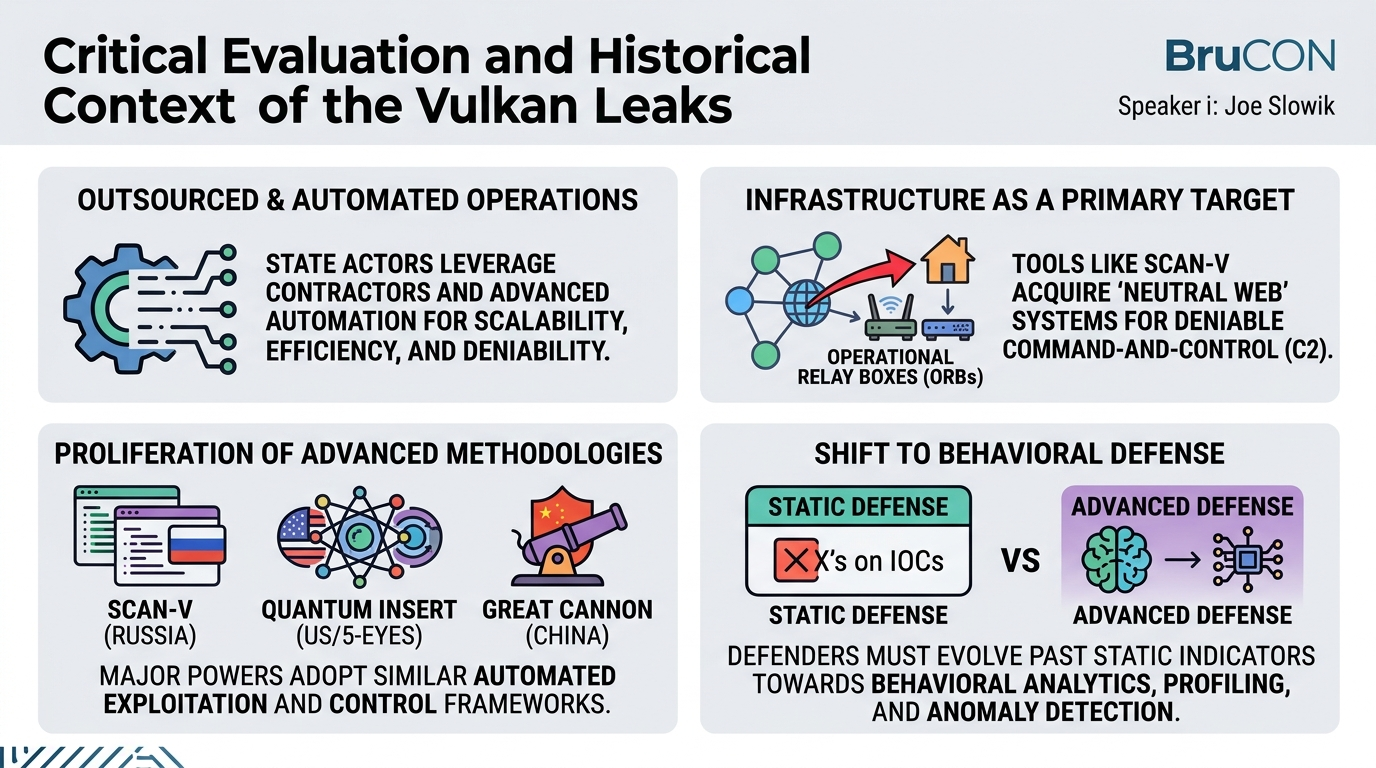
- Outsourced and Automated Operations: State-sponsored cyber operations are increasingly leveraging private contractors and advanced automation to achieve scalability, efficiency, and deniability, moving beyond monolithic in-house development.
- Infrastructure as a Primary Target: Tools like Scan-V prioritize the mass acquisition of "neutral web" infrastructure (Operational Relay Boxes) from non-strategic victims, using them as deniable C2 nodes for subsequent, more targeted operations.
- Proliferation of Advanced Methodologies: Similar automated exploitation and control frameworks (e.g., Quantum Insert, Great Cannon, Scan-V) have been independently developed or adopted by major cyber powers, suggesting a shared evolution or proliferation of sophisticated CNO tradecraft.
- Shift to Behavioral Defense: Defenders must move away from static indicator-based defenses, which are easily circumvented, towards advanced behavioral analytics, profiling, and anomaly detection to counter dynamic and deniable adversary operations.
- Automation for Defense: To keep pace with adversaries, defenders must aggressively adopt machine learning and artificial intelligence to automate detection, analysis, and response workflows, scaling security operations beyond human capacity.
- Evolving Red Team Engagements: Red teams need to enhance their emulation capabilities to accurately simulate highly automated, distributed, and deniable adversary methodologies, providing more realistic assessments and driving demand for advanced defensive solutions.
About the Speaker(s)
Joe Slowik is a prominent figure in the cybersecurity community, specializing in Cyber Threat Intelligence (CTI) and Operational Technology (OT) consulting. He currently represents himself and his company, Paralis LLC, while also working for Huntress, a managed detection and response (MDR) provider. Slowik's extensive background includes roles in threat intelligence research at Dragos and DomainTools, detection engineering team leadership at Gigamon, and a foundational start in security with the US Navy. Notably, he also led the security team at Los Alamos National Laboratory for several years, bringing a wealth of experience from both government and private sectors to his analysis of complex cyber threats.
Reviews
- Heather Calloway (CISO) — MUST SEE ★★★★★