Improving Cyber Resilience
Christian Schneider (Freelance Security Architect), Kevin Ott (Senior Red Team Engineer · Exploit Labs)
BruCON 0x0F · Day 2
Overview
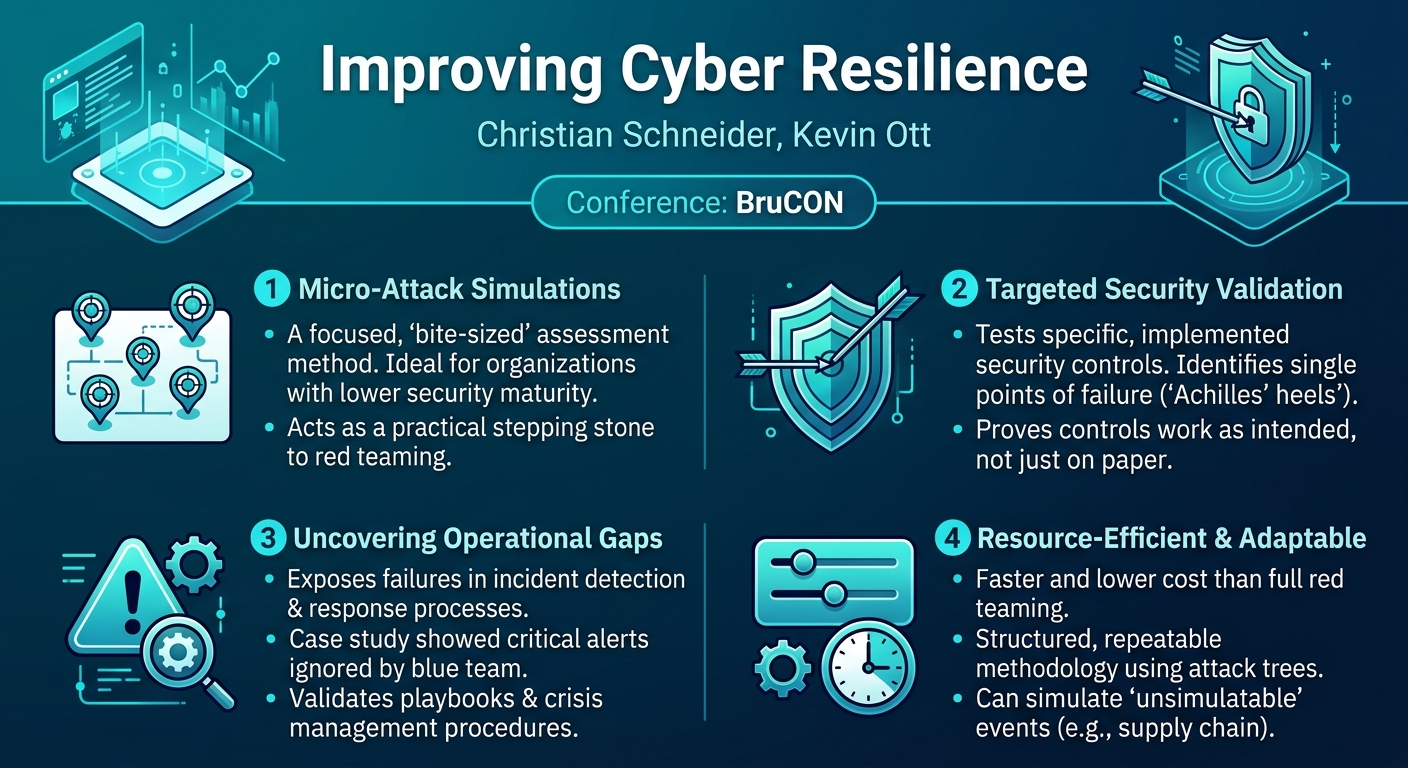
In their BruCON 2023 talk, "Micro Attack Simulations to Improve Cyber Resilience," Christian Schneider and Kevin Ott introduce a novel approach to cybersecurity assessment designed to bridge the gap for organizations with lower cyber security maturity or limited resources. They propose micro-attack simulations as a focused, bite-sized alternative to traditional, full-scale red team operations, offering a practical stepping stone towards more comprehensive security validation. The core idea is to move beyond broad vulnerability scanning and even typical penetration testing to specifically test the effectiveness of implemented security controls and incident response procedures.
Key moments
- 0:00 Introduction: Why Micro-Attack Simulations?
- 3:20 Defining Micro-Attack Simulations: Bite-sized Assessments
- 7:00 Attack Tree Modeling to Identify Controls
- 15:30 Example: Active Directory Misconfiguration Testing
- 24:00 Case Study: Financial Org Ransomware Simulation Setup
- 34:30 Case Study: Re-enabling Domain Admin Account, IR Failure
- 38:00 Micro-Attack vs. Traditional Red Teaming Comparison
- 47:00 Q&A: Planning Time and Low Maturity Organizations
Improving Cyber Resilience
Speakers: Christian Schneider (Freelance Security Architect); Kevin Ott (Senior Red Team Engineer, Exploit Labs)
Conference: BruCON
YouTube: https://www.youtube.com/watch?v=1oJ9ZZf5mO4
Overview
In their BruCON 2023 talk, "Micro Attack Simulations to Improve Cyber Resilience," Christian Schneider and Kevin Ott introduce a novel approach to cybersecurity assessment designed to bridge the gap for organizations with lower cyber security maturity or limited resources. They propose micro-attack simulations as a focused, bite-sized alternative to traditional, full-scale red team operations, offering a practical stepping stone towards more comprehensive security validation. The core idea is to move beyond broad vulnerability scanning and even typical penetration testing to specifically test the effectiveness of implemented security controls and incident response procedures.
The speakers highlight that many organizations, particularly those in earlier stages of cyber security maturity, struggle with resource constraints, skill gaps, and a lack of well-defined processes. For these entities, traditional red teaming can be prohibitively expensive, time-consuming, and often reveals only low-hanging fruit without adequately testing existing, but potentially fragile, defenses. Micro-attack simulations aim to provide quick, actionable insights by targeting specific "Achilles' heels" within an organization's security posture, thereby improving overall cyber resilience more efficiently.
This methodology emphasizes a scenario-driven approach, leveraging attack trees to model potential threats and identify critical controls. By simulating focused attacks against these controls, organizations can validate their efficacy, identify gaps in technical defenses, and crucially, test non-technical aspects like incident response playbooks and crisis management procedures. The talk culminates in a compelling case study that vividly demonstrates the power of this approach in uncovering significant operational deficiencies in a large financial institution.
Background
▶ Watch: Introduction: Why Micro-Attack Simulations? (0:00)
The landscape of cybersecurity threats is constantly evolving, yet many organizations find themselves struggling to keep pace, particularly in their early stages of cyber resilience maturity. Traditional security assessments, such as vulnerability scans and penetration tests, often fall short for these entities. As Christian Schneider explains, this is primarily due to several factors: resource constraints (limited staff or budget), a low maturity level (lacking sophisticated security controls), undefined processes (especially for incident response), and a skill gap in internal teams. Full-scale red team operations, while highly effective for mature organizations, are typically out of reach or overkill for those just beginning to build robust defenses. They are costly, time-consuming, and might only expose readily exploitable vulnerabilities that an early-stage organization might already be aware of or simply hasn't had the capacity to address.
Kevin Ott references an IBM study, based on Ponemon Institute research, which indicates a near 50/50 split between organizations rating themselves at middle or lower stages of cyber security maturity versus higher stages. This suggests a significant portion of the market needs tailored solutions. The "classic quote" recognized by some in the audience points to companies that "don't really need a full-blown red team but still want to test the procedures and reactions to certain types of attacks that goes beyond traditional penetration testing." This void is precisely where micro-attack simulations come into play.
Micro-attack simulations are presented as "red team unit tests" – miniaturized, focused exercises targeting single or multiple specific security controls rather than the entire organizational attack surface. Their purpose is to quickly validate these controls and identify gaps, not only in technical domains (e.g., firewalls, IDS/IPS) but also in non-technical areas such as policies, incident response playbooks, and escalation procedures. This approach offers a feasible and actionable "bite-sized assessment," serving as a practical stepping stone for organizations to enhance their cyber resilience without the overhead of a full red team engagement.
Key Findings
▶ Watch: Attack Tree Modeling to Identify Controls (7:00)
The central finding of this talk is the efficacy and necessity of micro-attack simulations as a targeted and resource-efficient method for improving cyber resilience, especially for organizations with lower security maturity. The speakers demonstrate that by focusing on specific, implemented controls and their potential "Achilles' heels," significant gaps can be identified that might be overlooked by broader assessments or remain untested by traditional red teaming.
A critical finding from the detailed case study was the profound lack of detection, investigation, and containment capabilities within a large financial organization, even when faced with multiple critical alerts and clear indicators of an active ransomware attack. Despite the red team intentionally triggering numerous high-severity alerts, including a Cobalt Strike beacon detection, extensive Active Directory enumeration, and a successful privilege escalation, the blue team and incident response processes largely failed to react in a timely or effective manner. This highlighted a severe disconnect between theoretical procedures and practical execution, revealing that "processes and procedures related to incident response and incident management are working as intended and not just on paper." The white team's invaluable perspective, viewing the exercise as an "opportunity to learn and improve," underscored the intrinsic value of such simulations in providing tangible evidence for management to prioritize security investments.
Furthermore, the comparison between micro-attack simulations and traditional red teaming revealed distinct advantages for the former in specific contexts: significantly shorter duration (hours/days vs. weeks/months), lower cost and resource requirements, higher adaptability to different threat actors and scenarios, and the ability to simulate "unsimulatable" events like supply chain attacks or code backdooring. While traditional red teaming validates the overall security posture, micro-attack simulations provide detailed, focused feedback on specific controls, allowing for a more rapid and targeted improvement cycle. The ability to "close the feedback loop" by updating the attack tree with failed controls and recalculating risk provides a continuous, evolving view of an organization's security posture.
Technical Deep Dive
▶ Watch: Case Study: Financial Org Ransomware Simulation Setup (24:00)
The methodology for implementing micro-attack simulations is structured and systematic, designed to provide focused and actionable insights. It comprises several key steps:
- Attack Tree Modeling: The process begins with creating an attack tree model to gain a holistic view of potential threats. This is a scenario-driven modeling approach that allows for defining various threat actor personas (e.g., common criminals, nation-state actors, insider threats) and their potential attack goals. The attack goals are essentially what attackers want to achieve, and their potential impact helps prioritize which controls to focus on. The tree uses AND/OR logic to connect attack steps, from initial entry vectors (leaves) to the ultimate attack goal (root). Likelihood of occurrence is assigned by considering the frequency of the threat actor and the complexity of the attack, which then bubbles up the tree to calculate path likelihoods.
- Creating Micro-Attack Simulations: Unlike traditional red teaming that seeks to find missing controls, micro-attack simulations target implemented security controls that are identified as single points of failure or "Achilles' heels" within the attack tree. If these critical controls fail, the likelihood of a high-impact event significantly increases. The goal is to prove that these controls are not truly effective as intended.
- Staging Test Cases: Micro-attack simulations are typically staged. This means specific test setups are used, often within production environments but carefully scoped to the control being tested. The approach does not necessarily require penetrating from the outside, allowing for a more focused and targeted assessment. It can incorporate red team undercover techniques for testing detective controls.
- Execution: The simulations are executed in an ordered fashion to test specific outcomes: preventing access, stopping an attack, or triggering incident detection/response processes. For detective controls, silent or covert techniques are employed.
- Identifying Controls and Instruction Sets: Security controls are applied to nodes in the attack tree, with more generic controls closer to the root (attack goal) and more specific ones towards the leaves (initial vectors). Each control has an associated effect (high, medium, low) on reducing risk. To ensure repeatability and consistency, instruction sets (or "cooking recipes") are created for each micro-attack simulation, detailing the steps for a red team engineer to execute the test.
- Finding Achilles' Heels: The model identifies which controls are marked as "implemented" by the organization. Then, using simulation techniques (like Monte Carlo simulations), it calculates combinations of implemented controls that, if broken, would lead to the highest impact from an attacker's perspective. These "Achilles' heels" are the prime candidates for micro-attack simulations.
Examples of Micro-Attack Simulations:
The speakers provided concrete examples:
- Abuse of Active Directory Misconfigurations:
- Objective: Assess vulnerabilities or misconfigurations leading to AD compromise, test Privileged Access Management (PAM) solutions.
- Controls Tested: AD security settings, best practices analyzers, tools like PingCastle, PAM solutions.
- Simulation: Exploiting vulnerabilities like ESC1 (from SpecterOps' ADCS abuses paper) to forge certificates and escalate privileges (e.g., to Domain Admin), then testing if adding a user to an admin group or bypassing PAM is detected.
- Covert Communication Channels:
- Objective: Test an organization's ability to detect malware operating over covert channels (e.g., WebSockets, DNS C2).
- Controls Tested: Network Intrusion Detection Systems (NIDS), Application Layer Firewalls, DNS monitoring tools, Endpoint Protection Platforms (EPP), Endpoint Detection and Response (EDR), antivirus.
- Simulation: Running a custom or off-the-shelf C2 (e.g., customized Cobalt Strike) using these covert channels and observing if NIDS detects beaconing or if EPP/AV detects the implant.
- Custom Built Ransomware:
- Objective: Test detection and containment of custom ransomware spreading laterally.
- Controls Tested: EPP/EDR, heuristic analysis tools (detecting file changes, entropy changes).
- Simulation: Running a custom ransomware (e.g., encrypting user files, preserving file headers to potentially trick entropy-based detection, using a specific encryption algorithm like Salsa20 and file extensions like LockBit) in timed intervals to simulate lateral movement without business interruption.
- Crisis Management:
- Objective: Validate incident response and incident management processes beyond paper.
- Controls Tested: Crisis management procedures, incident detection, alerting mechanisms.
- Simulation: Tying into the ransomware simulation, dropping ransom notes, sending ransom emails (e.g., via ProtonMail, demanding a specific Bitcoin amount), including proof of breach and Indicators of Compromise (IOCs) to actively trigger incident response and crisis management.
This comprehensive technical framework allows organizations to systematically identify, test, and improve their cyber resilience in a highly focused and repeatable manner.
Demo / Proof of Concept
▶ Watch: Case Study: Re-enabling Domain Admin Account, IR Failure (34:30)
The speakers presented a compelling case study of a micro-attack simulation conducted for a large financial organization with multiple international entities, specifically targeting their German entity. This real-world exercise vividly demonstrated the methodology's effectiveness in uncovering significant security posture weaknesses.
Parties Involved:
- White Team: Primarily crisis management personnel, responsible for initiating and overseeing the exercise.
- Blue Team: Comprising SOC analysts and incident responders, the primary target for detection and response.
- Data Protection Officer (DPO): Targeted with ransom emails, reflecting a realistic attack vector.
- External Red Team: Christian Schneider and Kevin Ott's team, executing the simulation.
Setup and Tools:
The red team was initially provided with VPN client access to simulate an active compromise. However, to avoid immediate detection by common EDRs targeting C2 frameworks like Cobalt Strike, they established a covert SOCKS channel using Chisel (or a custom version of it) to tunnel their activities. A second endpoint was configured with a DNS C2 agent as a backup communication channel, ensuring persistence even if the primary access was lost. The ransomware itself was custom-built, using Salsa20 encryption, mimicking LockBit's file format and extensions, and crucially, preserving file headers to potentially bypass entropy-based detection while encrypting only user files to avoid business interruption.
Timeline and Observations:
The exercise unfolded over a single day, with critical observations at each stage:
- Morning - Cobalt Strike Execution (Yellow - Detected, No Investigation): The initial execution of Cobalt Strike via a loader was technically detected by the endpoint protection program through network indicators. However, despite being clearly marked as Cobalt Strike in AV activity logs, no investigation was triggered by the SOC.
- 9:45 - Chisel Tunnel (Red - No Detection): The red team established a Chisel tunnel. This covert communication channel went completely undetected by EDR, AV, and network monitoring.
- 10:00 - Tool Throwing & AD Enumeration (Yellow - Multiple Critical Alerts, No Investigation): The red team began actively using common post-exploitation tools, performing port scans, Burp scans, and a full Active Directory enumeration through the SOCKS proxy. The AV generated 15-20 critical alerts from its network detection engine. Still, despite multiple critical alerts on the system, no investigation was triggered.
- 15:30 - ESC1 Attack (Red - No Detection): After identifying a critical vulnerability during AD enumeration, the red team executed the ESC1 attack, successfully escalating privileges to Domain Admin. This critical compromise again went undetected, and the white team confirmed no active investigation.
- 15:45 - PAM Bypass & Target Server Access (Red - No Detection): The red team tested the PAM solution by adding their user to an administrator group with privileges on all servers. This was not noticed at all, allowing them to access the target server directly.
- 16:00 - Ransomware Execution & Custom DNS C2 (Red - No Detection): The custom ransomware was executed on the target server, encrypting user files. Simultaneously, the custom DNS C2 agent was deployed as a backup. Both the ransomware activity and the covert C2 remained undetected, with no investigation initiated.
- 17:00 - First Ransom Email (Ignored): A ransom note was sent via ProtonMail to the DPO, demanding $40,000 and providing a Bitcoin address. This initial communication was ignored, with no incident response triggered.
- 17:45 - Second Ransom Email (Triggered IR): A second email was sent, increasing the demand to $70,000 and, crucially, including proof of full control over the Active Directory (e.g., screenshots). This escalated communication finally prompted the crisis management team to trigger incident responders, and an active investigation began 15 minutes later.
- 18:00 - IR Team Doubts (Ineffective Response): The incident response team, despite the proof, expressed doubts about the authenticity of the threat and believed the red team did not have full domain access.
- 18:10 - Attempted Containment (Failed): The IR team eventually attempted to disable the compromised Domain Admin account. However, the red team had already compromised a second account and simply re-enabled the first one, maintaining full access. Crucially, the original laptop with the Chisel tunnel was never quarantined or contained.
- 18:20 - Third Email (Proof of Persistence): A final email was sent, including screenshots demonstrating the red team's ability to re-enable the disabled Domain Admin account, proving their continued persistence and control.
- 18:45 - Exercise Resolution: The white team decided to resolve the exercise to prevent further escalation, including the potential involvement of local law enforcement.
Post-Mortem Analysis:
The post-mortem revealed that while there were sufficient indicators for detection, many were ignored or not acted upon. The crisis management and incident response processes were activated far too late. The white team, however, praised the exercise as an "opportunity to learn and improve," recognizing the tangible evidence it provided to management about critical deficiencies. This outcome was deemed invaluable for driving necessary improvements in detection, investigation, and containment strategies.
Defensive Implications
▶ Watch: Q&A: Planning Time and Low Maturity Organizations (47:00)
The insights gained from micro-attack simulations, particularly from the BruCON case study, offer crucial defensive implications for organizations aiming to strengthen their cyber resilience:
- Prioritize Validation of Implemented Controls: Defenders should shift focus from merely identifying missing controls to actively validating the effectiveness of existing ones. An implemented control that doesn't work as intended is a false sense of security. Micro-attack simulations provide the methodology to do this systematically.
- Enhance Incident Detection and Alerting Mechanisms: The case study starkly revealed that even critical alerts (e.g., Cobalt Strike detection, multiple AD enumeration alerts) were often ignored or not investigated. Organizations must review their Security Information and Event Management (SIEM) rules, EDR configurations, and alerting thresholds. More importantly, they need to ensure that alerts trigger actual human investigation and not just log entries.
- Strengthen Incident Response (IR) and Crisis Management Processes: The significant delay in activating IR, the initial disbelief in the threat, and the inability to effectively contain the attack highlight profound gaps. Defenders need to:
- Regularly Exercise IR Playbooks: Go beyond tabletop exercises to practical, scenario-based simulations.
- Improve Communication and Escalation Paths: Ensure clear, rapid communication between SOC, IR, and crisis management teams.
- Train for Real-World Scenarios: Prepare teams for the psychological impact of a real attack, including dealing with attacker communications (e.g., ransom notes).
- Improve Active Directory Security Monitoring: The ease with which AD misconfigurations (ESC1) were exploited and PAM solutions bypassed, coupled with the lack of detection for these activities, underscores the need for robust Active Directory security monitoring. This includes tracking privilege escalation, group modifications, and suspicious authentication events.
- Monitor for Covert Communication Channels: Tools like Chisel and DNS C2 often bypass traditional network defenses. Organizations must enhance their monitoring capabilities for unusual network traffic patterns, atypical DNS queries, and non-standard protocols (WebSockets) that could indicate covert C2 activity.
- Implement Robust Ransomware Detection and Containment: While entropy-based detection is useful, the potential for attackers to bypass it (e.g., by preserving file headers) means a multi-layered approach is essential. This includes behavioral analysis, file system monitoring for suspicious encryption activity, and rapid automated containment mechanisms.
- Embrace a Continuous Improvement Cycle: The "close the feedback loop" concept is vital. After each simulation, the attack tree should be updated to reflect failed controls, recalculate the overall risk, and prioritize remediation efforts. This iterative process ensures that security posture is continuously assessed and improved.
- Leverage Simulations for Management Buy-in: The tangible, real-world failures exposed by micro-attack simulations provide compelling evidence to management for increased investment in security tools, staff, and training. This moves security discussions from theoretical risks to demonstrated vulnerabilities.
By adopting these defensive implications, organizations can move beyond a reactive stance and build a more proactive, resilient cybersecurity posture, even with limited resources.
Key Takeaways
- Bridging the Maturity Gap: Micro-attack simulations offer a focused, cost-effective, and actionable assessment method specifically designed for organizations with lower cybersecurity maturity or limited resources, serving as a practical stepping stone towards full red teaming.
- Targeted Validation of Controls: Unlike broad assessments, this approach focuses on validating implemented security controls, identifying specific "Achilles' heels" or single points of failure that, if broken, significantly increase an attacker's success likelihood.
- Uncovering Operational Gaps: The case study powerfully demonstrated that even critical alerts and clear indicators of compromise can be missed, ignored, or inadequately addressed by SOC and IR teams, highlighting severe deficiencies in detection, investigation, and crisis management processes.
- Repeatability and Adaptability: The methodology, leveraging structured attack trees and "cooking recipe" instruction sets, ensures simulations are repeatable and easily adaptable to different threat actors, attack scenarios, and evolving controls, allowing organizations to track improvement over time.
- Tangible Evidence for Management: The concrete results and documented failures from simulations provide invaluable, non-arguable evidence to management, enabling security teams to secure necessary resources and prioritize investments based on proven vulnerabilities.
- Beyond the "Simulatable": Micro-attack simulations can test scenarios that are difficult or impossible for traditional red teaming, such as supply chain attacks or deliberately planted backdoors, offering insights into complex and emerging threats.
About the Speaker(s)
Christian Schneider is a freelance security architect, white hacker, and trainer. His professional focus areas include security architecture, threat modeling, and penetration testing.
Kevin Ott is a Senior Red Team Engineer for Exploit Labs, based out of Germany. His work primarily involves red team engagements, alongside teaching and security research.