Decentralization: Mo' Systems, Mo' Bridges, Mo' Comms, ... Mo' Problems?
Maya Boeckh
Security BSides London 2023 · Day 1 · Track 2
Overview
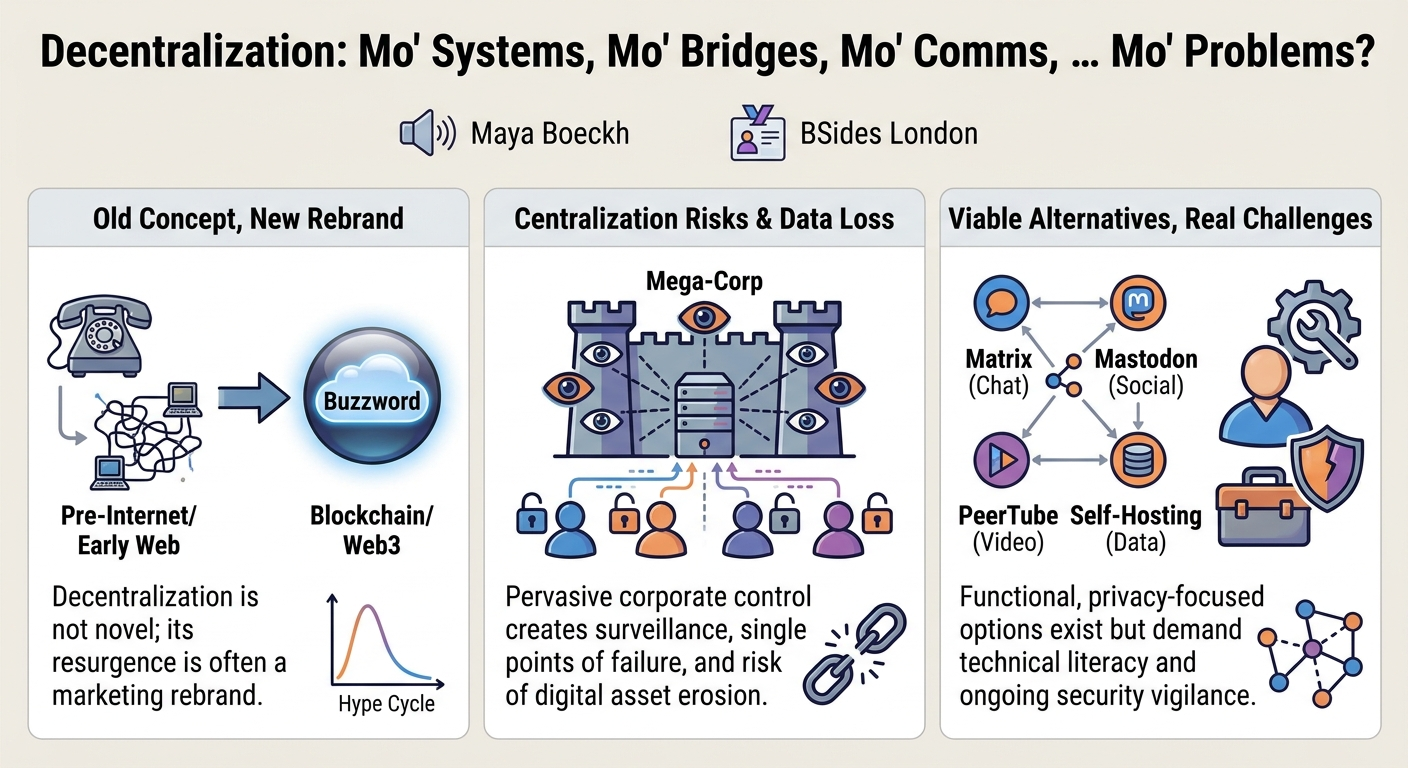
In her BSides London talk, "Decentralization: Mo' Systems, Mo' Bridges, Mo' Comms, ... Mo' Problems?", Maya Boeckh delivers a compelling and often critical analysis of the modern discourse surrounding decentralization. Moving beyond the pervasive buzzwords of blockchain, Web3, and cryptocurrencies, Boeckh meticulously unpacks the historical roots of decentralized architectures, tracing them back to the very foundations of the internet and even earlier communication networks. Her core argument is that while the concept itself is not new, its current re-emergence is driven by a complex interplay of corporate monopolization, encroaching legislative threats, and a growing user desire for digital autonomy.
Key moments
- 0:00 Introduction and talk's non-blockchain focus
- 4:22 Speaker's personal definition of decentralization
- 7:30 Centralized vs. decentralized daily services
- 13:50 Debunking cryptocurrency's decentralization claims
- 22:50 Legislative threats and corporate surveillance motivations
- 28:50 Challenges and limitations of decentralization
- 34:00 Call to action: host your own content
Decentralization: Mo' Systems, Mo' Bridges, Mo' Comms, ... Mo' Problems?
Speakers: Maya Boeckh
Conference: BSides London
YouTube: https://www.youtube.com/watch?v=LCoNSj0q6zw
Overview
In her BSides London talk, "Decentralization: Mo' Systems, Mo' Bridges, Mo' Comms, ... Mo' Problems?", Maya Boeckh delivers a compelling and often critical analysis of the modern discourse surrounding decentralization. Moving beyond the pervasive buzzwords of blockchain, Web3, and cryptocurrencies, Boeckh meticulously unpacks the historical roots of decentralized architectures, tracing them back to the very foundations of the internet and even earlier communication networks. Her core argument is that while the concept itself is not new, its current re-emergence is driven by a complex interplay of corporate monopolization, encroaching legislative threats, and a growing user desire for digital autonomy.
Boeckh, a cybersecurity and information security professional known for her community involvement and CTF contributions, challenges the prevailing, often oversimplified, narratives of decentralization. She posits that a truly decentralized internet requires a deliberate fragmentation of control away from corporate and governmental entities, empowering individuals, organizations, and foundations. The talk serves as a crucial call to action, urging both technical professionals and everyday users to critically evaluate the systems they use, understand the underlying power structures, and actively participate in building a more resilient, private, and genuinely free digital ecosystem.
This presentation matters significantly in the current security landscape because it directly confronts the risks inherent in hyper-centralized digital services, from pervasive surveillance to the erosion of data ownership. By highlighting the legislative push for encryption backdoors and the monopolistic tendencies of "Fang-m-geddon" corporations, Boeckh underscores the urgent need for robust, community-driven alternatives. Her pragmatic approach, acknowledging both the potential and pitfalls of decentralized solutions, provides a grounded perspective essential for anyone navigating the complexities of digital freedom and security.
Background
▶ Watch: Introduction and talk's non-blockchain focus (0:00)
The concept of decentralization, as Maya Boeckh argues, is far from new. It's "old stuff, about as old as the internet," with early examples like the global telephone network and the World Wide Web itself (launched in 1989) inherently operating on decentralized principles. The internet, with its distributed servers and information accessible from multiple routed locations, was, in its essence, a decentralized store of information. However, the term has recently been co-opted and re-branded, primarily associated with technologies like blockchain, Web3, and cryptocurrencies. Boeckh explicitly distances her talk from these buzzwords, clarifying that her focus is on the broader architectural shift away from centralized control, not speculative financial instruments.
The problem, as Boeckh identifies it, stems from the overwhelming consolidation of power and services into the hands of a few "Mega corporations" – a phenomenon she colorfully dubs "Fang-m-geddon." Daily communication, social media, video streaming, and even blogging are increasingly dominated by a handful of tech giants (Meta, Google, Amazon, Microsoft, Apple, Twitter/X, TikTok). This centralization creates single points of failure, facilitates widespread surveillance, and diminishes user control over their data and digital lives. The speaker's definition of decentralization directly addresses this: "purposefully fragmenting the internet into smaller pockets that are not controlled by Mega corporations or governments but by organizations, foundations or people."
Boeckh critically examines the claims made by proponents of cryptocurrencies, particularly their purported ability to decentralize finance, protect anonymity, or empower the disenfranchised. She argues that finance was "never centralized" in the way often claimed, pointing to existing national instant banking systems (e.g., Twint in Switzerland, iDeal in the Netherlands) and informal, honor-based ledger systems like Hawala. Furthermore, she asserts that cryptocurrencies offer the "literal opposite of anonymity" due to signed, immutable transaction statements, and that their value remains tied to real money, keeping banks involved. The speaker also highlights the inherent power imbalance in crypto mining, where those with more capital can acquire more rigs, exacerbating existing inequalities rather than resolving them. This skepticism is underscored by current events, such as Binance reportedly handing over its books to federal authorities. Ultimately, the background for this talk is a call to reclaim the true spirit of decentralization from its commercialized and often misleading modern interpretations, focusing instead on practical, community-driven architectures that foster digital freedom and privacy.
Key Findings
▶ Watch: Centralized vs. decentralized daily services (7:30)
Maya Boeckh's talk reveals several critical findings regarding the state of decentralization and its implications for digital freedom:
- Decentralization is a Rebranded Old Concept: Far from being a novel idea, decentralization has existed since the early internet and even before (e.g., telephone networks). Its current resurgence is a "rebrand" driven by a reaction to corporate centralization and legislative overreach, not a fundamentally new technological paradigm.
- Centralized Control is Pervasive and Problematic: The vast majority of commonly used digital services are controlled by a few large corporations, leading to a "Fang-m-geddon" scenario. This centralization results in corporate surveillance, data monetization, content censorship, and the potential loss of digital cultural heritage, as exemplified by the SoundCloud hypothetical or PlayStation's removal of purchased Discovery shows.
- Cryptocurrency as "Decentralization" is a Misnomer: Boeckh rigorously debunks the notion that cryptocurrencies offer genuine financial decentralization, anonymity, or empowerment. She argues that they are not truly decentralized (value tied to real money, banks still involved), are the "literal opposite of anonymity" due to immutable ledgers, and exacerbate wealth disparities through mining power.
- Viable Decentralized Alternatives Exist (But Come with Trade-offs): The talk highlights numerous functional, privacy-focused alternatives to centralized services across various domains:
- Communication: Matrix, Signal Protocol, XMPP, IRC.
- Social Media: Mastodon, Pleroma, Pixelfed (often leveraging ActivityPub).
- Video Streaming: PeerTube, Plex (for self-hosted libraries).
- Hosting/Domains: Smaller registrars and hosting providers, self-hosting (even on a Raspberry Pi).
These alternatives offer greater control and privacy but often come with "non-negligible amounts of sacrifices" in terms of immediate availability, latency, or user convenience.
- Legislative Efforts Threaten Encryption and Privacy: Boeckh identifies several alarming legislative trends, including the UK's Online Safety Bill, France's analogous law, the EU's eIDAS 2.0, and the EU Chat Control Bill. She asserts that these bills, often framed under the guise of child safety, propose dangerous measures like breaking end-to-end encryption, which is fundamentally flawed as "you can't just put a back door and assume that only good people can use the back door."
- Corporate Surveillance is Inherent: Modern operating systems and platforms (Android, Windows, Apple ecosystem) are designed with "bloatware," telemetry, and tracking services (e.g., Google Analytics) that continuously monitor user activity. This widespread data collection feeds monetization strategies and trend manipulation.
- Decentralization Demands Effort and Technical Literacy: Moving to decentralized systems is not a passive act. It requires a significant "learning curve," technical literacy (network engineering, systems administration), and dedicated human effort for administration and moderation. This contrasts sharply with the "conveniences" of centralized platforms.
- Decentralized Systems are Not Immune to Vulnerabilities: While offering privacy benefits, decentralized platforms are still software and can have security flaws. Boeckh cites specific CVEs:
- Mastodon: Domain spoofing, translation features allowing injection.
- Matrix: Inline SVG embedded scripts.
- PeerTube: DoS due to decompression size checks.
This underscores that decentralization shifts the security model but does not eliminate the need for vigilance.
- Over-Decentralization Can Create New Problems: The talk warns against taking decentralization to an illogical extreme, such as hosting open-source project wikis or downloads solely on platforms like Discord, which introduces new limitations like ephemeral links, lack of code of conduct, and reliance on proprietary infrastructure. Similarly, using IPFS for a simple blog is deemed "silly."
Technical Deep Dive
▶ Watch: Debunking cryptocurrency's decentralization claims (13:50)
Maya Boeckh's technical deep dive into decentralization moves beyond superficial definitions, grounding the concept in architectural realities and existing protocols. Her core definition of decentralization is "purposefully fragmenting the internet into smaller pockets that are not controlled by Mega corporations or governments but by organizations, foundations or people." This stands in stark contrast to a mere distributed architecture (like a large corporation having multiple servers globally for availability), which she argues still constitutes centralization of control.
The talk champions the Fediverse as a prime example of a functioning, community-owned, and privacy-centric decentralized ecosystem. While acknowledging that its official definition might stretch the meaning of "social network" to include video streaming and picture hosting, the Fediverse represents a collection of interconnected services built on open standards.
Key technical examples and protocols discussed include:
- Matrix Protocol: For communications, Matrix is highlighted as an open-source, reasonably well-documented protocol that allows users to choose between hosting their own server, using an official server, or joining someone else's. Crucially, its end-to-end encryption has been publicly audited, with findings and comments transparently released, offering a strong privacy assurance. This contrasts with traditional email, where messages are readable on servers despite TLS encryption, unless explicitly secured with protocols like PGP or S/MIME.
- ActivityPub: This W3C-recommended federated social networking protocol is the backbone for many Fediverse platforms like Mastodon (a Twitter-like service), Pleroma, and Pixelfed (an Instagram analogue). ActivityPub enables seamless communication between different instances (servers), allowing users on one instance to interact with users on another. A key feature emphasized is the absence of algorithms designed to generate engagement, fostering smaller, more interactive networks.
- PeerTube: A decentralized video streaming platform, it allows users to host their own video content, similar to how Plex allows self-hosting media libraries. This provides an alternative to centralized platforms like YouTube or Netflix, offering more control over content and avoiding advertisements.
- Self-Hosting and Smaller Providers: Boeckh advocates for basic self-hosting, citing that a "fully static HTML page does not need to be hosted on AWS," but can run on a "Raspberry Pi for [expletive] sake." This extends to using smaller domain registrars (e.g., Glauca) and hosting providers, even if they offer less availability or a smaller selection of TLDs compared to giants like AWS or Google Cloud.
- Veiled Protocol: Mentioned as a fully decentralized, no-trust-hierarchy, multimodal system unveiled at Defcon, where "every node pitches in." Boeckh notes she ran nodes herself, confirming its functionality.
However, the talk also delves into the technical challenges and pitfalls of decentralization:
- Technical Literacy and Administration: Decentralized systems require a higher degree of technical literacy, encompassing network engineering, systems administration, and a general understanding of how digital systems interact. Unlike centralized services that abstract away these complexities, users and community administrators in decentralized environments are more directly responsible for maintenance and security.
- Bridges and Interoperability: The proliferation of new decentralized systems necessitates "bridges between systems" to ensure communication and interoperability. This echoes the classic XKCD comic about competing standards, where the creation of yet another standard (or protocol) often fragments the ecosystem further rather than unifying it.
- Security Vulnerabilities: Decentralized systems are not inherently more secure; they merely shift the attack surface. Boeckh highlights real-world CVEs:
- Mastodon: Vulnerabilities for domain spoofing and translation features allowing injection.
- Matrix: Issues with inline SVG embedded scripts.
- PeerTube: Susceptibility to DDoS attacks due to decompression size checks.
This underscores that even open-source, community-driven projects require rigorous security audits and ongoing maintenance.
- Critique of IPFS: While acknowledging IPFS (InterPlanetary File System) as a worldwide content delivery system effective for anti-censorship (e.g., for academic media access like Library Genesis or Sci-Hub), Boeckh cautions against its overuse, stating that using it to host a simple blog is "silly," implying an unnecessary architectural overhead for common use cases.
- Cryptocurrency Technical Flaws: Boeckh's critique of cryptocurrencies is also technical. She points out that they are not truly anonymous ("signed immutable transaction statement"), their value is "backed" by real money, and that the mining process inherently favors those with more capital to acquire more powerful rigs, thus centralizing power rather than decentralizing it. The mention of Binance providing its books to the Fed further highlights the eventual entanglement of these systems with traditional financial and legal structures.
In essence, the technical deep dive advocates for a pragmatic approach to decentralization, acknowledging the power of open protocols and community-driven platforms while remaining realistic about the technical demands, security considerations, and the constant need for interoperability in a fragmented digital landscape.
Demo / Proof of Concept
▶ Watch: Challenges and limitations of decentralization (28:50)
The talk, "Decentralization: Mo' Systems, Mo' Bridges, Mo' Comms, ... Mo' Problems?", did not feature a live technical demonstration or a proof of concept specific to a vulnerability or a new tool. Instead, Maya Boeckh focused on a comprehensive theoretical and critical analysis of decentralization, illustrating her points with conceptual diagrams, real-world examples of existing platforms, and a detailed discussion of their architectural and societal implications. The presentation's emphasis was on education and critical thinking rather than a hands-on technical showcase.
Defensive Implications
▶ Watch: Call to action: host your own content (34:00)
The insights presented by Maya Boeckh offer several crucial defensive implications for individuals, organizations, and the cybersecurity community at large, urging a proactive stance against pervasive centralization and its associated risks.
- Prioritize Legislative Awareness and Advocacy: Defenders must be acutely aware of legislative developments like the UK's Online Safety Bill, France's new law, the EU's eIDAS 2.0, and particularly the EU Chat Control Bill. These initiatives, often presented under the guise of safety, frequently propose measures that undermine end-to-end encryption. Security professionals should actively advocate against mandates that introduce backdoors, as Boeckh emphatically states, "breaking encryption does not make anyone safer." Understanding the political landscape and its direct impact on fundamental privacy and security is paramount.
- Mitigate Corporate Surveillance and Bloatware: Acknowledge that mainstream operating systems (Android, Windows, Apple) and their associated app stores and services are inherently designed for telemetry and data collection. Defenders should explore and recommend privacy-focused alternatives, such as CalyxOS or other de-Googled Android distributions, and actively manage privacy settings on all devices. For organizations, this means scrutinizing software dependencies and minimizing reliance on services known for aggressive data monetization.
- Embrace and Secure Decentralized Alternatives: Actively explore and integrate decentralized communication (e.g., Matrix), social media (e.g., Mastodon), and hosting solutions (e.g., PeerTube, self-hosting) where appropriate. While these platforms offer greater control and privacy, defenders must also recognize their inherent security challenges. As Boeckh highlighted, CVEs exist for these systems (e.g., Mastodon's domain spoofing and injection flaws, Matrix's SVG script vulnerabilities, PeerTube's DoS via decompression checks). Therefore, robust security practices, including regular patching, configuration hardening, and monitoring, are just as critical as for centralized systems.
- Invest in Technical Literacy and Administration: Decentralized systems demand a higher level of technical expertise from administrators and users. Organizations looking to adopt these solutions must invest in training for network engineering, systems administration, and general digital literacy. The "sizable learning curve" means that simply deploying a decentralized service without adequate operational knowledge can introduce new vulnerabilities and management overhead.
- Reclaim Data and Content Ownership: The talk underscores the fragility of relying on centralized platforms for content storage. The examples of SoundCloud's hypothetical disappearance or PlayStation's removal of purchased Discovery shows illustrate the risk of losing access to or ownership of digital assets. Defenders should advocate for and implement strategies for self-hosting critical content and data, ensuring long-term availability and control. This includes maintaining personal blogs and archives on infrastructure directly controlled by the user or organization.
- Critical Evaluation of "Decentralization" Buzzwords: Maintain a skeptical and analytical approach to technologies marketed as "decentralized," especially those involving cryptocurrencies or blockchain. Boeckh's critique emphasizes that many such solutions fail to deliver true decentralization, anonymity, or empowerment, and often introduce new forms of centralization or exploitation. Defenders should look beyond marketing hype to assess the actual architectural design and control mechanisms.
- Understand Jurisdiction and SLA Implications: When operating decentralized services, particularly those distributed across various instances or jurisdictions, it becomes critical to understand the legal implications, data protection laws (e.g., GDPR), and service level agreements (SLAs). Questions of "who has control," "what is the service's jurisdiction," and "how can content be taken down" are complex and require careful consideration.
In summary, defensive strategies in a world increasingly shaped by both centralization and the pursuit of decentralization require a multi-faceted approach: challenging problematic legislation, adopting privacy-enhancing technologies, securing decentralized platforms, investing in human expertise, and critically evaluating the true nature of digital control.
Key Takeaways
- Decentralization is a Rebranded Historical Concept: Far from being a new phenomenon, true decentralization has existed since the early internet and telephone networks. The current buzz around "decentralization" often misrepresents its historical context and is frequently co-opted by commercial interests.
- Corporate and Legislative Centralization Threatens Digital Freedom: The dominance of a few tech giants ("Fang-m-geddon") leads to pervasive surveillance and data monetization. Simultaneously, legislative efforts (e.g., UK Online Safety Bill, EU Chat Control) pose a direct threat to end-to-end encryption and fundamental privacy rights.
- Viable Decentralized Alternatives Exist for Core Services: Practical, privacy-focused alternatives to centralized platforms are available for communications (Matrix, Signal Protocol), social media (Mastodon, Pleroma, Pixelfed on ActivityPub), video streaming (PeerTube, Plex), and hosting (self-hosting, smaller providers).
- True Decentralization Demands User Effort and Technical Literacy: Adopting and maintaining decentralized systems requires a significant learning curve, active participation, and technical skills in areas like network engineering and systems administration. It's not a set-it-and-forget-it solution.
- Decentralized Platforms Are Not Inherently Immune to Security Flaws: While offering privacy benefits, decentralized systems are still software and can have vulnerabilities (e.g., CVEs in Mastodon, Matrix, PeerTube). Robust security practices, patching, and ongoing vigilance remain essential.
- Reclaim Control Over Data and Content: Users should proactively seek to regain control over their digital lives by self-hosting content, choosing privacy-focused tools, and critically evaluating who controls their data, rather than entrusting it entirely to centralized corporate entities.
About the Speaker(s)
Maya Boeckh is presented as a dedicated cybersecurity and information security professional. While intentionally vague about the specifics of her day job, her involvement in the security community is clear. She is active in various communities, handles and creates challenges for Capture The Flag (CTF) events, and regularly attends and speaks at conferences such as BSides London. Boeckh describes herself as "an extremely silly person in general," indicating a personable and engaging speaking style. Her talk reflects a deep, critical understanding of digital architectures and a strong commitment to advocating for internet freedom and privacy.
Reviews
Dr. Zero (Offensive Security Researcher) — SOLID
Boeckh spends her slot stating the obvious: Web3 is a grift, Big Tech is strip-mining your data, and standing up a Matrix homeserver is a giant pain in the ass. It's a perfectly competent BSides primer on the Fediverse that cuts through vendor hype, but it brings absolutely zero novel research to the table. Solid for the 101 track, entirely skippable if you already know how ActivityPub works.
Heather Calloway (CISO) — SOLID
This talk cuts through Web3 marketing to examine the actual operational and security trade-offs of decentralized systems like Matrix and Mastodon. While geared toward individual privacy, the strategic takeaway for the enterprise is clear: escaping vendor concentration requires a massive shift in headcount, technical overhead, and risk ownership. It's a solid primer for leadership teams evaluating alternative communication protocols or managing shadow IT in the federated space.