Breaking Bad Multifactor: MFA bypasses and how to assess the risks
Chester Wisniewski (Director, Global Field CTO · Sophos)
Security BSides London 2023 · Day 1 · Track 2
Overview
In an era where usernames and passwords alone are no longer sufficient to secure digital identities, Multifactor Authentication (MFA) has become a foundational security control. However, as organizations increasingly adopt MFA, threat actors are continuously evolving their tactics to bypass these protections. In his compelling talk at BSides London, Chester Wisniewski, Director and Global Field CTO at Sophos, delved into the intricacies of common MFA methods, their inherent weaknesses, and the sophisticated bypass techniques employed by criminals. Drawing from two decades of experience in incident response and managed detection and response, Wisniewski offered a critical examination of the current MFA landscape.
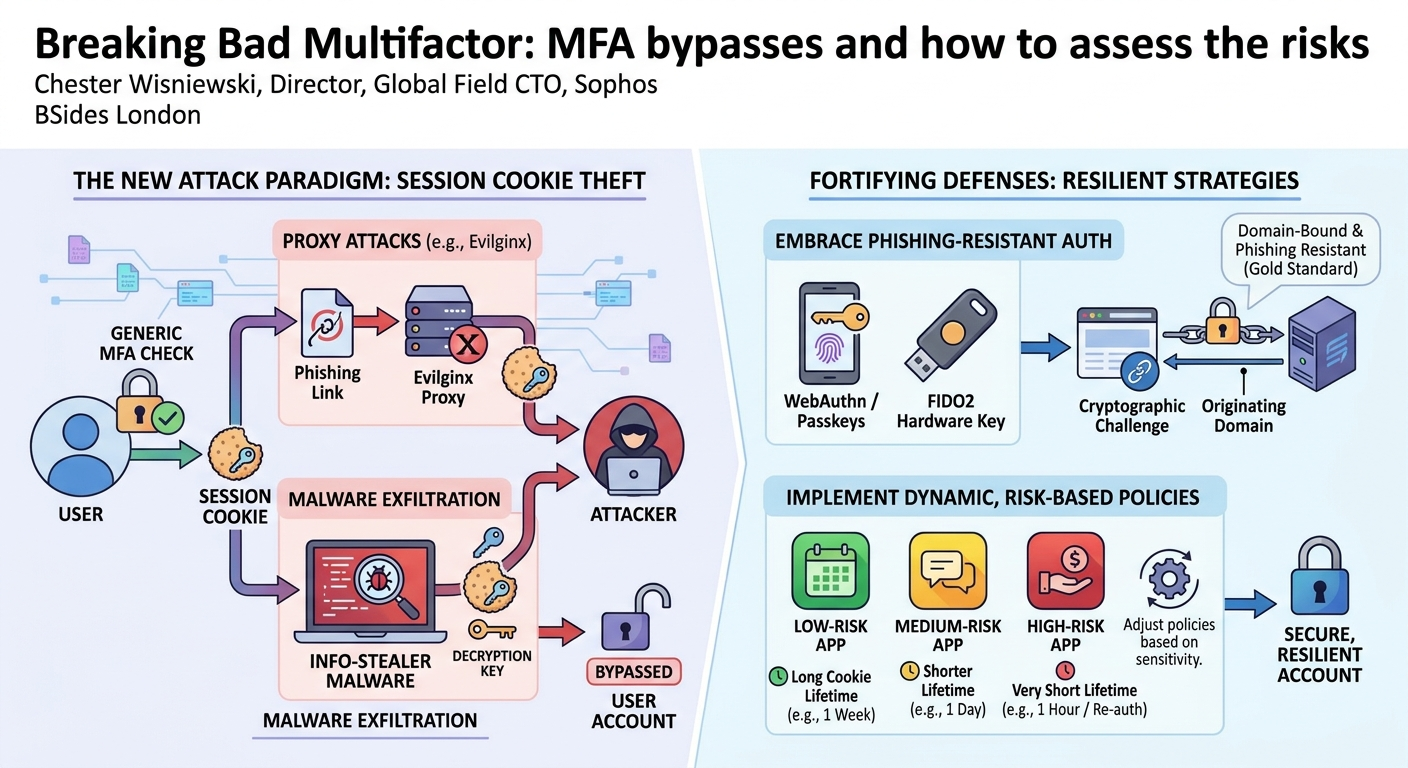
Key moments
- 0:00 Introduction and talk agenda
- 2:00 Overview of popular MFA methods and weaknesses
- 12:00 Evil GenX: Proxy attacks bypassing MFA
- 16:00 Cookie theft: The new MFA bypass frontier
- 22:00 WebAuthn and Passkeys: The fishing-resistant future
- 28:00 Implementing smart security policies and checks
- 35:00 Q&A: The passwordless future with Passkeys
Breaking Bad Multifactor: MFA bypasses and how to assess the risks
Speakers: Chester Wisniewski, Director, Global Field CTO, Sophos
Conference: BSides London
YouTube: https://www.youtube.com/watch?v=s7l6Ump6eqQ
Overview
In an era where usernames and passwords alone are no longer sufficient to secure digital identities, Multifactor Authentication (MFA) has become a foundational security control. However, as organizations increasingly adopt MFA, threat actors are continuously evolving their tactics to bypass these protections. In his compelling talk at BSides London, Chester Wisniewski, Director and Global Field CTO at Sophos, delved into the intricacies of common MFA methods, their inherent weaknesses, and the sophisticated bypass techniques employed by criminals. Drawing from two decades of experience in incident response and managed detection and response, Wisniewski offered a critical examination of the current MFA landscape.
The presentation underscored a crucial shift in adversary focus: rather than directly cracking MFA, attackers are increasingly targeting the resulting session artifacts, particularly session cookies, to circumvent authentication entirely. Wisniewski highlighted real-world compromises and the proliferation of specialized tools designed for MFA bypass, emphasizing that even seemingly robust MFA implementations can be rendered ineffective without a deep understanding of these advanced attack vectors. The talk served as a vital call to action, providing defenders with actionable advice and strategic insights to fortify their MFA deployments against an ever-adapting threat landscape.
This article dissects Wisniewski's insights, offering a comprehensive technical overview of MFA bypasses and detailing the defensive strategies necessary to mitigate these risks. It aims to equip security professionals with the knowledge to not only implement MFA but to implement it resiliently, anticipating and defending against the next generation of authentication attacks.
Background
▶ Watch: Introduction and talk agenda (0:00)
The evolution of authentication has seen a progression from single-factor passwords to the adoption of Multifactor Authentication (MFA), which requires users to present two or more pieces of evidence from distinct categories: something they know (like a password), something they have (like a phone or token), or something they are (like a fingerprint or face). Early MFA implementations included hardware RSA tokens generating time-based one-time passwords (TOTPs) and SMS-delivered six-digit codes, popular in the late 1990s and early 2000s. As technology advanced, these were supplemented by software authenticator apps (e.g., Google Authenticator, Duo, Microsoft Authenticator), push notifications, smart cards, and dedicated FIDO/U2F (Universal 2nd Factor) security keys like YubiKey and Google Titan. More recently, integrated biometrics such as Face ID and fingerprint readers on smartphones have become prevalent, offering convenience and an additional layer of security.
At the core of many of these methods, particularly OTPs, lies a pseudo random number generator (PRNG). Both the authentication server and the user's device (hardware token or app) share a secret seed. This seed initializes the PRNG, allowing both parties to predictably generate a sequence of seemingly random numbers that can be matched for verification. While convenient, the security of this method hinges entirely on the secrecy of the seed. Wisniewski pointed out that users often compromise this by taking screenshots of QR codes or storing the textual seeds insecurely, making them vulnerable to direct theft. SMS codes, on the other hand, operate with less transparency; Wisniewski and a colleague observed one provider using sequential numbers, exposing a fundamental flaw in their randomness and making them susceptible to prediction.
Biometric authentication, while offering a "something you are" factor, also has its nuances. Biometric data (fingerprints, facial scans) is typically processed into hashes and stored securely within a secure element chip on the device, rather than being uploaded to cloud services. This local storage enhances security. However, Wisniewski detailed that while accuracy in perfect conditions is around 99.97% against false negatives, real-world accuracy drops to about 87% due to environmental factors like grease, cold, or makeup. Furthermore, biometrics are intentionally "fuzzy" to ensure usability, meaning a statistically improbable but possible chance exists for an unauthorized individual to unlock a device (e.g., one in 256 for a fingerprint). Wisniewski also noted the genetic component of facial recognition, where family members might be able to bypass Face ID, contrasting it with fingerprints, which are unique even among identical twins. These inherent characteristics and practical vulnerabilities set the stage for the sophisticated bypass techniques that attackers have developed.
Key Findings
▶ Watch: Evil GenX: Proxy attacks bypassing MFA (12:00)
Wisniewski's talk illuminated several critical findings regarding the current state of MFA and its circumvention:
- MFA is Continuously Compromised: Despite widespread adoption, all forms of MFA, with the notable exception of truly fishing resistant methods, are susceptible to bypass. This continuous compromise is driven by criminals' evolving tactics, which now often target the post-authentication phase.
- Shift to Session Cookie Theft: The most significant paradigm shift identified is the move away from directly bypassing the MFA challenge itself. Instead, attackers are focusing on stealing valid session cookies after a legitimate MFA-protected login. Once a session cookie is acquired, it grants full access to the user's account without requiring re-authentication, effectively bypassing MFA entirely for the duration of the cookie's lifetime.
- Prevalence of "Person-in-the-Middle" Attacks: Tools like Evilginx have become increasingly popular, enabling sophisticated man-in-the-middle (MitM) attacks or "person-in-the-middle" proxies. These tools intercept legitimate authentication flows, including MFA challenges, and forward them to the genuine service while simultaneously capturing the resulting session cookies. This technique works against most MFA types, including push notifications and OTPs.
- Push Notification Fatigue as an Attack Vector: The convenience of push notifications has been weaponized. Attackers exploit user fatigue by sending a barrage of push notification requests, hoping the user will eventually accept to make them stop, inadvertently granting access. The Uber hack was a prime example of this "nag attack."
- Ubiquitous Info-Stealer Malware: Almost every modern info-stealer malware variant now includes functionality to exfiltrate browser-stored credentials and, crucially, session cookies. While browsers encrypt cookie storage, the decryption key is present on the machine, making it accessible to sophisticated malware.
- High Value of Stolen Accounts: Compromised accounts, particularly those with significant online presence or access to valuable data, are highly monetized on underground markets. Google reported blocking over 1.6 million phishing attempts targeting YouTubers, with stolen accounts fetching $3,000-$4,000, underscoring the economic incentive for these attacks.
- WebAuthn/FIDO2/Passkeys as the Gold Standard: The talk unequivocally positioned WebAuthn, FIDO2, and the emerging Passkeys as the most promising and truly phishing-resistant solutions for the future. Their design, which cryptographically binds authentication to the originating domain, makes them inherently resilient to the proxying and cookie theft attacks plaguing other MFA methods.
These findings collectively paint a picture of a security landscape where MFA is essential but demands continuous vigilance and a strategic shift towards inherently more secure, domain-bound authentication mechanisms to counter evolving bypass techniques.
Technical Deep Dive
▶ Watch: Cookie theft: The new MFA bypass frontier (16:00)
The effectiveness of Multifactor Authentication (MFA) is deeply rooted in its underlying technical mechanisms, and understanding these is key to comprehending their vulnerabilities. Wisniewski meticulously broke down the technical underpinnings of various MFA types, revealing where their strengths and weaknesses lie.
For OTP (One-Time Password) methods, such as those generated by RSA tokens or authenticator apps (e.g., Google Authenticator), the core mechanism is a pseudo random number generator (PRNG). Both the authentication server and the user's device possess a shared secret seed. This seed initializes the PRNG, which then generates a predictable sequence of numbers based on time (TOTP) or a counter (HOTP). When a user enters an OTP, the server generates its own OTP using the same seed and algorithm, then compares it. If they match, authentication proceeds. The vulnerability here is direct: if an attacker compromises the seed (e.g., via screenshots of QR codes or insecure backup of the seed string), they can generate valid OTPs independently, bypassing the "something you have" factor.
SMS-based MFA suffers from inherent opacity and susceptibility to network-level attacks. Unlike app-based OTPs, users have no visibility into how SMS codes are generated by the service provider. Wisniewski shared an anecdote of observing sequential SMS codes from a provider, indicating a lack of true randomness and making them potentially predictable. More critically, SMS is highly vulnerable to Sim swapping attacks, where attackers trick mobile carriers into porting a victim's phone number to a SIM card controlled by the attacker. This allows the attacker to receive SMS-based OTPs, bypassing MFA without needing to compromise the user's device or the seed.
Biometric authentication (fingerprint, face ID) operates differently. Instead of transmitting raw biometric data, devices capture, measure, and hash unique features. These hashes are stored in a secure element chip – a tamper-resistant hardware component – on the device itself. A shared set of keys within the secure element allows it to securely communicate with the authentication authority, attesting that a valid biometric scan was performed on that specific device for the associated identity. The critical point is that these hashes are never transmitted to the cloud, preventing large-scale biometric database breaches. However, the intentional "fuzziness" of biometric algorithms, necessary for usability across varying conditions (e.g., finger shrinkage in cold weather), introduces a statistical possibility of false positives, which Wisniewski quantified as approximately one in 256 for fingerprints in a sufficiently large crowd.
Push notifications, offered by solutions like Duo or Microsoft Authenticator, aim for convenience. When a login attempt occurs, a notification is sent to the user's registered device, requiring a simple tap to approve or, in more secure implementations, to enter a displayed number. While convenient, this method is susceptible to "nag attacks" or MFA fatigue. As demonstrated in the Uber hack, attackers relentlessly send push notifications, overwhelming the user until they, out of frustration, inadvertently approve a malicious login. This highlights that user psychology can be a significant vulnerability.
The most critical technical threat highlighted is session cookie theft, which leverages the stateless nature of HTTP. To maintain a user's authenticated state across multiple requests, web applications issue session cookies containing a session ID after a successful login (which may include MFA). Once issued, these cookies allow continued access without re-authentication until they expire. If an attacker steals a valid session cookie, they can impersonate the user and bypass all MFA mechanisms, as the active session has already been established.
This vulnerability is exploited by tools like Evilginx, an open-source man-in-the-middle (MitM) proxy specifically designed for MFA bypass. Evilginx operates by setting up a phishing site that acts as a reverse proxy. When a victim clicks a phishing link (e.g., an mpp3.html file disguised as an MP3 voicemail), they are directed to the Evilginx server. This server then proxies the entire legitimate authentication flow to the genuine service (e.g., Microsoft Office 365). The victim interacts with the legitimate login page, enters their credentials, and completes any MFA challenge (e.g., entering a number from a push notification). Evilginx transparently forwards these details to the real service. Critically, after successful authentication, Evilginx intercepts the legitimate session cookie issued by the service and then uses it to log in as the victim, completely bypassing the need for credentials or MFA in subsequent interactions. Microsoft documented such an attack, noting over 10,000 Office 365 compromises between September 2021 and July 2022, with account takeovers occurring in less than five minutes.
The threat is further compounded by info-stealer malware (e.g., RedLine, Racoon, Vidar, Lumma, Agent Tesla, Atomic Stealer), which are commodity malware strains designed to exfiltrate sensitive data from compromised machines. Almost universally, these info-stealers target browser-stored passwords and, critically, session cookies. While major browsers encrypt their cookie stores, the decryption key is necessarily present on the device, making it accessible to malware with sufficient privileges. This means even if a user employs a robust password manager like Bitwarden, their session cookies remain vulnerable to theft from the browser's storage.
The ultimate technical solution proposed is WebAuthn (part of FIDO2) and its user-friendly manifestation, Passkeys. This protocol is inherently fishing resistant because it cryptographically binds the authentication process to the specific domain. The flow involves:
- Registration: When a user registers a Passkey (or FIDO2 token) with a service (e.g., Gmail), they send their username. The service sends back a cryptographic challenge. The user's device (e.g., iPhone's secure element, YubiKey's Hardware Security Module (HSM)) generates a unique public/private key pair specifically for that domain. The private key is securely stored on the device, and the public key is sent back to the service, signed with the newly generated private key.
- Authentication: For subsequent logins, the service sends a new cryptographic challenge. The user's device uses the stored private key (which is bound to the domain
google.com) to sign this challenge. The signed challenge is sent back, and the service verifies it using the stored public key.
This design makes it phishing-resistant because the private key will only sign a challenge originating from the exact domain it was registered with. An attacker's phishing site, even if it looks identical, will have a different domain, preventing the Passkey from being used to authenticate to the attacker's proxy. While cloud backup of Passkeys (e.g., via iCloud, Google Account) introduces a potential vulnerability if the cloud account itself is compromised, it significantly enhances usability and is still vastly more secure than traditional password-based authentication. Furthermore, Passkeys leverage the same WebAuthn backend as physical FIDO2 tokens, allowing users to choose between the convenience of a phone-based Passkey or the higher security of a hardware token for the same service.
Demo / Proof of Concept
▶ Watch: Implementing smart security policies and checks (28:00)
While Chester Wisniewski's talk at BSides London did not feature a live, step-by-step demonstration or a novel proof-of-concept tool developed by Sophos, he extensively referenced and detailed multiple real-world examples and widely used tools that effectively serve as proofs-of-concept for the discussed MFA bypass techniques.
A primary example highlighted was Evilginx, an open-source proxy tool available on GitHub. Wisniewski described how Evilginx functions as a "person-in-the-middle" in a sophisticated phishing campaign. The talk visually presented a phishing email and the subsequent interaction with an Evilginx-controlled proxy. This demonstration, albeit conceptual, illustrated how the tool intercepts legitimate authentication flows, including those protected by push-based MFA, to steal session cookies. The specific Microsoft Office 365 compromise, affecting over 10,000 companies, served as a compelling real-world proof of Evilginx's efficacy in achieving rapid account takeovers.
Furthermore, the discussion of the Uber and Electronic Arts (EA) hacks provided concrete case studies of MFA bypasses. The Uber incident demonstrated the effectiveness of MFA fatigue attacks, where repeated push notifications coerced a contractor into inadvertently granting access. The EA breach showcased how stolen Slack session cookies from a compromised employee's PC allowed attackers to impersonate the employee internally, manipulate tech support, and ultimately exfiltrate sensitive data like the FIFA 21 source code.
Wisniewski also referenced underground marketplaces like the defunct Genesis Market and the more recent "broker" platform. Screenshots from these markets, showing categories for selling stolen cookies by industry, country, and service (e.g., Steam games, corporate access), served as tangible evidence of the active trade in compromised authentication artifacts. The mention of specific info-stealer malware families (RedLine, Racoon, Vidar, Lumma, Agent Tesla, Atomic Stealer) also acted as a proof-of-concept for the widespread capability of commodity malware to extract cookies and stored credentials from user machines.
In essence, the talk's "demonstration" was built upon a robust foundation of documented attacks, publicly available tools, and empirical observations from Sophos's incident response activities, collectively validating the vulnerabilities and bypass methods discussed.
Defensive Implications
▶ Watch: Q&A: The passwordless future with Passkeys (35:00)
Understanding the evolving landscape of Multifactor Authentication (MFA) bypasses is only half the battle; the other half involves implementing robust defensive strategies. Chester Wisniewski outlined several actionable recommendations for organizations and individuals to fortify their authentication mechanisms.
The foremost defensive implication is the urgent need to transition towards fishing resistant authentication methods, specifically WebAuthn, FIDO2, and Passkeys. These technologies, by cryptographically binding authentication to the originating domain, render traditional phishing and man-in-the-middle (MitM) attacks ineffective. Organizations should actively evangelize and implement Passkeys in their web applications and services. While cloud-backed Passkeys introduce a minor risk if the cloud account itself is compromised, they represent a significant leap in usability and security compared to passwords and most existing MFA methods. Developers and security professionals should advocate for their adoption, particularly with financial institutions and critical service providers.
Beyond adopting stronger MFA, organizations must implement sophisticated monitoring and dynamic policy adjustments:
- Anomalous Login Detection: Since proxy tools like Evilginx often channel multiple compromised login attempts through a single attacker-controlled IP address, security teams should monitor for anomalous geographic login patterns. If numerous users, previously logging in from diverse locations, suddenly appear to be authenticating from a single, unusual IP (e.g., "Central Kansas" or geolocation 0,0), it's a strong indicator of a large-scale phishing attack underway. While this may generate false positives (e.g., a corporate offsite), it serves as a critical early detection mechanism.
- Dynamic Cookie Lifetime Policies: A critical vulnerability lies in excessively long session cookie lifetimes. Wisniewski strongly advised against default settings, such as Slack's 10-year cookie expiry, recommending instead a risk-based approach. Organizations should:
- Inventory Applications: Categorize all applications based on their sensitivity (e.g., a "traffic light" system: green for low-risk, yellow for medium, red for high-risk).
- Adjust Cookie Expiry: Implement granular policies. For low-risk applications like an internal wiki, a one-week cookie might be acceptable. For high-sensitivity systems like HR portals (where salaries or sensitive employee data can be changed), an hourly re-authentication or a very short cookie lifetime is warranted. Cloud applications (Office 365, Google Suite, Slack) often have configurable cookie lifetimes that should be reviewed and shortened from their default "frictionless" settings.
- Enhanced Access Controls for Sensitive Systems: For highly sensitive operations, organizations should implement additional "smart checks" beyond MFA:
- Corporate Device Requirement: Mandate that critical actions or access to highly sensitive data can only occur from a corporate-managed device that possesses a valid corporate certificate. This significantly raises the bar for attackers, as they would need to compromise both user credentials/MFA and a specific corporate device.
- Device Health Checks: Integrate endpoint security solutions to assess device health. If a device is unpatched, infected with commodity malware (a common source of cookie theft), or otherwise out of compliance with corporate security standards, automatically force the user to re-authenticate with the highest level of security or restrict access until the device health is restored.
- Trusted IP Ranges: Reduce friction for users on known, trusted corporate networks by allowing slightly longer cookie lifetimes or fewer re-authentication prompts.
- Impossible Travel Detection: Monitor for logins from geographically disparate locations within an impossibly short timeframe. While prone to false positives (e.g., researchers using VPNs), it can be a useful indicator for high-risk systems.
- Geographic Restrictions: While not a panacea, some organizations may choose to blacklist entire countries (e.g., China, Russia) for specific access, acknowledging its limitations.
Finally, modern endpoint security remains paramount. Since many MFA bypasses originate from commodity malware stealing cookies, robust endpoint detection and response (EDR) and anti-malware solutions are essential to prevent the initial compromise that leads to cookie theft. By combining strong, phishing-resistant MFA with dynamic, risk-based access policies and vigilant monitoring, organizations can build a more resilient authentication posture against sophisticated adversaries.
Key Takeaways
- MFA is Essential but Not a Panacea: While Multifactor Authentication (MFA) significantly enhances security beyond passwords, it is not foolproof. Attackers continuously adapt, and many common MFA methods remain vulnerable to sophisticated bypass techniques.
- Session Cookie Theft is the New Frontier: The primary attack vector has shifted from directly bypassing MFA challenges to stealing legitimate session cookies after initial authentication. Once acquired, these cookies grant full access, circumventing all MFA controls for the session's duration.
- Embrace Fishing-Resistant Authentication: WebAuthn, FIDO2, and Passkeys represent the most robust defense against phishing and MitM attacks. Their cryptographic binding to specific domains makes them inherently resistant to proxying and cookie theft, making their adoption a critical priority.
- Implement Dynamic, Risk-Based Policies: Avoid static and overly permissive cookie lifetimes. Categorize applications by sensitivity and implement dynamic policies for session cookie expiry. Regularly review and shorten default cookie durations in cloud services like Office 365, Google Suite, and Slack.
- Proactive Monitoring and Device Health are Crucial: Monitor for anomalous login patterns, such as multiple users authenticating from a single, unusual IP address (indicating a proxy attack). Integrate device health checks to enforce stricter authentication requirements or restrict access for compromised or non-compliant devices.
- User Usability is Key to Adoption: While security is paramount, usability is critical for successful MFA implementation. Technologies like Passkeys, with their seamless integration with device biometrics and cloud backups, strike a balance between strong security and user convenience, making them ideal for broader adoption.
About the Speaker(s)
Chester Wisniewski is the Director, Global Field CTO at Sophos, a cybersecurity leader. With a career spanning two decades at Sophos, he is a seasoned expert in the field, having presented at conferences like BSides in 2019. Wisniewski's extensive experience is rooted in his work with Sophos's incident response teams and managed detection and response teams, where he directly engages with customers to help shore up their cybersecurity defenses and analyze real-world compromises. His insights are informed by practical, hands-on experience in understanding how criminals continuously bypass security measures, particularly in the realm of multifactor authentication.
Reviews
Dr. Zero (Offensive Security Researcher) — WEAK
Sophos sent a Field CTO to recite the Wikipedia page for Evilginx and remind us that info-stealers grab session tokens. It's a perfectly competent summary of authentication threats from 2022, but there is absolutely zero original research here. If you know what AitM stands for, you can skip this entirely.
Heather Calloway (CISO) — MUST SEE
This is required reading for your IAM architects and a perfect primer for your risk committee. It dismantles the false security of legacy MFA and cleanly sets up the business case for funding FIDO2 and conditional access.