Connected Chaos: Uncovering Router Vulnerabilities via Cloud API Connections
Vangelis Stykas (Chief Technology Officer · Tremau)
Security BSides London 2023 · Day 1 · Track 3
Overview
In "Connected Chaos: Uncovering Router Vulnerabilities via Cloud API Connections," Vangelis Stykas, CTO at Tremau, delivers a compelling and often alarming exposé on the pervasive security flaws found in widely used cloud-managed networking devices. The talk delves into how routers, Wi-Fi access points, and other connectivity devices, increasingly managed via cloud platforms for convenience and scalability, often harbor critical vulnerabilities that allow for unauthorized access, lateral movement within networks, and even Remote Command Execution (RCE). Stykas’s research highlights a fundamental disconnect between the promise of "built-in security" in cloud-managed solutions and the reality of their implementation.
Key moments
- 0:00 Talk introduction: Connected Chaos and router vulnerabilities
- 2:45 Cloud-managed routers: Advantages vs. security risks
- 4:00 Simple hacking: The 'plus one' methodology explained
- 5:45 Mimosa case: IDOR vulnerability and swift fix
- 11:50 Riggi zero-day: Persistent vulnerability, no company response
- 19:15 How companies should handle vulnerability disclosures
- 22:10 Security researcher responsibilities: Legal, ethical, and effective reporting
- 28:30 Q&A: Worst industry for vulnerability disclosure interaction
Connected Chaos: Uncovering Router Vulnerabilities via Cloud API Connections
Speakers: Vangelis Stykas, Chief Technology Officer, Tremau
Conference: BSides London
YouTube: https://www.youtube.com/watch?v=9_NNs8UVIPk
Overview
In "Connected Chaos: Uncovering Router Vulnerabilities via Cloud API Connections," Vangelis Stykas, CTO at Tremau, delivers a compelling and often alarming exposé on the pervasive security flaws found in widely used cloud-managed networking devices. The talk delves into how routers, Wi-Fi access points, and other connectivity devices, increasingly managed via cloud platforms for convenience and scalability, often harbor critical vulnerabilities that allow for unauthorized access, lateral movement within networks, and even Remote Command Execution (RCE). Stykas’s research highlights a fundamental disconnect between the promise of "built-in security" in cloud-managed solutions and the reality of their implementation.
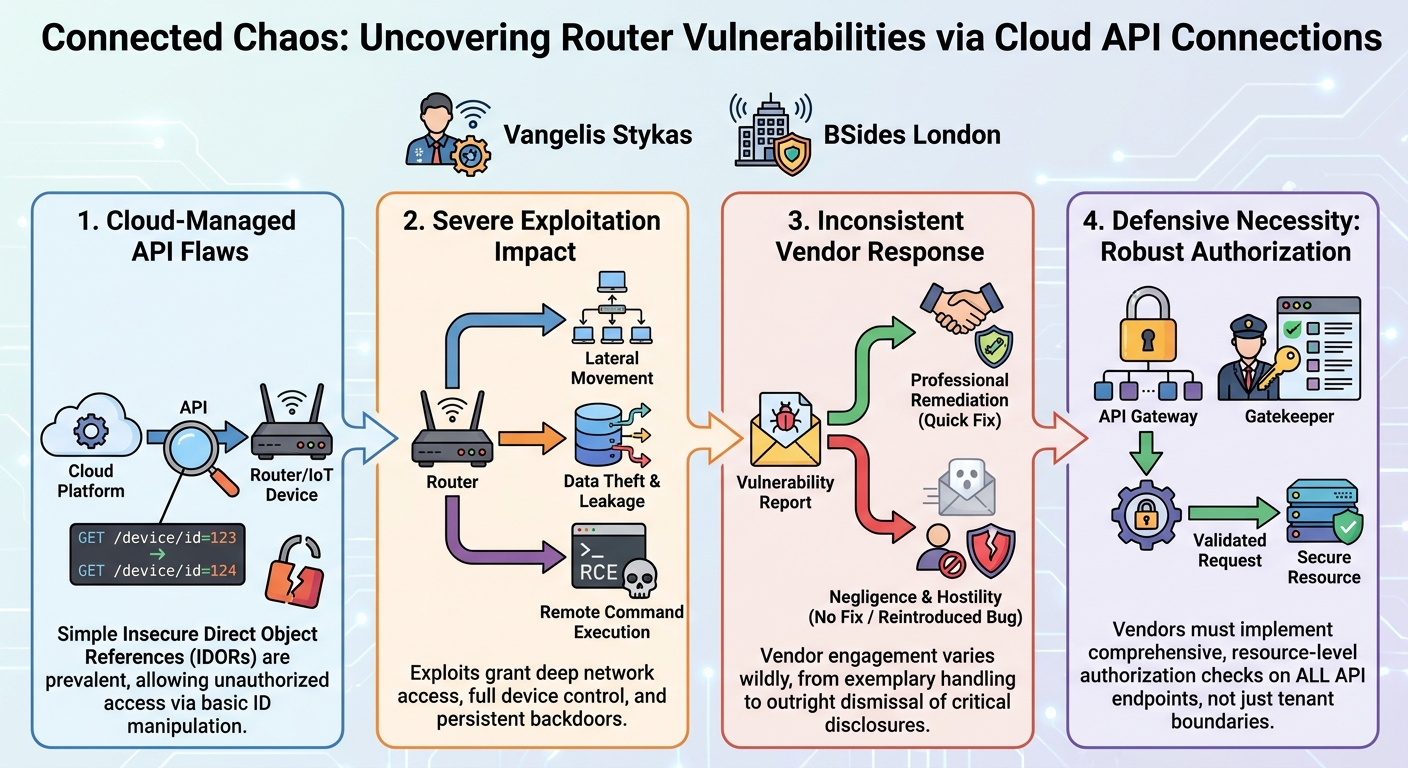
The core of Stykas's presentation revolves around the ease with which these vulnerabilities can be discovered and exploited, primarily through simple Insecure Direct Object References (IDORs). He demonstrates how basic manipulation of integer IDs in API requests can grant attackers administrative control over devices, entire organizations, and even cloud infrastructures. Beyond the technical specifics, the talk critically examines the often-poor and sometimes hostile responses from vendors to responsible vulnerability disclosures, contrasting exemplary vendor behavior with outright negligence and resistance.
This research is particularly significant given the critical role routers play as the gateway to most internal networks, connecting everything from personal devices to corporate infrastructure. A compromise at this level can have devastating consequences, ranging from data theft and network disruption to the establishment of persistent backdoors. Stykas's work serves as a stark warning to both device manufacturers and users about the hidden dangers lurking in the convenience of cloud-managed connectivity, urging a re-evaluation of security practices and disclosure ethics in the IoT and networking industry.
Background
▶ Watch: Talk introduction: Connected Chaos and router vulnerabilities (0:00)
The trend of managing networking devices like routers, Wi-Fi access points, and switches from the cloud has gained significant traction, driven by promises of simplified out-of-band management, enhanced security, ease of scalability, and comprehensive insights. From a vendor's perspective, this model offers a streamlined approach for deploying, configuring, and monitoring devices across diverse environments. However, Vangelis Stykas approaches these advertised benefits with a healthy dose of skepticism, reinterpreting "out-of-band management" as "out-of-band hacking" and questioning the inherent security claims.
Routers, by their very nature, are critical components of any network infrastructure. They provide internet access to all connected devices, often include VPN capabilities for secure point-to-point connections, and act as a primary firewall, controlling access to and from internal networks. Crucially, they typically have access to most, if not all, internal network devices, subnets, and VLANs. This privileged position makes them an incredibly attractive target for attackers, as compromising a router can grant deep access into an organization's or individual's digital ecosystem.
Stykas's research methodology is straightforward yet highly effective. It begins with identifying the cloud URLs associated with various networking device manufacturers. The next step involves creating an account on these cloud platforms, followed by meticulous review of all outgoing network traffic using tools like Burp Suite. The ultimate goal is to "break out" of the legitimate user's account by identifying and exploiting vulnerabilities, primarily IDORs, that allow access to unauthorized devices or services. The primary objectives of these exploits are lateral movement (accessing devices or networks that should be off-limits), accessing other cloud services, and ultimately achieving Remote Command Execution (RCE) on the devices themselves. Stykas emphasizes that his "hacking" often boils down to simple arithmetic – "just counting and changing numbers" – highlighting the basic yet devastating nature of the flaws uncovered.
Key Findings
▶ Watch: Simple hacking: The 'plus one' methodology explained (4:00)
Vangelis Stykas's research paints a concerning picture of the security landscape surrounding cloud-managed networking devices. Across all the devices and cloud platforms he investigated, significant security issues were discovered. A consistent theme emerged: the prevalence of easily exploitable vulnerabilities, primarily Insecure Direct Object References (IDORs), which allowed unauthorized access and control.
Specifically, Stykas found that:
- All of the cloud-managed devices tested exhibited some form of vulnerability.
- All devices allowed for lateral movement, enabling an attacker to access and control devices or network segments beyond their authorized scope.
- All but one of the investigated platforms allowed access to other cloud services that should have been restricted.
- Crucially, all but one of the devices provided a path to Remote Command Execution (RCE), granting attackers full control over the underlying hardware.
The simplicity of these vulnerabilities was a recurring point. Stykas repeatedly described his exploitation method as merely "counting and changing numbers," referring to the predictable, sequential nature of object IDs that could be manipulated in API requests. This "plus one, minus one" approach to IDORs proved incredibly effective, bypassing what vendors often claimed were robust security measures.
Stykas also introduced a "fomer" (fix-o-meter) to rate vendor responses, highlighting a wide spectrum of engagement, from swift and professional remediation to outright neglect and hostility. This aspect of the research underscores not only the technical vulnerabilities but also the critical importance of responsible disclosure practices and vendor accountability in the security ecosystem. The findings collectively suggest that the convenience of cloud management often comes at a steep security cost, leaving critical network infrastructure exposed to relatively unsophisticated attacks.
Technical Deep Dive
▶ Watch: Riggi zero-day: Persistent vulnerability, no company response (11:50)
The technical core of Stykas's presentation revolves around the exploitation of Insecure Direct Object References (IDORs) across various cloud-managed networking platforms. His toolset for this research was surprisingly minimal, consisting primarily of Burp Suite for intercepting and modifying HTTP traffic, Jadx for decompiling Android applications (to understand API calls), a standard web browser, and "enough patience to read through all your Burp logs." Crucially, he relied on a friend who owned the physical devices, ensuring his research remained within legal boundaries.
Stykas detailed five specific vendors, three of which had been disclosed and fixed three years prior to the talk, and two of which remained vulnerable at the time of the presentation.
- Mimosa (Fixed in 2020):
- Mimosa, acquired by Cambium Networks (formerly from NGP), specializes in long-range, high-speed antennas, including those used in military applications. They are easily configurable from their cloud platform.
- Vulnerability: During user registration, Stykas discovered that it was possible to specify an arbitrary
organization IDand assign an administrative role to the newly created user, without requiring any prior membership or authorization within that organization. This meant an attacker could become an administrator on any organization by simply incrementing or decrementing theorganization ID. - Impact: This simple IDOR allowed Stykas to access and control devices, achieve lateral movement across internal networks connected to the antennas, and gain Remote Command Execution (RCE) on all Mimosa antennas.
- Vendor Response: Mimosa received a perfect "fomer" score. The vulnerability was reported on August 7, 2020, fixed by August 10, 2020 (within one business day), and verified by Stykas.
- Grandstream (Reintroduced Bug, Fixed 2023):
- Grandstream is well-known for its PBX and Asterisk servers, having entered the Wi-Fi market a decade ago. Their devices are also cloud-configurable.
- Vulnerability: Similar to Mimosa, Grandstream's cloud platform had an IDOR that allowed an authenticated user to add another user to any
network IDwith anyrole ID. This bypassed authorization checks, granting the attacker arbitrary privileges across different customer networks. - Impact: Exploitation granted the ability to change Wi-Fi passwords, remotely turn off devices, retrieve access point information, obtain SSH passwords, access system logs, and gather comprehensive information about all devices connected to the Wi-Fi network.
- Vendor Response: Initially, Grandstream responded well, fixing the bug within 10 days of the August 7, 2020, report. However, Stykas highlighted a critical flaw in their remediation process: the exact same bug was reintroduced three years later, discovered in January 2023. This time, it took them a month and a half to fix, earning a lower "fomer" score due to the regression.
- SonicWall (Admin in their Cloud, Fixed 2020):
- SonicWall is a prominent cybersecurity company, previously owned by Dell and now by a VC firm, with a valuation in the billions. They provide a range of networking and security products, including SaaS offerings.
- Vulnerability: Stykas found another IDOR where he could add a user to any
partyGroup ID. ThispartyGroup IDwas a simple integer, easily guessable and manipulable. - Impact: This vulnerability granted Stykas administrative access to SonicWall's entire cloud infrastructure, encompassing routers, firewalls, VPNs, security reports, and all their SaaS web applications. He explicitly stated he was "root in their cloud."
- Vendor Response: SonicWall's response was notably poor. Stykas had to chase them three times and eventually escalated the issue directly to their CISO on LinkedIn to get it fixed, which then happened within 48 hours. The CISO's subsequent public statement downplayed the vulnerability's ease of exploitation, claiming it required obtaining a tenant ID that was "fully protected and not publicly available," a claim Stykas refuted given it was a simple integer.
- Ruijie (Zero-Day, Still Vulnerable at Talk Time):
- Ruijie is a major China-based Wi-Fi provider with a valuation of $4.5 billion, boasting significant R&D investment. They produce a wide range of network devices.
- Vulnerability: While Ruijie's cloud platform generally bound requests to specific tenants, Stykas discovered that certain critical API endpoints, particularly those related to remote access, such as
create tunnel, were not tenant-specific. These endpoints used device IDs that were simple, sequential integers. By manipulating these IDs, an attacker could create a tunnel to any device with a lower or higher integer ID. Stykas drew an analogy to AWS, noting that some core services exist outside specific regions, similar to how these Ruijie endpoints existed outside tenant boundaries. - Impact: This severe IDOR allowed access to other devices, internal networks, Remote Command Execution (RCE), VPN access, configuration backups, and ultimately, total control over the router. An attacker could, for example, add their own VPN configuration to a compromised router and connect directly.
- Vendor Response: Despite Stykas's extensive efforts over a year (initial report December 2, 2022; 43+ emails; contact via two journalists; 28 LinkedIn connections; Twitter DMs and mentions; BSides London mention), Ruijie provided no response or fix. A "new design, new experience" update was merely a front-end JavaScript library change, leaving the backend vulnerabilities untouched. Stykas concluded they "don't give a f***" about the issue, and the vulnerability remained active at the time of his talk.
- Wi-Tek (Zero-Day, Still Vulnerable at Talk Time):
- Wi-Tek, a subsidiary of Wireless Tech, is an Italian company founded in 2008, focusing on CCTV, Wireless ISP, WLAN, and fiber networking solutions. They launched their cloud SaaS in 2018.
- Vulnerability: Wi-Tek's cloud platform suffered from a complete lack of authorization checks. Stykas described it as "no kind of authorization, every ID, every parameter is no parameter is at all checked at any point." This meant an attacker could simply change any ID or parameter to view and control other users' devices.
- Impact: This total absence of authorization led to unfettered access to devices, internal networks, Remote Command Execution (RCE), data leakage, and "root" access within their account.
- Vendor Response: Wi-Tek's disclosure process was described as "a little bit better" but ultimately hostile. Stykas reported the issue on March 2, 2023, via their help desk, but the case was automatically closed on April 2. Subsequent re-reports on June 2 also resulted in case closure, followed by an email stating his email address was "banned." Further attempts via email, Twitter, and LinkedIn resulted in no response, and one employee even blocked him. Like Ruijie, Wi-Tek demonstrated a complete disregard for the reported vulnerabilities, which remained unpatched.
These detailed case studies underscore the pervasive nature of IDORs in cloud-managed infrastructure and the critical need for robust authorization mechanisms that extend beyond simple tenant IDs or basic authentication.
Demo / Proof of Concept
▶ Watch: How companies should handle vulnerability disclosures (19:15)
While the talk did not feature a live, interactive demonstration of exploiting these vulnerabilities in real-time on stage, Vangelis Stykas effectively conveyed the proof of concept through detailed descriptions of his findings and the specific API requests involved. He presented the vulnerabilities with screenshots of Burp Suite requests, highlighting the parameters that could be manipulated (e.g., organization ID, network ID, partyGroup ID, device IDs for create tunnel).
Stykas's presentation itself served as a compelling demonstration of the existence and exploitability of these flaws. For each vendor, he clearly outlined:
- The specific API endpoint or user action that contained the vulnerability.
- The parameter(s) that could be altered (e.g., changing
id=5toid=8). - The immediate impact of the manipulation (e.g., becoming an admin, gaining RCE, accessing other users' data).
- The communication and timeline of his disclosure efforts, including the lack of response from certain vendors, which implicitly demonstrated that the vulnerabilities remained active.
By walking through the simple "counting and changing numbers" methodology, Stykas made it clear that these were not complex, chained exploits but rather fundamental authorization bypasses. The detailed accounts of gaining administrative access to entire cloud infrastructures (SonicWall) and achieving Remote Command Execution on critical devices (Mimosa, Grandstream, Ruijie, Wi-Tek) served as strong evidence of the successful proof of concept for each identified vulnerability.
Defensive Implications
▶ Watch: Q&A: Worst industry for vulnerability disclosure interaction (28:30)
The findings presented by Vangelis Stykas carry significant defensive implications for both vendors of cloud-managed networking devices and the organizations or individuals who deploy them.
For Vendors:
- Implement Robust Authorization Checks: This is the most critical takeaway. Vendors must ensure that every API endpoint, especially those dealing with object IDs or sensitive actions, has comprehensive authorization checks. Reliance on simple
tenant IDsor basic authentication is insufficient. All parameters that refer to resources (users, organizations, devices, networks) must be validated to ensure the requesting user is authorized to interact with that specific resource. This directly addresses the pervasive IDOR issues. - Adopt Secure Software Development Lifecycle (SSDLC): Integrate security from design to deployment. Regular code reviews, automated security testing (SAST/DAST), and penetration testing are essential to catch vulnerabilities like IDORs before they reach production.
- Establish a Clear Security Contact: Provide an easily discoverable and monitored security email address or dedicated portal for vulnerability reports. This reduces friction for researchers and ensures reports are received promptly by the right team.
- Respond Promptly and Professionally: Acknowledge vulnerability reports within days, not weeks or months. Provide a timeline for investigation and remediation. Communicate transparently with researchers throughout the process.
- Avoid Reintroducing Fixed Bugs: Implement robust regression testing to prevent previously patched vulnerabilities from reappearing in future releases, as seen with Grandstream.
- Issue CVEs and Security Advisories: When vulnerabilities are fixed, issue CVEs (even for cloud-based services, despite the stated difficulty) and detailed security advisories or change logs. This informs users of the risks and helps them verify that their devices are patched.
- Consider Bug Bounties: While Stykas stated he didn't seek money, offering a bug bounty program can incentivize researchers and demonstrate a commitment to security. If not a bounty, at least acknowledge the researcher's efforts.
For Users and Organizations:
- Exercise Due Diligence in Vendor Selection: "Vote with your money." Prioritize vendors with a proven track record of quick, professional, and transparent responses to security vulnerabilities, like Mimosa. Avoid vendors who are unresponsive or hostile, such as Ruijie and Wi-Tek.
- Understand the Attack Surface: Recognize that cloud-managed routers introduce a new, potentially broader attack surface. The security of your internal network now depends not only on your local configurations but also on the security posture of the vendor's cloud platform.
- Evaluate Necessity of Cloud Management: If out-of-band management is not strictly required for your operational needs, consider disabling cloud management features where possible, or opting for devices that do not rely on it.
- Isolate Critical Networks: Implement strong network segmentation. Even if a router is compromised, lateral movement should be restricted to prevent an attacker from reaching sensitive systems.
- Regularly Update Firmware: While cloud vulnerabilities are often on the vendor's side, keeping device firmware updated is still crucial for patching local vulnerabilities.
- Monitor Network Traffic: Implement network monitoring solutions to detect unusual traffic patterns or unauthorized access attempts that might indicate a compromised router.
- Understand Disclosure Risks: Be aware that some vendors may not fix publicly disclosed vulnerabilities, leaving your devices exposed. This reinforces the need for careful vendor selection.
Ultimately, the talk serves as a call for greater accountability from manufacturers and increased vigilance from users, recognizing that the "connected chaos" of insecure devices poses a significant and ongoing threat.
Key Takeaways
- Cloud-managed networking devices are a critical attack surface: The convenience of cloud control often comes at the cost of significant security vulnerabilities, making routers and access points prime targets for attackers seeking deep network access.
- IDORs are a prevalent and easily exploitable flaw: Many cloud platforms suffer from basic Insecure Direct Object References (IDORs), allowing attackers to gain unauthorized access and control over other users' devices or entire cloud infrastructures through simple manipulation of integer IDs in API requests.
- Vendor response to vulnerability disclosures varies wildly: From excellent (Mimosa) to reintroducing fixed bugs (Grandstream), and outright negligence or hostility (Ruijie, Wi-Tek), the lack of consistent and professional disclosure handling exacerbates the risk.
- Simple exploitation can lead to severe impact: Basic "plus one, minus one" techniques can result in Remote Command Execution (RCE), full administrative control, data leakage, and extensive lateral movement within compromised networks.
- Robust authorization is paramount: Vendors must implement comprehensive authorization checks for all API endpoints and parameters, moving beyond superficial tenant-level restrictions to validate user permissions for every resource access.
- Choose vendors carefully and be prepared to disable cloud features: Users should prioritize vendors with strong security track records and responsive disclosure policies. If cloud management is not essential, consider disabling it or opting for alternative solutions to mitigate the inherent risks.
About the Speaker(s)
Vangelis Stykas is the Chief Technology Officer (CTO) at Tremau, a firm specializing in web application security penetration testing. He is also a dedicated security researcher with a keen interest in API security, IoT (Internet of Things), and general cybersecurity topics. In the past year, his research has also extended to tracking malware and its C2 (Command and Control) infrastructure. Stykas is known for his practical, hands-on approach to security research, often focusing on fundamental vulnerabilities that can be easily overlooked. He can be found on Twitter (or X) at @tv_stickers, and his personal website is stickers.com, though he notes it is not regularly updated.
Reviews
Dr. Zero (Offensive Security Researcher) — STRONG ACCEPT
Vangelis Stykas drops a reality check on why 'cloud-managed infrastructure' is usually just a fancy way of saying 'we exposed an unauthenticated web app to the entire internet.' It’s not deep reverse engineering, but using basic IDORs to root SonicWall’s entire cloud environment and drop unpatched zero-days for Ruijie is exactly the kind of ground-truth signal we need on stage.
Heather Calloway (CISO) — MUST SEE
Stykas demonstrates that the control planes for cloud-managed networking gear are riddled with elementary authorization failures. For security leadership, this isn't just an API bug report—it's a systemic failure in how we procure and manage edge infrastructure. I'd make this required viewing for any network architect pushing to move our hardware management to vendor-hosted SaaS.