Cyber Mind Tricks
Ant Murray
Christchurch Hacker Conference 2025 · Main Stage
Overview
In the realm of cybersecurity, the conventional wisdom often dictates that a significant breach or a looming threat is the most effective catalyst for driving security investment and behavioral change. As speaker Ant Murray aptly puts it, "Never let a good crisis go to waste." However, this talk, "Cyber Mind Tricks," challenges that reactive paradigm, proposing that security professionals can proactively influence organizational behavior and decision-making by leveraging a deeper understanding of human psychology. Murray, holding a Master's degree in psychology, presents a compelling case for moving beyond fear-based tactics and instead embracing the "force of influence" – a suite of psychological principles and communication strategies designed to foster trust, collaboration, and a genuine desire for improved security.
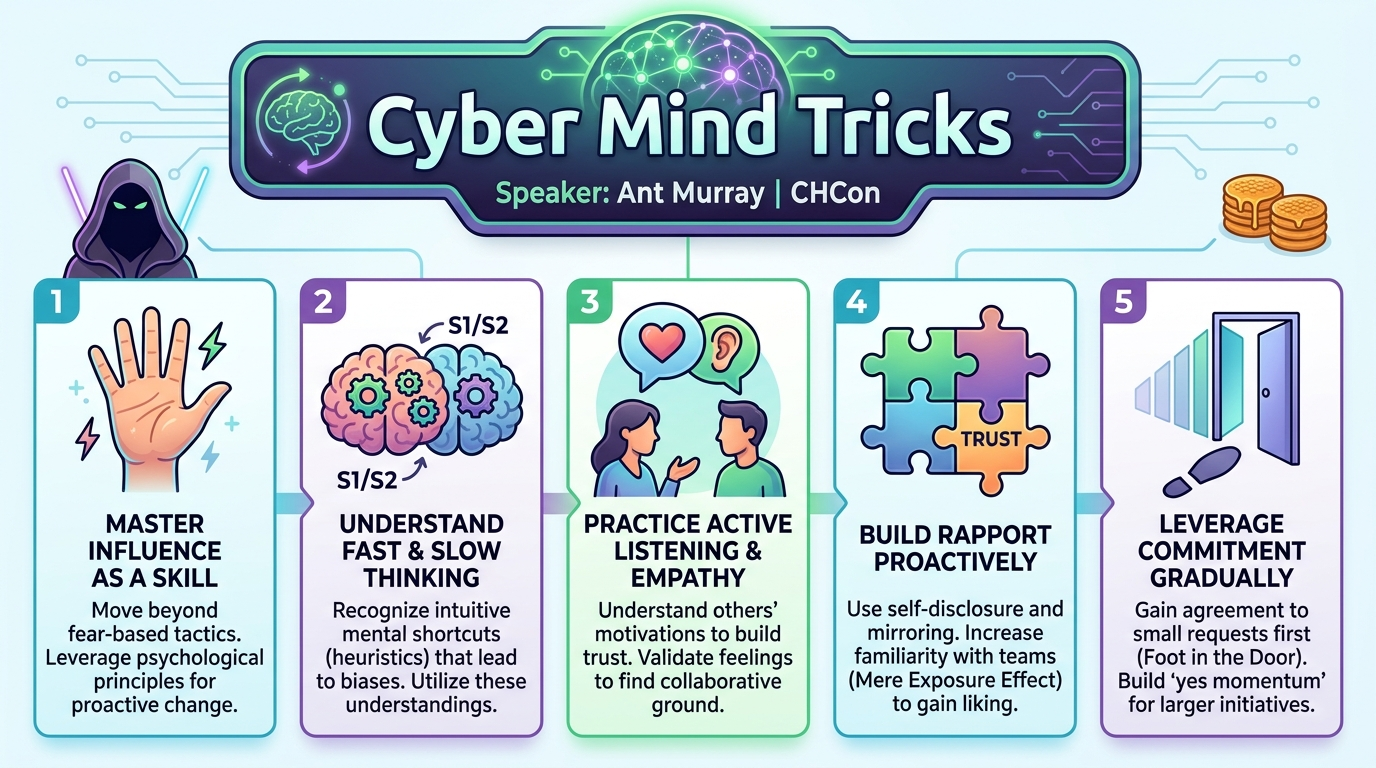
Key moments
- 0:30 Using human hacks to influence security decisions
- 3:00 Understanding fast/slow thinking and cognitive biases
- 9:30 Mastering active listening and empathy for collaboration
- 12:20 Building trust through self-disclosure and mirroring
- 15:20 Leveraging reciprocity and commitment biases
- 18:40 Applying influence techniques in a security scenario
Cyber Mind Tricks
Speakers: Ant Murray
Conference: CHCon
YouTube: https://www.youtube.com/watch?v=dxqV39RD74Y
Overview
In the realm of cybersecurity, the conventional wisdom often dictates that a significant breach or a looming threat is the most effective catalyst for driving security investment and behavioral change. As speaker Ant Murray aptly puts it, "Never let a good crisis go to waste." However, this talk, "Cyber Mind Tricks," challenges that reactive paradigm, proposing that security professionals can proactively influence organizational behavior and decision-making by leveraging a deeper understanding of human psychology. Murray, holding a Master's degree in psychology, presents a compelling case for moving beyond fear-based tactics and instead embracing the "force of influence" – a suite of psychological principles and communication strategies designed to foster trust, collaboration, and a genuine desire for improved security.
Ant Murray's presentation is a refreshing departure from purely technical cybersecurity discussions, shifting focus to the often-underestimated human element. She argues that while advanced tools and robust policies are crucial, their efficacy is severely limited if people are unwilling to adopt them or prioritize security. The talk aims to equip security practitioners with "human hacks" – conscious applications of psychological heuristics and biases – to "nudge people in the right direction and convince our organizations and leadership to make better security decisions." This approach underscores the idea that cyber risk is just business risk in a black hoodie, emphasizing the need to articulate security value in terms that resonate with business objectives and human motivations.
The core message of "Cyber Mind Tricks" is that true influence stems not from wielding authority or instilling fear, but from building strong relationships, establishing credibility, and understanding the intricate workings of the human mind. By doing so, security professionals can cultivate a proactive security culture, securing buy-in for initiatives long before a crisis forces the issue. This talk provides a practical "Jedi training" in the art of persuasion, offering a robust toolkit for transforming resistant stakeholders into enthusiastic allies, thereby significantly enhancing an organization's overall security posture.
Background
▶ Watch: Using human hacks to influence security decisions (0:30)
The persistent challenge in cybersecurity often lies not in identifying technical vulnerabilities, but in securing the necessary resources, attention, and behavioral changes from individuals and leadership. Traditional approaches frequently rely on fear, authority, or the aftermath of a security incident to push agendas. However, as Murray points out, "Darth Vader rules with fear, authority, and power," but "you will convince more Ewoks to join you in battle with honey cakes than you will with blasters." This analogy highlights a fundamental problem: people are often resistant to directives, especially when they perceive them as inconvenient or an added workload, leading to a disconnect between security mandates and actual adoption.
This resistance stems from inherent aspects of human cognition and social dynamics. To address this, Murray introduces foundational concepts from behavioral economics and social psychology. Central to her framework is Nobel Prize winner Daniel Kahneman's 2011 model of fast and slow thinking, which posits two systems for information processing:
- System 1: Fast, automatic, intuitive, and relies on gut feelings. This system is efficient for everyday decisions but prone to biases.
- System 2: Slow, deliberate, and cognitively taxing, used for complex analysis and weighing information.
Our brains, facing hundreds of decisions daily, rely heavily on mental shortcuts or heuristics to conserve energy. While these heuristics are efficient, they can lead to predictable biases and errors in judgment. Understanding these shortcuts is key to influencing behavior.
Another critical concept is cognitive dissonance, the discomfort experienced when one's thoughts, feelings, and actions are misaligned. Humans are motivated to reduce this dissonance by changing beliefs or modifying behavior. Murray illustrates this with the example of Lando Calrissian, who, after betraying Han Solo, experiences dissonance between his self-perception as a good friend and his actions, leading him to help Leia and Chewbacca escape.
Finally, the need to belong is highlighted as a fundamental human drive. As evolutionary survivors, humans are predisposed to seek in-groups for safety and support. This manifests as the similarity effect, where we are drawn to people who seem like us, assuming trustworthiness and competence. These innate psychological mechanisms form the bedrock upon which effective influence strategies can be built, offering a more nuanced and successful alternative to top-down, fear-based security mandates.
Key Findings
▶ Watch: Mastering active listening and empathy for collaboration (9:30)
The central finding of "Cyber Mind Tricks" is that influencing security outcomes effectively requires a conscious shift from a power-based, crisis-driven model to a relationship-based, psychologically informed approach. Murray demonstrates that by understanding and leveraging inherent human biases and social needs, security professionals can build trust, foster collaboration, and proactively drive security adoption without waiting for a breach.
The talk identifies several key psychological principles that, when consciously applied, form the bedrock of this "force of influence":
- Harnessing Heuristics for First Impressions: People make rapid, unconscious judgments based on limited information. Concepts like stereotypes, anchoring bias (giving disproportionate weight to initial information), and the halo effect (assuming competence in one area implies competence in others) dictate initial perceptions. Security professionals can strategically manage first impressions and demonstrate excellence in specific areas to create a positive halo that generates goodwill and makes others more receptive.
- The Power of Communication and Empathy: Effective influence begins with understanding the other party's motivations and needs. Active listening (listening carefully and paraphrasing to confirm understanding) and empathy (seeing things from another's perspective and acknowledging their emotions) are crucial for de-escalating frustration, validating feelings, and identifying underlying issues. Furthermore, framing information positively (positive reframing) empowers individuals rather than restricting them, turning challenges into manageable tasks.
- Building Rapport and Trust through Connection: Trust is the currency of influence. Murray details techniques to consciously build rapport:
- Self-disclosure: Appropriately revealing personal information or struggles fosters deeper connections, making one seem more human and trustworthy, tapping into the need to belong and triggering cognitive dissonance (if they're opening up to me, we must be closer).
- Mere exposure effect: Increased familiarity leads to increased liking and a sense of safety.
- Mirroring: Subtly copying body language, tone, or gestures creates a subconscious sense of similarity and comfort, making others feel part of the same "in-group."
- Leveraging Commitment and Consistency: Once people commit to something, especially publicly, they feel internal pressure to remain consistent with their past behavior. This can be strategically leveraged through:
- Reciprocity: People feel obliged to return favors. Offering small, upfront help creates a sense of obligation.
- Benjamin Franklin effect: Asking someone for a small favor makes them more likely to favor you, as their brain justifies their action by increasing their liking for you.
- Foot in the door: Gaining agreement to small requests makes it significantly easier to secure agreement for larger, subsequent requests, building "yes momentum."
- Sunk cost fallacy: Once resources (time, effort, money) are invested, individuals are more likely to continue an endeavor, even if it's no longer rational, to avoid the perception of wasted investment.
These findings collectively present a comprehensive playbook for security professionals to become "Jedi masters" of influence, transforming their interactions from adversarial to collaborative and ultimately securing better security outcomes.
Technical Deep Dive
▶ Watch: Building trust through self-disclosure and mirroring (12:20)
While "Cyber Mind Tricks" does not delve into traditional technical aspects like code vulnerabilities or network protocols, its "technical deep dive" is into the intricate mechanisms of human psychology and behavioral economics, providing a scientific basis for influence. The talk systematically dissects how various cognitive processes and social needs can be consciously leveraged to achieve security objectives.
The foundation of Murray's approach lies in System 1 and System 2 thinking, as articulated by Daniel Kahneman. System 1 operates on heuristics – mental shortcuts that allow for rapid decision-making. These heuristics, while efficient, are also the source of common cognitive biases. Murray elaborates on several key biases:
- Stereotypes: Unconscious generalizations about individuals based on perceived group characteristics, making information processing easier but often leading to faulty judgments.
- Anchoring Bias: The disproportionate weight given to the first piece of information received, which then serves as a mental "anchor" for all subsequent judgments. This can be exploited to set a positive initial impression.
- Halo Effect: The tendency to assume positive traits in one area imply positive traits in others. Excelling in a visible aspect of work can create a "halo" that generates goodwill, making people more forgiving of minor imperfections or more receptive to proposals.
Beyond individual cognition, the talk explores social psychology concepts critical for interpersonal influence. Cognitive dissonance is a powerful motivator; when a person's beliefs, values, and actions conflict, they experience discomfort and are driven to resolve it. This can be used to encourage behavioral change by gently highlighting inconsistencies. The need to belong is another fundamental drive, leading humans to seek in-groups and trust those perceived as similar. The similarity effect is a direct manifestation of this, where shared traits foster affinity and assumed trustworthiness.
The "technical" application of these principles involves specific communication and interaction techniques:
- Active Listening and Empathy: These are not mere soft skills but critical information-gathering and rapport-building tools. Active listening involves deliberately focusing on the speaker, asking clarifying questions, and paraphrasing their message back to them. This ensures accurate understanding, prevents assumptions, and, crucially, satisfies the speaker's need to be heard, which can de-escalate emotional responses. Empathy requires understanding the speaker's perspective and emotions, validating their feelings ("that sounds really frustrating"), even if one doesn't agree. This reduces defensiveness and opens the door to collaboration.
- Framing and Positive Reframing: The way information is presented significantly impacts its reception. Framing involves choosing specific aspects of an argument to emphasize. For instance, Grand Moff Tarkin could frame a choice as "Cooperate and your people will live" (gain frame) or "Resist and I will destroy your planet" (loss frame), both conveying the same information but eliciting different emotional responses. Positive reframing specifically transforms negative, restrictive language ("can't," "don't") into empowering, constructive language ("can," "do"), fostering a problem-solving mindset.
- Building Rapport:
- Self-disclosure: Appropriately sharing personal information (e.g., struggles with a project, a hobby) makes one appear more human and trustworthy. This subtly signals that the other person is part of one's "in-group," triggering cognitive dissonance where they re-evaluate the depth of their connection.
- Mere Exposure Effect: Simply increasing positive, repeated contact with individuals or teams leads to increased liking and a sense of safety. Familiarity, in this context, breeds comfort, not contempt.
- Mirroring: Subtly mimicking another person's body language, gestures, or tone of voice creates a subconscious sense of similarity, leveraging the similarity effect to build rapport. Conscious mirroring can even influence others to adopt more open postures, subtly shifting their cognitive state.
- Leveraging Commitment and Consistency:
- Reciprocity: This is a fundamental social norm where people feel obliged to return favors. Offering a small, unexpected favor (e.g., reviewing a document, helping with a task) creates a subconscious sense of obligation in the recipient.
- Benjamin Franklin Effect: Counter-intuitively, asking someone for a small favor can make them like you more, especially if they were previously neutral or disliked you. Their brain resolves the cognitive dissonance of doing a favor for someone they don't like by deciding they must like that person.
- Foot in the Door: This technique involves making a small, easily accepted request first. Once that is granted, a larger, related request is made. The initial agreement creates a psychological commitment, making the person more likely to agree to subsequent, larger requests to maintain consistency with their prior behavior.
- Sunk Cost Fallacy: This bias describes the tendency to continue investing in an endeavor once resources (time, money, effort) have been committed, even if continuing is no longer rational. People feel an internal pressure to justify past investments and avoid the perception of waste. This can be leveraged by getting early, small commitments and investments from stakeholders.
By dissecting these "cyber mind tricks" at a granular level, Murray provides a robust framework for security professionals to influence behavior with precision and predictability, transforming the human element from a vulnerability into a strategic asset.
Demo / Proof of Concept
▶ Watch: Leveraging reciprocity and commitment biases (15:20)
While "Cyber Mind Tricks" doesn't feature a live code demo or a traditional penetration test, its "demo" is a powerful, practical application of all the discussed psychological principles in a real-world cybersecurity scenario. Murray walks through a hypothetical but highly relatable situation: convincing a resistant team that doesn't prioritize security to do some work for the security team. This serves as a comprehensive proof of concept for the "force of influence."
The scenario unfolds as a step-by-step strategic engagement:
- Initial Outreach (Anchoring & Framing): Instead of issuing a directive, the security professional (the "Jedi") initiates contact by asking to attend the other team's meeting. The request is framed as "to find out more about what they do and how we can work closer together." This establishes an anchor of collaboration and frames the engagement as mutual support, not an increased workload.
- Building Goodwill (Reciprocity & Halo Effect): The Jedi brings snacks to the meeting. This small, unexpected gesture triggers reciprocity, making the team subconsciously feel obliged to return the favor. It also contributes to a positive halo effect, associating the security person with generosity and positive experiences.
- Establishing Connection (Mirroring & Mere Exposure Effect): During the meeting, the Jedi gently mirrors the team's body language and tone, subtly creating a sense of similarity and comfort. Afterward, the Jedi seeks opportunities for casual conversations around the office, leveraging the mere exposure effect to increase familiarity and liking through repeated, positive contact.
- Understanding Needs (Empathy & Active Listening): In these casual chats, the Jedi employs empathy and active listening. They acknowledge the team's perspective ("I can hear that you're disappointed about this") and listen carefully to understand what truly drives them, their goals, and their frustrations. This builds trust and provides crucial insights into how security can be aligned with their objectives.
- Initiating Commitment (Self-Disclosure, Benjamin Franklin Effect, Foot in the Door):
- If appropriate, the Jedi might self-disclose a minor professional struggle or a hobby, making them seem more human and relatable, fostering a deeper connection.
- Alternatively, or in conjunction, the Jedi might ask for a small favor, utilizing the Benjamin Franklin effect: "Can you show me how to do this thing?" or "I'd like your expert opinion on this discussion I'm having with a customer." This not only flatters them but also causes them to subconsciously justify their helpfulness by increasing their liking for the security professional.
- These small favors act as the "foot in the door," initiating a pattern of agreement.
- Gradual Escalation (Foot in the Door & Sunk Cost Fallacy): With initial small commitments secured, the Jedi gradually increases the size of their requests. This builds "yes momentum," making it psychologically harder for the team to refuse later, larger asks due to the commitment bias. As the team invests more time and effort, the sunk cost fallacy kicks in: they become more invested in the new plan, perceiving it as a waste to stop now.
By meticulously applying these psychological "mind tricks," the security professional transitions from an outsider making demands to a trusted collaborator who understands the team's goals and helps them achieve those goals. This practical demonstration highlights how a structured, psychologically informed approach can secure buy-in and achieve desired security outcomes where traditional methods might fail.
Defensive Implications
▶ Watch: Applying influence techniques in a security scenario (18:40)
The defensive implications of "Cyber Mind Tricks" are profound, extending beyond mere technical controls to fundamentally reshape how security professionals engage with people across an organization. By mastering the "force of influence," defenders can move from a reactive, crisis-driven posture to a proactive, integrated, and genuinely collaborative security culture.
- Proactive Security Program Development: Instead of waiting for a breach to justify new tools or headcount, security leaders can use influence techniques to build trust and demonstrate value upfront. By actively listening to business leaders, understanding their priorities, and framing security in terms of business enablement and risk reduction (rather than just technical jargon), they can secure buy-in for strategic initiatives like new security information and event management (SIEM) systems, endpoint detection and response (EDR) solutions, or dedicated security teams. Leveraging the Benjamin Franklin effect by asking for small, easily granted favors (e.g., reviewing a security policy draft for business impact) can turn indifferent executives into allies.
- Enhancing User Security Hygiene: Traditional security awareness training often relies on fear or compliance, leading to disengagement. By applying principles like positive reframing, security teams can present security behaviors as empowering ("You can protect our data by using strong passwords") rather than restrictive ("Don't use weak passwords"). Self-disclosure (e.g., a security professional admitting a past security slip-up) can make security advice more relatable. The mere exposure effect suggests that consistent, positive reinforcement of security messages, rather than sporadic warnings, will lead to better adoption.
- Fostering Cross-Functional Collaboration: The "demo" scenario explicitly shows how to influence a resistant team. This is critical for DevSecOps adoption, secure software development lifecycles (SSDLC), and incident response. By using active listening and empathy to understand development or operations teams' constraints and goals, security can frame its requirements as solutions to their problems (e.g., "This automated security scan will save you time in debugging later" instead of "You must run this scan"). Mirroring and finding common ground through the similarity effect can break down silos and build bridges between security and other departments.
- Improving Incident Response and Crisis Management: Even during a crisis, influence is crucial. An incident response team that has established trust and rapport through consistent application of these principles will find stakeholders more cooperative and less prone to panic. Framing communications carefully can manage expectations and reduce anxiety, while active listening can ensure all concerns are heard and addressed, improving decision-making speed and effectiveness.
- Building a Security-First Culture: Ultimately, the goal is to embed security thinking into the organizational DNA. This requires more than policies; it demands a shift in perception and motivation. By consistently applying techniques like reciprocity (offering help proactively), the foot in the door (starting with small, achievable security asks), and leveraging the sunk cost fallacy (getting early, small investments in security projects), security professionals can gradually make security an integrated, valued part of everyone's job, rather than an external imposition.
- Mitigating Insider Risk: Understanding human motivation and cognitive biases can also inform strategies for mitigating insider threats. By fostering a culture of psychological safety, open communication, and belonging, organizations can reduce the likelihood of employees feeling isolated or disenfranchised, which can sometimes be precursors to malicious insider activity.
In essence, "Cyber Mind Tricks" empowers security professionals to be more than just technical experts; it trains them to be strategic communicators and influencers, capable of navigating the complex human landscape of an organization to build a stronger, more resilient security posture from the inside out.
Key Takeaways
- Influence is a Core Security Skill: Effective cybersecurity extends beyond technical expertise; it fundamentally relies on the ability to influence people, secure buy-in, and drive behavioral change across the organization.
- Leverage Human Psychology: Move beyond fear-based tactics by understanding and consciously applying principles from behavioral economics and social psychology, such as Daniel Kahneman's System 1 and System 2 thinking, cognitive dissonance, and the need to belong.
- Build Trust and Rapport Proactively: Prioritize establishing strong relationships through techniques like active listening, empathy, self-disclosure, mirroring, and the mere exposure effect to foster a collaborative environment.
- Strategic Communication is Key: Frame security messages positively using positive reframing and tailor your arguments to align with others' goals and motivations, rather than dictating requirements.
- Gradual Commitment Drives Action: Utilize techniques like reciprocity, the Benjamin Franklin effect, and the foot in the door strategy to gain small commitments that build momentum towards larger security initiatives, leveraging the sunk cost fallacy to maintain investment.
- Don't Wait for a Crisis: Security professionals can proactively shape organizational behavior and secure resources by becoming "Jedi masters" of influence, fostering a robust security culture before a breach forces the issue.
About the Speaker(s)
Ant Murray is a cybersecurity professional with a distinctive background rooted in human psychology. She holds a Master's degree in psychology, where her academic focus included the dynamics of social groups and the intricacies of romantic relationships. This unique perspective fuels her professional passion for understanding "how people's brains tick, what motivates them, and how interpersonal relationships influence us." In her career, Ant has excelled at bridging the gap between complex cyber risks and business leadership, making security concepts accessible and relevant. She is also dedicated to helping everyday individuals improve their basic security hygiene, demonstrating her commitment to practical, people-centric security solutions.
Reviews
Dr. Zero (Offensive Security Researcher) — SOLID
A competent intro to applying Cialdini-style influence principles in security contexts. Nothing new if you've read Influence or taken a sales course, but delivered clearly enough that it'll help junior practitioners who haven't been exposed to this material. Perfectly fine community conference slot; not a research talk.
Heather Calloway (CISO) — SOLID
Useful primer on stakeholder management for junior-to-mid security professionals who haven't been formally taught influence skills. Competent delivery of well-established psychology concepts, but nothing here will surprise anyone who's read Cialdini or spent a decade negotiating budget with a CFO.