Bypassing Wireless Client Isolation
Ben Knight (Zante) (Senior Security Consultant · Pulse Security)
Christchurch Hacker Conference 2025 · Main Stage
Overview
In this insightful CHCon presentation, Ben Knight, also known as Zante, a Senior Security Consultant at Pulse Security, delves into a critical flaw in a widely relied-upon wireless security feature: client isolation. This talk illuminates how attackers can circumvent the intended separation between wireless clients on the same network, a feature commonly deployed in environments like coffee shops, corporate guest Wi-Fi, and BYOD networks to prevent clients from interacting directly with each other. The core premise of client isolation is to safeguard users from potentially malicious or insecure devices on the same shared network, ensuring that traffic only flows to and from the internet via the access point, not between clients.
Key moments
- 0:00 Introduction and purpose of client isolation
- 2:30 Core concept: bypassing AP with direct client-to-client communication
- 5:00 Critical 'from DS' bit for crafting frames
- 6:30 Handling WPA/WPA2 encryption for the attack
- 12:00 Demo: Bypassing client isolation on an open network
- 16:00 Demo: Full VNC access on a WPA2 network
- 19:00 Mitigations: WPA3, Enterprise Auth, Private PSK
Bypassing Wireless Client Isolation
Speakers: Ben Knight (Zante), Senior Security Consultant, Pulse Security
Conference: CHCon
YouTube: https://www.youtube.com/watch?v=KVDKxdL3FCk
Overview
In this insightful CHCon presentation, Ben Knight, also known as Zante, a Senior Security Consultant at Pulse Security, delves into a critical flaw in a widely relied-upon wireless security feature: client isolation. This talk illuminates how attackers can circumvent the intended separation between wireless clients on the same network, a feature commonly deployed in environments like coffee shops, corporate guest Wi-Fi, and BYOD networks to prevent clients from interacting directly with each other. The core premise of client isolation is to safeguard users from potentially malicious or insecure devices on the same shared network, ensuring that traffic only flows to and from the internet via the access point, not between clients.
Knight's presentation meticulously details the technical methodology for bypassing this control. He demonstrates that by leveraging the inherent broadcast nature of Wi-Fi and the capabilities of a monitor mode wireless adapter, an attacker can establish direct client-to-client communication, entirely bypassing the access point's isolation mechanisms. This bypass works not only on open, unencrypted networks but also on WPA and WPA2-protected networks, provided the attacker can obtain the necessary encryption keys. The findings presented in this talk are crucial for network defenders, as they challenge the assumption that client isolation provides a robust security boundary, necessitating a re-evaluation of network security strategies in shared wireless environments.
Background
▶ Watch: Introduction and purpose of client isolation (0:00)
Client isolation is a fundamental security control designed to prevent unauthorized communication between devices connected to the same wireless network. Its primary purpose is to mitigate risks in shared or untrusted environments, such as public Wi-Fi hotspots, guest networks, or bring-your-own-device (BYOD) segments within organizations. The typical expectation is that when client isolation is active, a packet sent from one client intended for another client on the same network will be intercepted and dropped by the access point (AP). This ensures that even if a client is running an insecure service, like a VNC server without a password, or has unpatched vulnerabilities, other clients on the network cannot directly exploit it. The communication path is strictly client-to-AP-to-internet, or AP-to-client from the internet, but never direct client-to-client.
The necessity for client isolation arises from the potential for lateral movement and exploitation within a flat network segment. Without it, a malicious actor could easily scan for vulnerable services, launch attacks, or simply snoop on traffic between other clients. While essential, the underlying assumption that the AP is the sole arbiter of client-to-client communication within the wireless medium is where the vulnerability lies. Unlike wired networks, where switches physically isolate ports, Wi-Fi operates over radio frequencies, meaning all clients within range can "hear" each other's transmissions. This inherent characteristic, combined with the capabilities of modern wireless adapters, forms the bedrock of the bypass technique explored in this talk. Previous work in Wi-Fi security, including "router Wi-Fi hacking" mentioned by Knight, often focuses on attacking the AP itself. This talk, however, shifts the focus to directly attacking clients by manipulating how Wi-Fi frames are interpreted, thereby challenging the efficacy of a widely deployed security feature.
Key Findings
▶ Watch: Critical 'from DS' bit for crafting frames (5:00)
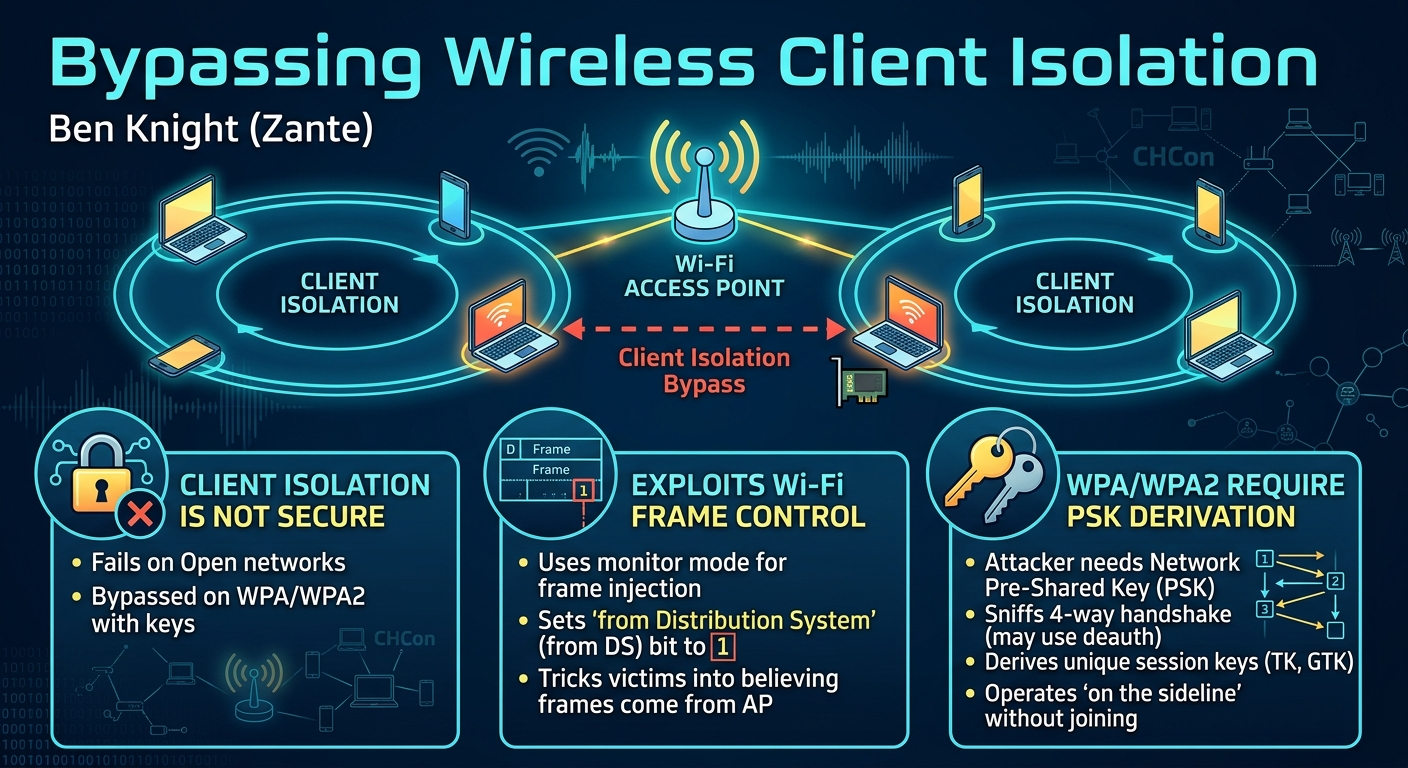
The central discovery presented by Ben Knight is that client isolation, a common security measure on wireless networks, can be effectively bypassed through direct client-to-client communication over the air. This circumvents the access point's role in enforcing isolation and allows an attacker to interact with other clients as if they were on an unisolated network segment. The core of this bypass relies on two fundamental characteristics of Wi-Fi:
- Radio Frequency Communication: Unlike wired networks, Wi-Fi traffic exists as radio waves in the air. This allows any device with a compatible wireless adapter operating in monitor mode to both passively sniff all frames transmitted within range and actively inject custom-crafted frames.
- Frame Control Field Manipulation: A critical component of the 802.11 Wi-Fi standard is the frame control field, specifically the "from Distribution System" (from DS) bit. By setting this bit to
1in injected frames, the attacker can trick a victim client into believing that the frame originated from the access point itself, rather than another client. This is crucial because standard client frames (from DS = 0) would typically be ignored by other clients in an isolated network, as they are expected to communicate via the AP.
This technique has been demonstrated to be effective against:
- Open (unencrypted) Wi-Fi networks: The most straightforward scenario, where no encryption keys are needed.
- WPA/WPA2 encrypted Wi-Fi networks: While more complex, the bypass is still feasible. It requires the attacker to obtain the Temporal Key (TK) and Group Temporal Key (GTK), which are derived during the four-way handshake when a client connects to the AP. These keys can be captured by sniffing the handshake, often facilitated by deauthenticating a client to force a reconnection. The attacker needs the Pre-Shared Key (PSK) to derive these session keys, but does not need to legitimately connect to the network.
The practical implications are significant. Despite client isolation being enabled, an attacker can perform network reconnaissance (e.g., ARP scans, Nmap scans) and exploit vulnerable services (e.g., connect to an unsecured VNC server) on other clients within the same isolated Wi-Fi segment. The speaker developed a Python-based tool, leveraging the Scapy library, to facilitate this attack, demonstrating its viability with readily available hardware (a monitor mode Wi-Fi adapter). This finding fundamentally redefines the security posture of networks relying solely on client isolation for internal segmentation.
Technical Deep Dive
▶ Watch: Handling WPA/WPA2 encryption for the attack (6:30)
The technical heart of this bypass lies in the attacker's ability to operate outside the traditional client-AP communication paradigm. By utilizing a monitor mode Wi-Fi adapter, the attacker effectively creates a direct, ad-hoc-style communication channel with the victim client, completely bypassing the access point's isolation logic.
The attacker's setup involves a custom Python script that acts as a bridge, designed to convert standard Ethernet frames into specially crafted 802.11 Wi-Fi frames for injection, and vice-versa for reception.
- Tap Interface: On the attacker's machine, a tap interface is established. This virtual network interface allows the attacker's operating system and applications (e.g.,
ping,nmap, VNC client) to send and receive standard Ethernet packets as they normally would. Any outgoing Ethernet frame from the attacker's OS is routed through this tap interface into the Python bridging script.
- Ethernet to 802.11 Frame Conversion: The Python script, primarily leveraging the Scapy library, intercepts these Ethernet frames. Its crucial task is to convert them into valid 802.11 Wi-Fi frames suitable for over-the-air transmission to the victim client. The core of this conversion involves manipulating the 802.11 frame control field. Specifically, the "from Distribution System" (from DS) bit must be set to
1. In a typical Wi-Fi infrastructure network, frames withfrom DS=1indicate that they are coming from the distribution system (i.e., the wired network, via the AP). By setting this bit, the attacker's injected frame appears to the victim client as if it originated from the legitimate access point, thus circumventing the client's internal logic to ignore direct client-to-client frames. Without settingfrom DS=1, the victim client would simply drop the frame.
An example using Scapy to craft an ARP request packet with the from_ds bit set:
(Note: The speaker showed a screenshot of Scapy code for from_ds=1 in an ARP packet, but not the full bridge script. This example reconstructs the concept.)
- Frame Injection: The crafted 802.11 frame is then injected into the air using the monitor mode Wi-Fi adapter.
- 802.11 to Ethernet Frame Conversion (Reception): When the victim client responds, its 802.11 frames are sniffed by the attacker's monitor mode adapter. The Python script then performs the reverse process: it extracts the relevant data from the 802.11 frame, reconstructs it into an Ethernet frame, and passes it back to the attacker's tap interface. From the perspective of the attacker's operating system, it simply appears as if a normal network connection has been established.
Handling Encryption (WPA/WPA2):
For WPA and WPA2 networks, the process requires an additional step: obtaining the encryption keys.
- Key Derivation: WPA/WPA2 utilizes a four-way handshake to establish session keys between a client and the AP. This handshake results in two crucial keys:
- Temporal Key (TK): Used for encrypting unicast traffic (client-to-AP and AP-to-client).
- Group Temporal Key (GTK): A shared key used for encrypting broadcast and multicast traffic.
- Key Capture: To obtain these keys, the attacker needs to capture the four-way handshake. This can be achieved by passively sniffing the air when a client connects. If no client is connecting, the attacker can use a deauthentication attack (e.g., with
aircrack-ng) to force an existing client to disconnect and then reconnect, thereby triggering a new four-way handshake for capture. - PSK Requirement: Crucially, the attacker needs the Pre-Shared Key (PSK) of the Wi-Fi network to derive the TK and GTK from the captured handshake frames. The speaker emphasizes that the attacker does not actually join the Wi-Fi network with a valid MAC address or IP. Instead, they operate "on the sideline," using the PSK and the derived keys to encrypt and decrypt traffic directly to and from the victim client. The MAC address used by the attacker in their crafted frames can be arbitrary.
- Management Frame Protection (MFP): The speaker notes that if Management Frame Protection (MFP) is enabled (also known as Protected Management Frames, PMF), deauthentication attacks become more difficult. However, this is described as a "mild inconvenience" rather than a full mitigation, as it only prevents the easy triggering of a handshake, not the bypass itself once keys are obtained.
Mitigations (WPA3 and Enterprise Authentication):
The talk briefly touches upon more robust security mechanisms:
- WPA3: This standard introduces Simultaneous Authentication of Equals (SAE), which significantly improves the key exchange process. With WPA3, passively sniffing the handshake frames no longer yields enough information to derive the session keys, making this type of bypass "really infeasible" for WPA3 networks. An attacker would likely need to be actively in the middle of the authentication process.
- Enterprise Authentication (EAP): For corporate environments using 802.1X/EAP, this bypass is also "really infeasible." Unlike PSK networks where one key unlocks access to all client keys, EAP requires individual client credentials. An attacker would need to steal the EAP credentials for each target client, a much higher bar than simply capturing a single PSK-derived handshake.
The Python-based tool, while effective, is acknowledged to be "not super super super performative" due to Scapy's nature as a packet manipulation library rather than a high-performance network stack. However, it successfully demonstrates the proof of concept.
Demo / Proof of Concept
▶ Watch: Demo: Full VNC access on a WPA2 network (16:00)
Ben Knight presented a compelling video demonstration of the client isolation bypass, cleverly narrated by a "DJ Zanti" persona to add a touch of fun. The demo showcased the attack on both open (unencrypted) and WPA2-encrypted networks, using a laptop with an Alpha Wi-Fi adapter capable of monitor mode and the speaker's custom Python tooling.
Scenario 1: Open Wi-Fi Network
- Initial State Verification: The demo begins by showing two laptops. The victim laptop is busy playing Solitaire. An attempt to
pingthe victim laptop from the attacker laptop fails, confirming that client isolation is active and preventing direct communication as expected. - Attacker Setup: The attacker configures their Python tool with essential network details: the Wi-Fi channel, SSID ("OPN"), BSSID (AP's MAC address), and the IP range of the target network. The attacker also sets a static IP address for their bridging interface.
- Environment Preparation: Using standard tools like
aircrack-ng, the attacker puts the Alpha Wi-Fi adapter into monitor mode, sets it to the correct channel (verified by scanning), and performs a packet injection test (achieving 29 out of 30 successful injections, indicating good signal and capability). - Bypass Execution:
- The custom Python bridge script is started.
- An ARP scan is performed from the attacker's machine. Crucially, this scan successfully identifies the victim's IP address on the network. This alone demonstrates a bypass of client isolation, as ARP requests are client-to-client communications that should have been blocked.
- The attacker then initiates a
pingto the victim. After an initial delay (attributed to the Python script's performance), the pings start receiving responses, confirming full network connectivity between the isolated clients. - An Nmap scan is subsequently performed against the victim. Again, after some time, the scan successfully identifies open services, specifically port 5900, which is the default port for VNC (the speaker's chosen example of an insecure network service).
Scenario 2: WPA2 Encrypted Wi-Fi Network
- Configuration for Encryption: The attacker modifies the Python tool's configuration to specify WPA2 encryption (using CCMP) and, critically, provides the Pre-Shared Key (PSK) for the network. The speaker reiterates that the attacker does not actually connect to the network but needs the PSK to derive the necessary Temporal Key (TK) and Group Temporal Key (GTK) from the four-way handshake.
- Key Capture: An additional Python script,
WPA_key_capture, is run. This script continuously sniffs for the four-way handshake frames, which are necessary to extract the TK and GTK. (The implicit step here is that a client would either naturally connect or be deauthenticated to force a new handshake.) - Encrypted Bypass Execution:
- With the keys obtained, the main Python bridge script is restarted, now configured for WPA2 encryption.
- A
pingto the victim is initiated. Similar to the open network scenario, after a short delay, ping responses are received, confirming the bypass on a WPA2 network. - Another Nmap scan is performed, again successfully identifying VNC on port 5900.
- VNC Connection: The attacker then attempts to connect to the victim's VNC server using a VNC client. After a brief loading period, the connection is established, and the attacker gains control of the victim's desktop, showcasing the Solitaire game. This conclusively demonstrates that client isolation on a WPA2 network has been completely bypassed, allowing full interactive access to a vulnerable service.
The demonstration clearly validated the technical claims, showing practical, albeit sometimes slow, exploitation of the client isolation vulnerability. The speaker also provided links to a more detailed technical article and the GitHub repository containing the tools, encouraging others to test the technique.
Defensive Implications
▶ Watch: Mitigations: WPA3, Enterprise Auth, Private PSK (19:00)
The findings from this talk carry significant implications for network defenders, particularly concerning the reliance on client isolation as a security boundary. The primary takeaway is that client isolation should not be considered a robust or standalone security control for preventing client-to-client communication within a wireless network segment.
Here are the key defensive implications:
- Re-evaluate Client Isolation as a Security Control: Organizations that deploy client isolation on guest, BYOD, or public Wi-Fi networks must understand that it provides a false sense of security against direct client-to-client attacks. It can be bypassed on both open and WPA/WPA2 networks, allowing malicious clients to interact with other devices thought to be isolated.
- Prioritize WPA3 Deployment: WPA3 significantly raises the bar for this type of attack. Its use of Simultaneous Authentication of Equals (SAE) prevents passive sniffing of the four-way handshake to derive session keys. While the speaker acknowledges that "never say never" in security, WPA3 makes the attack "really infeasible" compared to WPA/WPA2. Defenders should prioritize upgrading to WPA3-enabled access points and configuring networks to use WPA3 where possible.
- Implement Enterprise Authentication (802.1X/EAP): For corporate environments, moving away from Pre-Shared Key (PSK) networks to Enterprise Authentication (802.1X/EAP) offers a much stronger defense. With EAP, each client authenticates individually, and unique encryption keys are derived. An attacker would need to steal the EAP credentials for every individual target client to perform this attack, making it "really infeasible" to target multiple clients. This provides true per-client isolation and robust key management.
- Consider Private PSK (PPSK) Solutions: As an alternative, particularly for smaller organizations or specific use cases, Private PSK (PPSK) solutions can be considered. PPSK involves assigning a unique PSK to each client or user group. Depending on the implementation, these unique PSKs can be tied to specific VLANs, effectively achieving network segmentation at a deeper layer. This shifts the security from client isolation to VLAN-based segmentation, which is a more robust control.
- Strengthen Host-Based Security: Given the demonstrated bypass, host-based security measures become even more critical. Defenders should emphasize:
- Patch Management: Ensure all client devices (especially those on shared networks) are regularly patched to mitigate known vulnerabilities.
- Host Firewalls: Configure host-based firewalls to restrict inbound connections to only necessary and authorized services. This acts as a crucial last line of defense, preventing exploitation even if direct network access is achieved.
- Strong Passwords and Secure Configurations: Ensure all network services (e.g., VNC, RDP, SSH, SMB) running on client devices are secured with strong, unique passwords and are not exposed unnecessarily.
- Network Segmentation Beyond Wi-Fi: For critical assets or sensitive data, rely on deeper network segmentation strategies (e.g., VLANs, physical separation, firewall rules) that are independent of the wireless AP's client isolation feature. Do not assume the wireless layer alone provides sufficient protection.
- Awareness and Training: Educate users and IT staff about the limitations of client isolation and the importance of securing their devices, even on seemingly "protected" guest networks.
In essence, while client isolation might deter the most casual attackers, it is not a sufficient barrier against a determined attacker with the right tools and knowledge. Defenders must adopt a layered security approach, moving towards stronger wireless security protocols and robust host-based and network-level segmentation.
Key Takeaways
- Client isolation is not a reliable security boundary: It can be bypassed on both open and WPA/WPA2 Wi-Fi networks, allowing direct client-to-client communication despite its intended purpose.
- Direct communication is achieved via crafted 802.11 frames: Attackers use monitor mode adapters and custom Python scripts (leveraging Scapy) to inject frames with the
from DSbit set to1, tricking victim clients into accepting them as if from the access point. - WPA/WPA2 bypass requires key derivation: For encrypted networks, the attacker needs the network's PSK to derive the Temporal Key (TK) and Group Temporal Key (GTK) from a captured four-way handshake (often triggered by deauthentication).
- WPA3 and Enterprise Authentication offer strong mitigation: WPA3's SAE makes passive key derivation "really infeasible," and Enterprise Authentication (802.1X/EAP) significantly raises the bar by requiring individual client credentials.
- Host-based security remains crucial: Relying solely on client isolation is insufficient. Strong host firewalls, regular patching, and secure service configurations (e.g., strong VNC passwords) are essential last lines of defense.
- Network segmentation should extend beyond Wi-Fi: For robust security, implement deeper network segmentation (e.g., VLANs, firewalls) that does not depend on the wireless access point's client isolation feature.
About the Speaker(s)
Ben Knight, known by his handle Zante, is a Senior Security Consultant at Pulse Security. He is an experienced speaker, having previously presented at CHCon on topics related to "router Wi-Fi hacking," indicating a strong background and interest in wireless network security. Beyond his professional life in cybersecurity, Ben also has a passion for music, regularly DJing drum and bass music around Wellington. He actively shares insights and information on platforms like LinkedIn and encourages engagement with his research, including a detailed technical article on Pulse Security's website and a GitHub repository for the tools demonstrated in his talk. His practical approach to security research, including developing and open-sourcing tools, underscores his commitment to advancing community knowledge.
Reviews
Dr. Zero (Offensive Security Researcher) — SOLID
Solid technique explanation, useful demo, but this is 2016-era WiFi security research presented in 2024. The from-DS bit trick and monitor-mode injection aren't novel — they're table stakes for anyone who's read the 802.11 spec or played with Aircrack. Competent execution of known techniques, nothing more.
Heather Calloway (CISO) — SOLID
Solid technical demonstration that client isolation on WPA/WPA2 is bypassable via frame injection. Worth knowing if you're still treating guest Wi-Fi isolation as a real security boundary — it's not. Actionable for teams still deploying PSK networks in sensitive environments.