Opening Plenary - Guest Keynote
Unknown
CYBERUK 2026 · Day 1 · Main Plenary
Overview
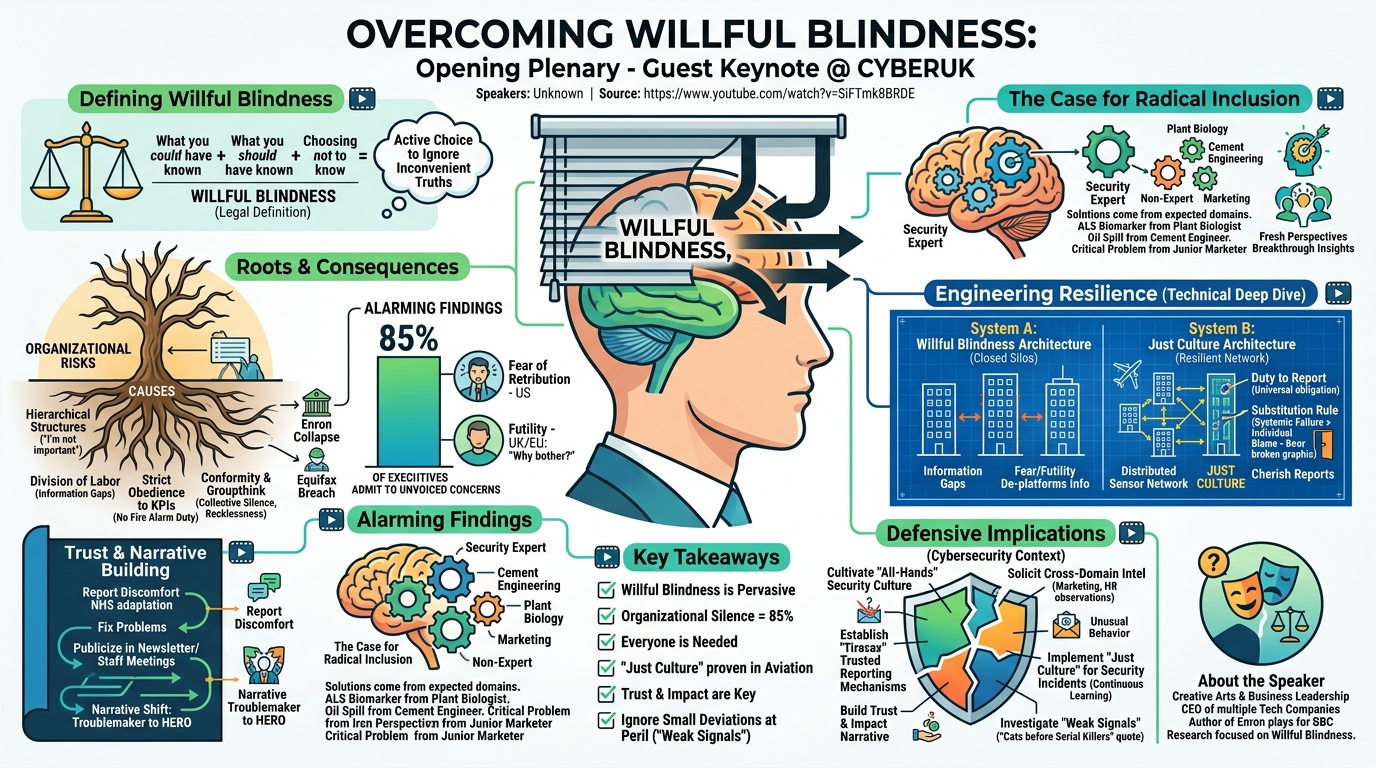
This keynote address delves into the pervasive phenomenon of willful blindness, examining its roots in organizational culture and its catastrophic consequences across various industries, from finance to healthcare. The speaker, whose name was not provided in the talk metadata, meticulously dissects why individuals and organizations fail to see or act upon critical information, even when it is readily available or widely suspected. Drawing parallels between high-profile corporate collapses like Enron and Equifax, the talk argues that these failures often stem not from a lack of information, but from systemic barriers that prevent concerns from being voiced, heard, or acted upon.
Key moments
- 1:50 Defining willful blindness and its legal concept
- 2:00 Personal realization and journey into willful blindness
- 3:00 Organizational causes of willful blindness
- 5:30 The 85% organizational silence statistic
- 6:15 Fear vs. futility: Reasons for organizational silence
- 8:00 Why we need everyone to speak up
- 8:30 Solving problems with cross-domain expertise
Opening Plenary - Guest Keynote
Speakers: Unknown
Conference: CYBERUK
YouTube: https://www.youtube.com/watch?v=SiFTmk8BRDE
Overview
This keynote address delves into the pervasive phenomenon of willful blindness, examining its roots in organizational culture and its catastrophic consequences across various industries, from finance to healthcare. The speaker, whose name was not provided in the talk metadata, meticulously dissects why individuals and organizations fail to see or act upon critical information, even when it is readily available or widely suspected. Drawing parallels between high-profile corporate collapses like Enron and Equifax, the talk argues that these failures often stem not from a lack of information, but from systemic barriers that prevent concerns from being voiced, heard, or acted upon.
The core message of the presentation is that our collective security—especially in the complex and uncertain realm of cybersecurity—is fundamentally dependent on overcoming these cultural impediments. The speaker challenges the notion that expertise is confined to specific roles or departments, advocating for a radical shift towards inclusive information gathering and problem-solving. By exploring successful models from industries like aviation and healthcare, the talk provides a compelling framework for fostering environments where every individual feels empowered and responsible for contributing to organizational safety and resilience, thus directly addressing the silent threats inherent in willful blindness.
Background
▶ Watch: Defining willful blindness and its legal concept (1:50)
The concept of willful blindness as explored in this keynote originated from the speaker's research into the collapse of Enron. Legal scholar Simeon Lake defined it as a situation where "if there's something that you could have known and you should have known and you somehow just managed not to know, then the law deems that you've been willfully blind because you had the opportunity for knowledge, but you shucked it." This definition highlights an active choice, or perhaps an ingrained organizational habit, to ignore inconvenient truths. The speaker's personal experience running companies, where they recognized moments of their own willful blindness, fueled a deeper investigation into this ubiquitous phenomenon.
The research revealed several recurring causes for willful blindness within organizations. Hierarchical structures often lead employees to believe they are "not important enough to raise concerns," fostering a sense of insignificance. Division of labor, particularly exacerbated by outsourcing, creates significant information gaps where individuals hold only fragmented pieces of a larger puzzle, unable to see the whole picture or its inherent risks. Furthermore, obedience to strictly defined KPIs and job descriptions can inadvertently discourage broader vigilance; as noted, "on nobody's job description did it say, 'If you think the bank's about to crash, please, you know, hit the fire alarm.'" Finally, conformity, or groupthink, plays a critical role. The more people agree and share the same perspective, the more likely they are to maintain collective silence, which paradoxically increases their appetite for risk, leading to recklessness because no one dares to challenge the consensus. These drivers collectively contribute to a dangerous organizational silence, rendering critical information effectively invisible.
Key Findings
▶ Watch: Organizational causes of willful blindness (3:00)
A central and alarming finding presented by the speaker stems from academic literature by professors at the New York University Stern School of Business. Their survey of executives across various industries revealed that a staggering 85% admitted to having "issues or concerns at work that you do not voice." This statistic, initially prompting the speaker to question the intellectual return on investment for hiring brilliant people, underscores the profound depth of organizational silence. When replicated with a British and European cohort, the percentage remained 85%, though the primary reason for silence shifted from "fear of retribution" (in the American context) to "futility" ("I could say something, but it won't make any difference. So why bother?"). This widespread reluctance to speak up, regardless of its underlying cause, poses a fundamental threat to security and resilience.
The talk strongly asserts that in an environment of profound uncertainty, particularly regarding future threats (like those in cybersecurity), the need for everyone to contribute observations and concerns is paramount. The speaker highlights that problems are routinely identified and solved by individuals working outside their conventional domain expertise, a phenomenon observed in open innovation platforms like InnoCentive. Examples include an ALS biomarker identified by a plant biologist and an oil spill solution from a cement engineer, demonstrating that fresh perspectives, unburdened by established frameworks, can yield breakthrough insights. This finding challenges traditional hierarchical models of expertise and problem-solving, advocating for a radically inclusive approach to intelligence gathering.
Technical Deep Dive
▶ Watch: The 85% organizational silence statistic (5:30)
While the talk does not delve into traditional software or network architectures, it offers a profound "technical deep dive" into the architecture of organizational intelligence and failure, and the methodologies for engineering resilience against willful blindness. The core "technical problem" is the systemic failure to collect and act upon critical information, even when it exists within the organization. The speaker identifies several mechanisms that contribute to this failure:
- Information Silos and Gaps: Hierarchical structures and the division of labor, particularly with outsourcing, create functional and geographical separation. This leads to individuals possessing only partial information, preventing a holistic understanding of risks. No single role is tasked with synthesizing disparate "weak signals" into a coherent threat picture.
- Psychological Barriers to Reporting:
- Fear of Retribution: In some cultures, voicing concerns is perceived as career-limiting, leading to a suppression of dissent. This is a direct threat to transparency.
- Futility: In others, a cynical belief that reporting issues will have no impact leads to apathy and inaction. Both fear and futility effectively "de-platform" critical information before it can reach decision-makers.
- Conformity/Groupthink: The human tendency to align with group opinions can stifle independent thought and critical challenge. This collective agreement can lead to an inflated sense of security and an increased appetite for risk, as dissenting voices are internalized or suppressed.
To counter these systemic flaws, the speaker proposes and elaborates on several "architectural" changes to organizational culture and process:
- Ubiquitous Observation and Contribution: The principle that "we need everybody on this case" is a call for a decentralized intelligence network. This acknowledges that the source of a critical insight cannot be predicted. The success of open innovation platforms serves as a "technical proof" that solutions often come from unexpected domains. For instance, a plant biologist, by reframing the problem of an ALS biomarker, could apply principles from their field to a medical challenge, demonstrating the power of cross-domain analogy. Similarly, a cement engineer's understanding of viscosity, not directly related to oil spills, provided a novel solution. This requires actively soliciting input from all employees, recognizing that their "non-expert" perspectives can be invaluable.
- Implementation of "Just Culture": Originating from the airline industry after a critical plane crash revealed the lethal accumulation of small, disconnected problems, just culture is a robust framework for incident reporting and analysis. Its key tenets include:
- Duty to Report: Every individual, "from the janitor to the CEO," has an obligation to report anything that "didn't look right," regardless of its perceived significance. This democratizes the reporting process.
- Substitution Rule: If an incident would have occurred regardless of the individual involved (i.e., "if Joe couldn't make the door break and when Jane tried it, it broke too, don't blame either of them. The door is the problem. Fix that."), blame is directed at systemic failures rather than individuals. This removes the fear of individual culpability, encouraging honest reporting.
- Cherish Reports: Organizations must actively value and act upon reports, demonstrating that feedback is taken seriously.
The efficacy of just culture is evident in the airline industry's safety record, which saw report volumes increase from approximately 5,000 to 15,000 per airline per year after its introduction, making air travel the safest form of travel.
- Building a Narrative of Trust and Impact: Simply stating "I'll never shoot the messenger" is insufficient. Organizations must actively demonstrate that reporting leads to positive change. The NHS adaptation of just culture, described by Helen McDonnely, exemplifies this. By creating a dedicated role for handling uncomfortable reports and, crucially, by publicly writing up and disseminating the resolutions in newsletters and staff meetings, the NHS successfully shifted the narrative. Employees learned that their reports were not futile and that they could be "heroes" rather than "troublemakers." This consistent communication builds trust and reinforces the idea that "you can really get things done around here."
In essence, the "technical deep dive" reveals that overcoming willful blindness requires re-engineering the human and cultural components of an organization to function as a highly sensitive, distributed sensor network, where information flows freely, is valued, and leads to demonstrable action, thus preventing "small problems" from accumulating into catastrophic failures.
Demo / Proof of Concept
▶ Watch: Why we need everyone to speak up (8:00)
While the keynote did not feature a live technical demonstration in the traditional sense of a cybersecurity exploit or tool, the speaker provided compelling real-world examples that serve as proofs of concept for the organizational principles discussed. These case studies illustrate both the dangers of willful blindness and the transformative power of fostering an open, "just culture."
One powerful example came from the speaker's own experience running a second tech company in the U.S. Faced with an existential engineering problem that the expert engineering team could not solve, the speaker, not being an engineer, took an unconventional approach. They gathered the entire company, laid out the problem, and explicitly stated their lack of an answer, inviting anyone with ideas to speak up. Within a day, a "very young, inexperienced woman in the marketing department" proposed a reframing of the problem that led directly to the solution, saving the business. This demonstrated the efficacy of open innovation and the value of non-domain expertise in solving complex, intractable problems.
The airline industry stands as a robust proof of concept for just culture. Following a catastrophic plane crash that revealed the lethal aggregation of individually minor issues, the industry fundamentally revamped its approach to safety. By implementing a system where everyone had a duty to report concerns and where blame was directed at systemic flaws (the substitution rule) rather than individuals, they transformed safety reporting. The dramatic increase from approximately 5,000 to 15,000 reports per airline annually illustrates how removing fear and futility can unlock a torrent of critical intelligence, making air travel the safest form of transportation.
Furthermore, the speaker highlighted the successful adaptation of just culture within the NHS. Helen McDonnely's experience at Mid Staffordshire NHS, where her alarms went unheeded, contrasted sharply with her role at North Staffordshire NHS. There, she was specifically tasked with receiving "reports of discomfort or problems that just couldn't get fixed." Crucially, her team didn't just fix problems; they "wrote it up, we put it in the newsletter, we included it in staff meetings so that everybody knew you can really get things done around here." This strategic communication of successful interventions served as a powerful proof of concept, demonstrating to staff that their reports were valued and effective, shifting the narrative from "troublemaker" to "hero."
Finally, the talk revisited the Enron collapse through the lens of Sharon Watkins, the so-called whistleblower. Watkins's insights—"Serial killers start with cats" (meaning trivial deviant behavior should not be ignored) and the observation that she and other whistleblowers often came from small towns where "you knew you really mattered"—underscored the critical importance of individual agency and the belief that one's actions have impact. These real-world narratives collectively serve as compelling evidence that organizational culture, specifically in how it handles information and dissent, is the ultimate determinant of resilience against willful blindness.
Defensive Implications
▶ Watch: Solving problems with cross-domain expertise (8:30)
The insights from this keynote have profound defensive implications for cybersecurity. In an environment characterized by constant, evolving threats and an often-invisible adversary, willful blindness is a critical vulnerability that must be actively mitigated.
- Cultivate an All-Hands-on-Deck Security Culture: Cybersecurity is not solely the responsibility of the security team. Organizations must foster an environment where every employee, regardless of their role or technical expertise, understands they have a duty to report anything that "doesn't look right." This includes suspicious emails, unusual system behavior, physical security lapses, or even seemingly minor compliance deviations. This requires moving beyond traditional security awareness training to instill a sense of personal responsibility and empowerment.
- Break Down Silos and Encourage Cross-Domain Intelligence: The principle of open innovation applies directly to threat detection and incident response. Security teams should actively solicit input from non-security departments. A marketing professional might notice a brand impersonation that technical tools miss, or an HR employee might observe behavioral anomalies indicative of insider threat. Establishing cross-functional working groups or dedicated channels for non-traditional security observations can harness this collective intelligence.
- Implement a "Just Culture" for Security Incidents: Fear of blame is a significant barrier to reporting. When a security incident occurs, the focus should shift from "who is to blame?" to "what can we learn and how can we prevent recurrence?" Adopting the substitution rule means investigating systemic vulnerabilities (e.g., inadequate training, poorly configured systems, unclear policies) rather than solely punishing the individual who clicked a phishing link. This encourages honest post-incident reviews and continuous improvement.
- Establish Clear, Trusted Reporting Mechanisms: Employees need to know how to report concerns and feel confident that their reports will be taken seriously and handled appropriately. This could involve anonymous reporting channels, a designated "security advocate" outside the direct chain of command, or a clear, well-communicated process for escalating observations. The goal is to eliminate both the "fear of retribution" and the "futility" of reporting.
- Build a Narrative of Security Success and Impact: Organizations must actively publicize the positive outcomes of reported concerns. When an employee's report leads to a vulnerability being fixed, a policy being updated, or a new defensive measure being implemented, this success should be shared widely. Highlighting how individual contributions made a tangible difference reinforces trust and encourages others to speak up, transforming the perception of reporting from a burden to an act of heroism.
- Address "Weak Signals" and "Trivial" Deviations: As Sharon Watkins warned, "Serial killers start with cats." Seemingly minor security anomalies—a consistently unlocked door, an ignored policy, a small data leak—should not be dismissed. They can be early indicators of deeper systemic issues or a decaying security culture that, if left unaddressed, can lead to catastrophic breaches. Proactive investigation of these "weak signals" is crucial for preventing larger failures.
By strategically dismantling the cultural and psychological barriers that enable willful blindness, organizations can transform their entire workforce into a proactive and resilient cybersecurity defense layer, significantly enhancing their ability to detect, respond to, and prevent threats.
Key Takeaways
- Willful blindness is a pervasive organizational failure where individuals and groups ignore critical information they "could have known and should have known," leading to catastrophic outcomes.
- Organizational silence is widespread, with 85% of executives admitting to unvoiced concerns, driven by either fear of retribution or a sense of futility, severely limiting an organization's collective intelligence.
- Everyone is needed for security, as critical insights and solutions often come from individuals outside their conventional domain expertise, highlighting the value of diverse perspectives and open communication.
- "Just culture," as demonstrated in the airline industry, is a proven model for fostering safety by encouraging universal reporting, focusing on systemic fixes over individual blame, and actively valuing all contributions.
- Building trust and demonstrating impact are crucial; organizations must actively publicize how reported concerns lead to positive change to counteract futility and encourage a culture where speaking up is seen as heroic.
- Small, seemingly trivial deviations ("weak signals") should never be ignored, as they can be early indicators of systemic issues that, if unaddressed, can escalate into major security incidents.
About the Speaker(s)
The speaker for this opening plenary, whose name was not provided in the talk metadata, is a highly experienced individual with a unique background spanning creative arts and business leadership. They identify as having a rare niche ability to "both read a balance sheet and write a play," a skill honed through their work, including writing two plays about the collapse of Enron for the BBC. This blend of analytical rigor and narrative understanding likely informed their deep dive into the phenomenon of willful blindness. The speaker has also run multiple technology companies in the U.S., leveraging their direct experience as a CEO to research and understand organizational dynamics. Their extensive work on willful blindness has been an ongoing journey, indicating a long-standing commitment to understanding and mitigating this critical human and organizational failing.
Reviews
Dr. Zero (Offensive Security Researcher) — SOLID
A competent, well-structured strategic keynote on organizational willful blindness applied to cybersecurity culture. The speaker — apparently Margaret Heffernan based on the description — knows this material cold and delivers it with genuine conviction. The 'just culture' framework and the 85% silence statistic land well, and the aviation/NHS case studies are appropriately concrete. But this is a CYBERUK opening plenary, not a TED Talk, and the audience skews toward practitioners and policymakers who've heard the 'psychological safety' pitch before. Nothing here advances the specific cybersecurity conversation in a way that a defender, CISO, or policy person couldn't have gotten from…
Heather Calloway (CISO) — STRONG ACCEPT
A governance-first keynote that names organizational silence as a systemic security vulnerability and gives security leaders a credible, evidence-backed framework for addressing it. The 85% statistic on unvoiced concerns alone should land in every CISO's next board deck. The talk does not break technical ground, but it was never trying to — and that clarity of purpose is part of its strength. Where it falls short is in the translation layer: it stops just before telling security leaders specifically how to operationalize just culture inside a regulated enterprise, where fear of retribution and legal exposure interact in ways the airline analogy does not fully resolve.