Networking and Drinks Sponsor Speech - Cisco
Unknown (Cisco)
CYBERUK 2026 · Day 1 · Main Plenary
Overview
Steven Dayne, the Managing Director of Cisco Security in the UK and Ireland, delivered a thought-provoking address at the 10th anniversary of CYBERUK, emphasizing the critical role of collaboration and proactive security strategies in bolstering the UK's digital resilience. While primarily serving as an invitation to a networking reception, Dayne’s speech provided a high-level strategic overview of the evolving cybersecurity landscape, highlighting the pervasive and escalating threats faced by government, critical national infrastructure, and businesses of all sizes. He underscored the profound impact of emerging technologies like Artificial Intelligence on both offensive and defensive cybersecurity capabilities, alongside the challenges posed by an ever-expanding attack surface.
Key moments
- 0:00 Introduction and importance of CYBERUK for digital resilience
- 0:40 Current threat landscape and AI's dual impact on cyber
- 2:00 Exploding attack surface; cyber security as national resilience
- 3:00 Cisco's three key approaches: secure by design, secure outcomes, securing together
- 4:15 Cisco's vision: UK with confident infrastructure, trusted innovation
- 5:18 Invitation to Cisco's networking and drinks reception
Networking and Drinks Sponsor Speech - Cisco
Speakers: Steven Dayne, Managing Director, Cisco Security in the UK and Ireland
Conference: CYBERUK
YouTube: https://www.youtube.com/watch?v=6b2R3XuDwxU
Overview
Steven Dayne, the Managing Director of Cisco Security in the UK and Ireland, delivered a thought-provoking address at the 10th anniversary of CYBERUK, emphasizing the critical role of collaboration and proactive security strategies in bolstering the UK's digital resilience. While primarily serving as an invitation to a networking reception, Dayne’s speech provided a high-level strategic overview of the evolving cybersecurity landscape, highlighting the pervasive and escalating threats faced by government, critical national infrastructure, and businesses of all sizes. He underscored the profound impact of emerging technologies like Artificial Intelligence on both offensive and defensive cybersecurity capabilities, alongside the challenges posed by an ever-expanding attack surface.
The talk positioned cybersecurity not merely as a technical concern, but as a fundamental pillar of national resilience, essential for maintaining essential services, fostering economic trust, and enabling innovation. Dayne articulated Cisco's commitment to being a trusted partner in this endeavor, outlining a three-pronged strategy centered on secure by design principles, the delivery of secure outcomes rather than fragmented point products, and the imperative of securing together through community-wide intelligence sharing and skill development. This strategic perspective, delivered by a leading industry voice, offers valuable insights into the top-of-mind concerns for major cybersecurity vendors and their vision for collective defense in an increasingly complex threat environment.
Background
▶ Watch: Introduction and importance of CYBERUK for digital resilience (0:00)
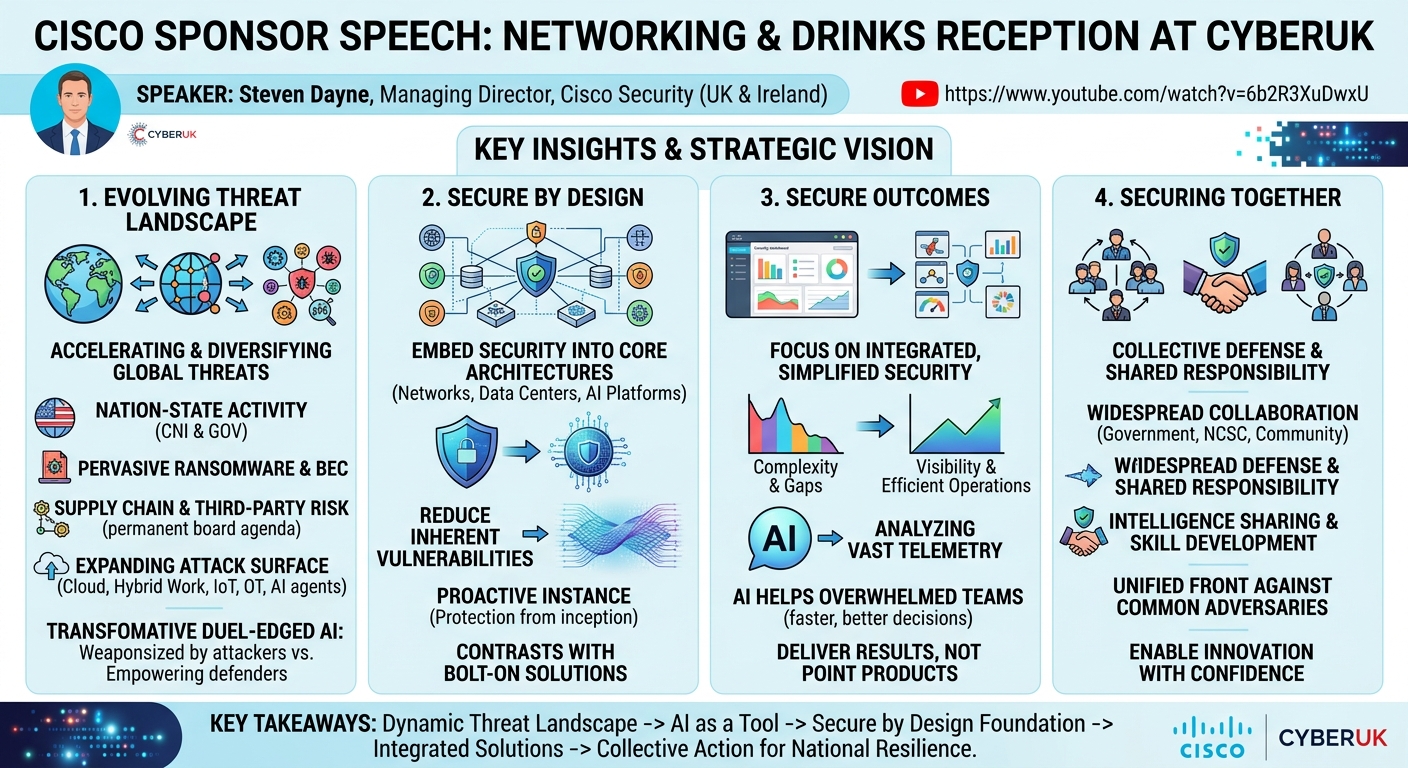
The context for Dayne's address is a rapidly accelerating and diversifying global threat landscape, which poses significant challenges to national and economic security. He explicitly identified several critical threats currently impacting the UK:
- Nation-state activity targeting critical national infrastructure (CNI) and government entities, representing sophisticated, persistent threats often driven by geopolitical motives. These attacks can aim for espionage, disruption, or sabotage, with potentially catastrophic consequences for essential services and public trust.
- The continued proliferation of ransomware and business email compromise (BEC), which continue to plague organizations across all sectors and sizes. Ransomware, in particular, has evolved into a highly lucrative and disruptive criminal enterprise, often involving data exfiltration in addition to encryption, increasing pressure on victims to pay. BEC schemes, while less technically sophisticated, exploit human vulnerabilities to defraud businesses of significant sums.
- The escalating challenge of supply chain and third-party risk, which has become a permanent fixture on board agendas. Organizations are increasingly reliant on a complex ecosystem of suppliers and partners, and a compromise within any part of this chain can ripple outwards, impacting numerous downstream entities. High-profile incidents have demonstrated how a single vulnerability in a widely used software component or service can lead to widespread breaches.
Adding another layer of complexity, Dayne highlighted the transformative, dual-edged nature of Artificial Intelligence (AI). On one hand, attackers are rapidly weaponizing AI to scale and enhance their capabilities. This includes generating more convincing phishing attacks, automating the discovery of vulnerabilities, and creating sophisticated deepfakes for social engineering. On the other hand, defenders have an unprecedented opportunity to leverage AI to process vast quantities of security telemetry, identify subtle anomalies, and automate incident response, potentially shifting the advantage in their favor. The core challenge, as Dayne framed it, is not whether AI is inherently good or bad, but how it is governed, secured, and used responsibly to empower defenders.
Simultaneously, the attack surface is undergoing an exponential expansion. The pervasive adoption of cloud computing, the rise of hybrid work models, the proliferation of millions of IoT devices, the increasing connectivity of operational technology (OT), the emergence of AI agents, and the interconnectedness of critical systems collectively create a vastly larger and more fragmented landscape for adversaries to target. This expansion means that traditional perimeter-based security models are increasingly insufficient, necessitating a more holistic and integrated approach to security that spans the entire digital ecosystem. This evolving threat landscape underscores why cybersecurity has transcended a narrow technical domain to become a central component of national resilience, vital for maintaining societal functions and economic stability.
Key Findings
▶ Watch: Exploding attack surface; cyber security as national resilience (2:00)
While Dayne's address was a strategic overview rather than a presentation of specific research findings, it articulated several critical observations and strategic priorities that serve as key insights for the cybersecurity community. These can be distilled into three overarching themes championed by Cisco: the necessity of secure by design principles, the focus on delivering secure outcomes over discrete products, and the imperative of securing together through collaborative efforts.
Firstly, the concept of secure by design is presented as a foundational principle. Dayne emphasized the need to embed and fuse security directly into the fabric of networks, data centers, and the nascent AI platforms themselves. This approach contrasts sharply with the traditional model of "bolting on" security solutions at the end of a development or deployment cycle. By integrating security from the outset, protection becomes an intrinsic part of the system architecture, reducing inherent vulnerabilities and making systems more resilient against attack. This proactive stance is crucial in an era where the speed of technological adoption often outpaces security considerations, especially with the rapid deployment of AI-driven services. The implication is that security should not be an afterthought but a core design requirement, ensuring that digital infrastructure is inherently trustworthy and robust.
Secondly, Cisco advocates for a shift towards developing and delivering secure outcomes rather than merely offering point products. Dayne highlighted the common challenge faced by organizations: an "overcrowded stack" of disparate security tools that often create complexity, visibility gaps, and operational overhead. The focus on secure outcomes implies a more integrated, simplified, and effective approach to security operations. This involves leveraging unified platforms that provide comprehensive visibility, streamline management, and enable rapid response capabilities. Crucially, this strategy emphasizes the role of AI in assisting "overwhelmed teams" to make faster, better-informed decisions. By consolidating security functions and harnessing AI for analysis and automation, organizations can move beyond a reactive, tool-centric approach to a more proactive, outcome-driven security posture that genuinely enhances their defensive capabilities and operational efficiency.
Finally, the talk underscored the profound importance of securing together through widespread collaboration. Dayne articulated that achieving a truly resilient UK digital economy, where critical infrastructure operates with confidence, businesses can innovate without fear (especially with AI), and citizens can engage online with trust, is only possible through collective action. This involves working closely with government bodies like the NCSC, engaging with partners, and fostering a broader cyber community to facilitate intelligence sharing, joint skill development, and coordinated incident response. The vision is one where security is a shared responsibility and a shared advantage, moving beyond individual organizational silos to a unified front against common adversaries. This collaborative model is seen as essential for aligning on standards, investing in the necessary skills, and maintaining an honest dialogue about what security measures are truly effective. The implication is that no single entity, however large or capable, can tackle the modern threat landscape alone; collective intelligence and coordinated action are paramount.
Technical Deep Dive
▶ Watch: Cisco's three key approaches: secure by design, secure outcomes, securing tog... (3:00)
As a sponsor speech delivered at a high-level conference, the primary objective was to articulate strategic vision and foster community engagement rather than delve into specific technical implementations, code, protocols, or architectural details. Consequently, this talk did not include a technical deep dive into Cisco's security products, specific vulnerabilities, exploit techniques, or defensive architectures. While the speaker referenced critical concepts such as "secure by design" and the use of "AI to sift vast amounts of telemetry and automate responses," these were discussed at a conceptual level, without detailing the underlying technologies, algorithms, or system integrations that facilitate such capabilities. Therefore, this section cannot provide specific technical content as it was not part of the presentation.
Demo / Proof of Concept
▶ Watch: Cisco's vision: UK with confident infrastructure, trusted innovation (4:15)
The nature of this address, being a sponsor speech and an invitation to a networking reception, meant that no live demonstration or proof of concept was presented. The speaker focused on strategic insights and community building rather than showcasing specific tools, exploits, or defensive technologies in action. The primary "call to action" was an invitation to further discussions and networking, rather than a technical demonstration.
Defensive Implications
▶ Watch: Invitation to Cisco's networking and drinks reception (5:18)
The strategic observations and priorities outlined by Steven Dayne carry significant defensive implications for organizations across all sectors, from critical national infrastructure to small and medium-sized businesses. The core message is a call for a fundamental shift in how cybersecurity is conceived and implemented, moving towards a more integrated, proactive, and collaborative model.
Firstly, the emphasis on secure by design is a critical directive for defenders. This principle mandates that security considerations must be integrated into every stage of the development lifecycle for new systems, applications, and services, rather than being an afterthought. For organizations, this means adopting frameworks like Security Development Lifecycle (SDL) and DevSecOps practices, ensuring that security requirements are defined early, threat modeling is conducted systematically, and secure coding practices are enforced. When deploying new technologies, particularly AI-driven services, security architects must actively fuse protection into the underlying network infrastructure, data pipelines, and AI platforms themselves. This proactive embedding of security reduces the attack surface from inception, mitigates inherent vulnerabilities, and makes systems more resilient to sophisticated attacks, including those leveraged by nation-state actors. It also implies a greater investment in security architecture reviews, code analysis tools, and robust configuration management from the outset.
Secondly, the call for secure outcomes over fragmented point products directly addresses the issue of operational complexity and security fatigue. Defenders are often overwhelmed by a proliferation of security tools that lack interoperability, leading to visibility gaps, alert fatigue, and slower response times. The implication here is a need to rationalize and consolidate security stacks, prioritizing integrated platforms that offer comprehensive visibility, simplified management, and automated response capabilities. Organizations should evaluate their existing security posture with an eye towards reducing complexity and enhancing efficiency. This involves leveraging technologies that can centralize security information and event management (SIEM), extended detection and response (XDR), and security orchestration, automation, and response (SOAR) functionalities. By utilizing AI to sift through vast amounts of telemetry – a concept explicitly mentioned by Dayne – and automate routine responses, security teams can significantly improve their ability to detect and mitigate threats faster, freeing human analysts to focus on more complex, strategic issues. This strategic shift moves away from a "more tools equal more security" mindset to one focused on measurable improvements in detection efficacy, incident response speed, and overall operational resilience.
Finally, the imperative to secure together underscores the critical role of collaboration and intelligence sharing in modern defense. Given the sophistication of nation-state adversaries, the pervasiveness of ransomware gangs, and the dynamic nature of supply chain risks, no single organization can effectively defend itself in isolation. Defenders must actively engage with national cybersecurity centers like the NCSC, industry peers, and trusted vendors (like Cisco) to share threat intelligence, best practices, and lessons learned from incidents. This includes participating in Information Sharing and Analysis Centers (ISACs), contributing to collective threat intelligence platforms, and aligning on common security standards and frameworks. Furthermore, investing in collective skill development is crucial to address the pervasive cybersecurity talent gap. By fostering a community where intelligence is openly exchanged and defensive strategies are collaboratively refined, organizations can gain a collective advantage against adversaries, enhancing their ability to anticipate, detect, and respond to threats more effectively as a unified front. This collaborative approach is not merely beneficial but essential for bolstering national digital resilience against an increasingly interconnected and aggressive threat landscape.
Key Takeaways
- The Threat Landscape is Accelerating and Diversifying: Organizations face a complex array of threats, including sophisticated nation-state attacks on critical infrastructure, pervasive ransomware and business email compromise, and escalating supply chain risks.
- AI is a Dual-Edged Sword: Artificial intelligence is being weaponized by attackers for scaled social engineering and faster vulnerability probing, but it also offers defenders unprecedented opportunities for telemetry analysis and automated response to tilt the field in their favor.
- Expanding Attack Surface Demands Holistic Security: The proliferation of cloud, hybrid work, IoT, OT, and AI agents means cybersecurity can no longer be a narrow technical concern but a fundamental component of national resilience, requiring integrated, comprehensive defense.
- Security Must Be "By Design": Embedding security into the core fabric of networks, data centers, and AI platforms from the outset is crucial, rather than bolting it on as an afterthought, ensuring inherent protection and resilience.
- Focus on Secure Outcomes, Not Just Point Products: Organizations should prioritize integrated security solutions that simplify operations, enhance visibility, and enable rapid response, leveraging AI to help overwhelmed teams make faster, better decisions, rather than adding to an overcrowded tool stack.
- Collaboration is Paramount for Collective Defense: Achieving national digital resilience requires a shared responsibility model, with active collaboration among government, industry, academia, and the wider cyber community to share intelligence, develop skills, and respond effectively to incidents.
About the Speaker(s)
Steven Dayne is the Managing Director of Cisco Security for the UK and Ireland. In this role, he leads Cisco's efforts to provide cybersecurity solutions and strategic guidance to organizations across these regions. His insights reflect Cisco's broader vision for securing digital transformation, emphasizing integrated security architectures, the strategic application of AI in defense, and the critical importance of collaborative efforts between industry, government, and the wider cybersecurity community. His presence at CYBERUK underscores Cisco's commitment to supporting the UK's national resilience and fostering a secure digital economy.
Reviews
Dr. Zero (Offensive Security Researcher) — HARD PASS
A networking drinks sponsor slot from Cisco's UK MD that delivers exactly what the label promises: a polished vendor pitch dressed in national-resilience language. There is no original research, no insider signal, no data, no specific commitments, and nothing a practitioner couldn't have assembled from Cisco's public marketing pages in twenty minutes. Graded generously against its own lane — strategic/executive — it still fails, because a strategic talk earns its place by telling the audience something they couldn't already know. This one doesn't.
Heather Calloway (CISO) — PASS
A sponsor speech dressed up as strategic insight. Steven Dayne articulates familiar themes — secure by design, AI as a dual-edged sword, collective defense — but delivers no original analysis, no evidence, no accountability framing, and no actionable decision path. This is vendor positioning at a podium, not thought leadership.