Lead Sponsor Keynote - Aretiico
Richard Parris (Chief Executive Officer · Aretiico Group plc)
CYBERUK 2026 · Day 1 · Main Plenary
Overview
In his opening keynote at CYBERUK 2026, Richard Parris, Executive Chair and founder of Aretiico, delivered a provocative address challenging the foundational assumptions of modern cybersecurity. Parris's talk, titled "Aretiico," centered on the escalating crisis of trust in an increasingly autonomous and AI-driven digital world. He posited that as systems accelerate, make decisions without human intervention, and interact with unprecedented complexity, the very concept of verifiable trust becomes the paramount challenge, surpassing even intelligence as the defining issue of the next decade.
Key moments
- 0:00 Introduction: The trust challenge in an AI world
- 2:15 Comparing current cyber security to home security
- 3:50 Protecting entire digital landscapes, not just homes
- 5:40 Accelerating threats and autonomous system challenges
- 6:25 Pivotal question: How do autonomous systems trust?
- 8:05 Where to anchor trust: individuals, organizations, nations
- 9:00 Who establishes trust and sets the rules?
- 10:00 Building robust trust and digital sovereignty for the future
Lead Sponsor Keynote - Aretiico
Speakers: Richard Parris, Chief Executive Officer, Aretiico Group plc
Conference: CYBERUK
YouTube: https://www.youtube.com/watch?v=OU7Zp2qmwwQ
Overview
In his opening keynote at CYBERUK 2026, Richard Parris, Executive Chair and founder of Aretiico, delivered a provocative address challenging the foundational assumptions of modern cybersecurity. Parris's talk, titled "Aretiico," centered on the escalating crisis of trust in an increasingly autonomous and AI-driven digital world. He posited that as systems accelerate, make decisions without human intervention, and interact with unprecedented complexity, the very concept of verifiable trust becomes the paramount challenge, surpassing even intelligence as the defining issue of the next decade.
Parris compellingly argued that current cybersecurity paradigms, largely focused on reactive monitoring and post-incident response, are fundamentally ill-suited to protect the vast, interconnected digital landscapes of today. He drew parallels between outdated physical security models and the digital realm, emphasizing that true security stems from architectural design and pre-emptive trust establishment, not merely detection after an event. The talk underscored the urgent need for a paradigm shift, where trust is not assumed but deliberately engineered into systems, anchored responsibly, and governed with clear authority, especially in an era defined by AI's ability to generate convincing but potentially untrustworthy realities.
Aretiico, as a British company and lead sponsor of the event, positions itself at the forefront of addressing these challenges, aiming to build the frameworks and trust platforms that empower organizations and nations to reclaim control over trust in their digital ecosystems. Parris's keynote served as a critical call to action for the cybersecurity community, urging a re-evaluation of how trust is conceived, built, and maintained, particularly as autonomous systems begin to shape economic, societal, and global stability.
Background
▶ Watch: Introduction: The trust challenge in an AI world (0:00)
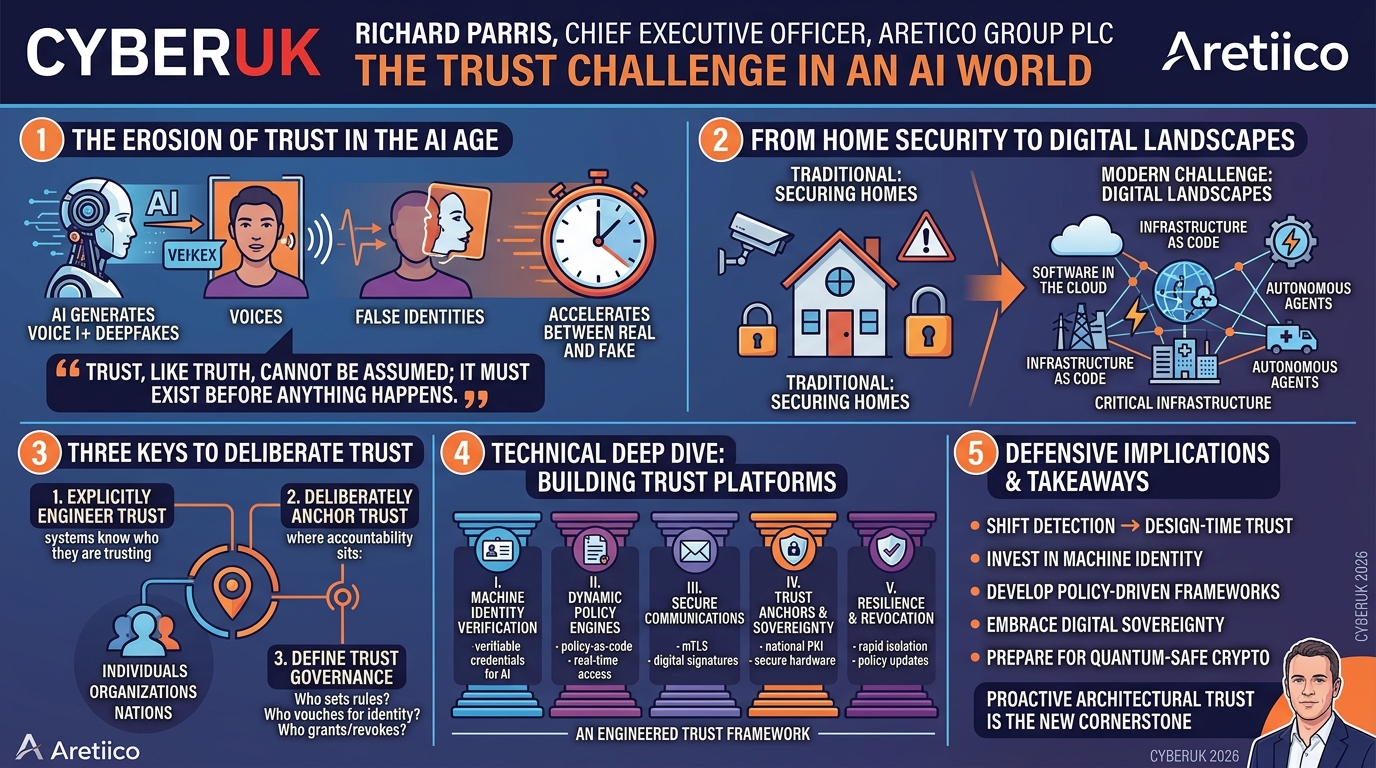
Richard Parris began by immediately confronting the audience with a fundamental question: "How do you know who I really am? Who I represent, and whether anything I'm about to say is trustworthy?" This rhetorical opening set the stage for a deep dive into the erosion of trust in an age where AI can convincingly generate voices and identities, blurring the lines between what is merely convincing and what is genuinely real. Parris highlighted that this isn't a theoretical concern but a daily reality, underscoring the accelerating pace of technological change and the increasingly significant consequences of misplacing trust.
He observed that while cybersecurity has made significant strides over the past decade – with improved monitoring, faster incident understanding, and enhanced cross-organizational collaboration – the underlying security model remains largely unchanged. Parris likened this approach to home security: installing better cameras provides comfort through observation and rapid detection, but it doesn't fundamentally prevent a determined criminal from causing harm. He argued that true security, both in physical and digital realms, comes from foundational design – "changing the locks," "reinforcing the doors," and the inherent architecture of the "house" itself. Historically, security was an intrinsic part of design, such as the walls and drawbridges of castles, reflecting a direct responsibility for protection.
However, Parris noted a shift towards "security by dependency" in modern society, relying on external responses like law enforcement, insurance, and legal redress, which operate "after the event, rather than before it." This reactive model has been largely carried into the digital world, where the stakes are far higher. Instead of individual homes, we are now protecting entire digital landscapes: energy supplies, transportation networks, supply chains, financial markets, and healthcare systems. The speaker cited recent major cyberattacks that have taken large commercial ecosystems offline for weeks or months, devastating national economies, jobs, and public confidence. He stressed that after-the-fact investigation offers little remediation for such extensive damage. The threat surface is expanding dramatically, with systems increasingly defined by software in the cloud, infrastructure as code, and continuous build/rebuild/reconfiguration cycles. Automated agents are now operating on our behalf, compressing decision-making to machine speed, further removing human oversight, and making it exponentially harder to discern reality from fabrication. Emerging technologies like quantum computing are also forcing a re-evaluation of long-held security assumptions, adding another layer of complexity to an already precarious situation.
Key Findings
▶ Watch: Protecting entire digital landscapes, not just homes (3:50)
The central "key finding" presented by Richard Parris is a stark realization: in a world of accelerating automation, artificial intelligence, and quantum computing, the traditional models of cybersecurity and trust are fundamentally broken and inadequate. His talk crystallizes several critical insights that collectively form a new imperative for the cybersecurity domain.
Firstly, Parris asserts that trust, like truth, cannot be assumed; it must exist before anything happens. This is a profound shift from the prevalent reactive security posture, which often focuses on detecting breaches and verifying authenticity after an event has occurred. He argues that as systems become increasingly autonomous, making decisions and acting on our behalf without human input, the ability to pre-establish and verify trust becomes paramount. Failure to grasp this, he warns, threatens not just cyberspace but the stability of the entire world around us.
Secondly, the talk highlights the critical need to deliberately anchor trust. As autonomy increases, the question arises: where should this trust be anchored? Parris explores three potential loci: individuals (their identities and intent), organizations (companies and global tech platforms), or national levels (tied to jurisdiction and sovereignty). While global technology platforms and international partnerships have provided immense benefits, the growing criticality and autonomy of digital systems necessitate a more deliberate anchoring of trust, closer to where accountability truly sits. This suggests a move away from purely global, undifferentiated trust models towards more localized, accountable frameworks.
Finally, Parris emphasizes the urgent need to define who establishes and governs trust. This involves answering crucial questions: Who sets the rules for trust? Who vouches for identity in an age of deepfakes and AI-generated personas? And, perhaps most critically, who possesses the authority to grant and revoke trust when circumstances change? This implies a need for robust, authoritative mechanisms that can dynamically manage trust relationships across complex, interconnected digital ecosystems. These findings collectively paint a picture of an impending crisis of trust that demands a foundational re-architecture of how we secure our digital future, moving from a reactive, detection-based model to a proactive, design-centric approach rooted in verifiable and accountable trust.
Technical Deep Dive
▶ Watch: Pivotal question: How do autonomous systems trust? (6:25)
While Richard Parris's keynote did not delve into specific code implementations or proprietary protocols, it articulated a foundational architectural challenge for the next decade, implicitly calling for a new generation of trust platforms and frameworks. The "technical deep dive" here must therefore interpret the speaker's vision for how trust would be engineered into autonomous systems, rather than detailing existing technologies.
Parris's core technical premise is that current security architectures are built on an implicit assumption of human-mediated trust and reactive detection. However, with the rise of Artificial Intelligence (AI) compressing decision-making to machine speed, and automated agents removing humans from control loops, this assumption breaks down. Systems are now "making decisions and acting on our behalf without human input in the moment," and critically, they are designed to "interact with systems they've never encountered before." This scenario demands a radical shift in how trust is technically established and managed.
The conceptual architecture for addressing this challenge, as implied by Parris, would involve:
- Identity Verification for Autonomous Agents: In a world where AI can generate convincing identities, the first technical hurdle is to establish verifiable, non-repudiable identities for every autonomous agent, system, or process. This goes beyond traditional user authentication. It requires machine-to-machine identity solutions, potentially leveraging decentralized identifiers (DIDs) and verifiable credentials (VCs), perhaps anchored on distributed ledger technologies (DLT) or blockchain. Each agent, whether a piece of software, an IoT device, or an AI model, would possess a cryptographically secured identity that can be independently verified by other systems without human intervention. This ensures that when a system interacts with another, it can definitively know "who" it is communicating with, even if that "who" is an AI.
- Dynamic Trust Policy Engines: Parris emphasizes that trust needs to be granted and revoked based on changing circumstances. This necessitates highly sophisticated, dynamic trust policy engines. These engines would operate on a "policy-as-code" paradigm, defining granular trust relationships based on identity, context, behavior, and real-time threat intelligence. For instance, an autonomous agent might be trusted to perform certain actions within a specific network segment during defined operational hours, but its trust level could be automatically downgraded or revoked if it exhibits anomalous behavior, attempts to access unauthorized resources, or if its underlying software components fail integrity checks. These policies would need to be continuously evaluated and enforced at machine speed, requiring robust Attribute-Based Access Control (ABAC) or Policy-Based Access Control (PBAC) mechanisms, potentially enhanced by AI for adaptive risk assessment.
- Secure and Verifiable Communication Protocols: When systems interact with previously unknown counterparts, the communication channels themselves must be inherently trustworthy and verifiable. This implies a need for mutual TLS (mTLS) and other forms of cryptographic authentication, not just at the network layer but deeply embedded within application protocols. Furthermore, the integrity of the data exchanged must be guaranteed, potentially through digital signatures and homomorphic encryption for privacy-preserving computations between untrusted parties. The goal is to ensure that both the identity of the communicating parties and the integrity of their messages are beyond reproach, even in adversarial environments.
- Trust Anchoring and Digital Sovereignty: Parris raises the critical question of "where do we choose to anchor that trust?" and "who ultimately establishes that trust?" Technically, this points to the need for robust root-of-trust mechanisms. For national-level trust, this could involve nationally managed Public Key Infrastructures (PKIs), secure hardware modules (like TPMs or HSMs) whose integrity is auditable by national bodies, or even state-sponsored DLTs. The concept of digital sovereignty implies that nations would have the technical means to define, enforce, and audit the trust relationships within their critical infrastructure, ensuring that foreign entities cannot unilaterally grant or revoke trust within sovereign digital spaces. This requires technical control over identity issuance, policy enforcement, and cryptographic key management.
- Resilience and Revocation Mechanisms: The ability to revoke trust swiftly and effectively is as crucial as granting it. Technical frameworks must include mechanisms for rapid certificate revocation, policy updates, and isolation of compromised autonomous agents. This could involve Certificate Revocation Lists (CRLs), Online Certificate Status Protocol (OCSP), or more advanced real-time revocation mechanisms in a DLT context. The design must account for cascading failures, ensuring that the revocation of trust in one component doesn't lead to an uncontrolled collapse of the entire system but rather a graceful degradation or isolation.
In essence, the "frameworks and trust platforms" Aretiico aims to build are not about patching existing vulnerabilities but about designing a new cybernetic immune system. This system would proactively establish and continuously verify the trustworthiness of every digital entity and interaction, operating at machine speed, anchored by accountable authority, and resilient to the sophisticated deceptions of AI-driven threats.
Demo / Proof of Concept
▶ Watch: Where to anchor trust: individuals, organizations, nations (8:05)
As this was a keynote address setting a strategic vision for the future of cybersecurity and trust, Richard Parris did not present a live demonstration or a proof of concept during his talk. The focus was on articulating the profound challenges and philosophical shifts required rather than showcasing specific technical implementations.
Defensive Implications
▶ Watch: Building robust trust and digital sovereignty for the future (10:00)
Richard Parris's keynote delivers a powerful mandate for a fundamental reorientation of defensive strategies, moving away from reactive incident response towards proactive, architectural trust engineering. The implications for defenders are profound and necessitate a strategic shift in investment, design, and operational philosophy.
- Shift from Detection to Design-Time Trust: The most critical implication is the imperative to embed trust at the foundational design stage of all digital systems, rather than attempting to bolt on security later. Defenders must advocate for and implement Security by Design and Privacy by Design principles, specifically focusing on trust. This means that every new system, application, or autonomous agent must be architected with explicit mechanisms for identity verification, policy enforcement, and trust management from its inception. Relying solely on intrusion detection systems, endpoint detection and response (EDR), or security information and event management (SIEM) tools, while still necessary, is insufficient when systems make autonomous decisions at machine speed.
- Invest in Verifiable Identity for Machines and AI: As AI-generated content blurs reality, defenders must prioritize the development and deployment of robust machine identity management solutions. This includes secure provisioning and lifecycle management for identities of autonomous agents, IoT devices, cloud workloads, and AI models. Technologies like Hardware Security Modules (HSMs), Trusted Platform Modules (TPMs), and cryptographic attestations become crucial for establishing roots of trust. Furthermore, exploring decentralized identity (DID) frameworks and verifiable credentials (VCs) could provide the necessary infrastructure for systems to cryptographically verify each other's authenticity and authorization without a single point of failure.
- Develop Dynamic, Policy-Driven Trust Frameworks: The ability to grant and revoke trust dynamically is paramount. Defenders need to implement policy-as-code solutions that can define granular trust relationships and enforce them automatically across heterogeneous environments. This requires advanced Attribute-Based Access Control (ABAC) or Policy-Based Access Control (PBAC) systems that can evaluate context, identity, and behavior in real-time. These frameworks must be capable of adapting to new threats and changes in operational posture, potentially leveraging AI-driven analytics to assess risk and adjust trust levels instantaneously.
- Embrace Digital Sovereignty and Accountable Trust Anchors: Parris's emphasis on anchoring trust closer to accountability, potentially at a national level, suggests a need for defenders within national critical infrastructure and government agencies to advocate for and develop sovereign trust mechanisms. This could involve nationally controlled Public Key Infrastructure (PKI), secure cloud environments, and data residency policies that ensure national oversight over critical digital assets and the trust relationships within them. For organizations, this translates to understanding where their trust anchors reside and ensuring they align with their risk appetite and regulatory obligations.
- Prepare for Quantum-Safe Cryptography: While Parris only briefly mentioned quantum computing, its implication is profound for trust. The potential for quantum computers to break current asymmetric encryption algorithms means that the cryptographic foundations of identity and secure communication could be undermined. Defenders must start planning and investing in quantum-safe (post-quantum) cryptography (PQC) solutions now, preparing for a transition that will affect every aspect of digital trust, from secure boot processes to network communications and digital signatures.
- Foster a Culture of Proactive Trust Engineering: Ultimately, the defensive implications extend beyond technology to organizational culture. Cybersecurity teams must evolve from being purely reactive responders to becoming proactive architects of trust. This involves cross-functional collaboration with developers, architects, and business leaders to integrate trust considerations at every stage of the system lifecycle, fostering a shared understanding that trust is an engineered outcome, not an assumed state. The goal is to build digital environments where systems inherently know "who to trust" and "whether that trust is deserved" before any critical action is taken.
Key Takeaways
- Trust is the New Cornerstone: In an era of accelerating AI and automation, trust is no longer an implicit assumption but the most critical and challenging aspect of cybersecurity. It must be explicitly engineered into systems from the ground up.
- Reactive Security is Insufficient: Current cybersecurity models, focused on detection and post-incident response, are inadequate for protecting vast, autonomous digital landscapes. A proactive, architectural approach to trust is urgently needed.
- AI Blurs Reality: The ability of AI to convincingly generate voices and identities makes discerning "what is real" increasingly difficult, demanding new mechanisms for verifying the authenticity of digital entities and interactions.
- Anchoring Trust Deliberately: As systems become more autonomous and critical, trust must be anchored more deliberately, potentially at national or organizational levels, closer to where accountability truly resides, rather than solely relying on global platforms.
- Defining Trust Governance: There is an urgent need to establish clear authority for who sets the rules of trust, who vouches for identity, and who has the power to grant and revoke trust in dynamic, autonomous environments.
- Proactive Design is Key: The most important security decisions are made in architecture, policy, and code, long before something goes wrong. Defenders must shift focus to designing robust, resilient, and trustworthy systems from inception.
About the Speaker(s)
Richard Parris is the Executive Chair and founder of Aretiico Group plc, a British company that served as the lead sponsor of CYBERUK 2026. With a career spanning decades working with complex systems, Parris brings a wealth of experience to the cybersecurity domain. He is characterized by his ability to identify recurring patterns in technological progress, allowing him to discern fundamental constants, such as trust, amidst rapid change. His leadership at Aretiico is centered on addressing the profound questions surrounding trust in the digital age, with a mission to build the frameworks and platforms necessary for organizations and nations to control trust effectively within a globally connected system.
Reviews
Dr. Zero (Offensive Security Researcher) — HARD PASS
A lead sponsor keynote from Aretiico's founder that delivers exactly what you'd expect from a company paying for stage time: 25 minutes of warmed-over 'trust is important' abstraction dressed up as strategic insight, with zero concrete commitments, zero data, zero proprietary signal, and a convenient conclusion that the speaker's own company is building the answer. The 'technical deep dive' section of this summary is particularly egregious — a freelance consultant's list of acronyms (DIDs, VCs, DLT, ABAC, PBAC, HSMs, TPMs, PQC) that any security architect could generate in ten minutes with a Wikipedia subscription. This is a pitch deck wearing a keynote costume.
Heather Calloway (CISO) — WEAK
Richard Parris opens with a real problem — the collapse of verifiable trust in autonomous, AI-driven systems — and frames it with genuine urgency. But the talk never gets past the frame. What sounds like a thesis is actually a prolonged setup for a vendor positioning, and the 'technical deep dive' is a speculative wish list generated by the article's author, not anything Parris actually demonstrated or defended. The governance questions he raises — who anchors trust, who has revocation authority, where does sovereignty reside — are exactly the right questions for a CISO or policymaker audience. He just doesn't answer any of them. You leave with a diagnosis and a company name.