KEYNOTE: Echoes from the Net: Floppy Memories, Digital Fingerprints
Mishaal Khan
Overview
Mishaal Khan's CypherCon keynote, "Echoes from the Net: Floppy Memories, Digital Fingerprints," offers a deeply personal and reflective journey through the evolution of cybersecurity, seen through the lens of a self-taught hacker. Far from a conventional technical presentation, Khan weaves a compelling narrative of his origin story, from childhood curiosity manipulating game code to becoming a renowned expert in Open-Source Intelligence (OSINT) and social engineering. The talk underscores the foundational role of curiosity, ethical responsibility, and human psychology in the complex world of information security.
Key moments
- 0:00 Introduction to Mishaal Khan
- 4:00 Hacking Double Dragon 2: His First Steps
- 12:00 Ethical Hacking: The Bully's Hotmail Story
- 22:00 OSINT in Action: Solving a School Bomb Threat
- 24:00 Building a Career: Network is Your Net Worth
- 28:00 Data Manipulation: Uber Pricing by Phone Type
- 44:00 Using OSINT for Good: Finding a Missing Son
KEYNOTE: Echoes from the Net: Floppy Memories, Digital Fingerprints
Speakers: Mishaal Khan
Conference: CypherCon
YouTube: https://www.youtube.com/watch?v=RWwxMK8aOWo
Overview
Mishaal Khan's CypherCon keynote, "Echoes from the Net: Floppy Memories, Digital Fingerprints," offers a deeply personal and reflective journey through the evolution of cybersecurity, seen through the lens of a self-taught hacker. Far from a conventional technical presentation, Khan weaves a compelling narrative of his origin story, from childhood curiosity manipulating game code to becoming a renowned expert in Open-Source Intelligence (OSINT) and social engineering. The talk underscores the foundational role of curiosity, ethical responsibility, and human psychology in the complex world of information security.
Khan argues that while technology has advanced at a dizzying pace, many core hacking methodologies, such as phishing, remain remarkably consistent and effective due to enduring human vulnerabilities. He champions the idea that cybersecurity professionals wield a potent "superpower" that demands ethical stewardship, particularly in an era where cybercrime is commoditized and AI blurs the lines of reality. The keynote serves as both a retrospective of the internet's early days and a forward-looking call to action, urging the current generation to bridge the knowledge gap and empower future defenders against an increasingly sophisticated threat landscape.
Background
▶ Watch: Introduction to Mishaal Khan (0:00)
Mishaal Khan's journey into cybersecurity began not in a classroom, but amidst computer parts in his father's hardware store, assembling machines from the tender age of four or five. His first foray into "hacking" emerged from a childhood frustration with games like Double Dragon 2, which lacked save features and forced players to eliminate each other to win. At age 10, Khan dove into the game's source code, discovering that by modifying variables—like changing start at level one to start at level five—he could alter gameplay, effectively creating cheat codes. This early experience solidified his understanding of hacking: "modifying code, modifying a system to do something it's not intended to do." This fundamental principle, he notes, applies across all forms of hacking, from software to social engineering.
Growing up in Saudi Arabia, Khan found the traditional education system stifling for his curious mind, preferring to deconstruct radios and analyze circuits from electronics books rather than solve abstract math problems. This innate drive to understand "how things work" became a hallmark of his approach. The era of floppy disks (1.4MB of storage considered vast) and dial-up modems (with their distinctive chirping sounds and internet-killing phone calls) shaped his early digital landscape. He fondly recalls LAN parties playing games like Medal of Honor and Counter-Strike, fostering a sense of community and real-world interaction that he contrasts with today's online gaming.
Necessity further fueled his innovation during college, where he lacked internet access in his dorm. Understanding antenna principles, he famously constructed a cantenna from a Pringles can, amplifying his Wi-Fi signal to extend his range by almost a kilometer. This ingenuity provided internet access, enabling gaming parties and cementing his reputation as a "genius." However, this power also presented an early ethical challenge. Faced with bullies, Khan installed Sub7, a Remote Access Trojan (RAT), specifically leveraging its keylogger function on computer lab machines. He captured a bully's Hotmail password, changed it, and left an explicit password hint in Arabic, demonstrating the profound impact of technological leverage. This incident, while an act of retaliation, also served as a critical turning point, instilling in him the "with great power comes great responsibility" ethos and a commitment to ethical boundaries.
Years later, his skills were again tested when a friend suspected her boyfriend of cheating. Khan devised a sophisticated phishing campaign, creating a fake "Hotmail e-greeting cards" service. He crafted an email promising a "secret admirer," which, when clicked, led to a spoofed login page. Upon entering credentials, the boyfriend's password was emailed to Khan. This early phishing success, executed two decades ago, starkly illustrates Khan's observation that fundamental attack vectors persist, despite exponential technological growth. The manual effort of a week to build this rudimentary phishing infrastructure highlights the significant advancements in tools and automation available today, particularly with AI.
Key Findings
▶ Watch: Ethical Hacking: The Bully's Hotmail Story (12:00)
Mishaal Khan's talk distills several profound observations and contributions to the understanding of cybersecurity:
- The Enduring Nature of Core Exploits: Despite two decades of technological progress, fundamental attack vectors like phishing remain the primary means for hackers to gain initial access. Khan's personal anecdote of his first phishing attempt 20 years ago underscores that human susceptibility, rather than technical sophistication, often dictates the effectiveness of these attacks.
- Curiosity as the Ultimate Driver: From modifying game code as a child to building a cantenna for internet access, Khan emphasizes that innate curiosity and a desire to understand "how things work" are the most potent catalysts for innovation and expertise in the cybersecurity field.
- OSINT as a Superpower: Khan positions Open-Source Intelligence as a formidable "superpower" that extends far beyond simple Google searches. He highlights its capacity to unearth vast amounts of publicly available but often unindexed data from the "deep web" (e.g., voting records, traffic violations, property deeds), enabling deep profiling and investigation. This power, he stresses, necessitates profound ethical responsibility.
- The Human Element is Critical: Social engineering is presented as a scientific discipline focused on "hacking the human mind." Khan's experience solving sextortion cases and unmasking stalkers demonstrates that understanding human psychology is as crucial as technical acumen in both offensive and defensive cybersecurity.
- Creative Problem-Solving (Thinking Different): The bomb threat case, where Khan deduced the specific iPhone model (iPhone X) from a cropped screenshot's pixel width (1125 pixels) in the absence of metadata, exemplifies the necessity of "thinking different" and employing unconventional methods to solve seemingly intractable problems.
- The Double-Edged Sword of Technology: Khan warns that technology, while offering immense benefits (GPS, weather prediction, instant information), also enables severe misuse. He highlights the rise of "crime as a service" offerings (doxxing, swatting, physical threats) as a stark example of how easily malicious activities can be commoditized and executed anonymously.
- The Responsibility to Educate the Next Generation: As part of the "last generation" to experience life both with and without pervasive technology, Khan argues that current cybersecurity professionals bear a unique responsibility to educate and empower younger generations. He illustrates this with his daughter's discovery of a school password formula and his subsequent lesson on Python scripting for brute-force attacks, stressing the importance of teaching ethical hacking.
- The Value of Practicality and Networking: Khan's personal struggle to find a job in the US without traditional degrees or certifications led him to start his own company. This experience underscores that practical skills, a strong professional network, and a willingness to "build it yourself" can be more valuable than formal qualifications in the cybersecurity industry.
- Basic Defenses Remain Paramount: The anecdote of recovering a lost Excel sheet, making him an "office hero," humorously but effectively illustrates that fundamental IT practices like robust backup and recovery systems are often the most impactful and appreciated defenses, even if they lack the glamour of advanced threat protection.
Technical Deep Dive
▶ Watch: OSINT in Action: Solving a School Bomb Threat (22:00)
Khan's narrative, while personal, is punctuated with illustrative technical examples, demonstrating his hands-on understanding and the evolution of attack vectors.
His earliest technical exploration involved game hacking. As a child, he delved into the source code of games like Double Dragon 2, not to write new features, but to identify and manipulate existing variables. By changing a variable intended to set the start at level to five instead of one, he essentially bypassed game progression. This is a rudimentary form of memory editing or runtime patching, where the program's state or behavior is altered to achieve an unintended outcome, such as "god mode" or skipping levels. This highlights the core concept of vulnerability exploitation—finding an input or variable that, when modified, grants advantageous control.
In college, faced with limited internet access, Khan engineered a cantenna. This DIY antenna, constructed from a Pringles can, leverages basic principles of RF engineering and directional antenna design. The cylindrical shape of the can acts as a waveguide, focusing and amplifying ambient Wi-Fi signals. By positioning the Wi-Fi dongle at the focal point within the can, Khan was able to significantly boost the signal strength and extend his wireless range by almost a kilometer (half a mile), turning a weak signal into a usable connection. This practical application demonstrates an understanding of how physical modifications can influence digital communications.
His early brush with ethical dilemmas involved the use of Sub7, a notorious Remote Access Trojan (RAT) prevalent in the late 1990s and early 2000s. Sub7 provided a suite of functionalities for remote control, including file management, screenshot capabilities, and, critically for Khan's purpose, a keylogger. A keylogger records every keystroke made on a compromised system, storing it in a log file. Khan installed this software on approximately 20 college computer lab machines, then waited for his target to use one. After a few days, he extracted the log files, searched for the target's email address, and retrieved their Hotmail password. The success of this attack was facilitated by the lack of modern security controls; there was no multi-factor authentication (MFA), robust password reset mechanisms, or sophisticated endpoint detection and response (EDR) solutions common today. This incident underscores the historical ease of credential compromise in less protected environments.
Khan's first phishing attempt was a manual, week-long endeavor to create a fake "Hotmail e-greeting cards" service. This involved several technical steps:
- Domain Spoofing/Imitation: Creating a convincing, but fake, web page that mimicked the Hotmail login interface. This required HTML and CSS knowledge.
- Server Hosting: Setting up a server to host the spoofed page and receive the submitted credentials. This likely involved basic web server configuration (e.g., Apache or IIS) and possibly a simple script (e.g., PHP, ASP) to process form submissions.
- Email Crafting: Sending a deceptive email designed to lure the target to the fake site. This would involve crafting a compelling social engineering pretext ("secret admirer") and potentially spoofing the sender's address to appear legitimate.
When the victim entered their password on the fake page, the server-side script captured it and emailed it directly to Khan, demonstrating a complete credential harvesting lifecycle.
Khan then delves into the realm of Open-Source Intelligence (OSINT), distinguishing it from simple web searches. He highlights accessing data from the "deep web"—information not indexed by conventional search engines but publicly available through specific portals or databases. Examples include voting records, traffic violations, and property ownership details. This requires knowledge of specific government or commercial databases, specialized search tools, and an understanding of how data is structured and accessed outside the typical browser experience.
A compelling illustration of his analytical thinking in OSINT is the bomb threat case. Faced with a cropped screenshot of the threat message, devoid of traditional metadata (like carrier info or time), Khan employed a novel technique. He analyzed the precise pixel width of the image, noting it was "1125 or something in width." By comparing this unique width to known screen resolutions of various iPhone models, he narrowed down the possibilities to a specific set, such as the iPhone X, iPhone XS, and iPhone 11 Pro. This method relies on the unique hardware specifications of devices, demonstrating how even seemingly insignificant visual details can be leveraged for digital forensics when conventional metadata is absent.
Finally, Khan describes teaching his daughter Python scripting to exploit a weak school password policy. The policy dictated a formula: CapitalLetterLowercaseLetterRegistrationNumberYear. His daughter, having discovered that registration numbers were publicly accessible via Google Workspace, only needed to guess the first two characters. Khan explained how to write a Python script to iterate through all possible combinations of a capital letter followed by a lowercase letter (26 * 26 = 676 possibilities). This simple script would then attempt to log in with each combination, combined with the known registration number and year, effectively performing a brute-force attack against a predictable password structure. This demonstrates the power of automation in exploiting systemic weaknesses and highlights the critical importance of robust password policies and credential management.
Demo / Proof of Concept
▶ Watch: Data Manipulation: Uber Pricing by Phone Type (28:00)
While Mishaal Khan's keynote primarily adopted a narrative and retrospective style, it did not feature a live technical demonstration or proof-of-concept during the talk itself. Instead, Khan referred to real-world applications of his skills and past demonstrations. For example, he mentioned having "actually demoed it yesterday how MySpace still exists" in a separate class or session, indicating that he does perform live technical demonstrations in other contexts. The core of this keynote, however, was to illustrate the principles and impact of cybersecurity through personal stories, leveraging past exploits and investigations as practical examples of his technical capabilities and OSINT prowess.
Defensive Implications
▶ Watch: Using OSINT for Good: Finding a Missing Son (44:00)
Mishaal Khan's journey, from game hacking to advanced OSINT, offers several critical defensive implications for individuals, organizations, and the cybersecurity community:
- Prioritize User Education Against Phishing: Khan's early phishing success and his assertion that phishing remains the number one attack vector underscore the critical need for continuous, effective security awareness training. Defenders must focus on teaching users to identify social engineering tactics, scrutinize links and attachments, and understand the dangers of credential harvesting. This education should emphasize critical thinking over rote memorization of rules.
- Implement Robust Multi-Factor Authentication (MFA) and Secure Password Management: The ease with which Khan compromised accounts using Sub7 and a keylogger in the past highlights the fundamental flaw of single-factor authentication. Organizations must enforce MFA across all critical systems and educate users on creating strong, unique passwords, ideally managed with a password manager. Password policies should actively prevent predictable formulas like the one discovered by Khan's daughter.
- Understand and Minimize Digital Footprints: Khan's expertise in OSINT demonstrates how vast amounts of seemingly innocuous public data (voting records, traffic violations, property deeds) can be aggregated to create detailed profiles. Defenders should educate individuals and employees about their digital footprint, the types of information publicly available about them, and how to control or minimize it. Organizations should also audit what public data they inadvertently expose.
- Cultivate Creative and Outside-the-Box Thinking: The bomb threat scenario, where Khan used pixel width to identify an iPhone model, emphasizes that traditional defensive measures may not always suffice. Security teams need to foster an environment where unconventional thinking and creative problem-solving are encouraged, enabling them to find solutions even when conventional data or tools are lacking.
- Address the "Crime as a Service" Threat: The rise of commoditized malicious services (doxxing, swatting, bricking) means that even individuals with limited technical skills can launch sophisticated attacks. Defenders must recognize this shift and develop strategies not just for technical defenses but also for incident response related to physical threats, reputational damage, and legal recourse. Monitoring for mentions of individuals/organizations on such platforms could become a necessary proactive step.
- Emphasize Backup and Recovery as Foundational Security: The anecdote about recovering a lost Excel sheet serves as a powerful reminder that fundamental IT hygiene, especially comprehensive backup and disaster recovery strategies, is paramount. While firewalls and advanced threat detection are important, the ability to restore critical data quickly and reliably often represents the most tangible and appreciated aspect of IT security for end-users.
- Bridge the Generational Knowledge Gap: Khan's call to educate the next generation is a critical defensive strategy. Current professionals must act as mentors, teaching ethical hacking, responsible technology use, and foundational cybersecurity principles. This proactive empowerment builds a stronger future defense workforce and a more security-aware populace.
- Promote Ethical Use of Technology and "Superpowers": For cybersecurity professionals themselves, Khan's message of "with great power comes great responsibility" is a core defensive principle. Ensuring that those with advanced technical skills operate within ethical boundaries prevents insider threats and fosters a trustworthy security community.
Key Takeaways
- Curiosity is the Genesis of Cybersecurity Expertise: Mishaal Khan's journey highlights that an innate desire to understand and manipulate systems, stemming from childhood curiosity, is a powerful and often overlooked foundation for a career in hacking and defense.
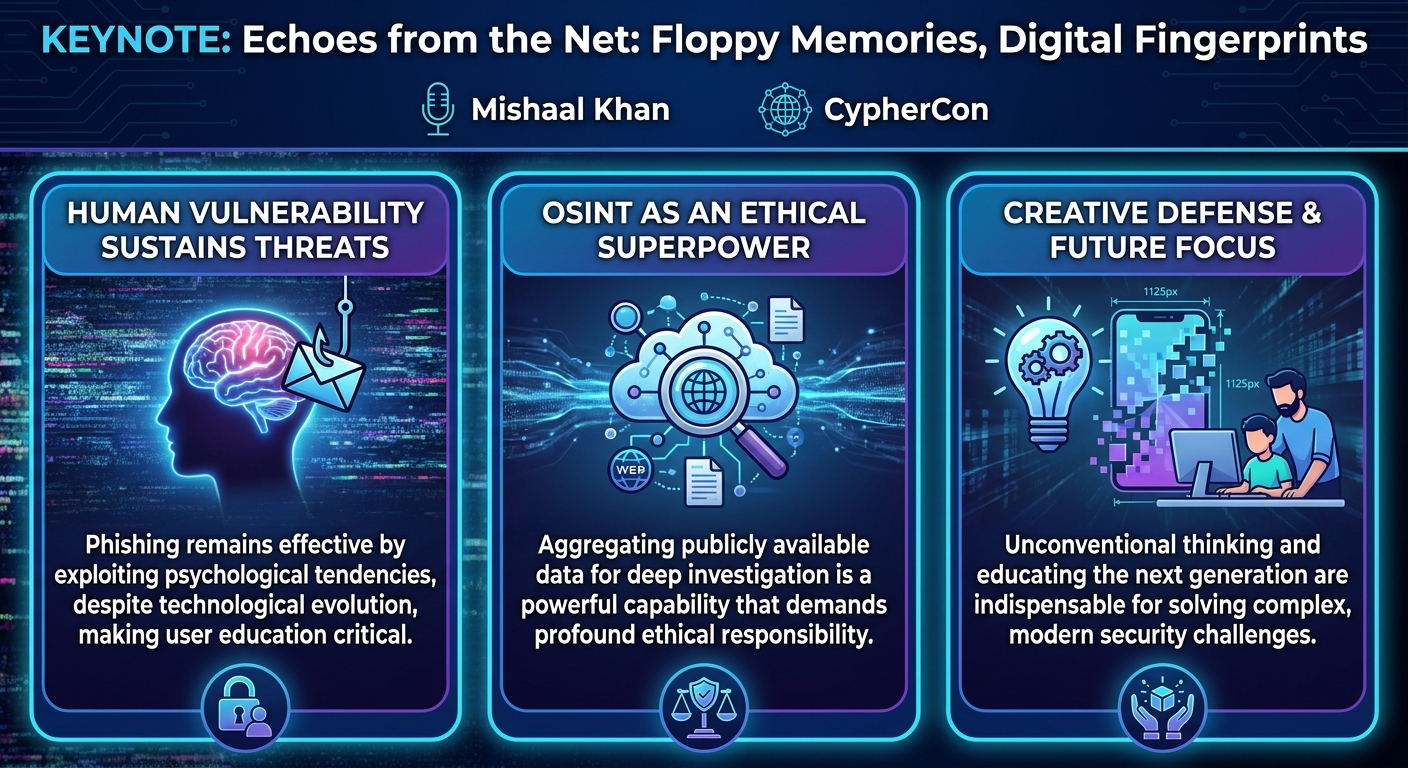
- Human Vulnerability Sustains Core Threats: Despite rapid technological evolution, fundamental attack vectors like phishing remain highly effective because they exploit enduring human psychological tendencies, making continuous user education paramount.
- Open-Source Intelligence (OSINT) is a Critical Superpower: OSINT extends far beyond simple search engine queries, enabling deep profiling and investigation by aggregating publicly available data from the "deep web," demanding ethical stewardship from its practitioners.
- Creative Problem-Solving is Indispensable: Effective cybersecurity requires "thinking different" and employing unconventional analytical methods, such as deriving device information from pixel width, especially when traditional metadata is absent.
- Ethical Responsibility is Paramount for "Superpowers": The immense power afforded by cybersecurity skills and OSINT carries a significant ethical burden, requiring professionals to use their abilities for good and to educate others on responsible technology use.
- Networking and Practical Experience Drive Career Success: In a field that often prioritizes formal qualifications, Khan's experience demonstrates that hands-on skills, self-reliance (like starting his own company), and building a strong professional network can be equally, if not more, valuable.
About the Speaker(s)
Mishaal Khan is introduced as a master of open-source intelligence, a cybersecurity all-rounder, and an amazing overall person. He grew up in Saudi Arabia, where he was exposed to computers from a very young age, assembling them with his brother and developing a keen interest in modifying games. This early curiosity laid the groundwork for his eventual career as a hacker. Khan holds a degree in engineering, but his path into cybersecurity was largely self-taught and driven by practical necessity and problem-solving.
Upon moving to the United States, Khan faced challenges in finding employment due to a lack of formal cybersecurity degrees or certifications, leading him to establish his own company. He is a professional certified social engineer and pentester, demonstrating a deep understanding of human psychology in addition to technical systems. Mishaal Khan is known for his ability to unmask individuals and solve complex cases using his advanced OSINT skills, from finding missing persons to exposing intellectual property theft. He is also an educator, teaching OSINT classes with the goal of empowering and enabling others to use their skills for positive change, viewing it as "creating an army, creating the Avengers." Khan emphasizes the importance of networking and using one's "superpowers" in cybersecurity for ethical purposes.
Reviews
Dr. Zero (Offensive Security Researcher) — WEAK
This is an autobiographical nostalgia trip wrapped in Marvel-movie metaphors, not a keynote that pushes the field forward. If you want a bedtime story about the days of dial-up and Pringles canennas, it fills a slot. If you want actionable OSINT or defensive strategies, you're going to starve.
Heather Calloway (CISO) — SOLID
This is an autobiographical keynote detailing a self-taught hacker's journey from 1990s game exploits to modern OSINT. It is an engaging cultural history lesson for practitioners, but it offers no new defensive intelligence. Keep your leadership team focused elsewhere.