The Price of a Life Online: Valuing Personally Identifiable Information on the Dark Web
Andréanne Bergeron
Overview
In "The Price of a Life Online: Valuing Personally Identifiable Information on the Dark Web," Andréanne Bergeron delivers a crucial presentation that challenges conventional wisdom regarding the risk assessment of Personally Identifiable Information (PII). Bergeron, a security researcher at Flare with a PhD in criminology, argues that not all PII carries the same risk or warrants the same level of protection. Treating all personal data uniformly can obscure the true threat landscape, leading to misallocated security resources and a misunderstanding of individual exposure.
Key moments
- 2:20 Defining the problem: Not all PII causes same harm
- 7:00 AI vs. human research: LLMs are awfully lazy
- 10:20 Economic model results: Surprising PII valuations
- 12:20 Criminological model: PII value based on legal sentences
- 17:00 Analysis of most exposed PII for general population
- 22:50 Beyond direct fraud: Social engineering, blackmail, physical threats
- 25:30 Conclusion: Focus security efforts on social engineering
- 27:30 Q&A: Limitations of the criminological model
The Price of a Life Online: Valuing Personally Identifiable Information on the Dark Web
Speakers: Andréanne Bergeron, Security Researcher, Flare
Conference: CypherCon
YouTube: https://www.youtube.com/watch?v=ac_tVYmdwTs
Overview
In "The Price of a Life Online: Valuing Personally Identifiable Information on the Dark Web," Andréanne Bergeron delivers a crucial presentation that challenges conventional wisdom regarding the risk assessment of Personally Identifiable Information (PII). Bergeron, a security researcher at Flare with a PhD in criminology, argues that not all PII carries the same risk or warrants the same level of protection. Treating all personal data uniformly can obscure the true threat landscape, leading to misallocated security resources and a misunderstanding of individual exposure.
The talk delves into a comprehensive research journey to develop a robust scoring mechanism for PII, moving beyond simplistic monetary valuations. Bergeron explores two distinct methodologies—an economic model reflecting dark web market prices and a criminological model based on legal sentencing severity—highlighting their strengths, limitations, and the often-divergent insights they provide. This research is particularly vital for individuals and organizations seeking to understand and mitigate the nuanced risks associated with data breaches, emphasizing the evolving tactics of threat actors who increasingly aggregate "soft data" for sophisticated social engineering and real-world attacks.
Background
▶ Watch: Defining the problem: Not all PII causes same harm (2:20)
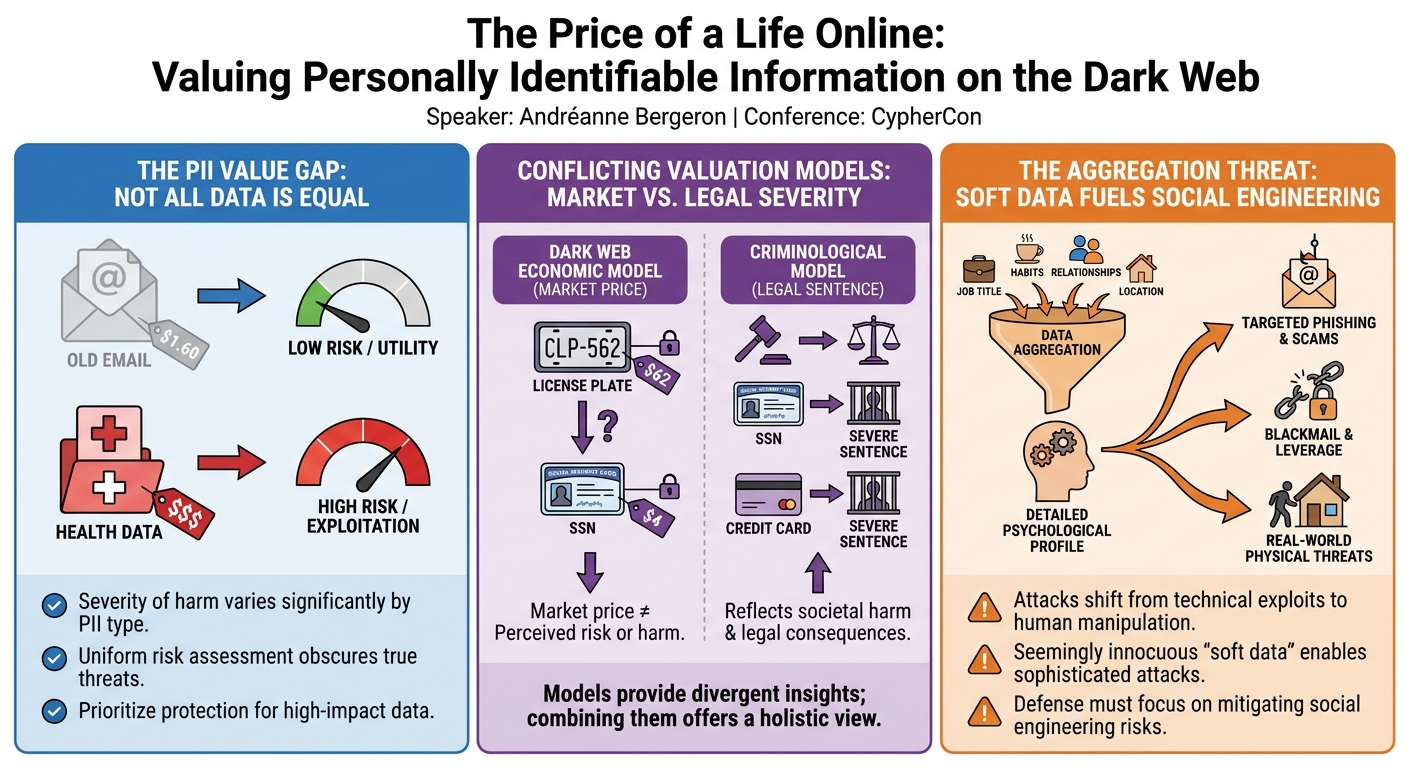
The premise of Bergeron's research stems from a critical gap in how PII is typically assessed and protected. Historically, discussions around data breaches often lump all exposed personal information into a single category, implying uniform risk. However, as Bergeron eloquently illustrates, the severity of harm, the types of crimes enabled, and the necessary protective measures vary significantly depending on the specific type of PII. An old, unused email address, for instance, does not carry the same weight as a social security number or personal health data. This disparity in risk is often overlooked, leading to an obscured understanding of the actual threats individuals face.
Flare, a dark web monitoring company, initially focused on protecting organizations by monitoring domain names and non-human identities. However, recognizing the growing threat to individuals, the company began to adapt its focus to individual threat assessment. This shift necessitated a more nuanced approach to valuing personal information. Instead of simply listing exposed data, Flare aimed to provide meaningful context, enabling individuals to understand which pieces of their PII posed the greatest risk. This objective led to the central research question: how can we accurately assess the value and risk of different types of PII, both on the clear web and the dark web? The complexity is further compounded by the sheer volume of personal information exposed online, making it imperative to differentiate between high-priority and low-priority data points for effective defense.
Key Findings
▶ Watch: Economic model results: Surprising PII valuations (10:20)
Bergeron’s research yielded several critical insights into the valuation and risk of PII:
- AI/LLM Limitations: Initial attempts to use Large Language Models (LLMs) for PII valuation proved ineffective. LLMs frequently hallucinated data, provided irrelevant sources, and produced nonsensical rankings, failing to accurately reflect the real-world value or danger of various PII types (e.g., ranking "encrypted key" highly while omitting "social security number" from the top 20). This highlights the current unreliability of generative AI for nuanced scientific research in this domain.
- Divergent Valuation Models: Two distinct models—an economic model based on dark web market prices and a criminological model based on the severity of legal sentences for PII misuse—produced different rankings for PII value. The economic model, for example, controversially valued a license plate at $62 while a social security number was only $4, suggesting that market price does not always equate to perceived risk or actual harm. The criminological model, conversely, elevated the social security number's importance but placed credit card information at the top, despite its relative ease of replacement.
- Bundle Effect and Info-Stealer Victims: The economic model struggled to accurately price individual PII types when sold in bundles, as often happens on the dark web. High-value breaches containing numerous PII types could artificially inflate the perceived value of less critical data points included in the bundle. Furthermore, victims of info-stealer malware were found to have significantly higher-value exposed profiles (sometimes exceeding $100,000) due to the aggregation of thousands of URLs, emails, and passwords from their compromised systems.
- Prevalence vs. Value: While email addresses, passwords, and usernames are the most commonly exposed PII (valued at approximately $1.6, $2, and $0.16 respectively in the economic model), they generally represent a low monetary value per item. In contrast, personal health data and financial data consistently ranked high in monetary value due to their potential for insurance fraud and direct financial exploitation.
- Social Engineering as a Primary Threat: Analysis of Flare's data revealed that most exposed PII is useful for social engineering. While authentication data (security questions, password hints) is also present, financial information is less commonly found, partly due to the rolling nature of credit card numbers. This underscores that defense efforts should increasingly focus on mitigating social engineering risks, which are often underestimated by technical professionals.
- Aggregation of "Soft Data" for Advanced Attacks: Beyond direct financial fraud or account compromise, threat actors are increasingly aggregating seemingly innocuous "soft data" such as job titles, company names, lifestyle habits, income levels, and relationship statuses. When combined, this information enables the creation of detailed psychological profiles, facilitating highly targeted phishing, blackmail, reputation damage, misinformation campaigns, and even real-world physical threats like stalking and burglary. This highlights a shift from purely technical exploitation to sophisticated human manipulation.
- Historical Breach Severity: The Mate1 dating website breach stands out as the most severe historical incident in terms of the sheer number of PII types exposed (25 different types from 27 million users), ranging from astrological signs to drinking habits, income levels, and job titles, illustrating a profound privacy violation.
Technical Deep Dive
▶ Watch: Analysis of most exposed PII for general population (17:00)
Bergeron's research embarked on a multi-faceted approach to quantify the nebulous concept of PII value and risk. The core problem statement was clear: current methods of assessing PII risk are inadequate because they fail to differentiate between the varying levels of harm and criminal utility associated with different data types. This leads to an "obscured threat landscape" where critical vulnerabilities might be overlooked.
The initial phase of the research involved an exploration of Artificial Intelligence (AI) and Large Language Models (LLMs). Bergeron attempted to leverage an LLM to scrape blogs and research reports, aiming to compile a database of PII values. The methodology involved carefully prompting the LLM to identify specific PII types and their associated prices. However, this approach quickly proved problematic. The LLM exhibited hallucination, generating prices and PII types not supported by its supposed sources. For instance, it frequently cited the same few, irrelevant sources and presented a skewed hierarchy of risk, placing "encrypted key" at the top while critical PII like "social security number" was absent from the top 20. Other unusual entries, such as "website activities" and "reward program balances," further demonstrated the LLM's inability to grasp the nuanced context of PII value in a cybersecurity threat model. This experiment served as a critical negative finding, reinforcing the need for human-driven data collection and analysis.
Following the failure of the AI approach, the research shifted to a human-driven data collection methodology. A team of students meticulously reviewed research reports, media coverage, and specialized blogs that discussed the value of PII, either individually or as part of a bundle. This manual process resulted in a dataset comprising 348 rows of information.
Economic Model: Market Price Valuation
The objective of the economic model was to estimate the market value of each PII type on the dark web. When PII was sold in bundles, the researchers developed a method to disaggregate the total price and attribute a proportional value to each individual PII type present in the bundle. Two crucial normalization steps were applied:
- Temporal Normalization: All prices were adjusted to today's value to account for inflation, ensuring comparable figures across data breaches that occurred in different years.
- User Normalization: Prices were normalized per user to account for the varying scale of data breaches, allowing for a fair comparison of PII value irrespective of the number of affected individuals.
The results of the economic model revealed a top 20 list of PII by price. Personal health data consistently ranked highest, a known phenomenon attributed to its high utility in insurance fraud and other medical-related scams. Financial data also appeared in the top three, which aligns with expected criminal motivations. However, the model also produced some anomalous results, such as a license plate valued at $62 while a social security number (SSN) was valued at a mere $4. Bergeron highlighted the incongruity, pointing out that license plates are publicly visible, whereas SSNs are highly sensitive. This discrepancy suggested that the dark web market price, influenced by supply, demand, and the ease of monetization for specific fraud types, does not always align with an individual's perceived risk or the potential for long-term harm. Another anomaly was the presence of "account balance URL" and "names URLs" in the top 20, which upon deeper investigation, were found to be frequently bundled with high-value breaches, artificially inflating their individual perceived worth within the model. This led to the conclusion that "market price is not equal to the perceived risk."
Criminological Model: Legal Severity Assessment
To address the limitations of the economic model, Bergeron introduced a criminological approach. The underlying hypothesis was that the law, reflecting societal norms, could serve as a proxy for the general population's perspective on the severity of PII misuse. This model aimed to quantify the risk of PII by linking it to the actual sentences received by threat actors who criminally exploited such data.
The data for this model consisted of 29 cases spanning from 2001 to 2026 (likely a typo, meant to be 2001-2016 or 2001-2021, given the talk date), where PII was used in criminal activities. These cases involved 43 different laws being broken, with sentences ranging from zero to 40 years (zero indicating restitution or fines, sometimes exceeding $1.6 million). Examples of laws included "fraud and related activity in connection with identification document authentication feature and information," "aggravated identity theft," "conspiracy to commit offense or to defraud United States," and "bank fraud."
Applying a similar mathematical model to normalize and analyze the data, the criminological approach produced a different ranking. Notably, the social security number moved significantly higher in the ranking, aligning more closely with intuitive perceived risk. Conversely, date of birth/age moved farther down. However, this model also presented its own curiosities. Credit card information ranked as the "worst" PII to have exposed, despite Bergeron's personal anecdote of its relatively easy replacement by banks. Social media accounts also ranked highly, driven by cases where defendants accessed private videos and shared them without consent, leading to severe sentences. This highlighted that while the law reflects societal harm, it might not always align with the direct hassle or long-term personal impact for every individual.
Model Comparison and Limitations
Bergeron acknowledged the inherent limitations of both models. The economic model struggles with the bundle effect, making it difficult to isolate the true value of individual PII types. Furthermore, dark web data is notoriously difficult to obtain comprehensively. The criminological model, while providing a human-centric perspective, is limited to cases where threat actors were arrested, prosecuted, and sentenced, which represents only a fraction of actual PII-related crimes. It also doesn't fully account for aggravating factors, jurisdictions, or the number of victims, which can heavily influence sentences. Bergeron expressed a desire to combine these models in future work to create a more holistic valuation framework.
PII Exposure Profile from Flare Data
Leveraging Flare's extensive dataset, Bergeron presented an analysis of PII commonly exposed in practice. Unsurprisingly, email addresses ($1.6), passwords ($2), and usernames ($0.16) were the most frequently exposed items. This data revealed that the "profile of most people will not worth a lot in money term."
A visualization of "value buckets" showed that the vast majority of victims had a relatively low monetary worth of exposed information. However, a small but significant number of victims had profiles valued at $100,000 or more. These individuals were identified as victims of info-stealer malware. Such malware collects a vast array of credentials and data, often including thousands of URLs, emails, and passwords from a single victim, which then accumulate in value within the model.
Further categorization of exposed information (excluding ubiquitous email and password data) showed that social engineering-useful information (e.g., security questions, historical passwords, password hints) was the most prevalent. Authentication data followed, while financial information was the least common, partly attributed to the dynamic, "rolling" nature of credit card numbers, which change frequently. This finding led to a crucial defensive implication: "security effort must be put on the social engineering problem not on the financial one."
Worst Historical Leaks and Evolving Threats
Bergeron also highlighted historical data breaches to illustrate severe PII exposure. The Mate1 dating website breach was identified as the "worst breach based on the number of PII that was shared." This incident exposed 25 different types of personal information from approximately 27 million users, including highly sensitive details like drinking habits, drug habits, education level, ethnicity, fitness level, gender, geographic location, income level, and job title. Such a comprehensive data set offers unparalleled opportunities for profiling and exploitation. A bank breach ranked second, posing a direct financial fraud risk.
The talk concluded with an emphasis on the evolving nature of PII threats. While direct financial fraud from bank details or identity theft from IDs are well-understood, the "really interesting" and often underestimated risks lie in the aggregation of other PII. Information like email, job title, and company can enable perfectly believable phishing emails (e.g., fake HR messages, internal IT requests), far more effective than generic spam. Beyond hacking accounts, data such as messages, photos, and lifestyle information can be used for leverage, leading to blackmail and reputation damage, with permanent consequences once leaked.
Crucially, the aggregation of "soft data" like income, habits, and relationships allows threat actors to build "pretty strong psychological profiles" for highly precise targeting. This facilitates sophisticated scams, misinformation campaigns, and influence operations. Finally, Bergeron stressed the real-world physical risks associated with leaked PII, where knowledge of an individual's home address, routine, or travel habits can lead to stalking, burglary, or other physical threats. The core message is that the danger is not just about what data is leaked, but "how it can be combined and used by the threat actor."
Demo / Proof of Concept
▶ Watch: Beyond direct fraud: Social engineering, blackmail, physical threats (22:50)
This talk was primarily a presentation of research methodology, findings, and analysis, rather than a demonstration of a specific tool or exploit. Andréanne Bergeron did not present a live demo or a proof of concept during her session. Instead, she focused on detailing the process of PII valuation, the models developed, and the insights derived from Flare's extensive data sets.
Defensive Implications
▶ Watch: Q&A: Limitations of the criminological model (27:30)
The research presented by Andréanne Bergeron offers critical insights for individuals and organizations seeking to bolster their defenses against evolving cyber threats. The primary defensive implications are as follows:
- Prioritize Social Engineering Defenses: The most significant takeaway for defenders is the urgent need to shift focus towards social engineering mitigation. While efforts to secure email and password authentication are ongoing, the prevalence of PII useful for social engineering indicates that this vector is often underestimated and under-resourced. Organizations must train employees to recognize sophisticated phishing attempts that leverage aggregated personal data, and individuals should be highly skeptical of unsolicited communications, even if they appear highly personalized.
- Understand Data Aggregation Risks: Threat actors are no longer relying on single pieces of PII. They actively aggregate diverse data points, including seemingly innocuous "soft data" (job titles, lifestyle, income, relationships), to build comprehensive psychological profiles. Defenders must recognize that even minor data leaks, when combined with other publicly or illicitly obtained information, can become powerful tools for targeted attacks. This necessitates a holistic view of data exposure rather than isolating individual data points.
- Recognize the Value of "Soft Data": Data that may not have direct monetary value on the dark web can still be incredibly potent for manipulation. Information like personal interests, habits, and relationships, when aggregated, can enable highly effective scams, misinformation campaigns, and even blackmail. Defenders should educate users about the risks of oversharing such information and implement strategies to protect seemingly non-critical data.
- Mitigate Real-World Physical Threats: The talk highlights that PII leakage extends beyond digital compromise, posing real-world physical risks. Knowledge of home addresses, routines, and travel habits can facilitate stalking, burglary, or other physical threats. Individuals should be cautious about sharing location-based information online, and organizations handling such data should implement stringent security measures.
- Adopt a Nuanced Risk Assessment: Abandon the "all PII is equal" mindset. Defenders should adopt a nuanced approach to PII risk assessment, understanding that different types of data carry varying levels of harm and criminal utility. This allows for more effective prioritization of security controls and incident response strategies. For example, a breach involving social security numbers warrants a different response than one involving outdated email addresses.
- Be Wary of Info-Stealer Malware: The research clearly indicates that victims of info-stealer malware often have the highest-value compromised profiles due to the vast aggregation of credentials and personal data. Implementing robust endpoint detection and response (EDR) solutions, ensuring timely patching, and educating users about safe browsing and download practices are critical to prevent such comprehensive compromises.
Key Takeaways
- Not all PII is equal: The severity of harm, the types of crimes enabled, and the necessary protection levels vary significantly between different types of Personally Identifiable Information (PII). A nuanced approach to risk assessment is critical.
- AI/LLMs are not yet reliable for PII valuation: Initial research attempts using Large Language Models (LLMs) for PII valuation resulted in hallucinated data and nonsensical rankings, highlighting their current limitations for complex, context-dependent security research.
- Economic and criminological models offer different perspectives: Dark web market prices (economic model) do not always align with perceived risk or legal severity (criminological model). While market prices reflect immediate monetization potential, legal consequences often reflect societal harm and long-term impact.
- Social engineering is the paramount threat: Most commonly exposed PII is useful for social engineering, enabling highly targeted and effective phishing, scams, and manipulation. Defense efforts must prioritize mitigating these human-centric attacks over solely focusing on technical vulnerabilities.
- Data aggregation amplifies risk: Threat actors increasingly aggregate disparate pieces of PII, including "soft data" like lifestyle habits and relationships, to build detailed psychological profiles. This aggregated data enables sophisticated blackmail, misinformation campaigns, and even real-world physical threats.
- Info-stealer malware creates high-value victims: Victims of info-stealer malware are at particularly high risk due to the vast amount of credentials and personal data collected, leading to significantly higher-value compromised profiles compared to other breach types.
About the Speaker(s)
Andréanne Bergeron is a distinguished security researcher at Flare, a dark web monitoring company. She holds a PhD in criminology, bringing a unique social science perspective to the field of cybersecurity. With five years of experience in the cybersecurity industry, Bergeron actively bridges the gap between academic research and practical security applications. She maintains close ties with academia as an affiliated professor at Montreal University. Furthermore, Andréanne is deeply involved in the cybersecurity community, serving on the organizing team for NSec, a notable hacker conference in Montreal. Her work focuses on understanding the human element of cyber threats and developing innovative approaches to assess and mitigate risks associated with personal information.
Reviews
Dr. Zero (Offensive Security Researcher) — SOLID
Bergeron brings a criminology PhD to a dark web pricing problem, which is a hell of a lot better than the usual vendor 'dark web scan' pitches. The methodology of contrasting market price against legal sentencing severity is a neat lens, even if the dataset is painfully small. Good empirical work, but the final conclusions about social engineering are things we've known for a decade.
Heather Calloway (CISO) — STRONG ACCEPT
Andréanne Bergeron dismantles the assumption that dark web pricing equals enterprise risk. By contrasting economic market value with criminological sentencing data, she provides a rigorous framework for quantifying data exposure. This is highly relevant material for anyone trying to put a dollar figure on cyber risk for their board or insurance carrier.