N8N: The Automation Powerhouse – Building Production-Ready AI Agents Without the Code Complexity
Sri Hari Deep Kolagani (Director of Enterprise Applications · Elastic)
Overview
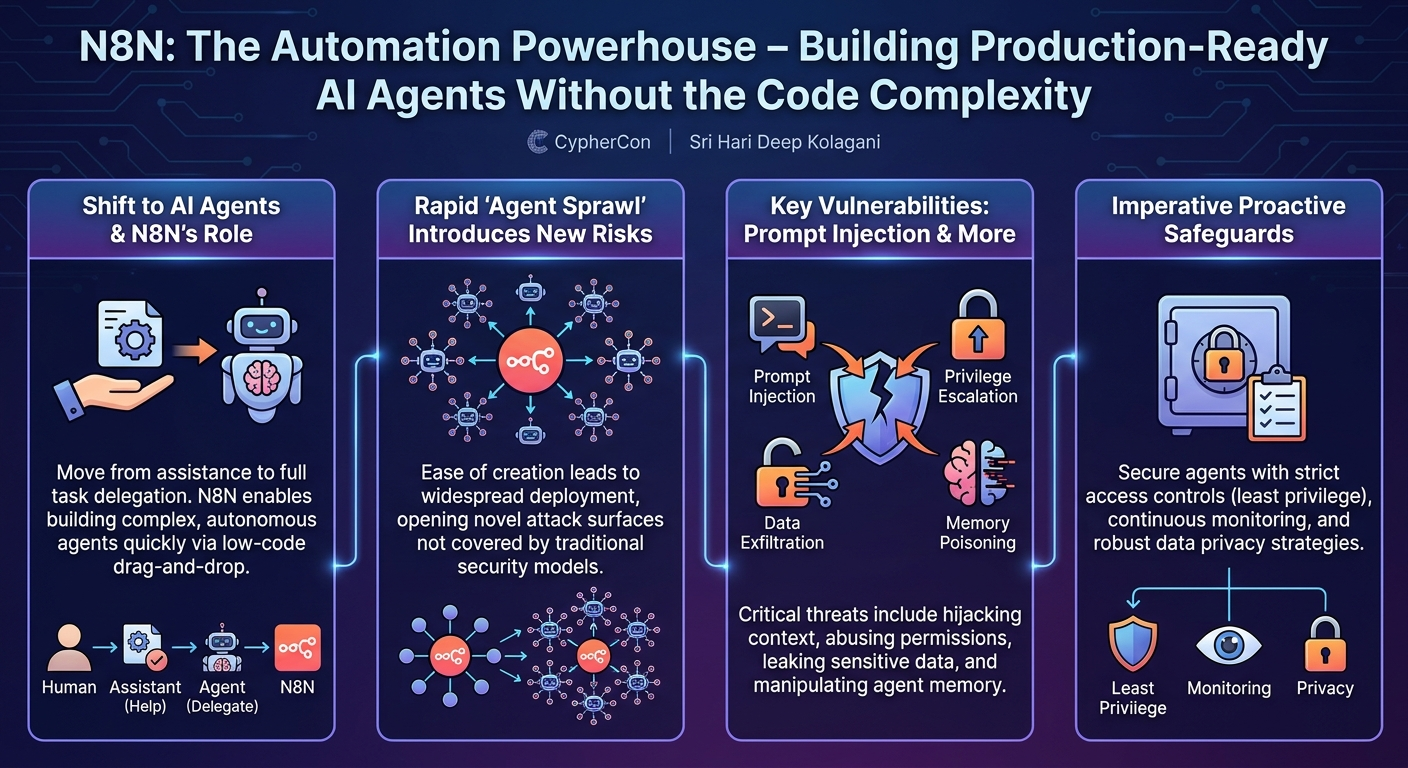
In this insightful CypherCon presentation, Sri Hari Deep Kolagani, Director of Enterprise Applications at Elastic, illuminated the rapid evolution from AI assistants to AI agents and demonstrated how easily these powerful, autonomous systems can be built using open-source tools like N8N. The talk served as a crucial wake-up call, highlighting that while agentic AI promises unprecedented productivity gains by delegating complex tasks, its inherent simplicity in creation also introduces a myriad of significant security vulnerabilities. Kolagani not only showcased a practical, real-world application of an AI agent handling sales leads and customer interactions but also meticulously outlined the critical security risks, such as prompt injection, privilege escalation, and data exfiltration, that defenders must urgently address as "agent sprawl" becomes an undeniable reality.
Key moments
- 2:00 Evolution from AI Assistants to AI Agents
- 5:48 N8N: Open-source tool for building AI automations
- 9:40 Demo context: AI sales rep creating CRM leads
- 12:20 Live demo: AI agent makes a sales call
- 14:35 N8N workflow powering the AI sales call demo
- 17:00 Understanding security risks: prompt injection, privilege escalation
- 19:40 Q&A: EU customer privacy and AI data sharing
N8N: The Automation Powerhouse – Building Production-Ready AI Agents Without the Code Complexity
Speakers: Sri Hari Deep Kolagani, Director of Enterprise Applications, Elastic
Conference: CypherCon
YouTube: https://www.youtube.com/watch?v=whXvIAefQD0
Overview
In this insightful CypherCon presentation, Sri Hari Deep Kolagani, Director of Enterprise Applications at Elastic, illuminated the rapid evolution from AI assistants to AI agents and demonstrated how easily these powerful, autonomous systems can be built using open-source tools like N8N. The talk served as a crucial wake-up call, highlighting that while agentic AI promises unprecedented productivity gains by delegating complex tasks, its inherent simplicity in creation also introduces a myriad of significant security vulnerabilities. Kolagani not only showcased a practical, real-world application of an AI agent handling sales leads and customer interactions but also meticulously outlined the critical security risks, such as prompt injection, privilege escalation, and data exfiltration, that defenders must urgently address as "agent sprawl" becomes an undeniable reality.
The presentation underscored a fundamental shift in how humans interact with AI: moving from merely assisting users to actively working for them. This paradigm change necessitates a re-evaluation of security postures, as traditional safeguards designed for deterministic software may prove insufficient against the probabilistic and autonomous nature of AI agents. Kolagani's talk is vital for anyone in the cybersecurity community, offering a timely exploration of the emerging threat landscape presented by easily deployable, powerful AI agents and providing actionable insights into the defensive strategies required to secure this new frontier of automation.
Background
▶ Watch: Evolution from AI Assistants to AI Agents (2:00)
The landscape of artificial intelligence has undergone a profound transformation, evolving from purely deterministic systems to sophisticated, autonomous AI agents. Historically, AI applications were akin to rigid decision trees: if A, then B; if B, then C. These were predictable, rule-based systems often found in Robotic Process Automation (RPA), designed to execute predefined workflows. The advent of Generative AI (GenAI) marked a significant leap, introducing AI assistants that could handle probabilistic decision-making, augmenting human productivity by performing tasks like drafting content or summarizing information. However, humans still retained the ultimate oversight and decision-making authority.
The current era, as highlighted by Kolagani, is defined by the rise of AI agents. These agents represent a powerful fusion of probabilistic and deterministic actions, capable of not just assisting but completely delegating tasks from humans. They are designed to work autonomously, making decisions and taking actions on behalf of their human counterparts. This shift implies a complete delegation of work, where AI agents are empowered to perceive, decide, act, and remember. Kolagani simplifies the foundational principles of an AI agent into four core components: perception, decision-making, action, and memory. The speaker specifically emphasized the critical role of memory, noting its importance for contextual understanding and ensuring that actions are relevant and non-redundant. Without robust memory, an agent lacks the context to select appropriate deterministic actions within complex workflows.
To facilitate the creation of these sophisticated agents, tools like N8N have emerged. N8N is an open-source automation tool, often described as an enterprise-grade, self-hostable alternative to commercial offerings like Zapier. It provides a highly intuitive, drag-and-drop graphical user interface (GUI) that enables users to build complex automations and integrate various services. N8N supports over 400 pre-built nodes, which are essentially connectors or wrappers for common enterprise platforms (e.g., Salesforce, Workday), cloud services, and custom APIs. These nodes abstract away the complexity of API interactions, allowing users to quickly configure workflows by simply providing authentication tokens and dragging components. The platform is API-driven and event-driven, meaning workflows can be triggered by external events (like a new lead in a CRM) or scheduled tasks. While earlier AI frameworks like LangChain, LangGraph, CrewAI, and AutoGen laid the groundwork for AI-driven automation, N8N provides the infrastructure layer, allowing developers and even non-technical users to build "skills" – essentially, English-language recipes that dictate an agent's behavior atop this robust automation backbone.
Key Findings
▶ Watch: Demo context: AI sales rep creating CRM leads (9:40)
The central discovery presented in this talk is the astonishing ease and speed with which sophisticated AI agents can now be constructed and deployed using open-source platforms like N8N. Kolagani demonstrated that complex, multi-system automations involving voice interactions, CRM updates, and AI-driven decision-making can be built in a matter of minutes, specifically stating that the demo's intricate workflow was assembled in "10 minutes." This unprecedented accessibility to agentic AI development marks a pivotal shift, moving beyond mere AI assistance to full task delegation, where agents work for humans rather than just with them.
However, this ease of development directly correlates with the primary security finding: the rapid proliferation of these agents, termed "agent sprawl," is poised to introduce a new and significant class of security vulnerabilities. The speaker meticulously outlined how the very mechanisms that make AI agents powerful – their autonomy, probabilistic decision-making, and access to enterprise systems – simultaneously create novel attack vectors. Key findings include:
- Simplicity Breeds Risk: The drag-and-drop nature of tools like N8N lowers the barrier to entry for AI agent creation, but this simplicity often overlooks robust security practices, leading to inherently insecure deployments.
- New Attack Surfaces: Traditional security models are ill-equipped to handle the probabilistic nature of AI agents. Attacks like prompt injection, where malicious data embedded in emails or web pages can hijack an agent's context, become highly effective.
- Elevated Privilege Risks: Over-privileging agents can lead to privilege escalation and data exfiltration. An agent with broad access, if social-engineered, can expose sensitive codebases or credentials, as exemplified by a recent vulnerability in a
pipackage that granted access to environment variables. - Memory as a Vulnerability: The critical role of memory in AI agents also presents a risk. If attackers can manipulate or poison an agent's memory, they can control its future actions and decision-making processes.
- The Delegation Dilemma: As humans delegate more sensitive enterprise tasks to agents, the consequences of a compromised agent become far more severe, impacting critical business operations and potentially leading to significant data breaches.
In essence, the talk's key finding is a dual revelation: the immense power and accessibility of agentic AI, coupled with an urgent warning about the severe, often overlooked, security implications arising from this new paradigm of automated delegation.
Technical Deep Dive
▶ Watch: Live demo: AI agent makes a sales call (12:20)
The technical core of the presentation revolved around N8N, an open-source workflow automation tool designed for building complex integrations and, crucially, AI agents. N8N acts as a highly flexible integration layer, providing a visual, drag-and-drop interface for constructing workflows without extensive coding. It supports over 400 pre-built nodes, which are essentially connectors or wrappers for various services, ranging from enterprise platforms like Salesforce and Workday to cloud services and custom APIs. These nodes encapsulate API interactions, making it straightforward to connect disparate systems. For instance, a "Workday node" understands all possible API actions for Workday, allowing users to simply provide OAuth tokens and configure actions visually.
N8N's architecture is fundamentally API-driven and event-driven. Workflows can be triggered by webhooks (e.g., a new record created in Salesforce), scheduled cron jobs, or other system events. This makes it highly scalable and adaptable for enterprise-level automations. The tool is deployable in environments such as Docker or Kubernetes, offering flexibility for self-hosting and customization. Its community-driven nature means there's a rich ecosystem of pre-defined workflows and custom nodes available on platforms like GitHub, further accelerating development.
The speaker elaborated on the foundational principles of an AI agent, which N8N helps orchestrate:
- Perception: The ability of the agent to receive and interpret information from its environment (e.g., a new lead in a CRM, a user's voice input).
- Decision-Making: The agent's capacity to process perceived information, apply logical rules, and leverage AI models (e.g., large language models via OpenAI connectors) to determine the next course of action.
- Action: The execution of chosen actions through integrated tools and systems (e.g., making a phone call, creating a task in Salesforce).
- Memory: A critical component, enabling the agent to retain context, conversation history, and past decisions. This memory is essential for coherent, non-redundant actions and for adapting to ongoing interactions. The speaker emphasized that "memory stocks are skyrocketing" due to its importance in agentic AI.
The demonstration showcased a sophisticated multi-tool integration, illustrating how N8N stitches together various components to form a functional AI agent. The architecture for the demo involved:
- Claude: Used as the initial user interface for creating a lead.
- Custom MCP Server: A custom server acting as an intermediary, communicating with Salesforce.
- Salesforce: The Customer Relationship Management (CRM) system where leads are created and tasks are managed.
- N8N Workflow: The orchestration engine connecting all components and defining the agent's logic.
- Retell AI: An external service utilized for initiating and managing the AI-driven voice call.
The N8N workflow itself was intricately designed:
- Webhook Trigger: The workflow initiated with a webhook that listens for new lead creations within Salesforce (triggered by Claude interacting with the custom MCP server).
- Initiate AI Call: Upon receiving the lead data, N8N used the Retell AI connector to place an outbound voice call to the customer using the number associated with the newly created lead.
- Call Monitoring: The workflow continuously polled the Retell AI service to monitor the status of the call, specifically waiting for the call to end.
- Transcript Processing: Once the call concluded, N8N retrieved the full call transcript.
- AI Agent Analysis: The transcript was then sent to an AI agent (likely leveraging an LLM via an OpenAI or similar connector). This agent, equipped with its memory and toolset, analyzed the conversation to understand its content, identify key discussion points, and extract relevant action items.
- Task Creation: Finally, based on the AI agent's analysis, N8N created a task within Salesforce. This task included the full call transcript and AI-generated comments summarizing the findings and outlining follow-up actions for a human sales representative.
This detailed workflow exemplifies how N8N empowers the creation of highly automated, intelligent agents that can autonomously handle complex business processes, from initial data ingestion to AI-driven interaction and subsequent task management, bridging the gap between human input and automated execution across multiple enterprise systems.
Demo / Proof of Concept
▶ Watch: Understanding security risks: prompt injection, privilege escalation (17:00)
The core of the presentation’s impact was a live demonstration showcasing the seamless integration and autonomous capabilities of an AI agent built with N8N. The scenario simulated a sales lead management process, with an AI acting as a sales representative.
The demonstration began with the speaker using Claude (a conversational AI interface) to initiate the process. He instructed Claude to "create a lead for John Smith." Behind the scenes, Claude communicated with a custom MCP server, which then interfaced with a Salesforce instance to create the new lead record. This action, the creation of the lead in Salesforce, served as the trigger for the N8N workflow.
Immediately after the lead was created, the speaker received an incoming phone call. This call was placed by the AI assistant, "Sarah," powered by Retell AI and orchestrated by the N8N workflow. The AI assistant introduced herself as being from the sales team and inquired about the user's recent inquiry. The speaker, acting as "John Smith," engaged in a natural language conversation with the AI:
- AI: "To make sure I understand your needs, could you tell me a bit about the specific challenges you're looking to solve right now?"
- Speaker: "I'm looking for new AI agentic tools that can help with my business."
- AI: "Could you share a bit more about what areas of your business you'd like these AI tools to impact? For example, are you looking for help with customer service, sales, operations, or something else?"
- Speaker: "I'm looking for help with my customer service mostly."
The conversation continued, with the AI intelligently adapting its questions based on the user's responses. The speaker then demonstrated the agent's flexibility by stating, "I am still in the early research phase. And you know what? I am actually in the middle of the presentation. Would you mind calling me back next Monday at 6:00 Eastern time?" The AI assistant immediately processed this request, confirmed the callback details, apologized for the interruption, and respectfully ended the call.
Crucially, the speaker emphasized that the call could be ended at any point, and the AI agent would be "smart enough to transcribe and follow up for a human agent in the system." Following the call, the speaker navigated to the N8N workflow execution logs, showing that the system had successfully processed the call. He then moved to the Salesforce instance, where a new task had been automatically created. This task was linked to the "John Smith" lead and contained the full call transcript, as well as AI-driven comments summarizing the conversation, identifying the customer's interest in "AI agentic tools for customer service," and noting the requested callback time for a human sales representative.
The speaker proudly stated that this entire, sophisticated automation, encompassing lead creation, AI-driven voice interaction, intelligent conversation, and follow-up task creation, was "built in 10 minutes" using N8N. This speed and ease of deployment powerfully underscored the talk's central message: that building highly functional AI agents is now remarkably accessible, setting the stage for both immense productivity and significant security challenges.
Defensive Implications
▶ Watch: Q&A: EU customer privacy and AI data sharing (19:40)
The alarming ease with which AI agents can be built using tools like N8N, as demonstrated by Kolagani, presents a new and rapidly evolving threat landscape for cybersecurity defenders. The speaker explicitly warned of "agent sprawl," where countless agents will soon be interacting across enterprise systems, handling sensitive data and critical tasks. This proliferation, coupled with the inherent complexities of AI, introduces several novel and significant security risks:
- Prompt Injection: This is perhaps the most immediate and pervasive threat. Unlike traditional software, AI agents operate on natural language prompts. Attackers can embed malicious instructions or data within seemingly innocuous inputs like emails, web page content, or chat messages. If an agent processes this injected prompt, it can be coerced into performing unintended actions, bypassing security controls, or revealing sensitive information. Kolagani highlighted that prompt injection can "take the control over the context layer of the agents," effectively hijacking the agent's operational understanding.
- Privilege Escalation: A critical vulnerability arises when AI agents are over-privileged. If an agent is granted excessive access to internal systems, databases, or code repositories, an attacker who successfully compromises or social-engineers the agent could leverage these privileges. The speaker warned that an over-privileged agent could "give your code base to the end user," leading to unauthorized access to intellectual property or critical infrastructure. This risk is amplified by the agent's ability to act autonomously across connected systems.
- Data Exfiltration: Closely related to privilege escalation, data exfiltration becomes a heightened concern. If an agent is compromised or tricked, it can be manipulated to extract sensitive data from internal systems and transmit it to an attacker. Kolagani cited a recent, timely example in the LLM world: a vulnerability in a
pipackage that "gave access to all credentials in your environment file." This demonstrates how even seemingly minor vulnerabilities in the underlying tools or libraries used by AI agents can lead to catastrophic data breaches. Defenders must ensure that agents are using secure, vetted tools and are configured with the principle of least privilege.
- Memory Poisoning: The memory component of AI agents, crucial for maintaining context and enabling intelligent decision-making, also represents a significant attack surface. If an attacker gains control over an agent's memory, they can "poison" its context layer. This could involve injecting false information, altering past interactions, or manipulating the agent's understanding of its environment. A poisoned memory can lead the agent to make incorrect decisions, perform malicious actions, or provide misleading information, all while operating under the false pretense of legitimate context.
Beyond these specific attack vectors, Kolagani also touched upon broader defensive considerations:
- Lack of AI-Native Security: Current security practices and tools are often not designed for the probabilistic, autonomous, and context-dependent nature of AI agents. New safeguards and monitoring mechanisms are urgently needed.
- Compliance and Privacy: The speaker noted feedback from EU customers who "don't want to engage with AI yet" and "don't want their data to be shared with AI." This necessitates robust data governance strategies, such as preventing specific customer data from being sent to AI models, especially for privacy-sensitive regions.
- Auditability and Explainability: As agents make autonomous decisions, it becomes crucial to log their actions, decision-making processes, and the context they operated within for auditing, incident response, and compliance.
In conclusion, the ease of building AI agents introduces an "entirely new set of risks," as Kolagani stated. Defenders must move beyond traditional perimeter security to focus on agent-specific vulnerabilities, implement strict access controls, continuously monitor agent behavior, and prioritize secure development practices to mitigate the inevitable "agent sprawl" and its associated dangers.
Key Takeaways
- The Era of AI Agents is Here: We are rapidly transitioning from AI assistants (aiding humans) to AI agents (working for humans, performing delegated tasks autonomously), fundamentally changing how businesses operate.
- Ease of Agent Development: Tools like N8N democratize the creation of complex, multi-system AI agents through intuitive drag-and-drop interfaces, enabling sophisticated automations to be built in minutes.
- Agent Sprawl and New Attack Surfaces: The simplicity of agent creation will lead to a rapid proliferation of agents across enterprises, creating "agent sprawl" and introducing novel, significant security vulnerabilities.
- Critical Security Risks: Defenders must urgently address threats such as prompt injection (hijacking agent context), privilege escalation (due to over-privileged agents), data exfiltration (via compromised agents or insecure tools), and memory poisoning (manipulating an agent's understanding and future actions).
- Memory is Key (and a Vulnerability): The agent's memory, vital for context and coherent action, is also a prime target for manipulation, underscoring the need for its robust protection.
- Proactive Safeguarding is Imperative: Given the power and autonomy of AI agents, implementing strong safeguards, adhering to the principle of least privilege, and addressing data privacy concerns (e.g., for EU customers) are crucial to prevent widespread insecure practices.
About the Speaker(s)
Sri Hari Deep Kolagani is the Director of Enterprise Applications at Elastic. His work involves managing enterprise applications and contributing to the company's product offerings, particularly in the realm of search platforms and context engineering. This presentation marked his first time speaking at CypherCon, where he shared his expertise on the evolving landscape of AI and its practical applications in enterprise automation.
Reviews
Dr. Zero (Offensive Security Researcher) — WEAK
This isn't a security talk. It's an N8N product tutorial wrapped in recycled OWASP LLM Top 10 talking points. Dragging and dropping API connectors for ten minutes to make a Salesforce webhook doesn't make you a researcher, and reciting the definition of prompt injection doesn't make this a threat briefing.
Heather Calloway (CISO) — MUST SEE
This talk is a necessary warning about the next phase of shadow IT: autonomous AI agents built via low-code platforms. Kolagani demonstrates how easily business units can wire LLMs directly into core enterprise systems like Salesforce. It’s required viewing for security leadership because it shifts the AI risk conversation from data leakage to unauthorized, automated execution.