Open Source House Party
Kadi McKean
Overview
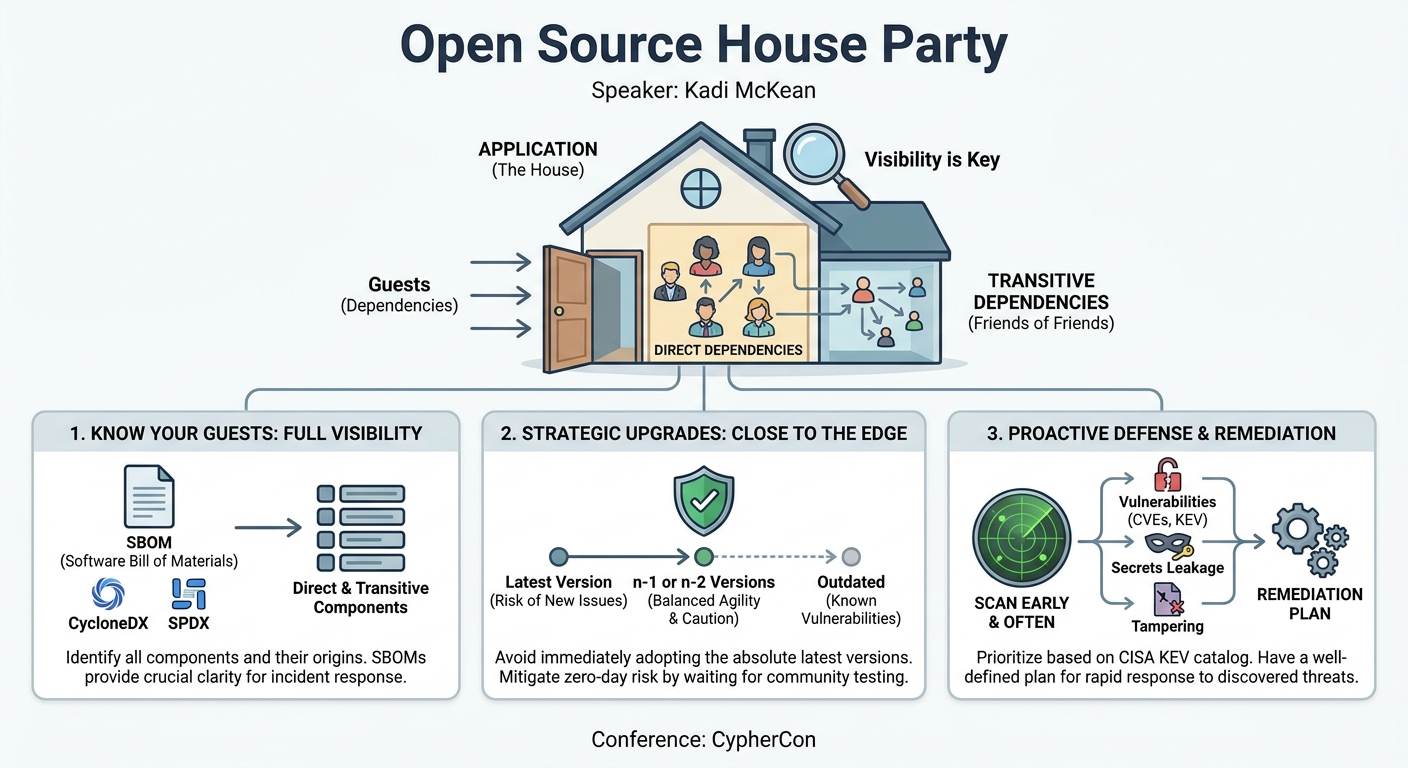
In her CypherCon talk, "Open Source House Party," Kadi McKean, Open-Source Community Manager at ReversingLabs, delves into the critical and often overlooked aspects of software supply chain security. McKean masterfully employs a relatable "house party" analogy to illustrate the complexities and inherent risks of relying on external software components. The core message of the talk is that modern applications are essentially "parties" composed of numerous guests – direct and transitive dependencies – each bringing their own potential vulnerabilities and security implications.
Key moments
- 2:00 Speaker introduction and house party analogy
- 10:00 Understanding direct vs. transitive software dependencies
- 12:00 Social, security, and legal impacts of dependencies
- 18:30 Threat actors scan for flaws in just 15 minutes
- 20:45 Key considerations for choosing software components wisely
- 30:20 Understanding SBOMs and securing the software supply chain
- 36:30 Upgrade strategy: 'Living close to the edge'
- 38:00 The importance of a robust remediation plan
Open Source House Party
Speakers: Kadi McKean, Open-Source Community Manager, ReversingLabs
Conference: CypherCon
YouTube: https://www.youtube.com/watch?v=g10z0cqbc_w
Overview
In her CypherCon talk, "Open Source House Party," Kadi McKean, Open-Source Community Manager at ReversingLabs, delves into the critical and often overlooked aspects of software supply chain security. McKean masterfully employs a relatable "house party" analogy to illustrate the complexities and inherent risks of relying on external software components. The core message of the talk is that modern applications are essentially "parties" composed of numerous guests – direct and transitive dependencies – each bringing their own potential vulnerabilities and security implications.
McKean highlights the alarming reality that a vast majority of contemporary codebases are built upon open-source components, often maintained by individuals or small teams, creating a significant attack surface. The presentation moves beyond traditional vulnerability management, urging security professionals and developers to consider a broader spectrum of risks, including secrets leakage, tampering, and the overall health of the open-source communities behind these critical packages. This talk is essential for anyone involved in software development, security, or technology leadership who needs to understand and mitigate the pervasive threats within the software supply chain.
Background
▶ Watch: Speaker introduction and house party analogy (2:00)
The foundation of McKean's talk rests on a fundamental truth of modern software development: approximately 90% of code comes from external suppliers (06:00). This means that organizations heavily rely on pre-existing open-source packages and libraries, rather than reinventing the wheel. While this accelerates development, it introduces a complex web of dependencies. McKean introduces the vivid analogy of an application as a house party: just as a host invites direct guests, an application directly uses certain packages. However, these direct guests often bring their own friends – transitive dependencies – creating an expansive and often unseen network of code (10:00).
This reliance on external components, often maintained by "some dude named Bob in Nebraska" (06:00), creates inherent security challenges. Recent high-profile incidents, such as the Team PCP hack and Log4j vulnerability, underscore the catastrophic potential when a single, widely used component is compromised. McKean stresses that merely tracking vulnerabilities is no longer sufficient; it's considered "table stakes" in today's threat landscape (08:00). The focus must expand to encompass other critical aspects like secrets leaking, tampering, and evaluating the hardening of packages. Furthermore, the health and reactivity of the supporting community (e.g., active PR requests, updated documentation) are crucial indicators of a package's trustworthiness (10:00). The "house party" analogy extends to the real-world consequences, likening security incidents to theft, vandalism, or even legal repercussions from an out-of-control party, emphasizing that one bad dependency can have widespread and long-lasting impact (12:00-14:00).
Key Findings
▶ Watch: Social, security, and legal impacts of dependencies (12:00)
McKean's presentation reveals several critical findings that underscore the urgency of robust software supply chain security:
- Prevalence of Sub-Optimal Choices: A study, possibly from the Linux Foundation, suggests that software developers make "sub-optimal choices" 69% of the time regarding updating third-party dependencies (14:00). This highlights a systemic issue in how dependencies are managed.
- Widespread Package Flaws: Analysis of popular open-source ecosystems reveals a high prevalence of flaws. In PyPI and NPM, a significant number of packages are found to have issues ranging from vulnerabilities to dependency management problems and secret leaking (16:00).
- High Severity Vulnerabilities in Top Packages:
- Scans across 30 of the top OSS packages found an average of 68 vulnerabilities per package, with an average of six critical severity and 33 high severity vulnerabilities (16:00).
- For Python, scans across 10 high-traffic packages showed an even more dire average of 134 flaws per package, including 11 critical and 67 high severity vulnerabilities (18:00).
- Speed of Threat Actors: Threat actors are incredibly fast. It takes only 15 minutes for them to start actively scanning for and exploiting newly disclosed flaws in packages (18:00). This short window emphasizes the need for rapid detection and remediation.
- Inadequate Remediation Planning: A significant challenge for organizations is the inability to quickly identify which applications use a compromised component, track its remediation across the entire portfolio, or estimate the time until an update can be shipped (18:00). This indicates a widespread lack of comprehensive visibility and agile response mechanisms.
Technical Deep Dive
▶ Watch: Key considerations for choosing software components wisely (20:45)
The technical deep dive into securing the open-source supply chain begins with a framework for preparedness, akin to the "Scouts of America" motto: "Be Prepared" (20:00). McKean outlines five key pillars:
- Knowing What's in Your Binary: This involves having granular visibility into every component within an application, understanding its purpose, and identifying all third-party components (24:00). This is crucial for quickly identifying potential "party crashers" – malicious or vulnerable elements.
- Software Bill of Materials (SBOMs): An SBOM is a comprehensive, machine-readable list of all components, libraries, and modules used in a software product, including their versions and dependencies (30:00). McKean emphasizes that SBOMs provide clarity for what an application is using and are indispensable for triaging issues when something inevitably goes wrong. Two primary standards for SBOMs are SPDX (from the Linux Foundation) and CycloneDX (from OWASP). While both are valuable, CycloneDX is observed to be more widely adopted, possibly due to OWASP's security focus and the robustness of its maintaining team (34:00). The concept extends beyond mere components to securing the entire software supply chain, including development tooling, as demonstrated by the Team PCP CLI tool hack (32:00).
- Choosing Upgrades Wisely: Continuous upgrades are essential for managing technical debt and reducing regression risk, but they also present a critical inflection point for security (34:00). McKean introduces the concept of "living close to the edge" rather than "on the edge" (36:00). "Living on the edge" implies immediately updating to the latest version, which, while automated and scalable, carries the highest risk of encountering new vulnerabilities or malicious injections. "Living close to the edge" advocates for a more cautious approach, such as upgrading to n-1 or n-2 versions of the latest release. This strategy allows for automated, scalable workflows while ensuring that new releases have had some time in the wild for potential issues to be identified and patched, thus mitigating risk without sacrificing agility (38:00).
- Scanning Early and Often: Regular, comprehensive scanning is paramount. McKean warns that "not all scans are created equal," as some tools may only collect or display limited information (24:00). The goal is to obtain a full picture of potential issues quickly. The talk uses the analogy of a "dusty tangled ball of Christmas lights" to describe a dependency graph – often complex and overwhelming, making it difficult to ascertain the health of individual components (26:00). Effective scanning tools should help unravel this complexity.
- Having a Remediation Plan: Despite all preventative measures, incidents are inevitable. A robust remediation plan is crucial, involving clear rules, assigned roles, and regular drills within a DevSecOps pipeline (38:00). This ensures that when an issue arises, the team knows exactly what to do and who is responsible, enabling a swift and coordinated response.
McKean also discusses specific tools and standards for identifying and assessing vulnerabilities:
- CVEs (Common Vulnerabilities and Exposures): These are publicly listed disclosures of vulnerabilities, serving as a starting point for research, much like Wikipedia (28:00). However, their minimum content is often very basic.
- CVSS (Common Vulnerability Scoring System): This provides a numerical score (1-10) for vulnerability severity. While useful, McKean notes caveats, such as the XZ Utils package being rated 10 despite being malicious rather than a traditional vulnerability (28:00).
- KEV Catalog (Known Exploited Vulnerabilities): Maintained by CISA, this catalog is particularly valuable as it lists vulnerabilities known to be actively exploited in the wild (29:00). It acts as a "billboard" for immediate threats, providing more actionable information than a standard CVE.
The talk emphasizes evaluating components not just for security, but also for functionality, training cost, ease of review, project activity (e.g., numerous PR requests, community chatter, PR parties), and licensing (citing the OpenWRT example where Cisco's commercial product became open-source due to license violations) (22:00). Ultimately, if a component cannot be avoided, the focus shifts to understanding its inherent risks and improving its security posture.
Demo / Proof of Concept
▶ Watch: Understanding SBOMs and securing the software supply chain (30:20)
While technical difficulties prevented the full display of all visual aids during the live presentation, Kadi McKean effectively demonstrated the conceptual application of her company's free tool, secure.software (24:00, 40:00). This tool serves as a practical example of how security professionals and developers can gain rapid insights into their software supply chain.
McKean explained that secure.software allows users to quickly identify third-party components within a binary, offering a clear view of both direct and transitive dependencies. The tool is designed to bypass the need for extensive research projects, providing immediate data on potential issues like vulnerabilities, secrets leakage, and tampering. Users can scan packages to assess their security posture, understand project recommendations, and evaluate code quality. McKean highlighted its utility for performing up to 100,000 lookups a month via API access for registered users, making it a powerful resource for proactive security analysis and package evaluation. This presentation of secure.software served as a concrete illustration of the "scanning early and often" principle and the importance of having readily accessible data to inform component selection and risk management.
Defensive Implications
▶ Watch: The importance of a robust remediation plan (38:00)
The defensive implications derived from McKean's "Open Source House Party" talk are profound and call for a paradigm shift in how organizations approach software security. Defenders must move beyond reactive vulnerability patching to a proactive, holistic software supply chain security strategy.
Firstly, the adoption and consistent use of Software Bill of Materials (SBOMs) are non-negotiable. Organizations should generate SBOMs using established standards like CycloneDX or SPDX for every software product. These SBOMs provide unparalleled clarity into an application's composition, enabling rapid identification and triage of affected components during a security incident (30:00). The scope of protection must extend beyond just the final application to encompass the entire supply chain, including development tooling and build environments, as these are increasingly becoming targets for sophisticated attacks (e.g., the Team PCP CLI tool hack) (32:00).
Secondly, a strategic approach to upgrades is critical. Instead of blindly adopting the latest versions, defenders should advocate for a "living close to the edge" strategy (38:00). This means implementing automated upgrade workflows that target n-1 or n-2 versions of components. This cautious approach allows for the discovery and patching of initial vulnerabilities in new releases by the broader community before an organization adopts them, significantly reducing immediate exposure to zero-day or newly introduced malicious code.
Thirdly, continuous and comprehensive scanning is essential. Defenders need to employ tools that offer a full, granular picture of dependencies, rather than partial views (24:00). This includes scanning for not only known vulnerabilities (CVEs, CVSS scores) but also for secrets leakage, tampering, and indicators of a healthy, active open-source community. Prioritizing remediation based on the CISA KEV catalog for actively exploited vulnerabilities is a crucial step for immediate risk mitigation (29:00).
Finally, robust remediation plans and incident response capabilities are paramount. Organizations must develop clear, well-defined plans with assigned roles and responsibilities for handling security incidents (38:00). Regular drills and simulations can ensure that teams are prepared to act swiftly and effectively when a compromise occurs, minimizing the "15 minutes" window threat actors have to exploit flaws (18:00). This proactive posture, combined with continuous monitoring and a structured response, transforms security from a reactive burden into a resilient operational advantage.
Key Takeaways
- Embrace Comprehensive Supply Chain Security: Modern applications rely heavily on open-source, making software supply chain security paramount. Go beyond just tracking vulnerabilities to include secrets leakage, tampering, and overall package health.
- Understand Your Dependencies Deeply: Use tools and practices to identify all direct and transitive dependencies in your binaries. Just like a house party, you need to know who everyone is and who they brought with them.
- Leverage Software Bill of Materials (SBOMs): Implement SBOMs (preferably using CycloneDX or SPDX) to gain full visibility into your application's components. This is crucial for rapid incident response and clarity.
- Adopt a "Close to the Edge" Upgrade Strategy: Avoid immediately upgrading to the very latest versions. Instead, aim for n-1 or n-2 versions to benefit from community-driven vulnerability discovery and patching, balancing agility with caution.
- Prioritize Proactive Scanning and Remediation: Scan early and often using comprehensive tools. Prioritize remediation efforts based on actively exploited vulnerabilities listed in resources like the CISA KEV catalog, and have a well-rehearsed remediation plan in place.
- Evaluate Community Health and Licensing: When selecting open-source components, assess the activity and health of their communities (e.g., active PRs, documentation). Always review licensing to avoid legal pitfalls.
About the Speaker(s)
Kadi McKean is the Open-Source Community Manager at ReversingLabs, a company specializing in binary-based malware analysis and software supply chain security. Her work at ReversingLabs focuses on fostering engagement and managing the open-source aspects of the company's initiatives. Beyond her role at ReversingLabs, Kadi is a co-organizer for State of the Stack (formerly DevOpsDays DC), an event dedicated to "hackery things" and broader technology discussions, for which the CFP (Call for Papers) was open at the time of the talk. She also hosts a podcast called 10X Insights, where she likely explores various technology and security topics. McKean's expertise lies particularly in software supply chain security, making her a knowledgeable voice on the challenges and solutions in this critical area.
Reviews
Dr. Zero (Offensive Security Researcher) — HARD PASS
McKean spends 40 minutes explaining what a software dependency is using a high school house party analogy before pitching a ReversingLabs scanner. If you still need a speaker to define an SBOM, a CVE, or Log4j for you, you shouldn't be at a security conference. Pure vendor lead-gen dressed up as an awareness session.
Heather Calloway (CISO) — SOLID
This is a competent, accessible primer on software supply chain risk that covers well-established basics like SBOMs and transitive dependencies. While it doesn't break new strategic ground for a CISO, the recommendation to standardize on an 'n-1' upgrade strategy provides a practical policy lever for balancing engineering velocity with zero-day exposure. It is a solid baseline review for your application security and DevSecOps teams.