Meschcore & Meshtastic Command & Control Infrastructure
Eric Escobar
Overview
In this compelling CypherCon talk, "MeshCore & Meshtastic Command & Control Infrastructure," red teamer Eric Escobar delves into the often-overlooked potential of Meshtastic—an open-source, low-power mesh network protocol—as a stealthy and resilient Command and Control (C2) channel for offensive security operations. Escobar, a red teamer at Sophos/Secureworks, shares his innovative approach to leveraging this off-grid communication technology for physical breaches and persistent access, circumventing traditional network defenses.
Key moments
- 2:15 Introduction to Meshtastic: open-source mesh network
- 6:05 Meshtastic vs. Ham Radio: no license, encrypted
- 11:05 Importance of elevation and line of sight
- 14:05 Practical long-range setups: solar nodes, mountain repeaters
- 20:35 Meshtastic vs. Mesh Core: routing and network design
- 22:55 Introducing Mesh C2 for red teaming and physical breaches
- 29:55 How the Mesh C2 script works and its features
- 40:45 Difficulty of detecting a Meshtastic C2 device
MeshCore & Meshtastic Command & Control Infrastructure
Speakers: Eric Escobar
Conference: CypherCon
YouTube: https://www.youtube.com/watch?v=tdkS_8HDp0k
Overview
In this compelling CypherCon talk, "MeshCore & Meshtastic Command & Control Infrastructure," red teamer Eric Escobar delves into the often-overlooked potential of Meshtastic—an open-source, low-power mesh network protocol—as a stealthy and resilient Command and Control (C2) channel for offensive security operations. Escobar, a red teamer at Sophos/Secureworks, shares his innovative approach to leveraging this off-grid communication technology for physical breaches and persistent access, circumventing traditional network defenses.
The talk highlights how Meshtastic, built upon LoRa (Long Range) radio technology, provides an ideal medium for low-bandwidth, long-distance, and encrypted communication that operates entirely outside conventional Wi-Fi or cellular networks. This makes it exceptionally difficult for defenders to detect or monitor. Escobar demonstrates how he integrates Meshtastic devices into custom-built implants, such as a Raspberry Pi disguised within a "rat trap," to establish out-of-band communication channels that exploit existing Meshtastic community infrastructure.
Escobar's presentation is a critical exploration of emerging C2 vectors, emphasizing the need for defenders to broaden their threat intelligence beyond traditional IP-based communications. By showcasing the practical application of Meshtastic for remote shell access, troubleshooting, and data exfiltration, he underscores the stealth and persistence achievable with these low-cost, readily available devices. This talk is essential for both red teamers seeking novel attack methodologies and blue teamers aiming to understand and counter advanced, non-standard threats.
Background
▶ Watch: Introduction to Meshtastic: open-source mesh network (2:15)
Meshtastic is an open-source project that transforms inexpensive LoRa radio modules into a robust, off-grid communication system, effectively creating a peer-to-peer text messaging network using only dedicated hardware. Unlike Wi-Fi or cellular, Meshtastic operates on its own radio frequencies, typically in the 900 MHz ISM band (Industrial, Scientific, and Medical) in the United States. This choice of frequency is crucial, as it allows for encrypted communications without requiring a ham radio license, a significant barrier to entry for private use cases. Ham radio, by contrast, generally mandates clear-text transmissions.
The core of Meshtastic's functionality lies in its chirpy spread spectrum modulation, a characteristic visible on spectrum analyzers that enables signals to be demodulated even when deeply embedded in noise. This technique significantly extends the range of transmissions, making it suitable for long-distance, low-power applications. While not designed for high-bandwidth data like photos or video, Meshtastic excels at transmitting small packets of text, akin to old-school T9 messaging. This reduced bandwidth is a deliberate trade-off for extended range.
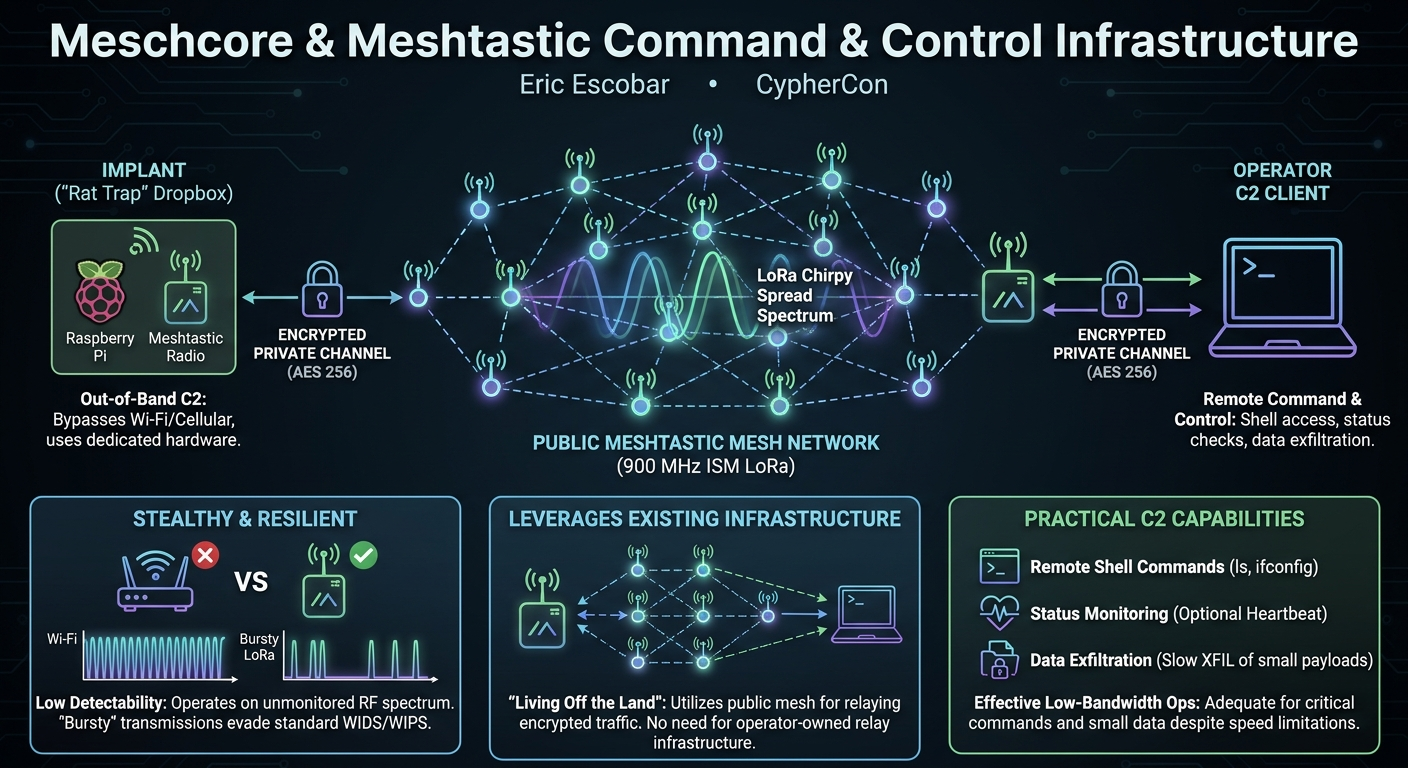
A key feature of Meshtastic is its inherent mesh networking capability. When a message is sent, any other Meshtastic device within range acts as a repeater or router, forwarding the message and decrementing a hop counter (typically 3-7 hops by default). This allows messages to propagate across significant distances, leveraging the infrastructure deployed by other users. Critically, if a private channel is established with AES 256 encryption, devices not part of that channel will still relay the message, but they cannot decrypt its contents, seeing only metadata. This "living off the land" approach, utilizing existing public mesh infrastructure, is a cornerstone of its utility for stealthy C2.
Escobar highlights the importance of physical placement for optimal range. Line of sight and elevation (e.g., placing devices on mountain peaks or tall trees) are far more critical than antenna size alone. He cites personal examples of achieving 170-mile point-to-point communications across California from mountain nodes and a 50-mile radius from a node placed 60 feet up a tree. Meshtastic devices also feature a built-in range test mode, allowing users to fine-tune antenna placement and optimize coverage.
The talk also briefly touches on Mesh Core, an alternative LoRa mesh project. While Meshtastic's default behavior is for every device to repeat messages (simpler for small, ad-hoc groups), Mesh Core reserves repeating functionality only for designated routers. This distinction makes Meshtastic prone to congestion in dense environments (like conferences with hundreds of nodes), whereas Mesh Core is better suited for established, terrestrial networks. Meshtastic also supports specialized roles like tracker (for GPS telemetry) and lost and found (a quiet device that activates upon receiving a specific packet), showcasing its versatility beyond simple messaging.
The problem Escobar addresses stems from the challenges faced by red teamers during physical penetration tests. Deploying a "Dropbox" (an implant designed for persistent access) near or inside a target facility often encounters issues: Wi-Fi or cellular connectivity might be monitored, unreliable, or fail silently. Without a reliable, out-of-band C2 channel, troubleshooting a hung implant or confirming its status becomes impossible, risking detection or forcing a risky return to the site. Meshtastic, with its low detectability and ability to leverage community infrastructure, presents a compelling solution to this critical red team challenge.
Key Findings
▶ Watch: Importance of elevation and line of sight (11:05)
Eric Escobar's central contribution is the demonstration of Meshtastic's profound suitability for covert Command and Control (C2) operations, particularly within the context of red teaming and physical breaches. His key findings revolve around Meshtastic's inherent properties that make it an ideal, stealthy, and resilient communication channel, directly addressing critical challenges faced by offensive security practitioners.
- Out-of-Band Stealth and Resilience: The primary finding is that Meshtastic provides an out-of-band communication channel that operates entirely independently of conventional Wi-Fi, cellular, or wired networks. This makes it invisible to standard enterprise security monitoring tools, which typically focus on IP-based traffic or common wireless bands. Its reliance on LoRa radio and the 900 MHz ISM band places it in a spectrum rarely monitored by corporate security teams. Furthermore, Meshtastic's ability to leverage existing community mesh infrastructure means that a red team implant doesn't need to establish direct line of sight to the operator, but rather to any Meshtastic node, providing significant operational flexibility and resilience.
- Low Detectability: Escobar emphasizes that Meshtastic traffic is exceptionally difficult to detect. Unlike a rogue Wi-Fi access point that constantly beacons its presence, Meshtastic devices are "bursty" and low-power. If configured without an active heartbeat (which is the default for his C2 solution), an implant will only transmit when sending a command response. This, coupled with its chirpy spread spectrum modulation, allows it to blend seamlessly into background radio noise, especially in urban areas with existing Meshtastic communities. Detecting such a device would require specialized Software Defined Radios (SDRs), continuous monitoring of the 900 MHz band, and sophisticated baseline analysis—a capability rarely found in defensive operations.
- Leveraging Community Infrastructure for C2: A groundbreaking aspect of Escobar's approach is the exploitation of publicly accessible Meshtastic mesh networks. A red teamer can deploy an implant in a city with a vibrant Meshtastic community, and their implant can seamlessly integrate into this existing mesh. This means the operator can communicate with their C2 from a remote location (e.g., a hotel miles away) without needing to deploy their own extensive relay infrastructure. The encrypted nature of private Meshtastic channels ensures that while public nodes may relay the packets, the contents remain confidential to the intended C2 operator.
- Practical C2 Capabilities for Implants: Escobar's Mesh C2 solution, integrated into a "rat trap" Dropbox, demonstrates that despite Meshtastic's low bandwidth, it is perfectly adequate for critical C2 functions. These include:
- Remote Shell Commands: Executing basic commands like
ls,ifconfig, andrebootfor troubleshooting or initial reconnaissance. - Data Exfiltration (XFIL): Slowly exfiltrating small, critical data payloads, such as Wi-Fi handshakes (e.g., WPA2 handshakes), completely out-of-band.
- Status Monitoring: Using an optional heartbeat to confirm the implant's online status.
- Reliable Command Delivery: Implementing retries to ensure commands are acknowledged and received.
- Physical Breach Advantage: The "rat trap" design highlights the synergy between physical pretext and stealthy C2. The implant's innocuous appearance allows for covert placement, while Meshtastic provides the undetected communication back to the operator. This combination significantly reduces the risk of physical detection and subsequent network detection, offering persistent access that is difficult to disrupt.
In essence, Escobar's work identifies Meshtastic as a potent, underutilized vector for offensive security, challenging the conventional wisdom of what constitutes a detectable C2 channel and forcing a re-evaluation of defensive strategies.
Technical Deep Dive
▶ Watch: Meshtastic vs. Mesh Core: routing and network design (20:35)
The Mesh C2 solution developed by Eric Escobar is a python-based application designed to run on a low-power embedded device, typically a Raspberry Pi, and communicate with a Meshtastic radio. Its architecture is built for stealth, reliability, and ease of use in challenging environments.
At its core, the Mesh C2 operates as a systemd daemon on the implant device. This ensures that the C2 listener starts automatically on boot and runs persistently in the background. The daemon interfaces with the Meshtastic device via its serial port, allowing it to send and receive messages over the LoRa radio.
Crucially, the C2 system leverages Meshtastic's private channel functionality. When the C2 daemon is set up, it generates a unique, AES 256 symmetric key for a dedicated channel. All operator-controlled Meshtastic devices are then synced to this private channel, ensuring that all communications between the operator and the implant are fully encrypted and inaccessible to other nodes on the broader Meshtastic mesh. While public nodes will still relay the packets, they cannot decrypt the content, maintaining operational secrecy.
The C2 daemon is designed to execute remote shell commands on the implant. By default, it can be configured with a whitelist of permissible commands (e.g., ls, ifconfig, reboot). This prevents accidental or malicious execution of arbitrary commands if the channel were somehow compromised, though this whitelist can be disabled for full shell access if desired. When a command is sent from the operator's device, the daemon receives it, executes it on the host system, and then transmits the output back over the encrypted Meshtastic channel.
One of the significant technical challenges with Meshtastic's low bandwidth is handling large command outputs. Escobar's solution incorporates message chunking and queuing mechanisms. If a command generates a substantial amount of data (e.g., ls of a directory with hundreds of files), the C2 daemon breaks the output into multiple, smaller Meshtastic packets. It then queues these packets for sequential transmission. The operator's client can then receive these chunks and even send a "quit" command to stop receiving further output if the initial pages provide sufficient information. This intelligent handling of data prevents packet overflow and ensures efficient use of the limited bandwidth.
To enhance reliability, the C2 system includes retry mechanisms. When the implant sends a command response, it expects an acknowledgment from the operator's device. If no acknowledgment is received, the implant will retry sending the message a configurable number of times, ensuring that critical data or command outputs eventually reach the operator, even if temporary signal loss occurs.
An optional heartbeat feature is also built into the C2. If enabled, the implant will periodically transmit a small packet over the private channel, indicating its online status. While useful for monitoring, this feature is typically disabled by default in red team scenarios to minimize radio traffic and maintain stealth.
For long-term deployments, Escobar emphasizes robust hardware choices. His "rat trap" Dropbox typically houses a Raspberry Pi, a large battery (e.g., two Orbtronic 18650 batteries with built-in circuit protection to prevent overcharging/discharging, crucial for safety in outdoor deployments), and a Meshtastic device like the "Pocket Mesh" (his favorite due to its integrated GPS and battery efficiency). For remote router nodes, especially those on mountain peaks, he uses more powerful setups, such as a RAKwireless 10dB antenna with a solar panel and a steel enclosure designed to withstand extreme temperatures (up to 140°F inside the box) and contain potential battery incidents. The emphasis is on practical, field-tested durability and power efficiency.
The C2 framework also includes full logging of commands and responses on the operator's side, providing an audit trail and allowing for later analysis of implant activity. This comprehensive design transforms Meshtastic from a hobbyist communication tool into a potent and discreet C2 platform.
Demo / Proof of Concept
▶ Watch: Introducing Mesh C2 for red teaming and physical breaches (22:55)
While Eric Escobar's talk does not feature a live, real-time demonstration of the Mesh C2 in action, the entire presentation serves as a comprehensive proof of concept. He vividly describes the creation and successful real-world application of his custom-built Dropbox, affectionately dubbed the "rat trap," which integrates a Raspberry Pi and a Meshtastic device. This implant is designed for covert physical placement outside or inside target facilities during penetration tests.
The core of the "demo" lies in Escobar's detailed explanation of how this physical implant, coupled with the custom Mesh C2 daemon, enables critical offensive capabilities. He walks through scenarios where the C2 is indispensable:
- Remote Troubleshooting: If a conventional network connection to the Dropbox fails (e.g., port security blocks an unknown MAC address, Wi-Fi drops), the Meshtastic C2 provides an out-of-band communication channel to diagnose and potentially resolve the issue by sending commands like
rebootorifconfig. This prevents the need for a risky return to the physical location. - Command Execution: The C2 allows the operator to send shell commands (e.g.,
ls,cd) to the Raspberry Pi, enabling basic reconnaissance of the implant's environment. - Data Exfiltration (XFIL): Escobar explicitly mentions the ability to exfiltrate small, sensitive data, such as a captured WPA2 handshake. This demonstrates Meshtastic's utility for extracting valuable information without relying on monitored network channels.
- Persistent Access and Monitoring: The C2's optional heartbeat feature, though usually disabled for stealth, proves its capability to confirm the implant's online status remotely. The automatic daemon setup via
systemdensures persistence across reboots.
Escobar reinforces the practicality of his solution by detailing the robust physical design of the "rat trap" and other remote nodes. He discusses the use of durable Orbtronic 18650 batteries with circuit protection, solar panels for extended uptime, and protective enclosures to withstand harsh environmental conditions. The speaker also references his GitHub repository, inviting attendees to clone and experiment with the Mesh C2 code, effectively extending the proof of concept to the audience.
Furthermore, the conference itself provides a subtle, indirect "demo" of Meshtastic's capabilities. Escobar mentions running "fun mesh challenges" at CypherCon, including a "French autoresponding robot" that can dispense a CTF flag. This highlights the interactive and functional nature of Meshtastic devices within a live, dense environment, underscoring the very infrastructure his C2 system would leverage.
In essence, the "demo" is woven throughout the narrative, presenting a thoroughly developed and field-tested solution rather than a live, on-screen execution. It clearly illustrates what the Mesh C2 can do and how it addresses real-world red team challenges, backed by the speaker's extensive experience.
Defensive Implications
▶ Watch: Difficulty of detecting a Meshtastic C2 device (40:45)
Eric Escobar's talk serves as a stark warning to defenders, highlighting a significant blind spot in many organizations' security postures. The adoption of Meshtastic for Command and Control (C2) represents a sophisticated, out-of-band communication threat that bypasses traditional detection mechanisms.
- Inadequacy of Traditional Monitoring: The most critical implication is that standard enterprise security tools—including WIDS/WIPS (Wireless Intrusion Detection/Prevention Systems), firewalls, network traffic analyzers, and endpoint detection and response (EDR) solutions—are largely ineffective against Meshtastic C2. These systems are designed to monitor IP-based traffic or common Wi-Fi frequencies (2.4 GHz, 5 GHz). Meshtastic operates on the 900 MHz ISM band using LoRa radio, a spectrum typically unmonitored by corporate security.
- Extreme Difficulty of Detection: Detecting a Meshtastic C2 implant is exceptionally challenging. Unlike rogue Wi-Fi access points that constantly beacon, Meshtastic devices are "bursty" and low-power. If the optional heartbeat is disabled, the implant only transmits when responding to a command. To detect such activity, defenders would need:
- Specialized Hardware: Deployment of Software Defined Radios (SDRs) capable of monitoring the 900 MHz ISM band.
- Baseline Analysis: Extensive baseline profiling of ambient radio frequency (RF) noise in the 900 MHz spectrum to identify anomalous "chirpy spread spectrum" transmissions.
- Sophisticated Analytics: Tools like Kismet, while capable of detecting some LoRa traffic, would provide only a snapshot, making triangulation or trilateration to pinpoint a low-power, intermittent source extremely difficult, especially within a dense urban mesh or an office building.
- Enhanced Physical Security Requirements: The "rat trap" Dropbox concept underscores the critical importance of robust physical security. If an adversary can physically place an implant near or inside a facility, they gain a significant advantage. Defenders must re-evaluate physical access controls, perimeter security, and internal asset protection. The innocuous appearance of such devices means security personnel might overlook them.
- Supply Chain and Device Awareness: Organizations need to be aware of the proliferation of small, inexpensive, and easily concealable LoRa-enabled devices. These can be readily purchased online without licenses, making them accessible to a wide range of actors. Security teams should consider the potential for these devices to be smuggled in or disguised.
- Incident Response Challenges: If a Meshtastic C2 is suspected, incident responders face unique challenges. Forensic analysis would need to extend beyond typical network logs and endpoint forensics to consider RF spectrum analysis and physical searches for hidden devices. The lack of standard IP addresses also complicates attribution.
- Need for Advanced Threat Intelligence and Training: Defenders must expand their threat intelligence to include emerging C2 vectors beyond IP networks. Training security teams on the capabilities of LoRa and Meshtastic, and the potential for their misuse, is crucial. This includes understanding the trade-offs between range, bandwidth, and stealth that these technologies offer.
In summary, Escobar's talk serves as a call to action for defenders to evolve their monitoring and detection capabilities. Relying solely on traditional network security will leave organizations vulnerable to highly stealthy, persistent threats leveraging non-standard communication channels like Meshtastic. Proactive measures in physical security and advanced RF monitoring are becoming increasingly necessary.
Key Takeaways
- Meshtastic as a Stealthy C2: Meshtastic, an open-source, low-power LoRa mesh network, provides an exceptionally stealthy and resilient out-of-band Command and Control (C2) channel, operating outside traditional Wi-Fi/cellular networks.
- Leveraging Existing Infrastructure: Meshtastic C2s can "live off the land" by utilizing existing public Meshtastic community mesh networks to relay encrypted commands and responses, significantly extending range and reducing the need for adversary-controlled infrastructure.
- Extreme Difficulty of Detection: Due to its low power, bursty nature, operation on the 900 MHz ISM band, and chirpy spread spectrum modulation, Meshtastic C2 traffic is exceedingly difficult to detect with conventional enterprise security tools. Detection requires specialized Software Defined Radios (SDRs) and dedicated RF spectrum analysis.
- Effective for Low-Bandwidth Operations: Despite its low bandwidth, Meshtastic is highly effective for critical C2 functions such as remote shell command execution, troubleshooting, status monitoring via heartbeat, and slow data exfiltration of small, sensitive payloads (e.g., WPA2 handshakes).
- Physical Security is Paramount: The "rat trap" Dropbox concept underscores that robust physical security measures are crucial to prevent the covert placement of such implants, as their wireless communication is designed to evade network detection.
- Defenders Must Adapt: Organizations must expand their defensive strategies beyond IP-based network monitoring to include RF spectrum analysis and enhanced physical security protocols to counter sophisticated, non-standard C2 threats like those enabled by Meshtastic.
About the Speaker(s)
Eric Escobar is a dedicated red teamer currently working at Sophos/Secureworks as part of their adversarial group. His expertise lies in various forms of penetration testing, including physical breaches, where he focuses on identifying and exploiting vulnerabilities in client environments. Escobar's work often involves innovative approaches to gaining and maintaining persistent access, as showcased by his development of the Meshtastic Command and Control infrastructure. He is passionate about radio technologies and their applications in security, often engaging with the Meshtastic and ham radio communities.
Reviews
Dr. Zero (Offensive Security Researcher) — STRONG ACCEPT
Escobar solves a massive physical red team headache by turning 900MHz LoRa hobbyist meshes into a resilient, unmonitored C2 channel. He's bouncing AES-encrypted Python payloads off public Meshtastic nodes to talk to a Raspberry Pi hidden in a rat trap. This is how you actually survive when the target's NAC drops your dropbox off the network.
Heather Calloway (CISO) — SOLID
This talk demonstrates how attackers can use off-grid LoRa mesh networks for command and control, completely bypassing corporate network monitoring. It is a necessary reality check for any organization that relies on network access controls to catch rogue hardware. Worth your red team's time to operationalize, and a critical input for your physical security threat model.