Ctrl + Alt + Lead: Rebooting Cyber Culture with Human Skills
Amanda Kollmorgan
Overview
In her compelling CypherCon talk, "Ctrl + Alt + Lead: Rebooting Cyber Culture with Human Skills," Amanda Kollmorgan delivers a powerful message challenging the conventional wisdom that technical prowess alone defines success in cybersecurity. Kollmorgan, a seasoned leader with extensive experience in high-pressure, mission-driven environments, argues that while technical skills may open doors, it is leadership, communication, and mentorship – often dismissed as "soft skills" – that truly foster growth, resilience, and high-level contribution within teams. Her presentation advocates for a fundamental shift in the industry's cultural priorities, moving beyond an exclusive focus on tools and certifications to a holistic investment in human capital.
Key moments
- 2:00 The human side of the firewall: strategic leadership
- 6:50 Addressing the leadership vacuum: accidental managers
- 9:45 Connecting roles to mission: avoiding missed opportunities
- 24:00 Reflecting on communicating technical roles to diverse audiences
- 31:40 Practical conflict resolution: addressing passive aggression
- 36:30 Mentorship: a critical leadership strategy and self-reflection
- 51:30 Workplace relationships: you don't have to be a family
- 59:00 Q&A: How to be comfortable being uncomfortable
Ctrl + Alt + Lead: Rebooting Cyber Culture with Human Skills
Speakers: Amanda Kollmorgan
Conference: CypherCon
YouTube: https://www.youtube.com/watch?v=AW4HQh9qAM4
Overview
In her compelling CypherCon talk, "Ctrl + Alt + Lead: Rebooting Cyber Culture with Human Skills," Amanda Kollmorgan delivers a powerful message challenging the conventional wisdom that technical prowess alone defines success in cybersecurity. Kollmorgan, a seasoned leader with extensive experience in high-pressure, mission-driven environments, argues that while technical skills may open doors, it is leadership, communication, and mentorship – often dismissed as "soft skills" – that truly foster growth, resilience, and high-level contribution within teams. Her presentation advocates for a fundamental shift in the industry's cultural priorities, moving beyond an exclusive focus on tools and certifications to a holistic investment in human capital.
Kollmorgan highlights a critical observation: the cybersecurity workforce gap isn't primarily at the entry level, but rather in middle management. This deficiency creates a leadership vacuum, often filled by rapidly promoted technical staff who, despite their brilliance, are ill-prepared to lead without adequate mentorship and training. This mismatch leads to declining quality, low morale, and even toxic environments, ultimately compromising an organization's security posture. The talk underscores the strategic imperative of cultivating human skills, positioning them as foundational controls for any robust cyber defense.
The core premise of Kollmorgan’s talk is that people solve problems, not tools. She contends that effective communication is a core control, irrespective of its inclusion in frameworks like NIST. The presentation serves as a vital call to action for cybersecurity professionals and leaders alike, urging them to recognize that the future of cyber defense hinges not merely on advanced technology, but on the strength, collaboration, and adaptive capacity of its human teams. By addressing these often-overlooked aspects, the industry can build more resilient, innovative, and sustainable security operations.
Background
▶ Watch: The human side of the firewall: strategic leadership (2:00)
The cybersecurity landscape has undergone a profound transformation, moving IT and cyber professionals from the "server closet to strategy sessions." Historically, their role was confined to maintaining systems and ensuring operational uptime. Today, however, they are central to digital transformation, data privacy, and enterprise risk management, necessitating a shift from mere technical expertise to strategic partnership. This evolution demands the ability to communicate risk, align with business objectives, and lead with clarity, skills often underdeveloped or outright ignored in traditional cyber education and career paths.
Kollmorgan identifies a pervasive issue within the industry: the systematic undervaluation of soft skills. Despite their critical importance, leadership, communication, and mentorship frequently fall to the bottom of development plans, if they appear at all. This oversight creates a "leadership vacuum," particularly in middle management, which she identifies as the most impactful leadership tier due to its blend of operational experience and technical expertise. Organizations, desperate to fill these gaps, often promote technically brilliant individuals into leadership roles without providing the necessary training or mentorship. These "accidental managers" struggle, leading to burnout, frustration, and toxic work environments, perpetuating a cycle of underprepared leaders.
The speaker draws parallels with military experiences, where rapid promotions due to retirements or separations can leave critical holes in the leadership pipeline. Without deliberate mentorship, the accumulated experience leaves the organization, and new leaders rise without having experienced or been trained in effective leadership models. Kollmorgan starkly points out that "many cyber incidents weren't caused by a mispatch, but by a misconversation." This highlights the direct link between communication breakdowns and tangible security failures, emphasizing that if professionals cannot clearly articulate risk, value, or mission impact, their technical skills become significantly diminished. The problem, therefore, is not a lack of technical talent, but a systemic failure to cultivate the human capabilities essential for leveraging that talent effectively within a complex organizational context.
Key Findings
▶ Watch: Connecting roles to mission: avoiding missed opportunities (9:45)
Amanda Kollmorgan's talk unveils several critical findings that challenge conventional wisdom in the cybersecurity domain, advocating for a paradigm shift toward human-centric approaches.
Firstly, Kollmorgan asserts that technical skills get you in the door, but leadership, communication, and mentorship keep you growing and contributing at a high level. This foundational principle underscores the argument that soft skills are not merely "nice-to-haves" but are essential for career progression and organizational resilience. She directly links the lack of these skills to the current middle management workforce gap, identifying it as the most impactful leadership tier, yet the most underserved in terms of development.
Secondly, the presentation firmly establishes that communication is a core control, regardless of whether it's explicitly listed in frameworks like NIST. Kollmorgan posits that "tools don't solve problems, people do," emphasizing that even the most advanced firewall is ineffective if a team cannot communicate, collaborate, and grow. She argues that poor communication is a direct contributor to security incidents, often more so than technical misconfigurations. Effective communication is crucial for articulating risk to business leaders, fostering trust with customers to mitigate shadow IT, and ensuring team alignment with organizational missions.
Thirdly, Kollmorgan redefines the role of conflict in team dynamics. Contrary to the prevalent avoidance of conflict in modern workplace culture, she highlights that "storming" is a natural and necessary stage in the forming, storming, norming, and performing model of team development. She advocates for creating environments where dissent and disagreement can be facilitated appropriately, differentiating between productive conflict and toxic behavior. Her "80/20 rule" for conflict resolution suggests that most interpersonal issues stem from miscommunication or lack of communication, which can often be resolved through direct, honest confrontation.
Finally, the talk emphasizes that mentorship is a leadership strategy, not a luxury. Kollmorgan stresses that without robust mentorship pipelines, organizations perpetuate a cycle of promoting individuals into roles for which they are unprepared, leading to burnout and underperformance. She champions mentorship as a "force multiplier" that builds a culture of learning, knowledge sharing, and long-term leadership sustainability. The speaker challenges every professional to both seek and become a mentor, highlighting its critical role in the interconnected cybersecurity community.
Technical Deep Dive
▶ Watch: Practical conflict resolution: addressing passive aggression (31:40)
While "Ctrl + Alt + Lead" does not delve into traditional cybersecurity technical content like code, protocols, or architectures, it offers a profound "technical deep dive" into the human-centric protocols and architectures required for building resilient and high-performing cyber teams. Kollmorgan effectively frames soft skills not as abstract concepts, but as actionable methodologies that can be systematically applied and optimized within an organizational structure.
One key "protocol" presented is the distinction between tactical, operational, and strategic thinking. Kollmorgan observes that the term "strategy" is often misused, applied to activities that are, in reality, tactical or operational. She urges professionals to critically evaluate their activities: tactical actions support operational objectives, which in turn support strategic goals. This hierarchical understanding is vital for aligning individual and team efforts with overarching organizational missions, ensuring that daily tasks contribute meaningfully to long-term security postures. Mislabeling efforts can lead to misallocated resources and a lack of clear direction, undermining the efficacy of technical initiatives.
The talk also explores the "architecture" of team development through Tuckman's stages of group development: forming, storming, norming, and performing. Kollmorgan argues that many organizations, particularly in the cyber sector, are "terrified of conflict" and inadvertently suppress the "storming" phase. This avoidance prevents teams from truly maturing into high-performing units. By embracing controlled, facilitated conflict, teams can work through disagreements, establish norms, and ultimately achieve higher levels of performance and cohesion. This is not about encouraging toxic environments but fostering appropriate and effective disagreements that lead to stronger, more adaptable teams.
Kollmorgan introduces a practical "algorithm" for conflict resolution based on the 80/20 rule: 80% of the time, direct communication and facilitated discussion will resolve issues, while 20% of the time, individuals may be unwilling to engage constructively. Her "lock them in a room" method for passive-aggressive team members, while unconventional, is a structured intervention designed to force direct communication. The goal is not necessarily friendship, but mutual professional respect, acknowledging that individuals can dislike each other personally while still collaborating effectively. This method emphasizes accountability and the importance of addressing underlying issues rather than letting them fester.
Furthermore, Kollmorgan outlines a structured "communication protocol" for effective one-on-ones, whether supervisor-to-subordinate, peer-to-peer, or driven from below. Key elements include discussing "what's going well," "what needs work," and critically, "how can I help?" The consistent offer of assistance, even if declined, builds trust over time. Establishing follow-up timelines (e.g., 30-, 60-, 90-day check-ins) provides structure, direction, and accountability, creating an environment where growth is supported and feedback flows bi-directionally. This structured approach to communication is presented as a fundamental component of leadership and team development, akin to a robust network protocol ensuring reliable data exchange.
Finally, the concept of "leading from the back" or "influence without authority" is presented as a crucial leadership "pattern." Kollmorgan emphasizes that one does not need a formal title to drive change or mentor others. This decentralized leadership model encourages every individual to take ownership of their development and the development of their peers, fostering a pervasive culture of growth and improvement throughout the organization. This "distributed leadership" architecture enhances resilience and adaptability by not solely relying on top-down directives.
Demo / Proof of Concept
▶ Watch: Mentorship: a critical leadership strategy and self-reflection (36:30)
Kollmorgan implemented a highly effective and interactive practical exercise as a "demo" for the audience, directly illustrating the challenges and nuances of effective communication. This hands-on segment served as a tangible proof of concept for her central thesis about the importance of tailoring communication to different audiences.
The exercise involved dividing the large conference room into several smaller groups. Each group was tasked with a two-part challenge:
- Explaining their job to a CEO or non-technical "head honcho": Attendees were asked to articulate their technical roles in a way that a high-level business leader, lacking deep technical understanding, would comprehend the value, risk, and mission impact. This segment pushed participants to translate complex jargon into plain, business-oriented language.
- Explaining their job to family at Thanksgiving dinner: Following the first part, the groups were then instructed to switch gears and describe their work to their family members at a casual, non-technical gathering. This required an even further simplification and contextualization, often focusing on relatable outcomes rather than technical processes.
Kollmorgan observed that many participants found the transition between these two audiences "jarring" and "uncomfortable." This discomfort highlighted a common blind spot in the technical community: the ingrained habit of speaking solely in technical terms to peers, making it difficult to adapt to diverse audiences. The exercise effectively demonstrated that while professionals are adept at "talking tech with other tech people," they often lack the agility to switch to plain language for business leaders or general audiences.
The speaker encouraged attendees to continue practicing this exercise, even with imaginary audiences, to develop their introspective communication skills. By placing themselves in the audience's vantage point, individuals can better dissect and articulate their work from various perspectives, enhancing their ability to be understood and to build trust across different organizational layers and social contexts. This interactive "demo" powerfully underscored that communication isn't a one-size-fits-all skill, but a dynamic capability requiring conscious practice and adaptability.
Defensive Implications
▶ Watch: Q&A: How to be comfortable being uncomfortable (59:00)
The insights presented by Amanda Kollmorgan carry profound defensive implications for cybersecurity practitioners and organizations, extending beyond traditional technical controls to the realm of human factors. By prioritizing human skills, organizations can significantly bolster their overall security posture.
Firstly, enhanced communication skills directly contribute to better risk management. Kollmorgan argues that if cyber professionals cannot clearly communicate risk, value, or mission impact to leadership, peers, and subordinates, their technical expertise is diminished. Effective communication allows for accurate translation of technical vulnerabilities into business language, enabling executives to make informed decisions about resource allocation and risk tolerance. This proactive articulation of risk can prevent incidents by securing buy-in for necessary security controls and initiatives, rather than reacting to breaches.
Secondly, fostering leadership and collaboration can mitigate the pervasive problem of shadow IT. When security teams are perceived as merely saying "no," business units often bypass official channels to acquire tools that meet their immediate needs, creating unmanaged risks. By leading with empathy, collaborating on solutions, and communicating the "why" behind security controls, cyber professionals can become trusted partners. This approach encourages business units to engage with security early, allowing for the integration of secure alternatives that meet operational requirements while adhering to organizational security policies, thus reducing the attack surface created by unsanctioned systems.
Thirdly, investing in mentorship pipelines strengthens the entire security workforce. The rapid promotion of technically brilliant but unprepared individuals into middle management creates vulnerabilities, as these "accidental managers" may struggle to lead and develop their teams effectively. A robust mentorship program ensures that new leaders acquire the necessary soft skills—such as coaching, conflict resolution, and strategic thinking—to guide their teams. This builds a more competent and stable leadership layer, reducing burnout, improving morale, and ensuring continuity of knowledge, which are all critical for maintaining a vigilant and effective defensive operation.
Finally, cultivating a culture that embraces constructive conflict and psychological safety enhances incident response and resilience. In high-pressure situations like a breach, a team's ability to communicate clearly, challenge assumptions respectfully, and collaborate effectively under duress is paramount. Teams that have learned to navigate disagreements and trust their leaders to support them in conflict resolution are better equipped to identify root causes, implement solutions, and adapt quickly. Leaders who model vulnerability, admit mistakes, and empower their teams to fail safely foster an environment where continuous learning and improvement thrive, making the organization more resilient against future threats. Essentially, a team that can "talk to each other" effectively is a more secure team.
Key Takeaways
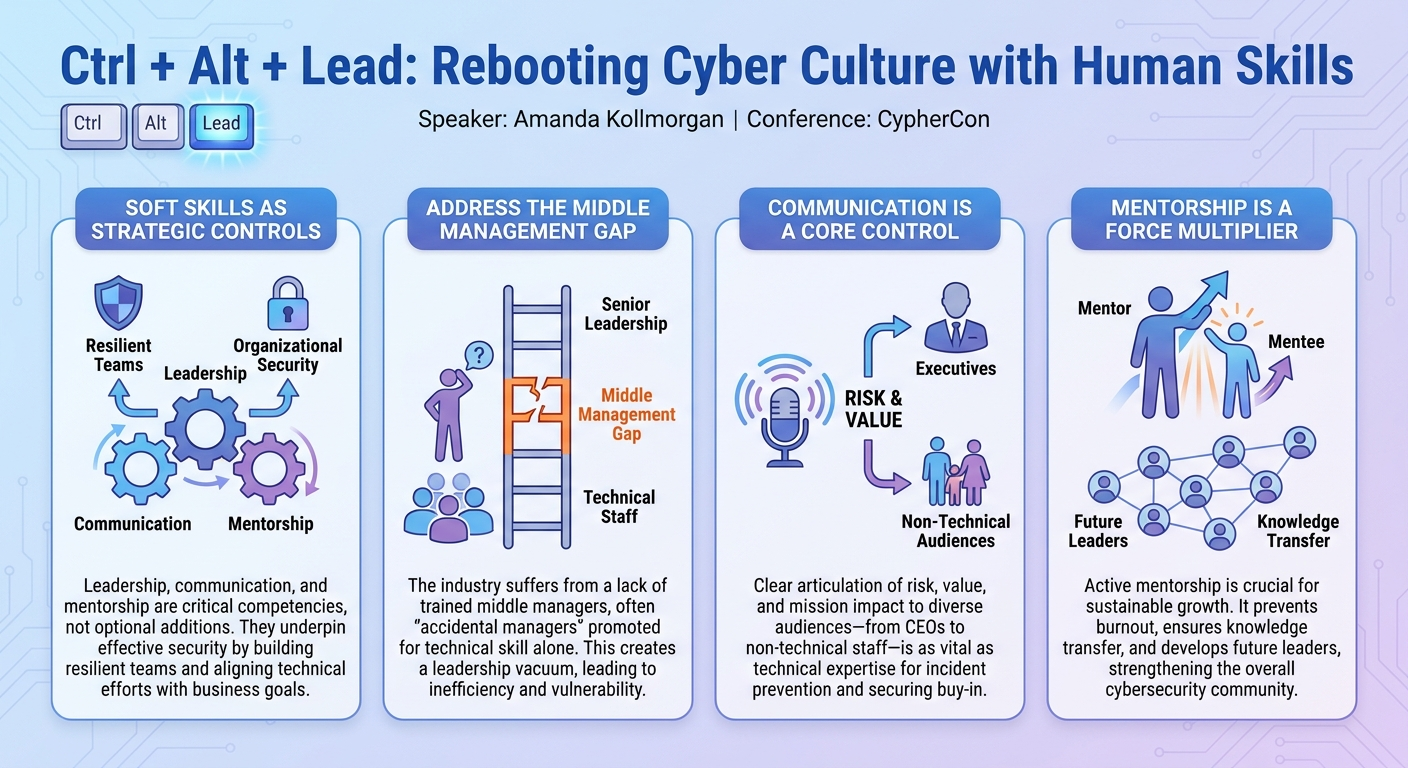
- Soft Skills are Strategic Controls: Leadership, communication, and mentorship are not optional "soft skills" but critical competencies that underpin effective cybersecurity, directly impacting team resilience and organizational security.
- Address the Middle Management Gap: The cybersecurity workforce gap is most pronounced in middle management, and rapid promotions without adequate leadership training create "accidental managers" who struggle, leading to organizational inefficiencies and vulnerabilities.
- Communication is a Core Security Control: The ability to clearly articulate risk, value, and mission impact to diverse audiences (from CEOs to family members) is as vital as technical expertise for preventing incidents and gaining buy-in for security initiatives.
- Embrace Constructive Conflict: Conflict ("storming") is a natural and necessary stage of team development. Leaders must create safe environments for appropriate disagreement to foster stronger, more collaborative, and high-performing teams.
- Mentorship is a Force Multiplier: Actively seeking and providing mentorship is crucial for the sustainable growth of the cybersecurity community, preventing burnout, transferring knowledge, and developing future leaders.
- Model Desired Behavior and Admit Mistakes: Effective leaders must practice self-reflection, celebrate wins, admit when they are wrong, and empower their teams to learn from failures, fostering trust and resilience.
About the Speaker(s)
Amanda Kollmorgan is a highly experienced and multifaceted leader with a diverse background spanning nearly two decades in high-pressure, mission-driven environments. Her 19+ years of military service, including 12 years on active duty, saw her engaged in a wide array of operations from chemical and detainee operations to diesel engine maintenance, rocket launching in field artillery, and eventually transitioning into IT and cyber. She has deployed to Iraq and Africa and served on a two-star general's plans and strategy staff in a joint operations theater, demonstrating extensive operational leadership experience.
Currently, Kollmorgan serves as the Deputy State IT Director for the Wisconsin Department of Military Affairs. She is also an incident responder and volunteer with the Wisconsin Cyber Response Team, and leads a cyber operations element for the Defensive Cyber Operations Element in the Wisconsin Army National Guard. Beyond her professional accolades, Amanda is a mother, a pet lover (four dogs, two cats), a gardener, a triathlete, and a middle school track coach, showcasing a vibrant personal life. Known for her ability to discuss both zero trust and Zoolander in the same conversation, she identifies herself as someone who "breaks firewalls and stereotypes," driven by a passion for cultivating better teams, leadership, and communication in cybersecurity.
Reviews
Dr. Zero (Offensive Security Researcher) — SOLID
Kollmorgan points out a massive vulnerability—the catastrophic void of competent middle management in cyber—and tries to patch it with HR 101. It's competent leadership advice for socially stunted analysts who just got promoted to SOC lead, but there is zero novel material here.
Heather Calloway (CISO) — SOLID
This is a clear, actionable diagnosis of the middle-management vacuum in security organizations. Kollmorgan correctly frames communication and conflict resolution not as HR issues, but as operational controls that dictate our incident response capability. I'd have my engineering directors watch this before our next promotion cycle.