Spiders, Deepfakes, and Access Credentials
Tom Cross
Overview
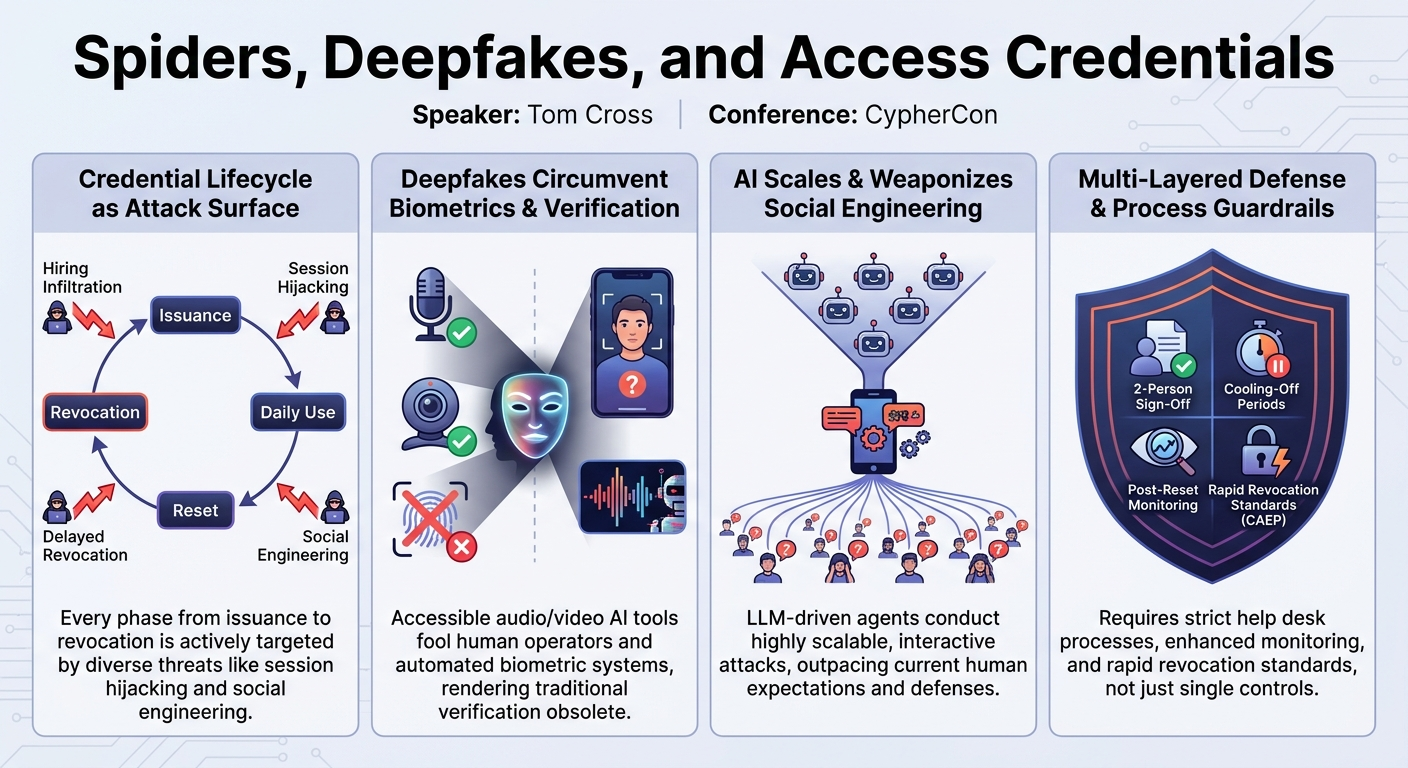
In this compelling CypherCon presentation, cybersecurity expert Tom Cross delves into the escalating "arms race" surrounding credential lifecycle management, highlighting how modern authentication and identity verification methods are increasingly vulnerable to sophisticated social engineering and emerging deepfake technologies. Cross argues that despite advancements in security controls, adversaries are rapidly adapting, consistently finding new ways to bypass protections and compromise organizational networks. The talk provides a critical examination of the current state of identity security, underscoring the community's lack of long-term solutions to these pervasive problems.
Key moments
- 1:50 Credential life cycle: a major attack surface
- 10:50 MGM/Caesars breach: help desk social engineering
- 14:15 Callback verification bypassed by SIM swaps
- 22:00 Creating realistic voice deepfakes with W-Okada
- 24:20 AI agent for interactive deepfake phone calls
- 33:00 Video deepfakes bypass face biometrics (SwapFace)
- 42:30 Practical recommendations for help desk security
- 54:40 Q&A: Securing behavioral biometrics data
Spiders, Deepfakes, and Access Credentials
Speakers: Tom Cross
Conference: CypherCon
YouTube: https://www.youtube.com/watch?v=sLFsQV76vSQ
Overview
In this compelling CypherCon presentation, cybersecurity expert Tom Cross delves into the escalating "arms race" surrounding credential lifecycle management, highlighting how modern authentication and identity verification methods are increasingly vulnerable to sophisticated social engineering and emerging deepfake technologies. Cross argues that despite advancements in security controls, adversaries are rapidly adapting, consistently finding new ways to bypass protections and compromise organizational networks. The talk provides a critical examination of the current state of identity security, underscoring the community's lack of long-term solutions to these pervasive problems.
Cross meticulously breaks down the various phases of the credential lifecycle – from issuance and daily use to delegation, reset, and revocation – demonstrating how each stage is actively targeted by threat actors. He emphasizes that some of the most significant cybersecurity incidents of the past five years have exploited weaknesses in this very cycle. The presentation then pivots to explore the profound impact of deepfake audio and video on identity verification, revealing how easily these technologies can circumvent even advanced biometric systems. Ultimately, Cross offers a series of practical, process-oriented recommendations for defenders, while also acknowledging the ongoing challenge of staying ahead in this rapidly evolving threat landscape.
Background
▶ Watch: Credential life cycle: a major attack surface (1:50)
The fundamental premise of modern authentication, as articulated by Cross, is the transformation of a human being into a private key. This private key, typically stored on a tamper-proof hardware device like a YubiKey or, more commonly, a smartphone, serves as the primary identifier. The lifecycle of these private keys is multifaceted, encompassing:
- Issuance: When an employee is onboarded and receives their initial credentials.
- Daily Use: Regular authentication for accessing systems and resources.
- Delegation: Issuing delegate keys (e.g., GitHub Personal Access Tokens, Amazon API keys) for specific tasks or programmatic access.
- Reset: The process of reissuing credentials, often due to a lost device or forgotten password.
- Revocation: Disabling compromised or no-longer-needed credentials.
Cross highlights how sophisticated threat actors are targeting each phase. Examples include North Korean groups infiltrating organizations by getting hired and acquiring legitimate credentials during issuance, and widespread MFA fatigue attacks where repeated authentication prompts wear down users. More recently, session hijacking has become prevalent, with attackers taking over authenticated sessions in real-time after a user completes a phishing-induced login. Delegate keys, particularly on developer laptops, present a significant risk due as they often grant broad access to critical systems like CI/CD pipelines.
The talk specifically focuses on the credential reset scenario, citing groups like Scattered Spider who leverage social engineering against help desks to initiate resets. Another critical issue is excessive session lifetime, where compromised credentials remain valid for extended periods (e.g., 24 hours) even after revocation attempts, providing attackers ample time to move laterally.
The shift towards remote work, significantly accelerated by the COVID-19 pandemic, has exacerbated these challenges. In 2018, only 4.3% of large enterprise employees were fully remote; by the time of the talk, this figure had more than doubled to 11.2%. This means that physical verification for credential resets is often impossible, forcing organizations to rely on remote interactions to confirm identity. This remote context creates a fertile ground for social engineering attacks, where criminals, often motivated by financial gain like direct deposit hijacking, exploit vulnerabilities in help desk processes. The State of New Jersey, for instance, issued an advisory after an incident where a convincing Gmail account was used to trick HR into changing direct deposit details.
Historically, credential resets relied on verifying personal information. However, this method is fundamentally flawed because vast amounts of personal data – including email addresses, employers, residences, and job titles – are publicly available or obtainable from data brokers and breach databases like Have I Been Pwned?. This wealth of information allows attackers to appear highly credible to help desk staff.
A prime example is the MGM and Caesars breaches in 2023. While initially simplified as a "10-minute conversation" after finding an employee on LinkedIn, Okta's disclosures suggested a more nuanced attack. The threat actor, likely AlphV ransomware group, possessed the employee's password but lacked MFA access. They then leveraged publicly available information about an IT employee (identified via LinkedIn) combined with their ability to log in (minus MFA) to convince the help desk to reset the MFA. This allowed them to gain super admin rights, rapidly issue additional credentials, and deploy ransomware. Cross highlights that outsourced and offshore help desks, often under-compensated and untrained in security, are particularly susceptible to social engineering due to pressure to provide excellent customer service and avoid saying "no."
Key Findings
▶ Watch: Callback verification bypassed by SIM swaps (14:15)
Tom Cross identifies several critical findings regarding the current state of identity security and the escalating threat landscape:
- Credential Lifecycle is Under Constant Attack: Every phase of the credential lifecycle, from initial issuance to eventual revocation, is actively targeted by sophisticated threat actors using diverse techniques, from social engineering to real-time session hijacking.
- Traditional Identity Verification is Obsolete: Methods relying on personal information are easily bypassed due to the public availability of such data. Even advanced measures like callback verification are compromised by techniques like SIM swapping, rendering them insufficient.
- Biometrics Are Not a Panacea: Voice and facial biometrics, often touted as solutions, are demonstrably vulnerable to deepfake technologies. Open-source and commercial tools allow for highly convincing impersonations that can fool both human operators and automated biometric systems.
- AI Scales Fraud: The emergence of accessible, performant AI tools for voice and video synthesis, coupled with powerful Large Language Models (LLMs), enables the creation of highly scalable, interactive, and emotionally manipulative AI agents. These agents can conduct sophisticated social engineering attacks at an unprecedented scale and low cost, leading to a "future shock vulnerability" where people are unprepared for the reality of AI capabilities.
- Workplace IDV/eKYC is Vulnerable: Automated identity verification systems used for onboarding and account creation can be bypassed using AI-generated documents, virtual environments, and animated photos, indicating that even these advanced systems are not foolproof against determined adversaries.
- Help Desks Remain a Critical Weak Point: Due to organizational pressures, lack of security training, and the incentive to prioritize customer service, help desk personnel are highly susceptible to social engineering, making them a primary target for credential compromise.
- We Lack Long-Term Solutions: Cross concludes that the cybersecurity community does not yet fully understand the right long-term answers to these problems. The current trajectory is an "arms race" where new controls are met with evolving adversary techniques, leading to a continuous cycle of vulnerability and response.
Technical Deep Dive
▶ Watch: AI agent for interactive deepfake phone calls (24:20)
Cross provides a comprehensive technical exploration of how deepfake technologies are weaponized against identity verification mechanisms, demonstrating their ease of use and effectiveness.
Voice Deepfakes and Real-time Impersonation
The talk highlights the relative ease of generating voice deepfakes. Open-source software packages like RVC (Retrieval-based Voice Conversion) enable voice-to-voice translation. Cross introduces W-Okada, a free and relatively easy-to-use Japanese application that integrates RVC and other models for real-time voice-to-voice translation. With just a 30-second audio sample of a target's voice, W-Okada can make anyone speak in that person's voice, fooling not only humans but also sophisticated audio biometrics. Cross cites his colleague Devin's successful cloning of his own voice, which bypassed advanced audio biometric systems.
To operationalize these voice deepfakes for phone calls, virtual audio routing software is essential. For Windows, Virtual Audio Cable, a tool first released in the late 1990s and still actively maintained (despite its vintage website), allows users to route audio output from one application as input to another. Mac users can leverage tools like VB-Audio, which serves the same purpose. By configuring a VoIP application (like Google Voice) to use the virtual audio device as its input, an attacker can make real-time phone calls in any cloned voice.
AI Agents for Scalable Social Engineering
Cross takes this concept further by describing an advanced pipeline for creating an interactive AI agent capable of conducting phone-based social engineering. This pipeline involves:
- Whisper: OpenAI's highly effective voice-to-text system, used to transcribe incoming human speech during a call.
- Llama: A Large Language Model (LLM) that processes the transcribed text. Cross emphasizes using local LLMs like Llama (as opposed to SaaS-based AI services) to bypass guardrails that commercial providers might implement to prevent malicious use. This allows for unrestricted, aggressive prompting.
- Coqui: Another open-source voice cloning software, similar to RVC, which converts the LLM's text output back into speech using an arbitrary destination voice.
The output from Coqui is then fed back through the virtual audio cable to the phone application, creating a fully autonomous AI agent that can engage in interactive, human-like conversations. Cross's colleague Devin demonstrated this with an "evil IRS agent" prompt, designed to aggressively coerce individuals into buying gift cards to pay off fake tax debts. The AI's responses were highly adaptive and confrontational, even accusing Devin of "obstruction of justice" when he questioned if it was a scam. This showcases a "future shock vulnerability," where human expectations of computer limitations on the phone are dramatically outpaced by current AI capabilities, making them highly susceptible. Cross predicts a significant increase in this type of scalable, inexpensive fraud.
He also mentions services like Breacher AI that productize these attack chains for penetration testing, confirming their effectiveness in obtaining credentials by calling employees.
Video Deepfakes and Biometric Bypass
While audio deepfakes are currently more scalable, Cross also addresses video deepfakes. He demonstrates the use of SwapFace, a commercial tool that runs efficiently even on standard hardware like a Mac. Unlike more sophisticated open-source tools like Rope Live which demand substantial GPU resources, SwapFace requires only a single photograph of the target.
Current limitations of face-swapping technology include a "blending" effect between the subject and object faces, and the inability to alter hair. This makes it more effective for identity obfuscation (hiding one's own identity while speaking) rather than perfect impersonation, which often requires the attacker to have a similar facial structure and hairstyle to the target.
To integrate video deepfakes into live calls, tools like OBS Camera (popular among YouTubers for video mixing) function similarly to virtual audio cables, allowing the output of SwapFace to be presented as a virtual webcam input. Cross shows how Devin, using SwapFace, appeared with a blended version of Cross's face. Crucially, this output successfully bypassed AuraFace, an open-source face biometric verifier, identifying Devin (with Cross's face) as Tom Cross. Cross asserts that even highly sophisticated commercial face biometrics can be fooled by SwapFace given sufficient facial similarity between the attacker and the target.
The challenge of synchronizing audio and video in real-time deepfakes is also discussed. Audio processing often involves tunable "chunk sizes," leading to slight delays. OBS can be used to introduce a compensatory video delay to align lip movements with the audio. Cross anticipates that within 12 months, integrated applications will emerge that handle both voice and video deepfakes with synchronized output, simplifying these attacks.
Looking further ahead, Cross introduces body swapping, a nascent technology demonstrated by AI companies. This allows a user to "marionette" a fully AI-generated persona in a video, complete with their own hair, face, and movements, eliminating blending artifacts. While currently cloud-based and not real-time, Moore's Law suggests these capabilities will become open-source and run on consumer hardware within 1-2 years, making perfect, real-time impersonation widely accessible.
Bypassing Workplace IDV and eKYC
The talk also addresses the vulnerability of Workplace Identity Verification (IDV) and electronic Know Your Customer (eKYC) systems used by organizations and financial institutions for remote identity verification (e.g., showing a government ID and taking a selfie).
Cross reveals that the underground market is highly active in bypassing these systems. Examples include:
- AI-generated documents: Criminals have developed image generators (often without the "guardrails" of legitimate public tools) to create convincing fake passports and other IDs.
- KYC Destroyer methods: Old-school text files detail techniques like running a bank's app in a virtual iPhone development environment and injecting video streams.
- TikTok filters: A specific TikTok filter designed to animate static photographs has been successfully used to make a picture on an ID appear "live and moving" to some KYC validators, fulfilling the liveness detection requirement.
- Selling validated accounts: Individuals are actively selling KYC-validated bank and cryptocurrency exchange accounts online for around $180 each, demonstrating the scale of these bypasses.
The core vulnerability here is that these IDV/eKYC systems rely on computers verifying other computers (the attacker's injected video or animated photo), making deepfakes highly effective where human discernment is absent.
Demo / Proof of Concept
▶ Watch: Video deepfakes bypass face biometrics (SwapFace) (33:00)
While the talk did not feature live, interactive demonstrations during the presentation, Tom Cross and his colleague Devin conducted several proofs of concept and experiments that illustrate the technical capabilities discussed:
- Voice Cloning with W-Okada: Devin successfully cloned Tom Cross's voice using the open-source W-Okada software. This clone was then tested against sophisticated audio biometrics and found to be effective, demonstrating that realistic voice impersonation is achievable with readily available tools and minimal audio samples (around 30 seconds).
- AI Agent for Interactive Social Engineering: Devin constructed a full pipeline using Whisper (voice-to-text), a local Llama LLM (for unrestricted dialogue), and Coqui (text-to-speech with voice cloning). This AI agent was capable of placing phone calls and engaging in aggressive, interactive conversations, exemplified by the "evil IRS agent" scenario designed to coerce victims into buying gift cards. This PoC highlighted the scalability and persuasive power of autonomous AI in social engineering.
- Face Swapping and Biometric Bypass: Using the commercial SwapFace application and OBS Camera for video routing, Devin was able to appear on video with a blended version of Tom Cross's face. This deepfake video was then fed into AuraFace, an open-source face biometric verifier, which incorrectly identified Devin as Tom Cross. Cross stated that similar experiments with more sophisticated commercial biometrics also yielded high scores, confirming the vulnerability of face biometrics to accessible deepfake technology.
- KYC/IDV Bypass Techniques: Although not a live demo, Cross referenced and explained the methods used by criminals, such as generating AI passports, injecting video into virtual iPhone environments, and using TikTok filters to animate static ID photos, all of which have been proven to bypass various automated identity verification systems.
These proofs of concept collectively underscore the practical, immediate threats posed by deepfake and AI technologies to current identity verification and authentication processes.
Defensive Implications
▶ Watch: Q&A: Securing behavioral biometrics data (54:40)
Cross offers a range of defensive strategies, emphasizing a multi-layered approach that combines process improvements, enhanced monitoring, and a forward-looking perspective on emerging threats.
Strengthening the Help Desk Against Social Engineering
The help desk is identified as a critical vulnerability. Defenders must implement guardrails to prevent staff from making exceptions under pressure.
- Two-Person Sign-Off: For sensitive actions like credential resets, require approval from two help desk employees to reduce the risk of a single point of failure.
- Mandatory Audit Trails: Institute a formal process (e.g., Jira tickets) for all credential reset requests, requiring detailed documentation and answers to specific questions. This creates accountability and a historical record.
- Cooling-Off Periods for Callback Verification: If using callback verification, enforce a mandatory delay (e.g., a few hours or even days) before completing a reset. This allows time for a legitimate user to notice a SIM swap (which often manifests as a loss of service, like Cross's personal experience with a Verizon outage) and report it.
- Tiered Cooling-Off: Apply longer cooling-off periods (e.g., 3 days) for IT and security personnel with administrative access, as they are high-value targets. CISOs have more leverage to impose such requirements on their own teams.
- Video Conference Verification: For credential resets, conduct a video call rather than just a phone call.
- Invite the Boss: Include the employee's direct manager on the video call to add an additional layer of human verification and increase the time pressure on the attacker.
- Disable Virtual Backgrounds: Request that participants disable virtual backgrounds and show their physical surroundings to provide context and detect potential deepfake environments.
Enhanced Monitoring and Correlation
Post-compromise detection and rapid response are crucial.
- Monitor for Subsequent Resets: A credential reset should trigger monitoring for the next 24-48 hours. If the same employee requests another reset shortly after, it's a strong indicator of compromise.
- SIM Correlation with Direct Deposit Changes: Implement Security Information and Event Management (SIEM) alerts (e.g., Splunk searches) to correlate credential resets with direct deposit changes within a short timeframe (e.g., 24 hours). Any unusual surge in direct deposit changes should also be flagged.
- Correlation with Privileged Access: Monitor for new credential creation, changes in authorizations, or privileged access activity immediately following a credential reset.
- Increased Scrutiny of Low-Severity Alarms: After a credential reset, elevate the priority of low-severity alerts associated with that user for 24-48 hours, inspecting them more carefully.
Addressing Other Attack Vectors
- Fake IT Workers & Session Hijacking:
- Set Employee Expectations: Inform employees that legitimate IT support will never call them outside of an official corporate application or established channel to request credentials or immediate logins.
- HR-CISO Collaboration: Recognize that HR lacks security training and CISOs lack recruiting expertise. Foster collaboration to develop processes for validating job candidates and preventing threat actors from infiltrating through the hiring process.
- VPN Landing Page Canaries: Embed JavaScript canaries in VPN landing pages. If an attacker clones the page to a typo-squatted domain, these canaries can trigger alerts, providing early warning of phishing campaigns.
- Web Monitoring: Actively monitor the web for unauthorized use of corporate image files and newly registered domains that resemble legitimate login pages.
- IP Correlation: Correlate VPN logins with CrowdStrike (or similar EDR) source IPs. Flag logins from unexpected source addresses, particularly from hosting services rather than legitimate "eyeball IPs," which often indicate a session hijacking proxy.
- Impossible Travel: Implement impossible travel alerts in SIEMs to detect rapid geographic shifts in user activity that are physically impossible (e.g., logging in from Atlanta, then from a distant hosting server).
- Delegate Keys:
- Fine-Grained Access: Implement fine-grained delegate keys to limit the scope of access granted, reducing the blast radius if compromised.
- Codebase Scanning: Regularly scan codebases for exposed delegate keys or secrets.
- Secure Developer Laptops: Recognize developer laptops as high-value targets due to the numerous delegate keys and sensitive information they often contain. Implement enhanced security measures for these endpoints.
- Excessive Session Lifetimes:
- Continuous Access Evaluation Profile (CAEP): Adopt emerging standards and protocols like CAEP (an IETF standard process) that are designed to ensure credentials are immediately revoked upon compromise, rather than remaining active for 24-48 hours.
Future Detection: Behavioral Biometrics
Cross acknowledges that the long-term solution may lie in deep behavioral modeling. By creating profiles of individuals based on their unique mannerisms (not just face or voice), it becomes significantly harder for AI to replicate. This is how Wiz employees detected their CEO's deepfake—it "didn't behave like him." However, storing such sensitive behavioral data presents its own risks, and Cross suggests exploring technologies like homomorphic encryption to allow verification against encrypted behavioral data without disclosing it.
Key Takeaways
- The Credential Lifecycle is a Primary Attack Vector: Adversaries consistently target every stage of how organizations issue, use, reset, and revoke digital identities.
- Deepfakes Bypass Biometrics: Readily available tools for voice and video deepfakes can effectively circumvent both human and automated biometric verification systems, challenging their efficacy as standalone security controls.
- AI Scales Social Engineering: The combination of LLMs and deepfake technology enables highly scalable, interactive, and emotionally manipulative AI agents, dramatically increasing the volume and sophistication of social engineering attacks.
- Help Desks are Critical Targets: Outsourced and undertrained help desk staff, pressured to prioritize customer service, are highly vulnerable to social engineering and require robust process-based guardrails.
- Multi-Layered Defense is Essential: No single control is sufficient. A combination of strict processes, enhanced monitoring (especially post-reset), adoption of new standards like CAEP, and vigilance against deepfake technologies is necessary.
- Future Requires Behavioral Modeling: Long-term solutions may involve advanced behavioral biometrics to verify identity based on unique mannerisms, though this introduces new data security challenges.
About the Speaker(s)
Tom Cross is a cybersecurity expert with a profound understanding of offensive and defensive security techniques, particularly in the realm of identity, authentication, and emerging AI-driven threats. His insights into the vulnerabilities of credential management and the practical application of deepfake technologies demonstrate extensive experience in both research and operational security. While his specific title and company were not detailed in the talk's transcript, his presentation reflects the expertise of a seasoned security professional, likely a CISO, security researcher, or consultant, who is actively engaged in confronting complex cybersecurity challenges.
Reviews
Dr. Zero (Offensive Security Researcher) — STRONG ACCEPT
Cross delivers a pragmatic, BS-free dissection of how attackers are weaponizing off-the-shelf deepfake pipelines to dismantle credential lifecycles. It doesn't drop new zero-days, but it strings together open-source models into a scalable attack chain and pairs it with procedural defenses that actually work. Mandatory viewing for anyone running a corporate help desk.
Heather Calloway (CISO) — STRONG ACCEPT
Tom Cross diagnoses the exact failure mode behind the MGM and Caesars breaches: our credential reset pipelines are fundamentally weaker than our primary authentication. While the deepfake demonstrations are slick, the real value here is the operational blueprint for hardening help desks, HR onboarding, and identity verification against scalable social engineering. This is required reading for your IAM leadership.