Choosing Where to Hit: How Defenders Can Shape Adversary Behavior
Greg Conti, Tom Cross
Overview
In a landscape often dominated by reactive defense, Greg Conti and Tom Cross delivered a compelling talk at CypherCon, challenging the conventional wisdom of cybersecurity. Their presentation, "Choosing Where to Hit: How Defenders Can Shape Adversary Behavior," advocates for a paradigm shift from merely responding to threats to proactively influencing adversary actions and undermining their foundational capabilities. The core thesis revolves around applying established military doctrine, specifically Center of Gravity (COG) analysis and effects-based operations, to the realm of cyber conflict.
Key moments
- 1:50 Shifting from reactive defense to proactive adversary shaping
- 5:50 Influencing adversary decisions: Coinbase bounty example
- 14:35 Military "Center of Gravity" analysis for cyber adversaries
- 19:45 Deconstructing Lockbit's operations using COG analysis
- 26:30 Real-world examples of undermining adversary centers of gravity
- 36:10 Understanding legal and reputational risks in cyber operations
- 41:00 The power of collective operations and templating campaigns
- 48:30 Q&A: Communicating complex analysis to senior leaders
Choosing Where to Hit: How Defenders Can Shape Adversary Behavior
Speakers: Greg Conti, Tom Cross
Conference: CypherCon
YouTube: https://www.youtube.com/watch?v=L98znQ4TICQ
Overview
In a landscape often dominated by reactive defense, Greg Conti and Tom Cross delivered a compelling talk at CypherCon, challenging the conventional wisdom of cybersecurity. Their presentation, "Choosing Where to Hit: How Defenders Can Shape Adversary Behavior," advocates for a paradigm shift from merely responding to threats to proactively influencing adversary actions and undermining their foundational capabilities. The core thesis revolves around applying established military doctrine, specifically Center of Gravity (COG) analysis and effects-based operations, to the realm of cyber conflict.
The speakers argue that while cybersecurity professionals excel at modeling adversary Tactics, Techniques, and Procedures (TTPs) once an attack is underway, there is a critical gap in understanding and manipulating the prerequisites and dependencies that enable threat actors to operate in the first place. By systematically identifying and targeting these underlying pillars, defenders can move beyond tactical skirmishes to strategic interventions that render adversary campaigns unprofitable or unsustainable. This analytical framework offers a powerful, systematic approach for organizations, individually or collaboratively, to reshape the cyber battlefield in their favor.
Conti and Cross illustrate how this proactive stance can transform the defender's role, enabling them to exert pressure at critical decision points within adversary operations. Their methodology provides a structured way to decompose complex threat actor groups, uncover their deepest vulnerabilities, and then apply targeted pressure that magnifies impact. This talk is crucial for any cybersecurity professional seeking to elevate their defensive strategy beyond incident response to a more impactful, preventative, and disruptive posture.
Background
▶ Watch: Shifting from reactive defense to proactive adversary shaping (1:50)
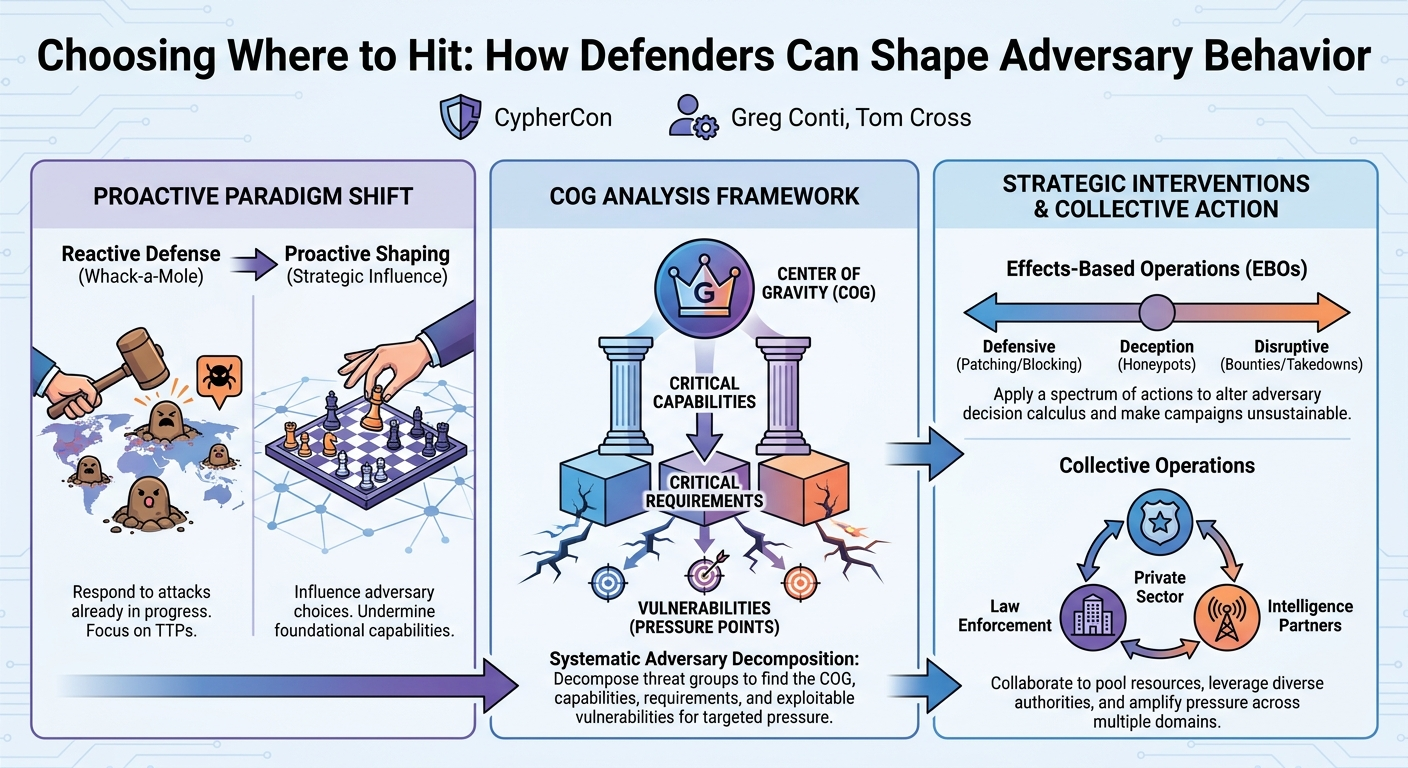
The prevailing approach in cybersecurity is largely reactive. Organizations invest heavily in understanding adversary TTPs to protect their networks, but this often means responding to attacks already in progress. Conti and Cross contend that this focus overlooks the fundamental question: what systems of dependencies do threat actors rely on to sustain their operations, and can these be undermined? The problem, as they see it, is a lack of systematic modeling of these upstream factors. While we map what adversaries do, we don't adequately map why they do it or how their entire operation functions as a cohesive system.
To address this gap, the speakers draw heavily from military doctrine, which has centuries of experience in analyzing and influencing adversaries. They introduce several key concepts:
- Campaigns and Lines of Operation/Effort: Militaries think in terms of campaigns, which involve various "lines of effort" (activities) and "lines of operation" (stages, akin to cyber kill chain stages). Applying this to ransomware, they illustrate how a campaign involves multiple operations, from initial access to negotiation and data exfiltration.
- Decision Points: Within any campaign, critical moments arise where an actor makes a choice, leading to multiple possible futures. Influencing these decision points is central to shaping adversary behavior. An illustrative example is Coinbase's response to a ransom demand: instead of paying, they offered the ransom amount as a bounty on the attacker's head, fundamentally altering the attacker's decision calculus.
- Effects-Based Operations (EBO): This concept moves beyond simply destroying targets to influencing an adversary's choices. The speakers emphasize a spectrum of EBOs, from defensive actions like patching and blocking to more aggressive measures like deception (e.g., honeypots to waste adversary time) or even logic bombs in open-source libraries that destroy data in adversary countries. The core idea is that an "effect" can be achieved without necessarily "blowing something up," as demonstrated by the use of inflatable tanks to mislead an enemy general.
- Center of Gravity (COG) Analysis: This is the cornerstone of their proposed methodology. Originating in military intelligence, COG analysis is a technique to decompose an organization (be it a military, company, or criminal group) to identify its most critical element – its center of gravity. Below the COG are critical capabilities that sustain it, which in turn rely on critical requirements. Flaws in these requirements reveal vulnerabilities that can be targeted. This process yields a prioritized list of targets for either attack or defense, making it a "dual-use technology."
The problem exists because the cybersecurity community largely lacks a systematic framework for this type of proactive, influence-based operation. While we have maps of TTPs, we lack comprehensive maps of adversary decision points and a structured way to systematically apply pressure to their fundamental operational pillars.
Key Findings
▶ Watch: Military "Center of Gravity" analysis for cyber adversaries (14:35)
The central discovery presented by Greg Conti and Tom Cross is that the application of military Center of Gravity (COG) analysis offers a potent, systematic framework for cybersecurity defenders to shift from a reactive posture to one that proactively shapes and undermines adversary behavior. This approach moves beyond merely blocking attacks to strategically targeting the foundational elements that enable threat actors to operate.
Key findings and contributions include:
- Systematic Adversary Decomposition: COG analysis provides a structured, multi-layered method to break down complex threat actor groups. By identifying their primary Center of Gravity (e.g., LockBit's brand dominance), then the critical capabilities supporting it (e.g., consistent operational success, reliable affiliate payouts, technical superiority), followed by the critical requirements for those capabilities (e.g., reliable data exfiltration, leak site infrastructure), and finally the underlying vulnerabilities, defenders can pinpoint high-leverage targets.
- Decision Point Manipulation: Adversaries, like any rational actors, operate within constraints and make decisions. The talk highlights that these decision points are crucial opportunities for defenders to exert influence. Actions like Coinbase's counter-ransom bounty demonstrate how unexpected responses can fundamentally alter an attacker's strategic calculus.
- Broad Spectrum of Effects-Based Operations: The speakers reveal that the range of actions available to defenders is far wider than often considered. This spectrum extends from traditional defensive measures (patching, blocking) to more aggressive effects-based operations such as deception (honeypots), wasting adversary time, or even highly disruptive (and risky) actions like embedding logic bombs in open-source software that targets specific geographies. The goal is not just destruction, but influencing behavior.
- Automation Potential for COG Analysis: While historically a manual military intelligence process, Conti and Cross emphasize that the graph-based nature of COG analysis makes it highly amenable to automation. A full LockBit analysis, for example, might involve around 1100 nodes, a tractable number for modern computing and graph theory applications, enabling continuous updates and enrichment with threat intelligence.
- Amplified Impact Through Collective Operations: Working in isolation limits impact. The talk strongly advocates for collective operations with partners, including law enforcement, other companies, and intelligence agencies. This collaboration allows for pooling of capabilities, leveraging diverse legal authorities, sharing intelligence, and applying pressure across cyber, narrative, and even physical domains, ultimately raising the risk for attackers faster than they can adapt.
- Real-World Validation (Conceptual): The talk cites real-world examples that align with their framework, such as the defacement of LockBit's leak site (undermining brand dominance) and law enforcement's takedown of 14,000 Mega accounts used for LockBit exfiltration (striking at critical data exfiltration capabilities). These incidents, they argue, demonstrate the practical efficacy of targeting an adversary's COG and critical capabilities.
Ultimately, the key finding is that by adopting a military mindset and tools like COG analysis, cybersecurity professionals can develop a more strategic and impactful defense, moving beyond a reactive "whack-a-mole" approach to systematically dismantle the foundation of adversary operations.
Technical Deep Dive
▶ Watch: Real-world examples of undermining adversary centers of gravity (26:30)
The core of Conti and Cross's technical framework is the adaptation of Center of Gravity (COG) analysis for cyber threat intelligence. This method provides a structured way to dissect an adversary, identify their vital components, and pinpoint vulnerabilities for targeted pressure.
The COG analysis proceeds through four distinct stages:
- Identify the Center of Gravity (COG): This is the most critical element of the adversary, without which they cannot function or achieve their objectives. For a criminal ransomware group like LockBit, potential COGs could include their ransomware-as-a-service platform, their brand dominance and market reputation, leadership stability, or automated tooling. The speakers, referencing an in-depth academic paper, chose brand dominance and market reputation as LockBit's COG for their demonstration.
- Determine Critical Capabilities: These are the primary functions or pillars that directly support and enable the COG. For LockBit's brand dominance, these include:
- Demonstrate consistent operational success.
- Ensure reliable affiliate payouts.
- Publicly signal technical superiority.
- Enforce threat credibility (chosen for further deep dive).
- Maintain a robust affiliate network.
- Effective public relations.
- Secure infrastructure.
- Rapid adaptation to defenses.
- Strong operational security (OPSEC).
- Effective negotiation strategies.
- Identify Critical Requirements: For each critical capability, there are specific requirements that must be met for it to function. Focusing on "enforce threat credibility," the requirements include:
- Reliable data exfiltration capability.
- Leak site infrastructure.
- Victim proof of compromise artifacts.
- Effective communication channels.
- Consistent encryption success.
- Secure payment processing.
- Ability to decrypt data.
- High-quality support for victims (to encourage payment).
- Reputation for following through on threats.
- Effective intelligence gathering.
- Uncover Vulnerabilities: These are the weaknesses or flaws within the critical requirements that can be exploited. For the chosen requirements:
- Reliable data exfiltration capability:
- Weakness in network monitoring and egress controls.
- Vulnerabilities in LockBit's encryption key mismanagement.
- Exposure of their exfiltration infrastructure (e.g., using Mega, which law enforcement could target).
- Leak site infrastructure:
- Domain seizure risk (registrars can take down domains).
- Distributed Denial of Service (DDoS) susceptibility.
- OPSEC errors leading to infrastructure exposure.
- Affiliate financial dissatisfaction (as a general vulnerability affecting multiple capabilities, particularly "reliable affiliate payouts"):
- Disrupted payment flows.
- Traceability and sanctioning of wallets.
- Publicizing payment disputes.
This systematic decomposition creates a hierarchical graph model. While the speakers showed a pruned version for clarity (representing only 3% of the potential graph), they noted that a full model for a group like LockBit could involve around 1100 nodes. Such a graph, though seemingly large, is entirely tractable for machine processing and allows for the application of graph theory to identify optimal pressure points.
The talk also detailed the spectrum of effects-based operations (EBOs). These range from traditional defensive actions (blocking, patching vulnerabilities) to more aggressive and risky measures. Examples include deception activities like honeypots to waste adversary time, or the extreme example of logic bombs placed in open-source libraries that destroy data on systems geolocated to an adversary's country. The key is to map these available capabilities to the identified vulnerabilities to achieve a desired effect, whether it's disrupting payment flows, coordinating hosting takedowns, or exploiting OPSEC mistakes. The goal is to apply pressure that is not merely tactical, but strategically undermines the adversary's COG.
Demo / Proof of Concept
▶ Watch: Understanding legal and reputational risks in cyber operations (36:10)
While the talk did not feature a live software demonstration or a traditional "proof of concept" in the sense of executable code, Greg Conti and Tom Cross effectively demonstrated the applicability and power of their proposed methodology through a detailed conceptual walkthrough. Their "demo" was the systematic application of Center of Gravity (COG) analysis to a real-world, high-impact threat actor: the LockBit ransomware group.
The visual centerpiece of this demonstration was a graphical model illustrating LockBit's operational structure, decomposed according to the COG framework. Starting with brand dominance as LockBit's identified Center of Gravity, the speakers meticulously mapped out the critical capabilities supporting it (e.g., "enforce threat credibility"), the critical requirements for those capabilities (e.g., "reliable data exfiltration capability," "leak site infrastructure"), and finally, the specific vulnerabilities that could be exploited (e.g., egress controls, encryption key mismanagement, domain seizure risk, DDoS susceptibility, OPSEC errors, affiliate financial dissatisfaction). This multi-layered diagram served as the primary proof of concept, showing how a complex criminal enterprise could be systematically reverse-engineered to reveal its Achilles' heel.
Beyond this conceptual model, the speakers reinforced their framework by referencing real-world events that align perfectly with their theory:
- Coinbase's Counter-Ransom Bounty: They cited Coinbase's innovative response to a ransom demand – offering the ransom money as a bounty on the attacker's head – as a prime example of an effects-based operation that directly influenced an adversary's decision points in an unexpected and impactful way, mirroring a scene from the movie "Ransom."
- LockBit Leak Site Defacement: The actual defacement of LockBit's leak site by an external actor was presented as a real-world instance of striking directly at LockBit's brand dominance and enforce threat credibility. This action, while aggressive, demonstrably undermined a key pillar of their operation, validating the COG analysis's predictive power.
- Law Enforcement Takedown of Mega Accounts: The coordinated action by law enforcement to take down 14,000 Mega accounts used for LockBit exfiltration was highlighted as a successful strike against the "reliable data exfiltration capability" – a critical requirement for enforcing threats and maintaining brand reputation. The speakers even inferred that LockBit's use of Mega, rather than AWS S3, was likely a consequence of prior adversary shaping behavior by Amazon or law enforcement, forcing them to less secure platforms.
These examples, integrated with the visual COG model, served as a compelling "proof of concept" for the analytical methodology, demonstrating how defenders can move beyond traditional reactive measures to systematically identify and apply pressure at points that truly matter to an adversary's overall survival and success.
Defensive Implications
▶ Watch: Q&A: Communicating complex analysis to senior leaders (48:30)
The implications of Conti and Cross's talk for cybersecurity defenders are profound, advocating for a fundamental shift in strategy from purely reactive measures to proactive, influence-based operations.
- Proactive Strategy Integration: Defenders must move beyond simply patching and blocking. The Center of Gravity (COG) analysis framework provides a systematic way to identify and prioritize adversary vulnerabilities that, if exploited, can undermine their entire operation. This allows for a more strategic and impactful allocation of defensive resources.
- Internal COG Analysis: The "dual-use technology" aspect of COG analysis means organizations can (and should) apply the same methodology to themselves. By identifying their own COG, critical capabilities, requirements, and vulnerabilities, enterprises can proactively shore up their defenses against the very pressure points adversaries might target. This creates a "race condition" where defenders aim to secure their COG before an adversary can identify and exploit it.
- Targeted Pressure and Effects-Based Operations: Instead of generic defenses, defenders can use the COG analysis to identify specific "pressure points" that flow back to the adversary's COG. This enables the design of effects-based operations (EBOs) tailored to influence adversary decisions. Examples include:
- Strengthening egress controls and network monitoring to make data exfiltration difficult, potentially pushing ransomware groups to encrypt only, not exfiltrate.
- Publicizing collaboration with law enforcement after an attack to deter future targeting by signaling a high-risk victim.
- Implementing deception tactics like honeypots to waste adversary time and resources.
- Banning specific services (e.g., Mega uploads) in the enterprise if they become known exfiltration points for adversaries, forcing attackers to less convenient or secure alternatives.
- Embrace Collective Operations: The talk strongly emphasizes the power of collective defense evolving into collective operations. Organizations should actively seek partnerships with law enforcement (e.g., coordinating takedowns of C2 infrastructure), other companies (e.g., sharing intelligence, capabilities), and industry ISACs. This collaboration pools resources, leverages diverse legal authorities, increases situational awareness, and amplifies pressure across cyber, narrative, and even physical domains.
- Robust Risk Management for Aggressive Actions: As defenders consider more aggressive EBOs, a comprehensive understanding and management of risk are paramount. This includes:
- Legal & Compliance: Understanding the legality of actions and potential litigation risks (e.g., "hacking back" is often unlawful for private entities).
- Reputational Risks: Assessing how public perception might be affected (e.g., consumer distrust if company products are used for intelligence gathering).
- Escalation Risks: Being cognizant of the potential to become a lawful combatant in an armed conflict, even unintentionally, by engaging in certain cyber activities (a critical point highlighted by the Red Cross's work on the "civilianization of the digital battlefield").
- Governance & Planning: Establishing clear command and control, authorization processes, precision, and safeguards to ensure actions are controlled and ethical.
- Intelligence-Driven Decision Making: Defenders should adopt a "commander-driven" intelligence process. Instead of passively receiving threat intelligence, they should actively task intelligence teams to answer specific questions derived from COG analysis, focusing on adversary vulnerabilities and decision points. This ensures intelligence directly supports strategic pressure operations.
By integrating these principles, defenders can move beyond merely reacting to incidents, building a more resilient and proactive defense posture that actively shapes the behavior of their adversaries and fundamentally undermines their ability to operate.
Key Takeaways
- Shift from Reactive to Proactive: Cybersecurity must evolve from merely defending against attacks to actively shaping adversary behavior and undermining their core operations.
- Adversaries Have a Center of Gravity: Threat actors, like any organization, have a "Center of Gravity" (COG) – a most critical element – supported by capabilities and requirements, all of which contain exploitable vulnerabilities.
- COG Analysis is a Powerful Tool: Applying military Center of Gravity analysis allows defenders to systematically decompose adversary groups (e.g., LockBit), identify their COG, critical capabilities, requirements, and ultimately, specific pressure points for maximum impact.
- Influence Adversary Decision Points: Campaigns have critical decision points that can be influenced through effects-based operations, ranging from defensive actions to deception and disruptive tactics, making campaigns unprofitable or unsustainable.
- Collective Operations Amplify Impact: Collaborating with law enforcement, other organizations, and intelligence partners significantly increases capabilities, legal authorities, and information sharing, leading to amplified pressure on adversaries across multiple domains.
- Understand and Manage Risks: Engaging in aggressive effects-based operations carries significant legal, reputational, and even physical risks (e.g., becoming a lawful combatant), necessitating robust governance, planning, and legal counsel.
About the Speaker(s)
Greg Conti is an experienced security professional with a distinguished background in military intelligence. He served for many years as an intelligence officer in the U.S. Army before transitioning into cybersecurity and cyberspace operations. His deep understanding of military doctrine, particularly in areas like campaign analysis and effects-based operations, forms the bedrock of the innovative approaches he advocates for in cybersecurity. He has previously collaborated with Tom Cross on other talks, including a presentation at Defcon titled "Dark Capabilities."
Tom Cross is a prominent voice in the cybersecurity community, known for his analytical insights and collaborative work. He has partnered with Greg Conti on multiple occasions, including the "Dark Capabilities" talk at Defcon, focusing on exploring the broader spectrum of actions tech companies could undertake against adversaries. Cross emphasizes the value of borrowing systematic thinking from military conflict theory to enhance cybersecurity strategies, advocating for frameworks that allow defenders to proactively influence and disrupt threat actor operations.
Reviews
Dr. Zero (Offensive Security Researcher) — SOLID
Conti and Cross are veterans, but pitching Center of Gravity analysis to corporate defenders is a 15-year-old parlor game. It's a competent strategic framework, but translating military doctrine into a commercial SOC usually just generates expensive Visio diagrams.
Heather Calloway (CISO) — SOLID
This is a competent framework for understanding how ransomware cartels operate as systems, but it fundamentally misjudges the risk appetite of the private sector. Your threat intel team should understand Center of Gravity analysis, but your leadership team needs to steer firmly clear of 'effects-based operations.'