Seeing Is Deceiving: Deepfakes, Creative Power, and the New Trust Crisis
Kyle Hinterberg
Overview
In an engaging and often humorous presentation at CypherCon, Kyle Hinterberg, a Senior Manager at LBMC, delved into the rapidly evolving world of deepfakes and the profound trust crisis they present. Titled "Seeing Is Deceiving: Deepfakes, Creative Power, and the New Trust Crisis," the talk highlighted how advanced generative AI has made it nearly impossible to distinguish between authentic and fabricated digital content, challenging our fundamental reliance on visual and auditory evidence. Hinterberg, while acknowledging his primary expertise in PCI compliance, expressed a clear passion for the more "fun" and impactful topic of deepfakes, illustrating their creative potential alongside their darker, more malicious applications.
Key moments
- 4:00 Live deepfake demonstration and audience participation
- 4:20 Explaining how generative AI and deepfakes are made
- 8:00 The evolution of AI video: Will Smith eating spaghetti
- 14:20 The disturbing reality of deepfake misuse and non-consensual content
- 18:00 Beneficial deepfake applications and the legal landscape
- 28:00 Why deepfake detection is difficult: The Brahma Lock analogy
- 32:00 Best defense: Focus on social engineering, not deepfake detection
- 36:00 Deepfake Rickroll: The ultimate demonstration of AI capabilities
Seeing Is Deceiving: Deepfakes, Creative Power, and the New Trust Crisis
Speakers: Kyle Hinterberg, Senior Manager, LBMC
Conference: CypherCon
YouTube: https://www.youtube.com/watch?v=FwkNyWYqtGA
Overview
In an engaging and often humorous presentation at CypherCon, Kyle Hinterberg, a Senior Manager at LBMC, delved into the rapidly evolving world of deepfakes and the profound trust crisis they present. Titled "Seeing Is Deceiving: Deepfakes, Creative Power, and the New Trust Crisis," the talk highlighted how advanced generative AI has made it nearly impossible to distinguish between authentic and fabricated digital content, challenging our fundamental reliance on visual and auditory evidence. Hinterberg, while acknowledging his primary expertise in PCI compliance, expressed a clear passion for the more "fun" and impactful topic of deepfakes, illustrating their creative potential alongside their darker, more malicious applications.
The core message of the talk resonated with Abraham Lincoln's apocryphal internet advice: "Never trust anything you see on the internet." Hinterberg demonstrated that this sentiment is more relevant than ever, as deepfake technology empowers individuals to create hyper-realistic visual and audio content with readily available tools. The presentation served as a stark warning about the erosion of trust in digital media, emphasizing that the ability to fabricate convincing realities has far-reaching implications for personal security, political stability, and societal cohesion.
This article explores the mechanics of deepfake creation, showcases their capabilities through compelling examples, and critically examines the limitations of current detection methods. Crucially, it outlines practical defensive strategies that shift focus from trying to discern authenticity to recognizing the underlying social engineering tactics, providing actionable insights for individuals and organizations navigating this new era of digital deception.
Background
▶ Watch: Live deepfake demonstration and audience participation (4:00)
The journey into deepfakes begins with understanding the fundamental principles of generative AI. Hinterberg explained that tools for generating images are trained by feeding them vast datasets. Initially, an AI is given an image (e.g., a dog) and instructed to recreate it. Gradually, noise is introduced, or data is removed from the input, prompting the AI to reconstruct the image based on its learned understanding. This iterative process continues until the AI can generate a coherent image from pure noise, effectively "imagining" what a dog, or any other subject, should look like based on its training data. This process highlights that generative AI outputs are reflections of their training data, not necessarily objective reality.
A significant leap in generative AI, particularly for creating realistic human images, came with the advent of Generative Adversarial Networks (GANs). Hinterberg detailed how GANs operate through a competitive process between two neural networks: a generator and a discriminator. The generator's role is to create a synthetic image, often of a person. This generated image is then passed to the discriminator, which acts as a critic, attempting to determine if the image is real or fake. If the discriminator identifies it as fake, it sends feedback to the generator, which then attempts to create a more convincing image. This adversarial loop, performed thousands of times per second, rapidly refines the generator's ability to produce highly realistic, often indistinguishable, deepfakes.
The rapid progression of this technology was vividly illustrated through the "Will Smith eating spaghetti" meme, a widely recognized benchmark for deepfake realism. Hinterberg showcased the evolution from crude, "bathing with spaghetti" animations in 2023 to remarkably convincing, albeit still slightly surreal, renditions by 2026. This progression underscores the exponential improvement in deepfake quality, moving from easily identifiable fakes to those that are "pretty real" and might pass for genuine content in everyday scenarios. Early indicators of AI's deceptive power were also noted, such as the 2023 incident where Will Smith's marketing team used AI to fill concert stadiums with fake audiences, or the thispersondoesnotexist.com website, which generates endless, unique, yet entirely synthetic, human faces. These examples collectively set the stage for the current "trust crisis," demonstrating how easily our perception of reality can be manipulated.
Key Findings
▶ Watch: The evolution of AI video: Will Smith eating spaghetti (8:00)
The talk revealed several critical findings about the current state and impact of deepfakes, painting a picture of a pervasive and rapidly escalating threat to digital trust.
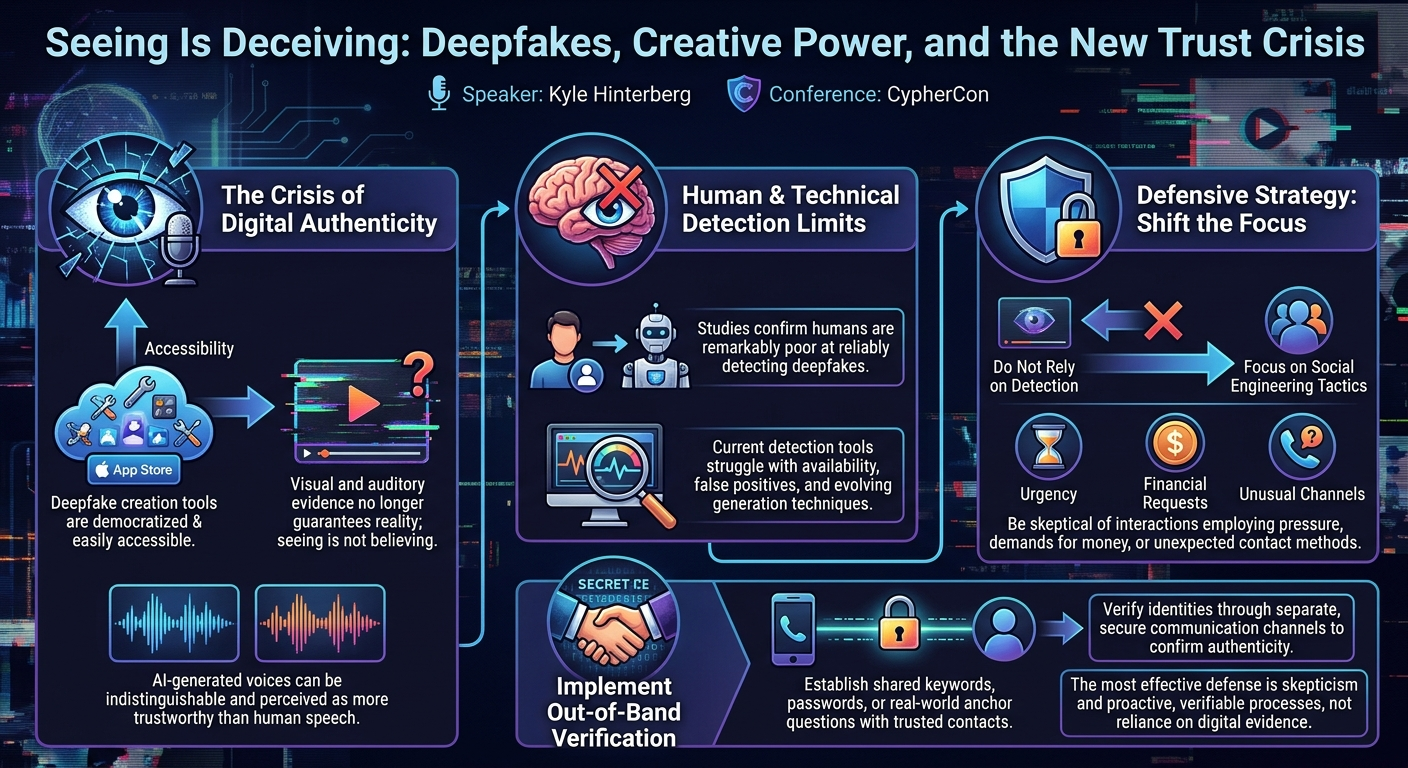
Firstly, deepfake creation has become incredibly accessible. Hinterberg emphasized that anyone can now produce deepfakes using a myriad of tools available on app stores or through open-source projects. He specifically mentioned powerful, albeit often misused, tools like DeepFaceLab, RVC (Retrieval-based Voice Conversion), and Deep Live Cam (which he used during his presentation). The ease of access means that malicious actors no longer require specialized skills or significant resources to generate convincing fake content, democratizing deception.
Secondly, the overwhelming majority of deepfake content online is malicious, specifically non-consensual pornography. Hinterberg cited a disturbing statistic: 98% of all online deepfake videos are made with non-consensual pornographic images. This highlights the dark side of the technology, where its advancements are largely driven by exploitative and harmful applications, causing immense personal distress and violating privacy. Beyond pornography, deepfakes are increasingly used for political disruption, inciting riots, and commercial fraud, as exemplified by a legitimate Whirlpool subsidiary using a deepfaked TED Talk of North Carolina State Senator DeAndrea Salvador in a commercial without her consent.
Thirdly, a crucial finding, backed by academic studies, is that humans are remarkably poor at detecting deepfakes. Hinterberg referenced a 2021 study titled "Fooled Twice: People Can't Detect Deepfakes," which concluded that people cannot reliably detect deepfakes, and even raising awareness or offering monetary incentives does not improve their detection abilities. This finding is particularly alarming given that deepfake technology has significantly advanced since 2021. Furthermore, a study from September of the previous year (2023) focused on audio deepfakes, finding that AI voices were indistinguishable from real people, often judged as "more dominant and sometimes more trustworthy than humans." These voices were created using "minimal audio" and "common off-the-shelf tools," underscoring the ease with which convincing audio deception can be achieved.
Finally, current deepfake detection tools, while showing promise, face significant limitations. Hinterberg noted that while various tools exist, they are often inconsistent in their effectiveness. More importantly, these tools suffer from availability issues, as they are rarely integrated into common communication platforms like Teams or Slack. They also struggle with false positives, where legitimate uses of digital filters (e.g., makeup filters, cat ears for digital identity) can be misidentified as deepfakes, creating a dilemma about individual expression versus security. This inherent unreliability means that relying solely on technological detection is not a viable long-term strategy.
Technical Deep Dive
▶ Watch: Beneficial deepfake applications and the legal landscape (18:00)
The technical underpinnings of deepfakes, as explained by Hinterberg, revolve around sophisticated AI models, primarily Generative Adversarial Networks (GANs), and their continuous refinement. The core idea for image generation starts with training an AI to understand the features of an object or person. This involves feeding it an image, then progressively adding noise or removing data, and asking the AI to reconstruct the original. Through this iterative process, the AI learns to generate an image from pure noise, effectively creating something from nothing based on its learned patterns.
GANs amplify this capability by introducing an adversarial relationship. A generator network is tasked with creating synthetic data (e.g., a fake image or video frame). Simultaneously, a discriminator network evaluates this generated data, attempting to distinguish it from real data. If the discriminator identifies the output as fake, it provides feedback to the generator, which then adjusts its parameters to produce a more convincing fake. This continuous feedback loop, operating at high speeds, allows GANs to rapidly improve the realism of their outputs, leading to the highly convincing deepfakes we see today.
For practical deepfake creation, a range of tools exists, catering to different levels of technical expertise and intent. Consumer-grade applications are plentiful on app stores, often designed for entertainment purposes, allowing users to swap faces or animate photos. Hinterberg also mentioned Sora, an advanced text-to-video model that, before its shutdown, could generate complex scenes from simple prompts, though he noted watermarks were easily removed. On the more advanced and often malicious side, tools like DeepFaceLab and RVC (Retrieval-based Voice Conversion) are open-source and freely available, enabling users to create sophisticated video and audio deepfakes, including non-consensual pornography and politically disruptive content. Hinterberg himself demonstrated Deep Live Cam, a tool capable of real-time face-swapping, illustrating its power by transforming his appearance throughout the talk.
Deepfake detection technologies are also under development, though they face an uphill battle against ever-improving generation techniques. Some methods focus on liveness detection, attempting to identify subtle physiological cues. This includes looking for a pulse under the skin, which might cause imperceptible facial color changes, or using a novel technique where a screen subtly changes color (e.g., slightly red) and a camera checks if the light reflects off the subject's face, indicating a real person. Another promising area involves analyzing the eyes. Hinterberg highlighted technology that uses principles similar to star mapping to identify light sources reflected in a person's eyes. In a real person, both eyes should reflect the same light source; discrepancies (e.g., different light sources for each eye) can be a strong indicator of a deepfake.
The University at Buffalo's DeepFake-o-Meter was presented as a publicly accessible tool that allows users to upload videos for analysis. However, Hinterberg demonstrated its limitations, showing how even an obviously fake video of him breakdancing in impossible ways received a 0% chance of being a deepfake from some of its underlying checks. This underscores the challenge: even advanced detection tools are not foolproof and can be inconsistent. The broader issues for detection tools include their availability (lack of integration into mainstream platforms) and false positives, where legitimate digital filters or identity choices (like cat ears in a video call) can trigger deepfake alerts, complicating their deployment in everyday scenarios.
Demo / Proof of Concept
▶ Watch: Why deepfake detection is difficult: The Brahma Lock analogy (28:00)
Kyle Hinterberg's presentation was a live, continuous demonstration of deepfake technology, primarily utilizing Deep Live Cam. From the outset, he used the tool to dynamically alter his appearance in real-time on the stage, shifting between various personas like Johnny Cash, Elvis, Jeffrey Epstein (complete with a tin foil cheese head), Robin Williams, Randy Travis, Keanu Reeves, Princess Leia, Danny DeVito, Mr. Rogers, Joe Biden, Donald Trump, Daenerys Targaryen, and Walter White, among others. This interactive element allowed the audience to witness the seamlessness and speed of real-time deepfake generation.
An engaging interactive component invited the audience to participate by scanning a QR code and uploading images. The speaker would then be deepfaked as the chosen individual, making the demonstration a collective experience and highlighting the ease of personalizing deepfake content. This direct interaction underscored the accessibility of the technology.
Beyond the live transformations, Hinterberg presented several pre-recorded examples to illustrate the evolution and capabilities of deepfakes:
- Will Smith Eating Spaghetti: A series of videos showcased the progression of deepfake realism from 2023 to 2026, where Will Smith's likeness was animated eating spaghetti. The earlier versions were comically unrealistic, showing Smith "bathing" or "showering" with spaghetti, while the 2026 version was described as "pretty real," demonstrating the rapid advancements in quality.
- Will Smith Concert Audience: A segment detailed how Will Smith's marketing team used AI to fill stadiums with fake audiences for his music videos, followed by his humorous response of re-releasing the video with an audience of cats. This illustrated the use of deepfakes in marketing and the potential for deceptive mass media.
- Napoleon Dynamite Dance: Hinterberg demonstrated taking a video of himself on stage and applying a deepfake to make him perform the iconic Napoleon Dynamite dance, showcasing the ability to transpose specific actions and styles onto a target video.
- Sora and Watermark Removal: An example of a video generated by Sora, featuring Hinterberg breakdancing in a city, initially displayed watermarks. He explained how easily these watermarks could be removed using widely available online tools, highlighting a significant challenge in content attribution and authenticity.
- Deepfake Ward Contest: Hinterberg also promoted a "deep fake ward" on the first floor of the conference, where attendees could experiment with deepfake tools and participate in a contest, with submissions being run through the University at Buffalo's DeepFake-o-Meter for evaluation. This hands-on experience further solidified the practical aspects of deepfake creation and detection challenges.
- Rick Astley "Never Gonna Give You Up" Deepfake: The talk concluded with a full, three-minute deepfaked rendition of Rick Astley's iconic music video, featuring various celebrity faces (including "11" from Stranger Things) superimposed onto the original dancers, serving as a memorable and entertaining demonstration of the technology's capability for creative, if whimsical, manipulation.
These diverse demonstrations collectively emphasized the power, accessibility, and evolving realism of deepfake technology, providing concrete examples of both its "fun" applications and its potential for deception.
Defensive Implications
▶ Watch: Deepfake Rickroll: The ultimate demonstration of AI capabilities (36:00)
The defensive implications of deepfakes, as articulated by Kyle Hinterberg, fundamentally shift from trying to detect the fakes themselves to adopting a more skeptical and proactive stance against social engineering. Given the proven inability of humans to reliably detect deepfakes and the limitations of current detection tools, the recommended strategy is to "not care about it's a deepfake" but rather to focus on identifying social engineering tactics.
Hinterberg advises that if an interaction, regardless of its apparent authenticity, attempts to coerce or manipulate, it should be treated with extreme caution. Key indicators of social engineering include a sense of urgency, requests for financial information, or contact through unusual or unexpected channels. The core principle is that if someone is trying to make you "do something bad," the authenticity of their digital persona is irrelevant; the malicious intent is the primary concern.
A crucial defensive measure is the implementation of out-of-band verification and real-world anchors. For personal security, he recommends establishing a shared keyword, password, or phrase with family members. This allows individuals to verify the identity of a caller, especially in high-stakes situations like ransom calls, by asking for the secret word. If the caller cannot provide it, the interaction can be dismissed as fraudulent. This technique directly addresses the threat of voice and video deepfakes used in scams.
In professional settings, similar principles apply. Employees should be encouraged to establish verbal or agreed-upon verification methods for unusual requests. Hinterberg recounted a story where a VP, suspicious of a CEO's urgent request via WhatsApp, asked, "What was the name of that book I borrowed you?" The inability of the imposter to answer immediately exposed the fraud, bringing the digital interaction back to a verifiable "real world" anchor. This strategy aligns with the "assume the insider" mentality, where organizations should operate under the assumption that an attacker might already be within their systems, potentially using deepfakes to impersonate legitimate personnel. Asking specific, obscure, and verifiable real-world questions can expose an imposter who lacks true insider knowledge.
The talk also touched upon the evolving legal landscape, noting that federal laws in the US are mostly proposed or pending. The Take It Down Act, specifically targeting non-consensual deepfake pornography, is a significant step, set to go into effect in summer. However, the broader legal challenge in the US lies in balancing the freedom of speech with an individual's right to their likeness, a conflict that may ultimately require Supreme Court intervention. State laws, such as Tennessee's Elvis Act, offer some protection for likeness and voice, often driven by the entertainment industry. Internationally, some countries, like South Korea, have much stricter laws, criminalizing not only the creation but also the viewing of deepfake pornography, and treating deepfake child pornography with the same severity as real child pornography globally. While these legal frameworks are developing, they are often reactive and struggle to keep pace with technological advancements, emphasizing the need for proactive personal and organizational defenses.
Ultimately, the most effective defense against deepfakes is a blend of critical thinking, a healthy skepticism of digital interactions, and the implementation of robust verification processes that transcend the easily manipulated digital realm.
Key Takeaways
- Deepfakes Fuel a Trust Crisis: The rapid advancement and accessibility of deepfake technology mean that visual and auditory evidence can no longer be trusted inherently, leading to a pervasive crisis in digital authenticity and public trust.
- Humans Are Ineffective Deepfake Detectors: Studies consistently show that people are poor at distinguishing between real and deepfaked content, even with awareness or incentives, and AI-generated voices can be perceived as more trustworthy than human ones.
- Shift Focus to Social Engineering: Instead of trying to identify if content is a deepfake, defenders should prioritize recognizing the underlying social engineering tactics, such as urgency, unusual requests, or demands for sensitive information.
- Implement Out-of-Band Verification: Establish shared keywords, phrases, or specific real-world questions with family, friends, and colleagues to verify identities during suspicious digital interactions, effectively bringing the conversation back to a verifiable anchor.
- Legal Protections Are Evolving but Limited: While some laws, like the Take It Down Act, are emerging to address specific deepfake abuses, the legal landscape is often reactive and complicated by issues like freedom of speech, highlighting the need for robust personal and organizational defenses.
- Technology is Accessible and Rapidly Advancing: Tools for creating sophisticated deepfakes are readily available and continuously improving, underscoring the urgency for individuals and organizations to adapt their security strategies.
About the Speaker(s)
Kyle Hinterberg is a Senior Manager at LBMC, a professional services firm. While his day-to-day expertise lies in PCI (Payment Card Industry) compliance, where he works as a QSA (Qualified Security Assessor), Hinterberg demonstrates a clear passion for the more dynamic and impactful field of deepfakes. He is known for his engaging and humorous presentation style, effectively using live demonstrations and interactive elements to illustrate complex technical concepts. His talks, like "Seeing Is Deceiving," blend technical insights with practical advice, making the often-daunting subject of cybersecurity accessible and thought-provoking for a broad audience.
Reviews
Dr. Zero (Offensive Security Researcher) — WEAK
A PCI auditor runs Deep Live Cam on stage and repeats the same 'trust crisis' talking points we've been hearing since 2019. It's a glorified security awareness seminar built around a parlor trick, with absolutely zero novel research.
Heather Calloway (CISO) — SOLID
An entertaining, demo-heavy briefing on commodity deepfakes that ultimately lands on standard security awareness advice. The speaker correctly concludes that technical detection is a losing battle, but the enterprise takeaways don't extend past basic challenge-response protocols. Good stagecraft, but it won't alter your program strategy.