Evolving PCI: Turning Compliance Into Continuous Defense
Kyle Hinterberg
Overview
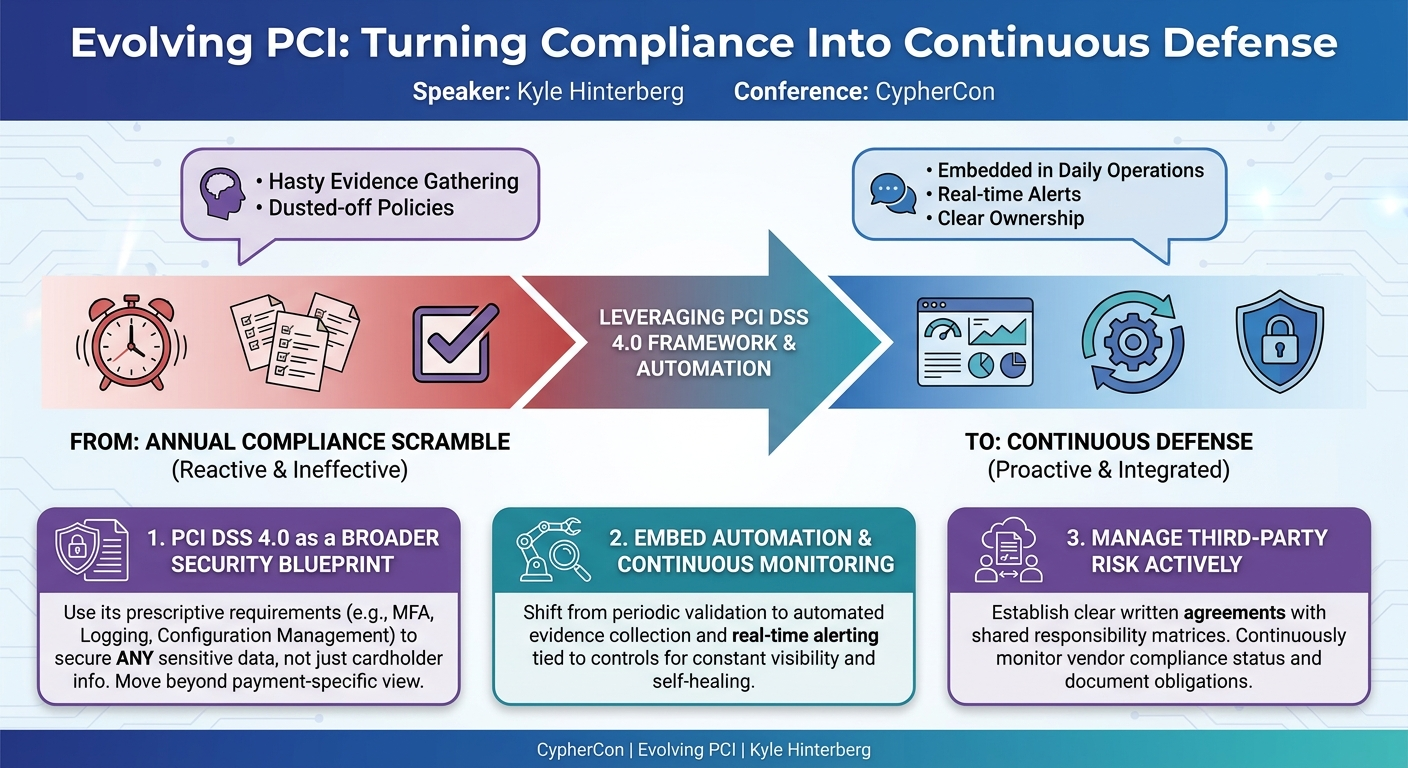
In his CypherCon talk, "Evolving PCI: Turning Compliance Into Continuous Defense," Kyle Hinterberg, a Senior Manager and PCI Qualified Security Assessor (QSA) with LBMC, challenges the conventional wisdom surrounding the Payment Card Industry Data Security Standard (PCI DSS). Often perceived as a burdensome, checkbox-driven exercise, Hinterberg argues that PCI DSS, particularly with the advancements in version 4.0, can and should be leveraged as a robust, prescriptive framework for continuous security improvement that extends far beyond just cardholder data. The core premise of his presentation is to shift organizational mindset from reactive, annual compliance scrambles to proactive, integrated, and automated defense strategies.
Key moments
- 4:00 What is PCI and who needs to comply?
- 7:30 PCI 4.0: Flexibility, custom controls, and ownership
- 12:30 PCI 4.0 requirements addressing MageCart attacks
- 20:30 Q&A: PCI scope for all vendors (not just payments)
- 27:30 Evolving PCI: From periodic validation to continuous monitoring
- 34:30 Importance of team integration for security and compliance
- 36:30 PCI maturity model: from annual to adaptive defense
- 41:00 Actionable takeaway: PCI Prioritized Approach Tool (PAT)
Evolving PCI: Turning Compliance Into Continuous Defense
Speakers: Kyle Hinterberg, Senior Manager, LBMC, PCI QSA
Conference: CypherCon
YouTube: https://www.youtube.com/watch?v=yRrbrP9uCj0
Overview
In his CypherCon talk, "Evolving PCI: Turning Compliance Into Continuous Defense," Kyle Hinterberg, a Senior Manager and PCI Qualified Security Assessor (QSA) with LBMC, challenges the conventional wisdom surrounding the Payment Card Industry Data Security Standard (PCI DSS). Often perceived as a burdensome, checkbox-driven exercise, Hinterberg argues that PCI DSS, particularly with the advancements in version 4.0, can and should be leveraged as a robust, prescriptive framework for continuous security improvement that extends far beyond just cardholder data. The core premise of his presentation is to shift organizational mindset from reactive, annual compliance scrambles to proactive, integrated, and automated defense strategies.
Hinterberg critiques the common "annual compliance scramble" where organizations hastily gather evidence and dust off policies just before an audit, a practice he asserts does not provide genuine security. Instead, he advocates for an approach where compliance activities are embedded into daily operations, driven by continuous monitoring, automation, and clear ownership. By dissecting specific requirements within PCI DSS 4.0 and illustrating their applicability to broader security challenges like Magecart attacks and third-party risk, he demonstrates how this standard can serve as a powerful blueprint for building a resilient, adaptive defense posture.
The talk provides practical insights for security professionals, IT teams, and compliance officers looking to extract maximum value from their compliance efforts. Hinterberg emphasizes that while "security doesn't equal compliance," compliance can and should be a measurable metric for security, proving that an organization is at least adhering to established best practices. His vision for evolving PCI is to transform it from a regulatory burden into a strategic asset that genuinely enhances an organization's overall security landscape.
Background
▶ Watch: What is PCI and who needs to comply? (4:00)
The Payment Card Industry Data Security Standard (PCI DSS) was established by the major credit card brands – Visa, Mastercard, American Express, Discover, and JCB – as a self-regulatory measure to protect cardholder data and prevent breaches. This collaborative effort aimed to pre-empt potential government regulation by creating a comprehensive set of security requirements. For the vast majority of organizations, when they refer to "PCI," they are specifically referring to the PCI DSS, which focuses on securing the credit card number and associated sensitive data.
Compliance with PCI DSS is mandatory for two primary groups: merchants (any organization that accepts credit card payments for goods or services) and service providers (organizations that offer services to merchants that could affect cardholder data security, such as Managed Security Service Providers, data centers, or cloud providers). Non-compliance carries significant penalties, ranging from fines levied by acquiring banks for merchants to contractual penalties and loss of business for service providers.
Hinterberg highlights a pervasive problem in the industry: the "annual compliance scramble." Organizations often treat PCI DSS as a once-a-year event, frantically collecting evidence and updating policies just before an audit. This reactive approach, often driven by a "check-the-box" mentality, is largely ineffective, provides minimal actual security, and fails to integrate security into ongoing business operations. This issue was exacerbated by older versions of PCI DSS, like 3.2.1, which were more point-in-time and audit-driven.
However, the landscape has evolved significantly with the introduction of PCI DSS version 4.0 (currently 4.0.1). This new version offers greater flexibility, allowing organizations to adopt customized controls if they can demonstrate they meet the intent of a requirement, or to use risk-based approaches to determine control frequencies. It also places a stronger emphasis on increased ownership and clear documentation of responsibilities, moving away from reliance on tribal knowledge. Despite these improvements, many organizations still struggle to leverage this flexibility, lacking the maturity to design effective custom controls or apply risk-based approaches appropriately, leading to compliance and scope drift.
A common misconception, which Hinterberg vehemently refutes, is that PCI DSS is a "minimum bar" or "sucks." He argues that this view often stems from an incomplete understanding of the standard. In reality, PCI DSS is a highly prescriptive framework that covers a broad spectrum of security domains. While it explicitly targets cardholder data, its requirements for authentication, MFA, logging, change detection, and configuration management can be readily adapted to protect any sensitive data type, such as Protected Health Information (PHI) or Personally Identifiable Information (PII). He suggests that for organizations seeking a stricter, more defined security baseline compared to open-ended frameworks like NIST, PCI DSS offers a robust and comprehensive starting point.
Key Findings
▶ Watch: PCI 4.0 requirements addressing MageCart attacks (12:30)
Hinterberg's talk reveals several key findings that challenge traditional views of PCI DSS and offer a pathway to enhanced security:
- PCI DSS 4.0 as a Comprehensive Security Framework: Contrary to the common perception of PCI DSS as a narrow, payment-specific compliance standard, Hinterberg asserts that its prescriptive nature makes it a robust and adaptable security framework. By substituting "cardholder data" with other sensitive information types (e.g., PHI, PII), organizations can leverage its detailed requirements for authentication, MFA, logging, change detection, and configuration management to secure their entire environment.
- The Inadequacy of Annual Compliance Scrambles: The prevalent practice of a yearly rush to gather evidence and update policies for an audit is fundamentally flawed. This "check-the-box" approach fails to provide continuous security, leaves organizations vulnerable for significant portions of the year, and ultimately wastes resources without delivering tangible defensive benefits.
- Modern Threats Addressed by PCI DSS 4.0: The latest version of the standard directly addresses contemporary and evolving threats, such as Magecart attacks. Specific requirements like 6.4.3 (identifying and validating payment page scripts) and 11.6.1 (monitoring payment pages for unauthorized modifications) demonstrate PCI DSS's relevance in countering sophisticated client-side skimming techniques.
- Criticality of Third-Party Risk Management: Hinterberg emphasizes that organizations cannot blindly trust their third-party service providers. PCI DSS requirement 12.8 provides a detailed roadmap for managing third-party risk, which includes maintaining comprehensive vendor lists, establishing written agreements with clear responsibilities, conducting due diligence, and continuously monitoring their compliance status. This framework is essential for maintaining a secure ecosystem, regardless of PCI scope.
- Transition to Continuous Monitoring and Automation: The talk advocates for a fundamental shift from periodic validation to continuous monitoring. This involves leveraging technology for automated evidence collection, implementing real-time alerts tied to security controls, and integrating compliance activities into daily operations. Automation, even simple tools like Outlook reminders, can significantly enhance efficiency and effectiveness.
- Importance of Targeted Risk Analysis and Ownership: PCI DSS 4.0's emphasis on Targeted Risk Analysis encourages organizations to make informed, documented decisions about control frequencies based on their specific risk profiles, moving beyond vague "periodically" requirements. Coupled with clearly defined ownership (both individual and role/team-based) for every control, system, and data flow, this ensures accountability and continuity, even amidst organizational changes.
- Integration as a Pillar of Defense: Effective security requires breaking down organizational silos. Hinterberg stresses the need for team integration across security, development (DevOps), and operations. This collaborative approach ensures shared understanding, documentation of data flows, and a unified effort towards security, moving beyond treating security as a standalone, "one-off" concern.
Technical Deep Dive
▶ Watch: Evolving PCI: From periodic validation to continuous monitoring (27:30)
Kyle Hinterberg's presentation delves into specific technical aspects and requirements within PCI DSS 4.0, illustrating how they can be leveraged for continuous defense against modern threats.
A significant focus is placed on Magecart attacks, a prevalent client-side skimming threat. Hinterberg explains that while PCI DSS traditionally advocates for securing credit card information using iframes (where sensitive data is entered directly into a bank's secure page rather than the merchant's), Magecart bypasses this by injecting malicious code into the host page. This injected code can then skim data as it's entered into the iframe, or before it even reaches it, funneling it to an attacker-controlled server. This highlights the evolving nature of web-based attacks and the need for more dynamic defenses.
PCI DSS 4.0 directly addresses this threat with two critical requirements:
- Requirement 6.4.3: This mandates that all payment page scripts must be identified, authorized, inventoried, and their integrity validated. This applies to both first-party code and, crucially, all third-party JavaScript libraries and other code loaded onto a payment page. The integrity validation is paramount, ensuring that if a third-party script source is compromised and altered, the merchant can detect the change and prevent malicious code from being served to customers.
- Requirement 11.6.1: This requires organizations to perform monitoring of payment pages for unauthorized modifications at least once a week. Hinterberg describes this as performing a "man-in-the-middle style attack" on one's own website. It involves actively examining what the customer's browser actually renders when loading the payment page, including all dynamically loaded elements and third-party scripts. The goal is to verify that the final rendered page matches expectations and does not contain any code designed to send credit card data to unauthorized destinations (e.g.,
hackme.com).
Beyond client-side security, Hinterberg emphasizes the critical role of third-party risk management, outlined in PCI DSS Requirement 12.8. He argues that organizations often fail to adequately scrutinize their vendors, assuming compliance by proxy. PCI DSS 12.8 provides a prescriptive framework that should be universally applied:
- Maintain a list of all service providers.
- Establish written agreements that clearly define security expectations and responsibilities.
- Implement a robust process for engaging third parties, including due diligence (e.g., reviewing their PCI Attestation of Compliance (AOC), SOC reports, or ISO certifications).
- Maintain a program to monitor their compliance status, collecting updated reports annually.
- Document specific PCI requirements (or general security responsibilities) for which each third party is accountable. This often takes the form of a shared responsibility matrix, clearly detailing who is "hands-on-keyboard," who authorizes actions, and who holds ultimate responsibility for each control. He cites examples where clients are unsure if their MSSP is responsible for specific security actions, leading to gaps.
Hinterberg advocates for leveraging PCI DSS as a generic, prescriptive security framework. He suggests replacing "cardholder data" with terms like PHI or PII, allowing organizations to apply the DSS's inherent guidance on:
- Authentication and Multi-Factor Authentication (MFA).
- System logging and log review.
- Change detection mechanisms.
- Configuration management and hardening standards.
- Implementation of Security Information and Event Management (SIEM) tools for log ingestion, alerting, and incident response.
The talk stresses the power of automation in transforming compliance. This includes:
- Automated evidence collection: Using AI or even simple Outlook reminders to ensure screenshots, logs, and other required evidence are gathered continuously, rather than in a last-minute scramble.
- Alerting tied to controls: Leveraging cloud provider capabilities (e.g., AWS, Azure) where security policies can be defined to trigger alerts if a configuration drifts from PCI DSS compliance (e.g., an SSL port being opened insecurely).
- Self-healing capabilities: The emerging concept of systems automatically correcting non-compliant configurations to maintain security posture.
Targeted Risk Analysis is highlighted as a key feature in PCI DSS 4.0, moving away from vague "periodically" requirements. For instance, instead of merely stating that pin pads should be inspected "periodically" for tampering, organizations must now perform a risk analysis to define a specific frequency (e.g., daily for a public kiosk, monthly for a behind-the-counter device) and document the rationale. This fosters informed decision-making rather than arbitrary compliance.
Finally, integration is presented not just as system integration (e.g., SIEM), but crucially as team integration. Hinterberg observes that security, development (DevOps), network, and end-user computing teams often operate in silos, especially with remote work. PCI DSS assessments, paradoxically, sometimes force these teams to communicate and discover shared responsibilities. The call to action is to proactively foster this cross-functional collaboration year-round, ensuring shared ownership of security controls, accurate data flow diagrams, and a unified approach to defense.
Demo / Proof of Concept
▶ Watch: Importance of team integration for security and compliance (34:30)
While Kyle Hinterberg's talk did not feature a live technical demonstration or proof of concept in the traditional sense, he effectively used real-world threat examples and specific PCI DSS requirements to illustrate the practical application of his concepts. Instead of showing code or live system interactions, his "demo" focused on a conceptual framework for implementing continuous defense.
A key practical tool he presented was the PCI Prioritized Approach Tool (PAT). This free Excel-based resource, downloadable via a QR code provided in the presentation, serves as a structured guide for implementing PCI DSS requirements. Hinterberg highlighted its utility not just for PCI compliance, but as a universal security framework.
The PAT categorizes PCI requirements into six prioritized groups:
- Do not store sensitive authentication data and limit cardholder data retention. This foundational step focuses on reducing the data footprint that attackers can target.
- Protect systems and networks, and be prepared to respond to a system breach. Encompasses network segmentation, firewall rules, and incident response planning.
- Secure your payment applications. Focuses on application security best practices.
- Monitor and control access to your systems. Addresses user access management, authentication, and logging.
- Protect stored cardholder data. Covers encryption, tokenization, and other methods for securing data at rest.
- Complete all other compliance efforts. A catch-all for remaining requirements.
Hinterberg demonstrated how, with "a little AI magic," these PCI-specific categories can be easily adapted to any organization's security needs, regardless of whether they handle cardholder data. For example, "Do not store sensitive authentication data and limit cardholder data retention" becomes "Limit and reduce the storage of sensitive data." This effectively shows how the prescriptive nature of PCI DSS can be leveraged as a universal roadmap for securing any type of sensitive information. The PAT, therefore, serves as an accessible, actionable blueprint for organizations to begin structuring their continuous defense efforts.
Defensive Implications
▶ Watch: Actionable takeaway: PCI Prioritized Approach Tool (PAT) (41:00)
The insights shared by Kyle Hinterberg carry profound defensive implications for any organization striving for robust security, extending beyond mere PCI DSS compliance.
First and foremost, defenders must transition from periodic to continuous security practices. This means embedding monitoring, scanning, and validation into daily operations rather than relying on annual audits. Implementing change detection for critical systems, script monitoring for all web applications (especially those handling sensitive data), and continuous vulnerability scanning (daily or weekly, not just quarterly) will provide real-time visibility into the security posture and allow for immediate remediation of issues. The goal is to move from "dusting off policies" to having an always-on, vigilant defense.
Automation is no longer a luxury but a necessity. Security teams should leverage automation for evidence collection, freeing up human resources and ensuring consistency. Integrating security controls with cloud platforms (e.g., AWS, Azure) to trigger real-time alerts for non-compliant configurations is crucial. Furthermore, exploring emerging self-healing capabilities where systems can automatically correct security misconfigurations will significantly enhance resilience and reduce response times. Even simple automation, like setting up recurring reminders for security tasks, can make a substantial difference.
Robust third-party risk management is critical. Organizations must maintain an accurate, up-to-date inventory of all service providers and establish detailed written agreements that clearly delineate security responsibilities, ideally through a shared responsibility matrix. This includes ensuring vendors are contractually obligated to maintain compliance (e.g., PCI, SOC 2, ISO 27001) and implementing a program for continuous monitoring of their compliance status, collecting updated reports annually. Blind trust in third parties is a significant vulnerability.
Adopting PCI DSS as a holistic security framework is a powerful defensive strategy. By applying its prescriptive controls to all sensitive data (PHI, PII, intellectual property) and critical infrastructure, organizations can establish a strong, well-defined security baseline. This includes leveraging its guidance on Multi-Factor Authentication (MFA), comprehensive logging, effective configuration management, and the implementation of a functional SIEM for proactive threat detection and incident response.
Accurate asset inventory and clear ownership are foundational. Defenders cannot secure what they don't know exists. Implementing automated inventory solutions that update dynamically as systems are added or removed is essential. Equally important is defining clear ownership for every system, control, data flow, and document, not just by individual names but by roles or teams, to ensure continuity and accountability despite personnel changes.
Finally, fostering team integration is paramount. Security is a shared responsibility. Breaking down silos between security, development (DevOps), network, and operations teams will lead to better understanding of data flows, shared accountability for controls, and more effective security implementations. Collaborative efforts will prevent "compliance theater" and ensure that security measures are genuinely enhancing the organization's defense capabilities rather than just checking boxes. Utilizing tools like the PCI Prioritized Approach Tool (PAT) can provide a structured starting point for any organization to implement these defensive strategies.
Key Takeaways
- PCI DSS 4.0 is a Powerful Security Framework: Organizations should move beyond viewing PCI DSS as a mere compliance burden and instead leverage its prescriptive nature as a robust, adaptable framework for securing any sensitive data, not just cardholder information.
- Embrace Continuous Defense over Annual Scrambles: The traditional "annual compliance scramble" is ineffective. Shift to continuous monitoring, real-time alerting, and automated evidence collection to embed security into daily operations and maintain a constant defensive posture.
- Prioritize Third-Party Risk Management: Do not assume third-party compliance. Implement a rigorous program for vendor due diligence, detailed contractual agreements (including shared responsibility matrices), and ongoing monitoring of their security posture to secure the entire ecosystem.
- Automate and Integrate Security Controls: Leverage automation for efficiency in evidence gathering and to enforce controls, especially with cloud-native capabilities that can alert on or even self-heal non-compliant configurations. Foster strong cross-functional team integration to ensure shared ownership and understanding of security.
- Foundational Security is Paramount: Maintain an accurate, up-to-date asset inventory and clearly define ownership (by role/team) for every system, control, and data flow. These are critical prerequisites for any effective security program.
- Focus on Genuine Security, Not "Compliance Theater": Make informed, risk-based decisions about control implementation and frequency. Avoid superficial security measures and instead concentrate on actions that provide tangible defensive benefits and mature the organization's overall security program.
About the Speaker(s)
Kyle Hinterberg is a Senior Manager with LBMC, a professional services firm. He is a PCI Qualified Security Assessor (QSA), a certification that enables him to perform official PCI DSS assessments for organizations. Hinterberg is also an active member of the ISACA Madison chapter in Wisconsin, encouraging local professionals to join and engage with the community. He is passionate about promoting Wisconsin's hacker history, specifically mentioning "the 414s," and believes in moving organizations beyond mere compliance to achieve continuous and effective security. His expertise lies in guiding companies through complex compliance landscapes and helping them mature their security programs.
Reviews
Dr. Zero (Offensive Security Researcher) — WEAK
A PCI QSA gave a talk arguing that compliance should be a continuous security process rather than an annual scramble. It's the exact same lecture the industry has regurgitated since 2005. If your idea of security automation includes setting Outlook calendar reminders, you're not evolving defense, you're just organizing your bureaucracy.
Heather Calloway (CISO) — SOLID
This is a practical roadmap for surviving the PCI DSS 4.0 transition without wasting headcount on compliance theater. Hinterberg correctly identifies that the annual audit scramble is a failure of governance, but his recommendation to apply PCI controls universally ignores the financial reality of doing so. Worth sending to your compliance director to mature your vendor risk program.