Cheese, Code, and Cybercrime: Wisconsin’s Role in Hacker History
Kyle Hinterberg
Overview
In a captivating and often humorous presentation at CypherCon, Kyle Hinterberg challenged conventional perceptions of cybersecurity history, arguing for Wisconsin's pivotal, yet frequently overlooked, role in shaping the early hacking landscape. Titled "Cheese, Code, and Cybercrime: Wisconsin’s Role in Hacker History," the talk delved into the story of the 414s, a group of teenage hackers from Milwaukee whose exploits in the early 1980s not only captured national attention but directly influenced the creation of foundational cybersecurity legislation in the United States. Hinterberg, a PCI QSA and president of the Madison ISACA chapter, underscored the importance of recognizing this local legacy, advocating for Wisconsin to reclaim its position as a hub of technological innovation and ethical exploration.
Key moments
- 4:00 Humorous 'Defense in Cheddar' cybersecurity model intro
- 8:30 Introducing The 414s: Wisconsin's original hacking group
- 9:55 Watch the 414s documentary trailer about their exploits
- 12:50 How the 414s formed and their non-malicious intent
- 20:00 The 414s directly led to the Computer Fraud and Abuse Act
- 27:00 Speaker's passionate rant against banning VPNs in Wisconsin
- 29:00 Call to action: Join Wisconsin's vibrant cybersecurity community groups
Cheese, Code, and Cybercrime: Wisconsin’s Role in Hacker History
Speakers: Kyle Hinterberg
Conference: CypherCon
YouTube: https://www.youtube.com/watch?v=9Pw5A5OmF5Q
Overview
In a captivating and often humorous presentation at CypherCon, Kyle Hinterberg challenged conventional perceptions of cybersecurity history, arguing for Wisconsin's pivotal, yet frequently overlooked, role in shaping the early hacking landscape. Titled "Cheese, Code, and Cybercrime: Wisconsin’s Role in Hacker History," the talk delved into the story of the 414s, a group of teenage hackers from Milwaukee whose exploits in the early 1980s not only captured national attention but directly influenced the creation of foundational cybersecurity legislation in the United States. Hinterberg, a PCI QSA and president of the Madison ISACA chapter, underscored the importance of recognizing this local legacy, advocating for Wisconsin to reclaim its position as a hub of technological innovation and ethical exploration.
The presentation served as both a historical retrospective and a call to action. Hinterberg meticulously detailed the 414s' motivations, their methods—which primarily leveraged basic vulnerabilities like default credentials—and the profound legal and cultural ramifications of their activities. By drawing parallels between the 414s' exploratory spirit and the contemporary challenges faced by cybersecurity professionals, he encouraged a renewed sense of curiosity and community within Wisconsin's tech scene. The talk aimed to inspire attendees to embrace their state's unique hacker heritage and actively contribute to its future as a leader in technology, pushing back against the notion that innovation is exclusive to coastal tech hubs.
Background
▶ Watch: Humorous 'Defense in Cheddar' cybersecurity model intro (4:00)
Wisconsin, often stereotyped for its cheese, beer, and fervent dedication to the Green Bay Packers, possesses a rich and varied history that extends far beyond these well-known cultural touchstones. Hinterberg highlighted several surprising contributions from the state, including the creation of Dungeons & Dragons, its status as the first state to ratify the 19th Amendment, and being the birthplace of companies like Trek Bicycle and Lands' End. Even the ubiquitous ZIP file format originated in Wisconsin, a fact many, including the speaker himself, were unaware of until recently. This historical context served to establish Wisconsin as a place of quiet innovation, setting the stage for the revelation of its significant, yet largely forgotten, impact on hacker culture.
The central narrative revolved around the 414s, a group of young computer enthusiasts from Milwaukee active in the early 1980s. Operating in an era predating the widespread commercial internet, their activities were centered around phreaking—manipulating telephone networks—and exploring nascent computer systems via telephone lines. Their emergence coincided with the release of the movie WarGames in 1983, a film that, ironically, not only brought computer hacking into the public consciousness but also inspired the 414s themselves to adopt techniques like war dialing. This period represented a frontier for digital exploration, where the boundaries of technology and legality were still largely undefined, creating fertile ground for the 414s' adventures and their subsequent, unforeseen, impact on national policy.
Key Findings
▶ Watch: Watch the 414s documentary trailer about their exploits (9:55)
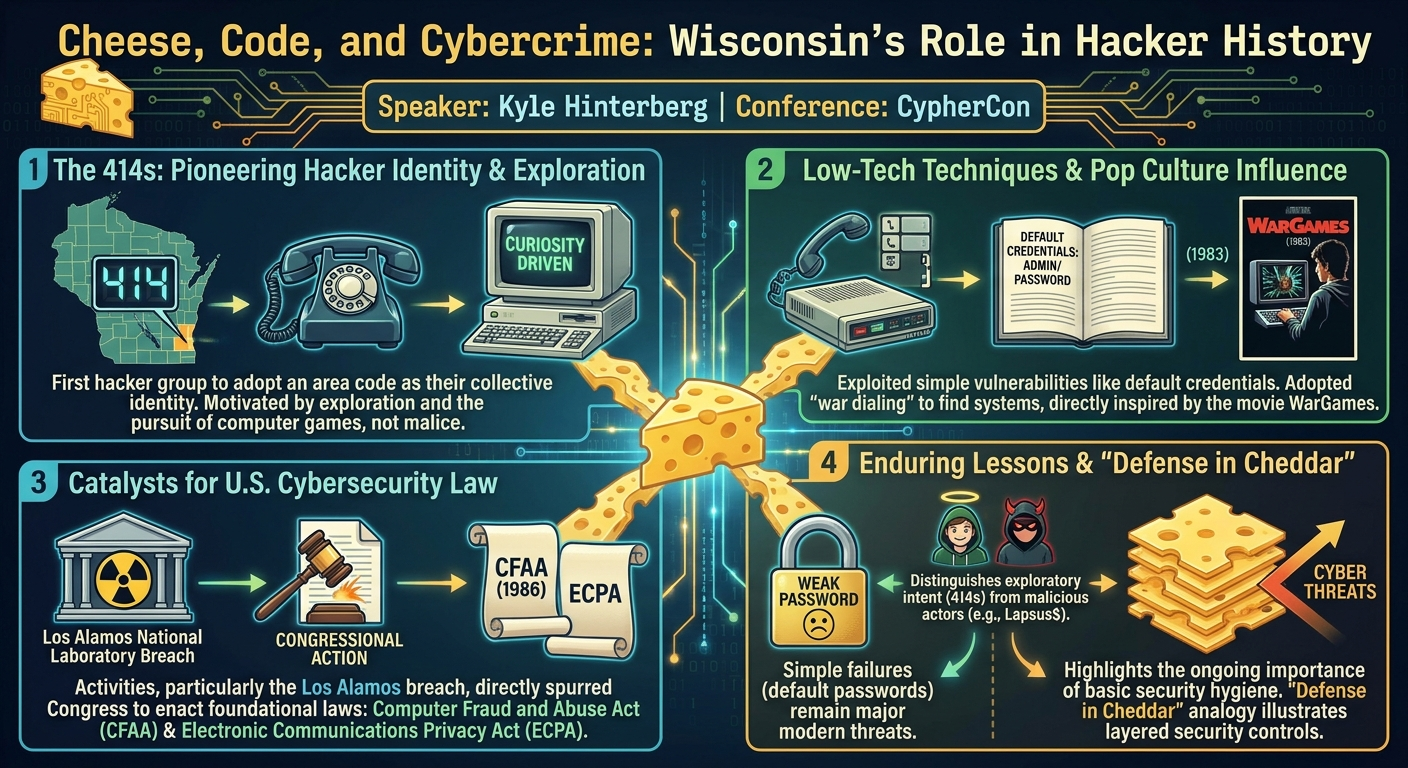
The talk's primary revelation was the foundational role of the 414s in hacker history and modern cybersecurity law. Hinterberg clarified that the 414s were, in fact, the original hacking group to adopt an area code (414 for Milwaukee) as their collective identity. This naming convention, born from observing gang graffiti based on street names, subsequently inspired numerous other hacking groups across the nation, such as the 303s, 513s, and 815s, establishing a lasting cultural precedent within the hacker community.
Their motivations were largely benign: driven by pure curiosity, a desire for exploration, and, most frequently, the simple goal of finding and playing computer games on remote systems. As one of the 414s, Tim Winslow (whom Hinterberg had the opportunity to interview), explained, their "hacking" often involved little more than discovering unreleased games or playing familiar ones on someone else's computer. Winslow adamantly stated that no one in the group ever intended to cause malicious harm.
Despite their innocent intentions, some incidents garnered significant media attention and legal fallout. The most notable events included:
- Accidental paper waste: One member inadvertently caused a Canadian company's printer to output "several reams of paper."
- Deletion of billing records: Another member accessed a hospital system and deleted billing records. Hinterberg clarified that this was not patient data, but rather administrative information, minimizing the perceived severity of the act.
- Los Alamos National Laboratory breach: Crucially, one of the 414s gained access to the Los Alamos National Laboratory, a nuclear weapons research facility. This particular breach, initially attributed by the FBI to an "unassociated hacker," was later confirmed to be the primary catalyst for federal intervention and the subsequent legal proceedings against the group.
The legal system at the time was ill-equipped to handle computer-related offenses. The three members over 18 years old could not be charged with specific computer crimes because such laws did not exist. Instead, they were charged with making fraudulent phone calls and sentenced to two years of probation. This legislative vacuum directly spurred Congress to action, leading to the rapid introduction of six crime bills. These bills eventually coalesced into two landmark pieces of legislation: the Computer Fraud and Abuse Act (CFAA) of 1986 and the Electronic Communications Privacy Act (ECPA). Thus, the actions of a handful of curious teenagers from Wisconsin directly laid the groundwork for modern U.S. cyber law, a legacy that continues to shape legal frameworks today.
Technical Deep Dive
▶ Watch: How the 414s formed and their non-malicious intent (12:50)
The technical exploits employed by the 414s were, by modern standards, remarkably unsophisticated, yet highly effective given the nascent state of computing security in the early 1980s. Their primary method of gaining unauthorized access hinged on two fundamental vulnerabilities: default credentials and war dialing.
Before the widespread adoption of the internet, computer systems were often accessed remotely via telephone lines using modems. The 414s extensively leveraged these phone lines. Their "hacking" often began with obtaining manuals, guides, or books for various computer systems. These resources frequently included the default usernames and passwords set by manufacturers for initial setup or administrative access. The group would then simply dial into systems and attempt to log in using these publicly known credentials. Hinterberg emphasized that "99% of what they were doing is they would get the manuals... and they would get the default credentials and go sign into the systems." This highlights a pervasive security oversight of the era: the assumption that default settings would be changed, or that the systems themselves were not attractive targets.
The influence of popular culture also played a direct role in their technical evolution. While the 414s were already exploring systems, the movie WarGames (1983) introduced them to the concept of war dialing. This technique involves systematically dialing a range of telephone numbers in search of modems, which would emit a characteristic "screech" when connected. Inspired by the film, the 414s "built dialers" – automated programs or devices – to perform this task efficiently. Once a modem was identified, they would attempt to connect and then try default credentials or other simple login attempts. This method allowed them to discover and access a multitude of systems, from academic networks to government facilities like Los Alamos.
It is crucial to understand that their techniques did not involve complex code injection, buffer overflows, or sophisticated network protocols, as these vulnerabilities and concepts were either unknown or not widely applicable to the systems they targeted. Instead, their success stemmed from exploiting human error (failure to change default passwords) and the inherent openness of early telecommunications infrastructure. The speaker noted that their activities were "a lot more like WarGames and less like the movie Hackers," underscoring the realism of the former in depicting early, low-tech exploitation. This historical perspective serves as a stark reminder that many significant breaches, even today, do not rely on zero-day exploits but rather on fundamental security hygiene failures.
Demo / Proof of Concept
▶ Watch: Speaker's passionate rant against banning VPNs in Wisconsin (27:00)
While the talk did not feature a live technical demonstration or proof of concept, Kyle Hinterberg did reference and play a brief trailer for a documentary video about the 414s. He strongly encouraged attendees to watch the full 11-12 minute short film, which was created around 2011 and provides an in-depth look at the group's activities and their broader impact. This documentary serves as a historical "proof of concept" in itself, visually and narratively documenting the exploits of the 414s and featuring interviews with some of the original members, including Tim Winslow. Hinterberg presented this video as essential viewing for anyone in Wisconsin's cybersecurity community, emphasizing its role in preserving and understanding their state's unique hacker history.
Defensive Implications
▶ Watch: Call to action: Join Wisconsin's vibrant cybersecurity community groups (29:00)
The historical account of the 414s, despite occurring decades ago, offers remarkably pertinent defensive implications for modern cybersecurity. Hinterberg highlighted the enduring relevance of the vulnerabilities exploited by the 414s, stating that "90% of the attacks you hear about, 90% of those hacks are still leveraging those same same things. Easy to guess passwords, social engineering." This underscores a critical, often overlooked, truth: many sophisticated breaches begin with simple, preventable failures like default credentials or weak passwords. Defenders must prioritize fundamental security hygiene, including robust password policies, multi-factor authentication, and regular auditing for default configurations, rather than solely focusing on advanced persistent threats.
The talk also introduced a humorous, yet insightful, "Cheese Model of Defense," suggesting "defense in cheddar" as an alternative to "defense in depth." While lighthearted, this analogy cleverly illustrates the concept of layering security controls, where each "slice" of cheese (or security layer) has holes, but when aligned correctly, they can collectively block threats. This reinforces the necessity of a holistic and layered security architecture.
Furthermore, Hinterberg drew a clear distinction between the 414s' exploratory intent and the malicious actions of modern groups like Lapsus$. While the 414s were driven by curiosity and lacked malicious intent, Lapsus$ (and similar groups) actively engage in ransomware, data deletion, and financial exploitation. This distinction emphasizes that while an "exploratory mindset" is valuable for discovering vulnerabilities, it must be coupled with strong ethical boundaries. Defenders should encourage ethical hacking and responsible disclosure while advocating for severe penalties for those who intentionally cause harm.
Finally, the speaker issued a call to action for the Wisconsin tech community to be more engaged and vocal. He cited the concerning attempt by Wisconsin and Michigan to ban VPNs as an example of legislative ignorance about technology. This incident underscores the critical need for cybersecurity professionals to educate policymakers and the public about the practical realities and legitimate uses of technology, preventing ill-informed regulations that could harm legitimate business and individual privacy. Hinterberg urged attendees to join local cybersecurity groups (like DC 608, MADS, ISACA, MilSec, Sector 67, InfraGard) to foster community, share knowledge, and collectively influence the state's technological future, ensuring Wisconsin remains a leader in technology and innovation.
Key Takeaways
- Wisconsin's Overlooked Hacker History: The state of Wisconsin played a foundational, yet largely forgotten, role in early hacker culture, primarily through the activities of the 414s in the early 1980s.
- Pioneers of Hacker Group Naming: The 414s were the first hacking group to adopt an area code as their identity, establishing a naming convention that influenced subsequent groups nationwide.
- Curiosity-Driven Exploitation: The 414s' "hacking" was largely motivated by curiosity, exploration, and the pursuit of computer games, primarily exploiting readily available default credentials and utilizing war dialing (inspired by the movie WarGames).
- Direct Impact on Cyber Law: The media attention and legal fallout from the 414s' activities, particularly the Los Alamos National Lab breach, directly led to the enactment of the Computer Fraud and Abuse Act (CFAA) and the Electronic Communications Privacy Act (ECPA), shaping modern U.S. cybersecurity legislation.
- Enduring Vulnerabilities: The simple techniques used by the 414s (default credentials, social engineering) remain highly effective, accounting for a significant percentage of modern cyberattacks, highlighting the ongoing importance of basic security hygiene.
- Ethical Exploration and Community Engagement: The talk advocates for maintaining an exploratory mindset within ethical boundaries, distinguishing between benign curiosity (414s) and malicious intent (Lapsus$), and encourages active participation in local cybersecurity communities to foster knowledge sharing and influence tech policy.
About the Speaker(s)
Kyle Hinterberg is a cybersecurity professional working for LBMC, based out of Nashville, though he works remotely. His primary area of expertise is PCI (Payment Card Industry) compliance, where he serves as a QSA (Qualified Security Assessor). Beyond his professional role, Kyle is the president of the Madison chapter of ISACA, an organization he actively seeks to grow with new members. He is also a passionate advocate for Wisconsin's role in technology and hacker history. A self-proclaimed dog lover, Kyle often shares anecdotes about his five dogs: Ace (11 years old), Oakley (10 years old), Artemis (3 years old), and her two puppies, Strider and Boddan (both 1 year old).
Reviews
Dr. Zero (Offensive Security Researcher) — SOLID
Milwaukee's 414s. Foundational lore. Hinterberg traces a direct line from 1980s war dialing to the birth of the CFAA. It's an entertaining history lesson tailor-made for a Wisconsin con, but ultimately amounts to a competent book report wrapped in dairy puns.
Heather Calloway (CISO) — SOLID
A historical retrospective on the Milwaukee 414s and their role in triggering the creation of the Computer Fraud and Abuse Act (CFAA). While an entertaining look at the birth of U.S. cyber law, it is primarily a regional history lesson rather than an operational briefing. It will not change your risk register today, but it is a sharp reminder of how reactive cyber legislation tends to be.