AI-Powered GRC: Leveraging Machine Learning for Risk Prediction and Compliance Automation
Kartik Khurana, Pranay Singh Suri
Overview
In an era where cyber threats evolve at unprecedented speeds, traditional Governance, Risk, and Compliance (GRC) frameworks are proving increasingly inadequate. This talk, delivered by Kartik Khurana and Pranay Singh Suri at CypherCon, critically examines the fundamental disconnect between the slow, reactive nature of conventional GRC and the dynamic, interconnected reality of modern digital ecosystems. The speakers argue that GRC, while effective in a simpler, slower world, is now "quietly breaking" under the pressure of AI-driven attacks, complex supply chains, and real-time threats.
Key moments
- 2:15 Traditional GRC breaks in AI speed era
- 5:00 Global cybercrime projected at $10.5 trillion
- 6:50 Reactive, manual, siloed, and overwhelmed by volume
- 9:30 AI redefines GRC: proactive detection before impact
- 13:50 Continuous monitoring, predictive analysis, automated compliance
- 22:00 Integration complexity, talent gap, data quality
- 25:45 Foundation, pilot, scale, and optimize your GRC
AI-Powered GRC: Leveraging Machine Learning for Risk Prediction and Compliance Automation
Speakers: Kartik Khurana, Lead, Customer Trust, Nvidia; Pranay Singh Suri, Associate Security Engineer, Coalfire
Conference: CypherCon
YouTube: https://www.youtube.com/watch?v=-BR92iWIxxk
Overview
In an era where cyber threats evolve at unprecedented speeds, traditional Governance, Risk, and Compliance (GRC) frameworks are proving increasingly inadequate. This talk, delivered by Kartik Khurana and Pranay Singh Suri at CypherCon, critically examines the fundamental disconnect between the slow, reactive nature of conventional GRC and the dynamic, interconnected reality of modern digital ecosystems. The speakers argue that GRC, while effective in a simpler, slower world, is now "quietly breaking" under the pressure of AI-driven attacks, complex supply chains, and real-time threats.
The core premise of the presentation is that artificial intelligence (AI) and machine learning (ML) offer a transformative solution to this challenge. Rather than merely speeding up existing GRC processes, AI redefines how risk is detected, analyzed, and managed, shifting organizations from a reactive posture to one of continuous, proactive intelligence. This article delves into the structural problems of traditional GRC, explores the specific capabilities and benefits of an AI-powered approach, dissects the technical implementation challenges, and outlines a strategic roadmap for organizations to responsibly adopt these advanced methodologies.
Background
▶ Watch: Traditional GRC breaks in AI speed era (2:15)
Traditional GRC, characterized by spreadsheets, checklists, periodic reviews, and scheduled audits, was designed for a world where risks were contained, predictable, and could be evaluated at fixed intervals. Five years ago, a breach was an incident to be investigated after it happened, allowing time for tracing, understanding, and controlled responses. Risks were isolated, often staying within a single system or boundary. This model, while effective for its time, no longer holds true.
Today's threat landscape is fundamentally different. A single vulnerability can propagate across an entire digital ecosystem—including vendors, APIs, and cloud environments—in minutes, transforming what was once an isolated incident into a rapid chain reaction. Risk is no longer static; it is continuous, dynamic, and amplified by deep interconnections. The speakers highlight staggering statistics: global cybercrime is projected to reach $10.5 trillion, making it the third-largest economy globally if measured as a country. The average cost of a data breach now hovers around $5 million per incident, encompassing not just technical recovery but also downtime, lost business, regulatory penalties, and long-term reputational damage. This isn't a temporary spike but a structural shift in the threat environment.
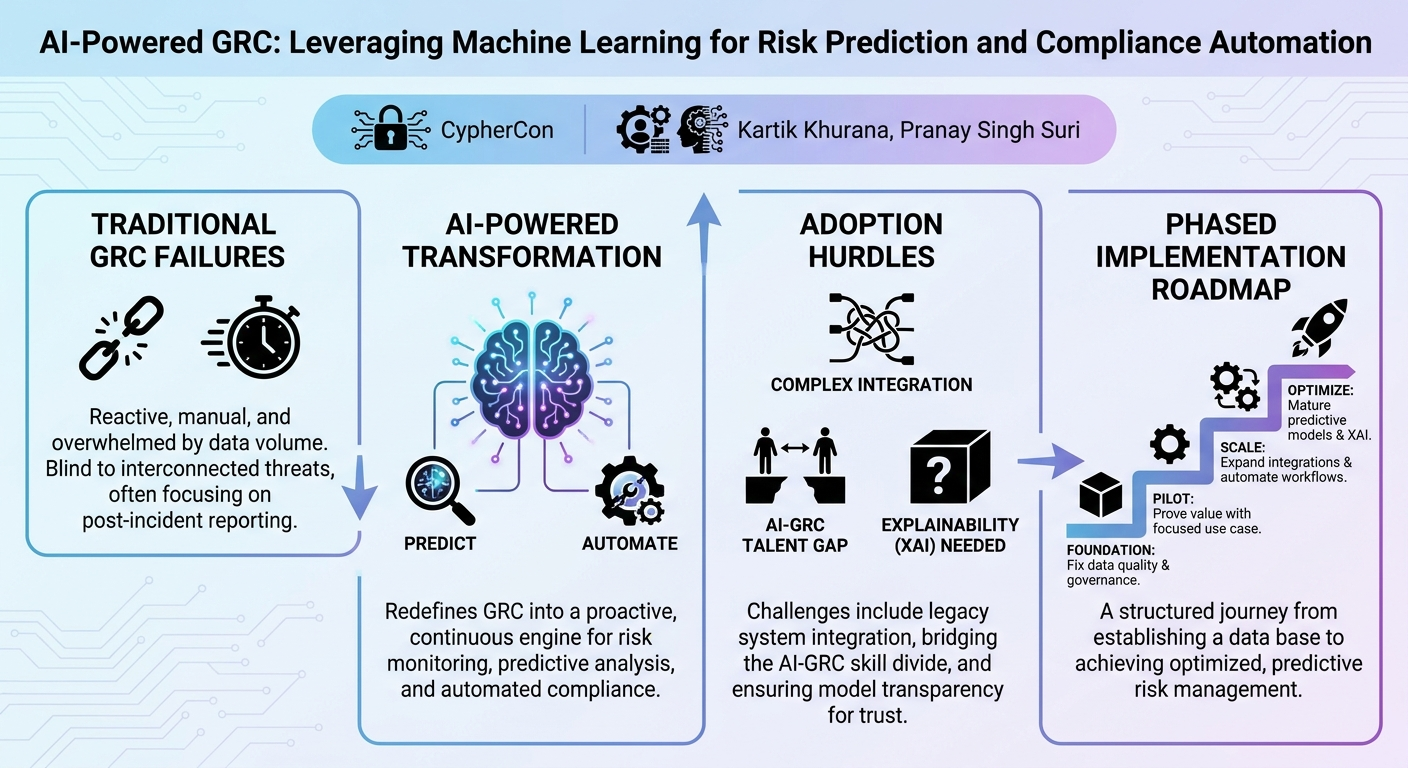
The speakers identify four critical areas where traditional GRC fails:
- Reactive by Design: It identifies risk after an incident, focusing on investigation and reporting rather than anticipation, leaving organizations constantly playing catch-up.
- Manual and Siloed: Reliance on spreadsheets, disconnected audits, and fragmented reporting systems prevents a unified, real-time picture of risk, leading to incomplete or delayed decisions.
- Overwhelmed by Volume: The exponential growth of data—logs, transactions, user activity, third-party signals—surpasses human capacity for review, turning GRC into a data management exercise rather than a risk management function.
- Blind to Interconnection: Traditional GRC struggles to map how risks propagate across interconnected systems, vendors, and platforms, often missing the amplified impact of combined vulnerabilities. This isn't just a tooling issue; it's a foundational problem that necessitates a radical rethinking of GRC.
Key Findings
▶ Watch: Reactive, manual, siloed, and overwhelmed by volume (6:50)
The central finding of the talk is that AI doesn't just speed up GRC; it fundamentally redefines it, transforming it from a reactive, reporting function into a proactive, decision-making engine. Machine learning pipelines are capable of continuously ingesting and analyzing vast quantities of real-time data from diverse sources—including user activities, system logs, transactions, and events—regardless of whether the data is structured or unstructured.
This continuous analysis allows AI to identify not just known risks but also subtle patterns, unusual behaviors, and anomalies that human analysts might miss due to scale or fatigue. Crucially, the system can assign risk scores and predict what could go wrong before an incident occurs, forecasting its potential severity, replication speed, and impact across systems. This capability shifts the focus from asking "What went wrong?" to "What is about to go wrong?"
Beyond mere detection, AI-powered GRC extends to proactive measures:
- Triggering alerts for high-risk activities.
- Flagging potential vulnerabilities or non-compliance.
- Blocking certain actions when given appropriate rights and access.
- Automating the logging of all activities for comprehensive compliance and audit trails, ensuring data is readily available without manual scrambling.
The speakers distilled the capabilities of AI-powered GRC into six core pillars:
- Continuous Risk Monitoring: Moving beyond periodic audits (e.g., yearly HITRUST or SOC 2), AI provides always-on surveillance across all users, systems, and environments, catching issues as they emerge.
- Predictive Analysis: Leveraging historical data, trends, and user behavior patterns, AI forecasts where and how severe risks might appear, enabling preemptive mitigation.
- Automated Compliance: AI tracks controls, generates reports, and maintains audit trails, significantly reducing manual workload and the potential for human error in frameworks like CCF (Common Controls Framework) with its hundreds of controls.
- Regulatory Awareness and Changes: The system can track evolving policies and regulations, flagging non-compliance instantly, such as a missed Multi-Factor Authentication (MFA) requirement in a security policy.
- Third-Party Risk Management (TPRM): Instead of one-off assessments, AI enables continuous monitoring of vendors, suppliers, and partners, integrating them into the organization's live risk environment.
- Built for GRC: The entire system is interconnected, where detection insights feed predictions, predictions drive automated actions, and actions, in turn, support compliance, creating a virtuous cycle of risk management.
Technical Deep Dive
▶ Watch: AI redefines GRC: proactive detection before impact (9:30)
The technical underpinnings of AI-powered GRC lie in its ability to ingest, process, and analyze vast, disparate datasets in real-time. The core component is a machine learning pipeline designed to pull continuous data streams from various organizational sources. This includes:
- User activity logs: Tracking access patterns, unusual login locations, or privilege escalations.
- System event logs: Monitoring infrastructure changes, software installations, or configuration drifts.
- Transaction records: Analyzing financial flows, data transfers, or API calls.
- Structured and unstructured data: Processing everything from database entries to free-text security reports.
Once ingested, the data undergoes sophisticated analysis. ML algorithms, including supervised and unsupervised learning models, are employed for:
- Pattern Recognition: Identifying deviations from established baselines or known attack signatures.
- Anomaly Detection: Pinpointing unusual behaviors that might signal a novel threat or internal misuse, such as an employee accessing sensitive data outside their typical working hours or from an unfamiliar location.
- Risk Scoring: Assigning a dynamic risk score to entities (users, systems, third parties) or events based on multiple factors, including severity, likelihood, and potential impact.
The output of these ML models is not just raw data but actionable intelligence. This intelligence drives automated responses:
- Real-time alerts: Notifying security teams of critical events.
- Automated flagging: Highlighting suspicious activities for immediate human review.
- Policy enforcement: Potentially blocking unauthorized actions or isolating compromised systems, given appropriate permissions.
- Audit trail generation: Automatically documenting every step for regulatory compliance, a critical feature for satisfying auditors who demand detailed explanations.
The talk highlighted several powerful use cases demonstrating the practical application of this technology:
- Financial Services: AI can predict loan defaults by analyzing transaction histories, spending patterns, and broader market signals, leading to better lending decisions and reduced losses. This shifts the focus from recovering lost money to preventing losses altogether.
- Healthcare: Given the stringent regulations like HIPAA and HiTRUST, AI continuously monitors access to patient data. Any unusual activity—such as unauthorized access attempts or data exfiltration—is immediately flagged, enabling real-time action to prevent breaches and avoid hefty regulatory fines.
- Fraud Detection: Across various industries, AI can scan immense volumes of transactions spanning users, devices, and locations to uncover subtle fraud patterns that are impossible for humans to detect. What might take months for human analysts can be identified in minutes or hours by an AI system operating at scale.
Despite the clear benefits, significant challenges hinder widespread adoption:
- Integration Complexity: Legacy GRC tools often operate in silos, lacking modern APIs or connectors for real-time data exchange. Integrating these disparate systems with an AI pipeline requires substantial effort and custom development.
- Talent Gap: A critical shortage exists of professionals proficient in both AI/ML engineering and GRC principles. Approximately 50% of organizations lack individuals who can bridge this domain knowledge gap, slowing down implementation.
- Data Quality: AI models are only as good as the data they consume. Incomplete, inconsistent, or poorly governed data can lead to "quiet failures," where the model produces inaccurate results without immediate flags, potentially poisoning the entire risk assessment process.
- Explainability and Governance: Auditors and regulators demand clear explanations for why a risk was flagged or why a specific action was taken. Current AI models, particularly complex deep learning networks, can often act as "black boxes." The lack of robust Explainable AI (XAI) capabilities creates a trust deficit and makes it difficult to justify AI-driven decisions to oversight bodies. These are not merely technical hurdles but fundamental organizational challenges requiring strategic investment and cultural shifts.
Demo / Proof of Concept
▶ Watch: Integration complexity, talent gap, data quality (22:00)
The talk focused on the conceptual framework, capabilities, and strategic implications of AI-powered GRC. While the speakers provided compelling use cases and outlined the technical mechanisms, a specific live demonstration or proof-of-concept of an AI-powered GRC system was not presented or described in the transcript.
Defensive Implications
▶ Watch: Foundation, pilot, scale, and optimize your GRC (25:45)
The shift to AI-powered GRC demands a fundamental reorientation of defensive strategies. Organizations must transition from a reactive, compliance-driven mindset to a proactive, intelligence-led approach. Key defensive implications include:
- Prioritize Data Foundation and Governance: Before deploying AI, organizations must invest heavily in data quality, consistency, and governance. This involves centralizing log data, standardizing formats, and ensuring data integrity across all systems. Without clean, reliable data, AI models will be ineffective or, worse, provide misleading insights.
- Foster a Hybrid Skillset: Security teams need to cultivate or recruit talent with a dual understanding of both GRC principles and AI/ML methodologies. This involves training existing GRC professionals in data science fundamentals and educating AI engineers on regulatory requirements and risk frameworks.
- Embrace Continuous Monitoring: Move away from periodic audits and adopt always-on continuous risk monitoring. This requires integrating AI pipelines into security operations to constantly analyze user behavior, system configurations, and third-party interactions for emerging threats.
- Implement Predictive Analysis: Leverage AI to forecast potential risks, allowing defenders to allocate resources proactively to mitigate vulnerabilities before they are exploited. This includes predicting the likelihood of a breach, its potential spread, and its impact.
- Demand Explainable AI (XAI) Capabilities: When adopting AI solutions, organizations should prioritize those offering Explainable AI (XAI) features. This is crucial for auditability, trust-building with regulators and leadership, and for security analysts to understand why an AI flagged a particular risk, enabling more effective investigation and response.
- Automate Compliance and Third-Party Risk: Use AI to automate the tracking of compliance controls, generate audit trails, and provide continuous oversight of third-party vendors. This not only reduces manual effort but also significantly improves accuracy and real-time visibility into supply chain risks.
- Adopt a Phased Implementation Strategy: The speakers recommend a four-phase journey rather than a "big bang" approach:
- Foundation: Fix data quality, define governance, and identify a low-risk pilot area.
- Pilot: Prove value with a focused use case (e.g., risk scoring, compliance monitoring) to track measurable outcomes like accuracy and efficiency.
- Scale: Expand beyond the initial use case, integrate AI with existing GRC systems, and automate workflows.
- Optimize: Mature the system with advanced predictive analysis, explainability, and continuous model improvement, making AI an integral part of GRC operations.
By embracing these defensive implications, organizations can transform GRC from a burdensome compliance function into a strategic asset that provides real-time, proactive intelligence against an ever-accelerating threat landscape.
Key Takeaways
- Traditional GRC models are obsolete in today's interconnected, AI-speed threat landscape, struggling with reactive processes, manual operations, data volume, and blind spots to systemic interconnections.
- AI and machine learning fundamentally redefine GRC by enabling continuous risk monitoring, predictive analysis, and automated compliance, shifting organizations from a reactive posture to proactive, real-time intelligence.
- AI-powered GRC can identify subtle patterns and anomalies in vast datasets, forecasting risks before they occur and automating actions like alerts, flagging, and even blocking to prevent incidents.
- Significant challenges to AI adoption in GRC include complex integration with legacy systems, a critical talent gap spanning AI and GRC expertise, the necessity for high-quality data, and the demand for Explainable AI (XAI) to build trust and meet regulatory requirements.
- Organizations should implement AI-powered GRC through a phased approach: establishing a strong data foundation, conducting focused pilot projects, scaling successful use cases, and continuously optimizing for predictive capabilities and explainability.
- The integration of AI into GRC is no longer a question of "if," but "how quickly" organizations can adapt and responsibly build the necessary foundations to leverage its transformative potential.
About the Speaker(s)
Pranay Singh Suri (Prane) is an Associate Security Engineer at Coalfire. His expertise lies in security engineering, likely focusing on implementing and managing security systems and processes within organizations.
Kartik Khurana leads Customer Trust for Nvidia. In this role, he is responsible for ensuring the security, privacy, and reliability of Nvidia's products and services from a customer perspective, likely involving a deep understanding of governance, risk, and compliance frameworks.
Reviews
Dr. Zero (Offensive Security Researcher) — HARD PASS
Kartik and Pranay delivered a 45-minute LinkedIn post, not a conference talk. Stringing together 'AI' and 'continuous risk monitoring' without showing a single model architecture, false-positive rate, or live demo isn't research—it's buzzword bingo. If you've walked an RSA vendor floor in the last five years, you have already heard this exact pitch.
Heather Calloway (CISO) — WEAK
A conceptual pitch that accurately diagnoses the failures of traditional GRC but offers machine learning as a magic wand rather than an engineered reality. Without a proof of concept or implementation roadmap, this is a consulting deck, not a strategy you can execute.