The Cold War Goes Online
Kayne Whitney
Overview
In "The Cold War Goes Online," Kayne Whitney masterfully connects the geopolitical tensions of the Cold War with the nascent stages of internet expansion and the dawn of digital espionage. Delivered at CypherCon, this talk provides a unique historical perspective, demonstrating how the intense rivalry between the United States and the Soviet Union inadvertently fueled revolutionary technological advancements that laid the groundwork for modern computing and networking, while simultaneously giving birth to sophisticated forms of cyber warfare. Whitney, with a background deeply rooted in history and cybersecurity, synthesizes these complex threads into a compelling narrative.
Key moments
- 2:10 Cold War, internet, and digital espionage overview
- 5:10 Cuban Missile Crisis drives ARPANET's resilient communication goal
- 11:20 The Soviet typewriter bug: first keylogger in an embassy
- 16:00 Chaos Computer Club founded: political hacking as activism
- 16:50 Markus Hess: The first documented case of cyber espionage
- 20:00 Aldrich Ames: Insider threat leverages classified computer access
- 22:30 Early hacking cases were signs of a larger invisible conflict
- 23:10 Q&A: Why Aldrich Ames became a spy for the Soviets
The Cold War Goes Online
Speakers: Kayne Whitney
Conference: CypherCon
YouTube: https://www.youtube.com/watch?v=HsG3cVvNKQ0
Overview
In "The Cold War Goes Online," Kayne Whitney masterfully connects the geopolitical tensions of the Cold War with the nascent stages of internet expansion and the dawn of digital espionage. Delivered at CypherCon, this talk provides a unique historical perspective, demonstrating how the intense rivalry between the United States and the Soviet Union inadvertently fueled revolutionary technological advancements that laid the groundwork for modern computing and networking, while simultaneously giving birth to sophisticated forms of cyber warfare. Whitney, with a background deeply rooted in history and cybersecurity, synthesizes these complex threads into a compelling narrative.
The presentation delves into critical moments from the 1960s to the late 1980s, tracing the evolution of computing from a military logistical tool to a global communication backbone. It highlights how the inherent "trust" model of early networks, coupled with escalating international espionage, created fertile ground for the first documented incidents of cyber espionage. This talk is crucial for understanding the historical roots of today's cybersecurity challenges, illustrating that the fundamental vulnerabilities and adversarial tactics we grapple with now have origins stretching back decades, shaped by a world on the brink of nuclear conflict.
Whitney’s talk is not merely a historical recounting; it serves as a foundational lesson for contemporary cybersecurity professionals. By examining the rudimentary yet ingenious methods of early digital spies, the audience gains insight into how geopolitical motives have always driven the exploitation of technology. It underscores the enduring relevance of concepts like insider threats, supply chain compromise, and the critical need for robust security architectures, even when systems are perceived as isolated or inherently secure.
Background
▶ Watch: Cold War, internet, and digital espionage overview (2:10)
The Cold War, defined as a period of intense international geopolitical rivalry between the United States and the Soviet Union from 1947 to 1991, set the stage for unprecedented technological competition. Following World War II, the initial cooperation between the Allied powers quickly dissolved, primarily due to the Truman Doctrine of 1947, which committed the US to containing the spread of communism. Germany became the immediate focal point, divided into Western (NATO-aligned, capitalist) and Eastern (Soviet-aligned) sectors, a division that would last 45 years and embody the core conflict.
The technological arms race intensified dramatically in 1961 when the Soviets successfully put a man into space. This achievement profoundly shook the United States, prompting a realization that it might be lagging in the technological realm and necessitating a massive allocation of resources into research and development. This period also saw the practical demonstration of packet switching technology, a theoretical concept until 1961, which would become fundamental to modern network communication. The Cuban Missile Crisis in 1962, bringing the world to the brink of nuclear war, served as a stark wake-up call for the US regarding the fragility of its centralized communication systems. This crisis underscored the urgent need for resilient, distributed communication infrastructure that could withstand a nuclear attack without collapsing the nation's ability to coordinate.
In this climate of urgency, JCR Licklider, working with DARPA (Defense Advanced Research Projects Agency) from the Pentagon, began championing his vision of a "galactic network" in 1963. Licklider envisioned a global network of interconnected computers accessible from anywhere, a concept that seemed like science fiction at the time but gained traction within DARPA. By 1966, this vision began to materialize with the greenlighting of ARPANET, a project initially conceived to connect computers across universities and military research sites. This initiative aimed to bridge the academic and military worlds, fostering rapid technological production. Concurrently, the Vietnam War became one of the first conflicts where computers played a significant battlefield role, with IBM mainframes processing logistics, tracking troop movements, and analyzing bombing data via systems like Autodin, an automated digital network for military messaging. This period served as a crucial testing ground for computer-assisted warfare, demonstrating the tangible benefits of digital technology in military operations and further cementing the need for advanced networking capabilities.
Key Findings
▶ Watch: The Soviet typewriter bug: first keylogger in an embassy (11:20)
Kayne Whitney’s talk reveals several key findings that fundamentally reshape our understanding of early digital security and espionage:
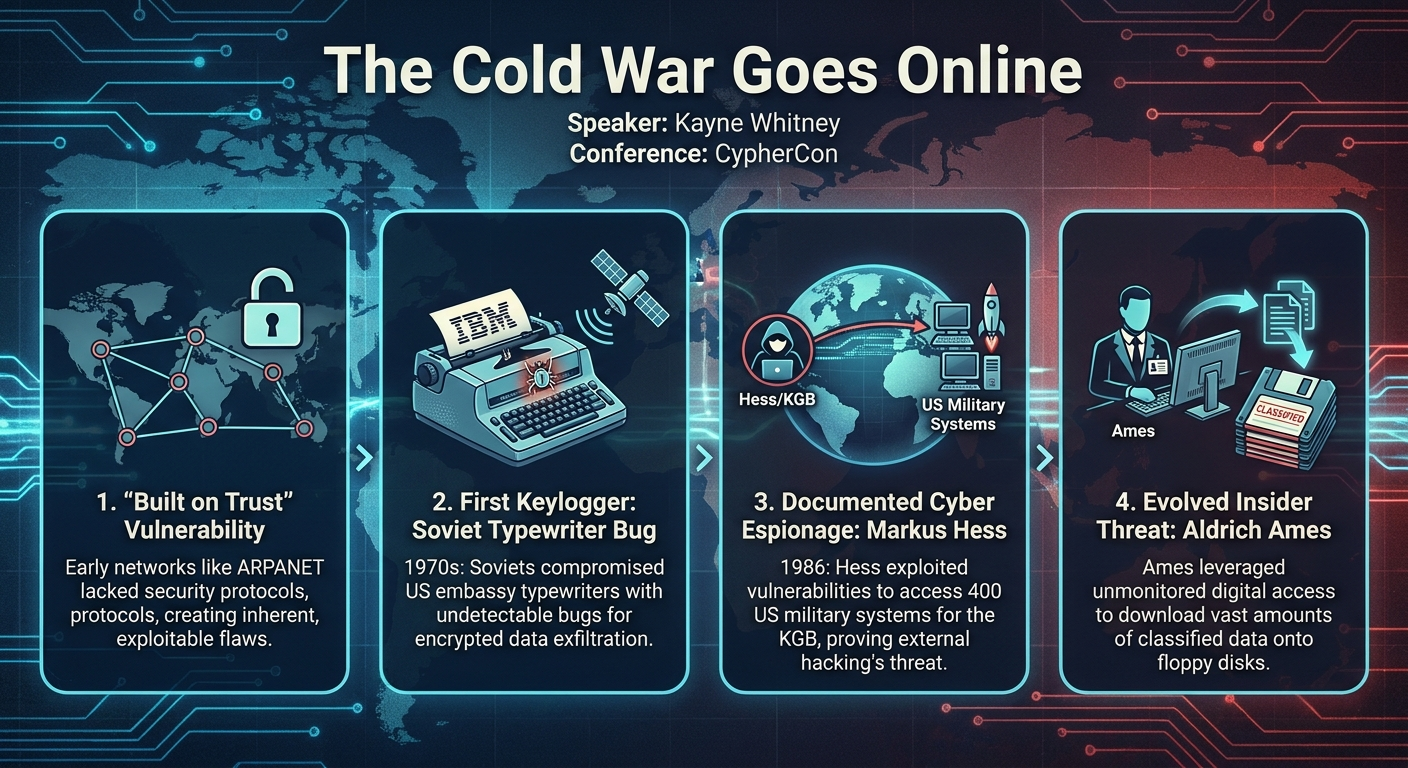
First, the ARPANET, the precursor to the internet, was initially "built on trust" with minimal security protocols. This design choice, made during its small-scale inception in 1969, created inherent vulnerabilities that would later be exploited, laying the groundwork for future computer hacking and espionage. The assumption that a closed network of universities and military sites wouldn't be targeted proved to be a critical oversight.
Second, the talk exposes the Soviet typewriter bug as the world's first documented keylogger, demonstrating an extraordinary level of technical sophistication in the 1970s. This incident, involving compromised IBM Selectric typewriters in a US embassy, proved that adversaries were capable of covert hardware modification and encrypted data exfiltration decades before the term "cybersecurity" was common.
Third, the case of Markus Hess in 1986 is presented as the first documented case of cyber espionage in history. This incident marked a pivotal shift, proving that hacking could be a tool for foreign intelligence services, not just for experimental or recreational purposes. Hess's intrusion into 400 US military computers, motivated by financial gain from the KGB, underscored the immediate and tangible threat posed by network vulnerabilities.
Finally, the talk highlights the Aldrich Ames case as a seminal example of an insider threat leveraging digital systems. Ames's ability to download classified information onto floppy disks from secure networks, undetected for years, illustrated how digital access fundamentally altered the nature of espionage. This case directly led to significant advancements in user behavior monitoring and access control policies, shaping modern digital security practices. These findings collectively demonstrate that the roots of contemporary cyber warfare are deeply intertwined with Cold War-era geopolitical tensions and technological advancements.
Technical Deep Dive
▶ Watch: Markus Hess: The first documented case of cyber espionage (16:50)
The technical core of Whitney's presentation revolves around the evolution of networking and the ingenious, albeit rudimentary, methods of early digital espionage. The ARPANET, initiated in the late 1960s, was the foundational piece. Its architecture comprised Interface Message Processors (IMPs), which functioned as the ancestors of modern routers. These IMPs connected university computers, routing data packets across the network. Crucially, the initial ARPANET was "built on trust," designed for a small, closed community of researchers and military personnel. This meant security was not a primary consideration, a decision that would have profound implications.
The invention of email by Ray Tomlinson in 1971 dramatically shifted ARPANET's utility. Previously, messages could only be sent locally on the same computer. Tomlinson's innovation allowed messages to traverse the network between different computers, transforming ARPANET from a mere resource-sharing network into a vital communication platform. This expansion of functionality also expanded its potential attack surface and the value of information transmitted across it.
One of the most striking technical revelations is the Soviet typewriter bug from the 1970s, which Whitney identifies as the world's first keylogger. In Moscow, the Soviets compromised IBM Selectric typewriters within a US embassy. The technical sophistication was remarkable: tiny, precise modifications were buried deep inside the typewriters, undetectable by the naked eye. These implants utilized magnometers to detect the unique X and Y positions of the internal bars that correlated to each key press. The signal from these magnometers was then sent to a small chip inside the typewriter, which broadcast the data. To avoid detection, the Soviets did not add external antennas; instead, they repurposed existing screws and springs within the typewriter to act as discrete antennas. The exfiltrated data was then encrypted and sent on the same frequency as 24-hour Soviet TV broadcasts, making the signal appear as mere background noise and incredibly difficult to identify amidst legitimate transmissions. This covert operation demonstrated an unparalleled level of embedded hardware compromise and signal intelligence for its time.
By the 1980s, the ARPANET had grown exponentially, becoming a coast-to-coast network with satellite connections extending to London. This era also saw the rise of personal computers (like the Apple II) and a burgeoning hacking subculture in the US. In contrast, Soviet computing was state-controlled, relying heavily on reverse-engineered American hardware and software, typically a model behind. This technological disparity, combined with Germany's status as the most active espionage environment on the planet, set the stage for the Markus Hess case in 1986.
Hess, a member of Germany's Chaos Computer Club (CCC), exploited a vulnerability in GNU Emacs to gain root privileges on a computer at the Lawrence Berkeley National Laboratory. This gave him complete control over the system. Crucially, Hess used the Berkeley system as a jump box, leveraging it to pivot and access approximately 400 US military computers across the country. His targets included sensitive information on semiconductors, satellites, spacecraft, and aircraft. The discovery of this intrusion was initiated by astronomer Clifford Stoll, who noticed a mere 75-cent accounting discrepancy. Stoll then employed an early form of intrusion detection by hooking a teleprinter to a phone line to record the hacker's actions. To confirm the espionage, Stoll created a fake department, "SDIET," filled with fabricated military jargon related to the Strategic Defense Initiative. When Hess eagerly downloaded these enticing, yet false, files for hours, it provided law enforcement with enough time to trace the connection back to Hanover, West Germany, leading to Hess's arrest. This incident unequivocally proved the viability of external network intrusion for state-sponsored espionage.
The talk also details the Aldrich Ames case, highlighting a significant shift in insider threat tactics. Ames, a 31-year CIA veteran, became a spy for the Soviets in 1985. In the pre-digital era, such an agent would have had to physically photograph or steal documents. However, Ames operated in a new era where he had direct access to classified networks. He could download vast amounts of sensitive information onto floppy disks, bypassing traditional physical security measures. The critical technical detail here was the complete absence of user behavior monitoring or tracking of what he accessed or downloaded. Ames simply stuffed the disks into bags and left them at dead drops, exchanging intelligence for over $2 million. This case underscored that the computer not only changed how outsiders could attack but fundamentally altered the capabilities and detection challenges associated with insider threats.
These incidents, ranging from hardware-level keyloggers to network exploitation and digital insider espionage, showcase the rapid evolution of technical capabilities and the continuous adaptation of adversaries during a period when the very concept of digital security was in its infancy.
Demo / Proof of Concept
▶ Watch: Aldrich Ames: Insider threat leverages classified computer access (20:00)
This talk was primarily a historical analysis, meticulously detailing past events and their technical underpinnings, rather than featuring a live technical demonstration or proof of concept performed by the speaker. However, the incidents discussed—the Soviet typewriter bug, the Markus Hess hack, and the Aldrich Ames case—served as real-world, high-stakes proofs of concept for early digital espionage techniques, demonstrating their efficacy and impact in a geopolitical context. The detailed explanation of these historical events effectively illustrated how these early cyber-attacks functioned and the novel methods employed by adversaries.
Defensive Implications
▶ Watch: Q&A: Why Aldrich Ames became a spy for the Soviets (23:10)
The historical incidents detailed in "The Cold War Goes Online" offer profound and enduring defensive implications for contemporary cybersecurity. The initial "built on trust" model of ARPANET serves as a stark reminder of the dangers of assuming inherent security in any network, especially as it scales or connects to external entities. This underscores the modern necessity of zero-trust architectures, where no user, device, or application is inherently trusted, regardless of its location or previous authentication.
The sophisticated Soviet typewriter bug highlights the critical importance of supply chain security. If adversaries can compromise hardware at the manufacturing or distribution stage with undetectable modifications, traditional perimeter defenses are rendered useless. Defenders must consider the integrity of every component, from firmware to physical devices, and implement robust hardware and software verification processes. The use of repurposed screws as antennas also illustrates the "living off the land" technique, where attackers leverage existing components to blend in, making detection far more challenging. This necessitates comprehensive tamper detection and physical security measures for sensitive equipment.
Clifford Stoll's discovery of the Markus Hess hack, triggered by a mere 75-cent accounting error, emphasizes the power of anomaly detection and meticulous auditing. Even minor discrepancies can indicate significant compromises. Modern security operations centers (SOCs) must prioritize robust logging, monitoring, and Security Information and Event Management (SIEM) systems to identify unusual behavior, however subtle. The use of Berkeley as a jump box also highlights the need for network segmentation and least privilege principles, limiting lateral movement once an initial compromise occurs. If Berkeley had been isolated from military networks, the breach's scope would have been significantly contained.
The Aldrich Ames case is a seminal lesson in insider threat mitigation. Ames's ability to download classified information onto floppy disks, undetected for years due to a lack of monitoring, directly informed the development of modern security policies. This case underscores the necessity of:
- User Behavior Analytics (UBA): Continuously monitoring user activities for deviations from normal patterns.
- Need-to-Know Access Controls: Restricting access to sensitive information only to those who absolutely require it for their job functions.
- Data Loss Prevention (DLP): Implementing technologies and policies to prevent sensitive data from leaving controlled environments, whether via physical media or network transfers.
- Continuous Auditing and Logging: Tracking all data access, downloads, and transfers, especially for users with elevated privileges.
- Separation of Duties: Ensuring that no single individual has complete control over critical systems or sensitive data.
Finally, the talk's overall message—that many successful Cold War intrusions were likely classified and remain unknown—serves as a cautionary tale. It implies that what we know about cyber threats is often just the "tip of the iceberg." This necessitates a proactive, threat-hunting mindset, assuming compromise and actively searching for hidden adversaries rather than solely relying on reactive defenses. The enduring lessons from these early digital conflicts reinforce that the fundamental challenges of securing information and systems against determined adversaries are deeply rooted in human nature and geopolitical realities, requiring constant vigilance and adaptive security strategies.
Key Takeaways
- The intense geopolitical rivalry of the Cold War significantly accelerated technological innovation, leading directly to the development of the internet and modern computing.
- Early networks like ARPANET were designed with a "built on trust" model, creating inherent vulnerabilities that were quickly exploited by sophisticated adversaries.
- The Soviet typewriter bug represents the first documented keylogger, showcasing advanced hardware compromise, covert data exfiltration, and encrypted communication decades ago.
- The Markus Hess case is recognized as the first documented instance of cyber espionage, demonstrating how network vulnerabilities could be leveraged by foreign intelligence services for strategic data theft.
- The Aldrich Ames incident revolutionized the understanding of insider threats, highlighting how digital access fundamentally changed methods of espionage and necessitated new security controls like user behavior monitoring.
- Many successful digital espionage operations during the Cold War likely remain classified, underscoring that known incidents are merely the visible signs of a much larger, ongoing, and often invisible conflict.
About the Speaker(s)
Kayne Whitney is a cybersecurity enthusiast with a strong academic background, holding an associate's degree in cybersecurity from Madison College and currently completing a bachelor's degree in the same field. He is passionate about staying active, competing in cyber competitions, and has a keen interest in history. His talk, "The Cold War Goes Online," is a direct reflection of his diverse passions, combining his historical knowledge with his expertise in cybersecurity to shed light on the origins of digital espionage.
Reviews
Dr. Zero (Offensive Security Researcher) — WEAK
This is an undergraduate book report on events every senior practitioner already knows. If you've never read The Cuckoo's Egg or visited the NSA Cryptologic Museum, it's a cute recap, but for anyone actually operating in this industry, it's a waste of a slot.
Heather Calloway (CISO) — SOLID
This is a clean synthesis of the origins of state-sponsored cyber espionage, detailing cases like Aldrich Ames and the Soviet Selectric bugs. It is not worth a senior leadership team's time, as experienced CISOs already know this history. However, it serves as excellent foundational context for junior analysts learning the roots of modern threat models.