WTF is going on with CVE?
Josh Bressers
Overview
Josh Bressers' CypherCon talk, "WTF is going on with CVE?", delivers a candid and critical assessment of the current state and future challenges facing the Common Vulnerabilities and Exposures (CVE) program. Bressers, a seasoned veteran in vulnerability management and host of the Open Source Security Podcast, pulls no punches in detailing what he describes as a "dumpster fire" of exponential growth, opaque funding, and a profound lack of accountability that has eroded trust in this foundational cybersecurity initiative. The talk serves as a stark warning to anyone relying on CVEs for vulnerability intelligence, highlighting systemic issues that threaten the program's efficacy and relevance.
Key moments
- 4:00 CVE program's funding crisis and lack of transparency
- 6:00 The confusing CVE, NVD, and CISA ecosystem
- 8:00 NVD halts enrichment and CVE's near funding loss
- 9:30 Analyzing the exponential growth of CVEs over time
- 12:00 GitHub and CNAs driving exploding CVE numbers
- 14:00 CVE program's lost trust and emerging alternatives like GCVE
- 18:00 LLMs dramatically increasing vulnerability discovery rates
- 24:20 Q&A: Drivers of exponential vulnerability growth
WTF is going on with CVE?
Speakers: Josh Bressers
Conference: CypherCon
YouTube: https://www.youtube.com/watch?v=JAyBg9Hjekc
Overview
Josh Bressers' CypherCon talk, "WTF is going on with CVE?", delivers a candid and critical assessment of the current state and future challenges facing the Common Vulnerabilities and Exposures (CVE) program. Bressers, a seasoned veteran in vulnerability management and host of the Open Source Security Podcast, pulls no punches in detailing what he describes as a "dumpster fire" of exponential growth, opaque funding, and a profound lack of accountability that has eroded trust in this foundational cybersecurity initiative. The talk serves as a stark warning to anyone relying on CVEs for vulnerability intelligence, highlighting systemic issues that threaten the program's efficacy and relevance.
The core of Bressers' argument is that the CVE program, designed in 1999, is fundamentally unprepared for the scale and complexity of today's threat landscape. He meticulously outlines how the program's manual processes and outdated data standards are buckling under an unprecedented surge in reported vulnerabilities, exacerbated by the rise of new vulnerability reporting mechanisms and the startling efficiency of AI in bug discovery. This talk is crucial for security professionals, developers, and organizations seeking to understand the shifting landscape of vulnerability disclosure and to identify more reliable sources of intelligence in an increasingly fractured ecosystem.
Beyond merely diagnosing the problems, Bressers explores the emerging alternatives and offers insights into what a more robust vulnerability reporting system might look like. He champions projects like the Global Common Vulnerabilities and Exposures (GCVE) program from Luxembourg as exemplars of modern, machine-parsable vulnerability data. While acknowledging the immense difficulty of managing a program like CVE, Bressers’ overarching message is a call for radical transparency, improved data quality, and a fundamental rethink of how vulnerabilities are identified, enriched, and consumed by the global security community.
Background
▶ Watch: CVE program's funding crisis and lack of transparency (4:00)
The Common Vulnerabilities and Exposures (CVE) program, initiated in 1999, was established to provide standardized identifiers for publicly known cybersecurity vulnerabilities. Operated by the MITRE Corporation as a Federally Funded Research and Development Corporation (FFRDC), the CVE program was initially funded by the Department of Homeland Security (DHS) and later by CISA (Cybersecurity and Infrastructure Security Agency). For decades, CVE IDs, such as those assigned to critical vulnerabilities like Heartbleed, the XZ incident, and Log4Shell, have served as the lingua franca for discussing and tracking security flaws. However, Bressers notes that even the scope of CVE has been inconsistently applied; for example, the XZ backdoor, technically outside CVE's original scope for backdoors, still received an identifier.
A significant component of the vulnerability ecosystem has historically been the National Vulnerability Database (NVD), run by the National Institute of Standards and Technologies (NIST). NVD's role was to take raw CVE IDs and "enrich" them by adding crucial context, including CVSS (Common Vulnerability Scoring System) scores for severity assessment and CPE (Common Platform Enumeration) names for software identification. Bressers critically refers to CPEs as "the worst way to identify software ever created in history," highlighting a long-standing frustration with data standards. The NVD's enrichment process was vital for automated vulnerability management, providing the necessary metadata for organizations to prioritize and address threats effectively.
However, Bressers points to a concerning trend of fragmentation and redundancy. CISA, the same agency funding MITRE to run CVE, has recently initiated its own "Vulnrichment" program, adding another layer of vulnerability processing that duplicates NVD's historical function. This convoluted setup, described as "bizarre" and a result of "organic growth from places that shouldn't have ever existed," underscores a lack of unified strategy and accountability within the federal approach to vulnerability data. The historical timeline presented by Bressers highlights key turning points: from CVE's inception in 1999 and NVD's emergence in 2005, to NVD's abrupt halt in vulnerability enrichment in 2024, and the critical contract expiration between CISA and MITRE on March 16th, 2024. This expiration led to a period of profound uncertainty, with organizations like Bressers' preparing for the "CVE program to vanish off the face of the planet." The fact that the CVE board members themselves learned about this potential funding loss through social media, rather than direct communication, further illustrates the program's transparency issues.
The underlying problem, according to Bressers, is a program that has changed "very slowly" since 1999, maintaining a "basic minimum" of description and reference links while the world of software and security has exploded in complexity. This stagnation led to the creation of NVD and other enrichment efforts, as the core CVE data proved insufficient for modern needs. Despite years of complaints about the "garbage" quality of CVE data, Bressers asserts that the program has "haven't listened to anybody," leading to a crisis of trust and a scramble for alternative solutions.
Key Findings
▶ Watch: NVD halts enrichment and CVE's near funding loss (8:00)
Bressers' talk unveils several critical findings that collectively paint a picture of a CVE program in disarray, struggling to adapt to the demands of the modern cybersecurity landscape:
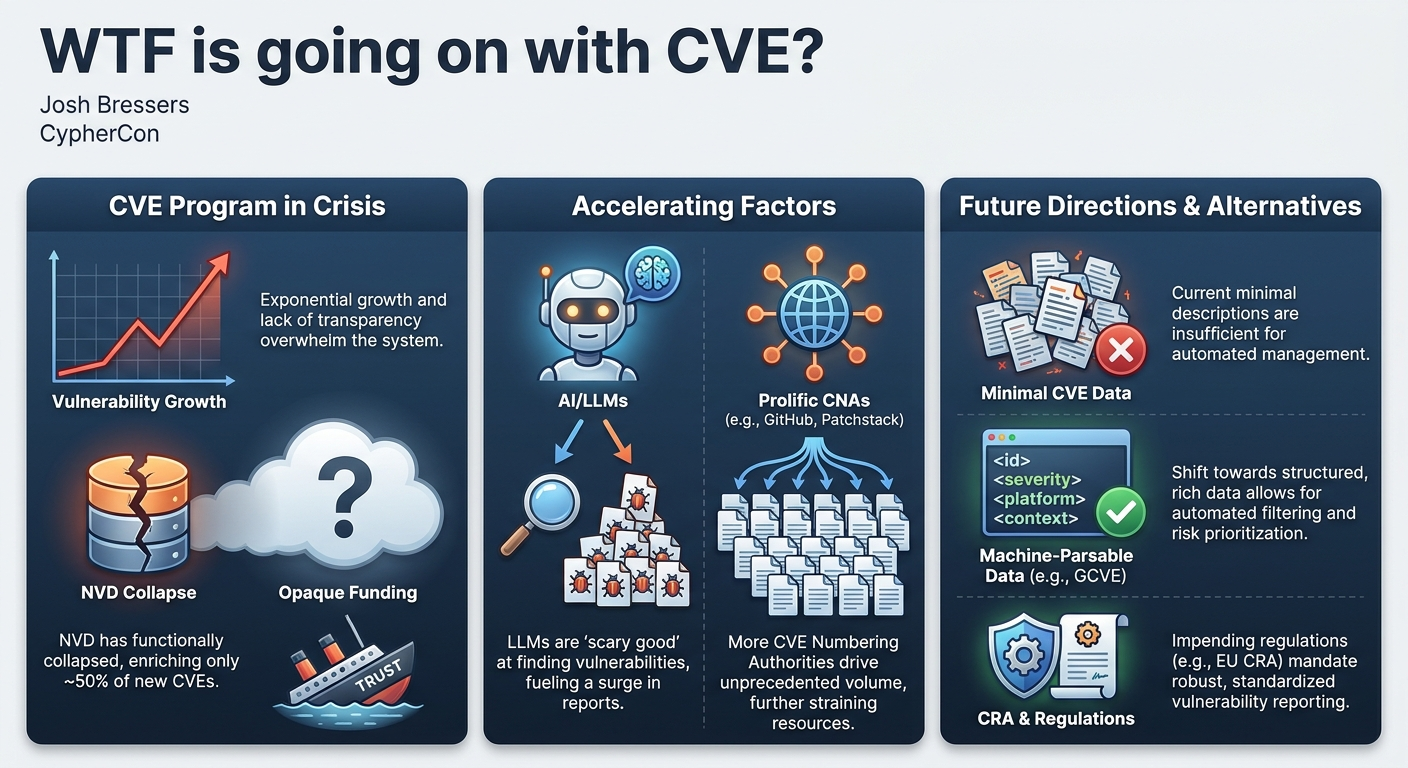
- Exponential Growth of Vulnerabilities: The most striking finding is the sheer, unsustainable rate of vulnerability disclosure. Bressers presents graphs illustrating a classic exponential growth curve for CVEs over time, reaching approximately 300,000 total CVEs. Annual CVE counts are increasing dramatically year-over-year, with significant jumps observed in 2025 and 2026. Bressers quotes the adage, "By the time you notice exponential growth, it's too late," suggesting that the program is already overwhelmed. This growth is driven by multiple factors, including an increase in software, open-source adoption, compliance standards mandating vulnerability reporting, and the proliferation of CVE Numbering Authorities (CNAs).
- NVD's Functional Collapse: The National Vulnerability Database (NVD), historically crucial for enriching CVE data with CVSS scores and CPEs, has significantly fallen behind. In 2024, NVD abruptly stopped enriching vulnerabilities, and as of the talk, it was only enriching approximately 50% of newly assigned CVEs. Bressers believes he was among the first to break this story, noticing the lack of updates in NVD data. This failure leaves a massive gap in actionable vulnerability intelligence, forcing organizations to work with incomplete or unprioritized data.
- Opaque Funding and Governance: A major point of contention is the mysterious funding status of the CVE program. The contract between CISA and MITRE expired on March 16th, 2024, and the current funding source and amount remain undisclosed. Bressers highlights a specific instance where the CVE board, described as a "powerless group," formally requested details on CISA's funding of the program from the CVE Secretariat (a faceless MITRE individual) and was told, "We can't tell you." This lack of transparency and accountability, where even the program's own board is kept in the dark, severely undermines trust and operational stability.
- Rise of Prolific CNAs: The expansion of CVE Numbering Authorities (CNAs), with the program recently announcing its 500th CNA, has contributed significantly to the exponential growth. Notably, GitHub has become a dominant CNA, allowing users to easily request CVEs for security advisories (GHSAs). Another example is Patchstack, which runs a bug bounty program specifically for WordPress plugins, generating a large volume of highly specific CVEs. Even the Linux kernel, after becoming a CNA, has become "prolific at assigning CVEs," leading to a surge in kernel-related vulnerability reports. Bressers observes that if the contributions from the top couple of CNAs were removed, the overall growth rate would appear less exponential, indicating that a concentrated number of entities are driving a large portion of the new CVEs.
- Impact of AI/LLMs on Bug Discovery: A terrifying new accelerator for vulnerability discovery is the application of Large Language Models (LLMs). Bressers reports that LLMs are "scary good" at finding vulnerabilities. His own company, Anchore, which previously received only one vulnerability report for its Syft SBOM scanner in five years, has received five LLM-generated reports this year, all of which were "real." Similarly, Greg KH from the Linux kernel project reported an increase from 5-10 vulnerability reports per month or quarter to weekly reports, largely LLM-driven and legitimate. This trend suggests an impending flood of vulnerability disclosures that current, manually-intensive systems are ill-equipped to handle.
- Emergence of Viable Alternatives: Due to the loss of trust and operational issues within the CVE program, alternative vulnerability databases and systems are gaining traction. Bressers points to the European Vulnerability Database (EUVDB), GitHub Security Advisories (GHSAs) (praised for their "phenomenal data"), and especially the GCVE program run by the Luxembourg CERT (circl.lu). GCVE is lauded for its "phenomenal" work, "nice data format," and innovative tools like Vulnerability Lookup, which incorporates namespacing for vulnerabilities. These alternatives represent a potential future for vulnerability intelligence that addresses the shortcomings of the legacy CVE system.
Technical Deep Dive
▶ Watch: GitHub and CNAs driving exploding CVE numbers (12:00)
Bressers' technical deep dive into the CVE ecosystem reveals a program struggling with antiquated processes, poor data standards, and a lack of scalability. At its core, the CVE program, managed by MITRE, is designed to issue unique identifiers for vulnerabilities. However, the data associated with these identifiers often remains minimal: typically just a brief description and a list of reference links. This "basic minimum," unchanged since 1999, is profoundly insufficient for modern, automated vulnerability management.
The historical solution to this data sparsity was the National Vulnerability Database (NVD), operated by NIST. NVD's crucial technical role was vulnerability enrichment. This involved taking a raw CVE ID and augmenting it with structured, machine-readable information, primarily:
- CVSS (Common Vulnerability Scoring System) scores: A standardized method for conveying the severity and characteristics of a vulnerability, enabling organizations to prioritize remediation efforts.
- CPE (Common Platform Enumeration) names: A structured naming scheme for IT systems, platforms, and packages, intended to precisely identify affected software. Bressers' strong criticism of CPEs underscores their practical limitations and complexity in accurately mapping software components.
The current dysfunction, however, means NVD is only enriching about 50% of new CVEs, leaving a vast amount of data unclassified and unprioritized. This forces downstream users to either manually enrich data or operate with significant blind spots. Compounding this, CISA has initiated its own "Vulnrichment" program, creating a redundant and confusing landscape where multiple federal entities are attempting to solve the same problem with different, uncoordinated efforts.
The proliferation of CVE Numbering Authorities (CNAs) is a key technical and operational shift. CNAs are organizations authorized by the CVE program to assign CVE IDs directly to vulnerabilities within their scope. While intended to decentralize and accelerate ID assignment, this model has led to an explosion of CVEs, particularly from CNAs like GitHub and Patchstack. GitHub allows maintainers of projects hosted on its platform to submit GitHub Security Advisories (GHSAs), some of which automatically receive CVE IDs. Bressers praises GHSAs for their "phenomenal data," indicating that these advisories often contain richer, more actionable technical details than basic CVE entries. Patchstack, focusing on WordPress plugin vulnerabilities, further illustrates how a CNA can operate a specialized bug bounty program to generate a high volume of CVEs specific to a particular ecosystem. The Linux kernel's decision to become a CNA also demonstrates the impact: a project once complaining about poor CVE coverage now generates a significant number of kernel-specific CVEs.
The inherent problem with this volume, even from prolific CNAs, is the lack of machine-parsable data for filtering. Bressers argues that the solution is not to reduce the number of CVEs (as "80% of them are probably crap" for any given user), but to make the information "very machine-parsable." This would allow users to easily discard the 80-90% of vulnerabilities they don't care about based on their specific software inventory and risk profile. GitHub's GHSA data is cited as an example of information that is "good enough" for such filtering.
Looking to the future, Bressers highlights the GCVE (Global Common Vulnerabilities and Exposures) program, run by the Luxembourg CERT (circl.lu), as a technical exemplar. GCVE has developed a "really nice data format" and a public, open-source tool called Vulnerability Lookup. This tool demonstrates advanced concepts like namespacing for vulnerabilities, allowing for distinct identifiers from different sources (e.g., MITRE, custom, Chinese NVD) to coexist and be integrated. GCVE's approach addresses many of the long-standing complaints about CVE: it provides structured, rich data that facilitates automation and intelligent filtering, showcasing what a modern vulnerability intelligence platform can achieve without the legacy constraints of the CVE program. The impending Cyber Resilience Act (CRA) in Europe, starting September 11th, will further push the need for robust, standardized, and machine-parsable vulnerability reporting systems, as it mandates reporting for software sold to EU consumers. This regulatory pressure will undoubtedly accelerate the demand for technically superior solutions like GCVE.
Demo / Proof of Concept
▶ Watch: CVE program's lost trust and emerging alternatives like GCVE (14:00)
While Josh Bressers' talk did not feature a live demonstration or proof of concept, he extensively referenced the Vulnerability Lookup tool developed by the GCVE (Global Common Vulnerabilities and Exposures) program. This tool, created by the Luxembourg CERT (circl.lu), is presented as a public, open-source solution that embodies many of the technical advancements and best practices that the CVE program currently lacks. Bressers highlights its "really nice data format" and its ability to handle namespacing for vulnerabilities, allowing for the integration of diverse vulnerability identifiers from various sources, including MITRE's CVE, custom namespaces, and even the Chinese NVD data. Although no direct demonstration was performed, the speaker's emphasis on GCVE and its public instance serves as a theoretical proof of concept for how modern, efficient vulnerability intelligence can be managed.
Defensive Implications
▶ Watch: Q&A: Drivers of exponential vulnerability growth (24:20)
The insights from Josh Bressers' talk carry significant implications for cybersecurity defenders, demanding a re-evaluation of current vulnerability management strategies.
- Diversify Vulnerability Intelligence Sources: Defenders can no longer solely rely on the CVE program and especially the NVD for comprehensive and timely vulnerability data. With NVD enriching only about 50% of CVEs and the core CVE data often being minimal, organizations must actively seek out and integrate alternative sources. GitHub Security Advisories (GHSAs) are highlighted for their "phenomenal data" and should be a primary consideration, especially for organizations using open-source software hosted on GitHub. Exploring the GCVE program from the Luxembourg CERT is also highly recommended due to its superior data format and tools.
- Prioritize Machine-Parsable Data: The exponential growth of vulnerabilities, coupled with the "garbage" quality of much of the CVE data, necessitates a shift towards highly automated, machine-parsable vulnerability intelligence. Defenders should prioritize data feeds and tools that provide structured, rich metadata, rather than just descriptions and links. This is crucial for enabling automated filtering, correlation, and risk prioritization, allowing security teams to efficiently discard the "80-90% of crap" that is irrelevant to their specific asset inventory.
- Prepare for Increased Vulnerability Volume: The impact of LLMs (Large Language Models) in accelerating vulnerability discovery is already being felt, with reports like the Linux kernel seeing a weekly influx of legitimate vulnerabilities. This trend, combined with the general exponential growth of software and compliance mandates (like the Cyber Resilience Act (CRA) in Europe starting September 11th), means defenders must prepare for a significantly higher volume of vulnerability reports. Manual processing will become increasingly untenable; investing in automation, robust vulnerability scanners, and intelligence platforms capable of handling this scale is paramount.
- Implement Granular Filtering and Contextualization: Given the rise of specialized CNAs like Patchstack (focusing on WordPress plugins), a large portion of CVEs may not be relevant to every organization. Defenders need to improve their asset inventory and vulnerability context to apply granular filtering. Rather than attempting to address every CVE, focus on those that impact the specific software, hardware, and configurations present in their environment. The goal is to move from a reactive, "fix everything" mentality to a proactive, "fix what matters" approach, enabled by better data and tooling.
- Advocate for Better Data Quality and Transparency: While individual defenders may not directly influence the CVE program, they can advocate for higher data quality standards from their vendors and open-source project maintainers. Demand that vulnerability disclosures include comprehensive, machine-readable information beyond just a CVE ID. Supporting initiatives like GCVE, which prioritize quality and transparency, can help drive the evolution of vulnerability management practices across the industry.
Key Takeaways
- CVE Program in Crisis: The Common Vulnerabilities and Exposures (CVE) program is facing an existential crisis due to exponential growth in vulnerability disclosures, the functional collapse of the National Vulnerability Database (NVD), and opaque funding mechanisms.
- Eroding Trust and Accountability: A lack of transparency regarding funding and governance, combined with consistently poor data quality, has severely eroded trust in the CVE program among the cybersecurity community.
- LLMs Accelerating Vulnerability Discovery: Large Language Models (LLMs) are proving "scary good" at finding real vulnerabilities, leading to a dramatic increase in reported bugs that current manual systems are unprepared to handle.
- Necessity of Machine-Parsable Data: To cope with the overwhelming volume of vulnerabilities, defenders must prioritize machine-parsable and richly contextualized data to enable automated filtering and risk prioritization, rather than relying on minimal CVE entries.
- Emergence of Superior Alternatives: Projects like the Global Common Vulnerabilities and Exposures (GCVE) program from the Luxembourg CERT offer a glimpse into a more effective future for vulnerability management, featuring better data formats, tools, and transparency.
- Impending Regulatory Pressure: New regulations like Europe's Cyber Resilience Act (CRA), mandating vulnerability reporting for software sold in the EU starting September 11th, will further intensify the demand for robust and standardized vulnerability intelligence systems.
About the Speaker(s)
Josh Bressers is a highly opinionated and deeply experienced voice in the field of vulnerability management, with over 20 years of expertise in dealing with vulnerability information. He is known for his candid assessments of the cybersecurity landscape. Bressers currently works at Anchore, a company specializing in software supply chain security with tools like Syft (an SBOM scanner) and Grype (a vulnerability scanner), which directly informs his practical insights into CVEs and vulnerability data. Beyond his corporate role, Josh is a prolific podcaster, hosting the popular Open Source Security Podcast and the Hacker History podcast specifically for CypherCon. He actively seeks guests for both shows, emphasizing that "everyone's story is interesting." Josh is easily found on social media platforms under the handle @JoshBressers.
Reviews
Dr. Zero (Offensive Security Researcher) — STRONG ACCEPT
Bressers delivers a desperately needed reality check on the bureaucratic dumpster fire that is the modern CVE program. He skips the polite industry deference and accurately diagnoses why NVD is collapsing and why MITRE is failing defenders. If you build your threat model around legacy CVE enrichment, this talk proves why you're already flying blind.
Heather Calloway (CISO) — MUST SEE
Bressers details the institutional collapse of the CVE and NVD programs, exposing a critical failure in the data supply chain that underpins enterprise vulnerability management. If your patching SLAs rely on automated NVD enrichment, your compliance metrics are currently failing silently. I'd make this mandatory viewing for whoever owns your vulnerability management program.