What Attackers Automate First (And Why You Should Care)
Jeremiah Salzberg
Overview
In his CypherCon talk, "What Attackers Automate First (And Why You Should Care)," Jeremiah Salzberg, Chief Security Technologist at CDW, delivers a critical analysis of how Generative AI is fundamentally reshaping the threat landscape. Salzberg argues that AI has not necessarily elevated the skill ceiling for elite attackers but has dramatically erased the skill floor, empowering a broader spectrum of adversaries to execute sophisticated attacks with unprecedented speed and precision. This shift demands a re-evaluation of traditional defensive strategies, which were often designed to catch human error and inefficiency.
Key moments
- 2:00 Speaker introduction and CISO role insights
- 7:00 AI's impact on attacker skill levels
- 11:00 How AI speeds up open-source intelligence gathering
- 18:00 Advanced phishing, language, and deepfake attacks
- 26:30 AI for custom malware and EDR bypasses
- 32:00 Prioritizing basic security controls over new AI tools
- 34:00 Enhancing MFA and controlling autonomous AI actions
- 42:50 Q&A: Discussing false security and loss of human skills
What Attackers Automate First (And Why You Should Care)
Speakers: Jeremiah Salzberg, Chief Security Technologist, CDW
Conference: CypherCon
YouTube: https://www.youtube.com/watch?v=gWO8sS3C-Y
Overview
In his CypherCon talk, "What Attackers Automate First (And Why You Should Care)," Jeremiah Salzberg, Chief Security Technologist at CDW, delivers a critical analysis of how Generative AI is fundamentally reshaping the threat landscape. Salzberg argues that AI has not necessarily elevated the skill ceiling for elite attackers but has dramatically erased the skill floor, empowering a broader spectrum of adversaries to execute sophisticated attacks with unprecedented speed and precision. This shift demands a re-evaluation of traditional defensive strategies, which were often designed to catch human error and inefficiency.
Salzberg, drawing from over 30 years of experience as a pentester, incident responder, and CISO, highlights specific areas where AI is first being leveraged by attackers: reconnaissance, highly contextualized social engineering, deepfakes, and automated code generation. His insights are grounded in real-world observations from CDW's security lab, where vendors are rigorously tested "deathmatch style" to determine actual efficacy. The talk underscores the urgent need for defenders to adapt by strengthening foundational security practices and judiciously integrating AI into their own operations, while remaining vigilant against a false sense of security.
The core message is a wake-up call: the nature of cyberattacks is evolving from slow, error-prone human-driven efforts to rapid, machine-assisted campaigns that exploit context and automation. Understanding where and how attackers are first applying AI is crucial for developing resilient defenses and prioritizing security investments effectively in this new era.
Background
▶ Watch: Speaker introduction and CISO role insights (2:00)
Historically, cybersecurity defenses have, perhaps inadvertently, relied on the inherent inefficiencies and mistakes of human attackers. As Salzberg vividly recounts, early phishing emails were often comically obvious, riddled with bad grammar, strange fonts, and the infamous "Nigerian prince" trope. Attackers would reuse templates, miscontextualize messages, and eventually burn out. Our security programs were largely optimized to catch these "sloppy humans" – a strategy that AI now completely undermines.
The advent of AI has transformed this dynamic. Attackers are no longer constrained by the time-consuming processes of manual reconnaissance or the linguistic barriers that once made global phishing campaigns challenging. AI systems don't get tired, bored, or emotional, and they don't forget to double-check their work. This paradigm shift means the fundamental assumptions underpinning many existing security programs are no longer valid. Salzberg emphasizes that AI hasn't raised the skill ceiling for the most elite attackers (like nation-states) but has instead erased the skill floor, enabling less skilled adversaries to perform at a much higher level.
Salzberg categorizes attackers into tiers:
- S-tier: Nation-states or large businesses with excellent skills and massive resources, now using AI for increased efficiency in complex operations like post-quantum cryptography attacks.
- A-tier: Organized cybercrime, operating like businesses with project managers, development teams, and pentesting capabilities. AI helps them speed up operations, making their organized attacks even faster.
- B-tier: Smaller groups targeting lower-hanging fruit, benefiting significantly from AI for development skills and organization.
- C-F tiers: Less skilled, less intelligent attackers. AI provides them with crucial language skills, automation capabilities, and speed, effectively elevating many to B-tier capabilities by overcoming their prior limitations.
This foundational shift necessitates a re-evaluation of defensive priorities, moving beyond simply detecting known attack patterns to building resilience against rapidly evolving and highly contextualized threats.
Key Findings
▶ Watch: How AI speeds up open-source intelligence gathering (11:00)
Jeremiah Salzberg's talk reveals several key areas where attackers are first and most effectively leveraging AI, fundamentally changing the landscape of cyber warfare:
- Accelerated Reconnaissance: What once took days now takes minutes. AI automates Open Source Intelligence (OSINT) gathering, creating detailed dossiers on target companies (overview, financials, digital footprint, risks) and even potential supply chain vulnerabilities. This enables attackers to quickly identify lucrative targets and their weak points without ever touching the company's network.
- Contextualized Social Engineering: AI empowers attackers to craft highly personalized and convincing phishing and social engineering attacks. It analyzes public information (job postings, social media, company blogs) to match an organization's specific tone, internal language, and even individual employee details. This results in fewer emails but significantly higher conversion rates, making traditional "spray and pray" phishing less common among sophisticated attackers.
- Language and Cultural Nuance: AI overcomes linguistic barriers, allowing attackers to create perfectly worded phishing emails in any language or dialect (e.g., distinguishing British English from American English, or using specific formal tones). This broadens the target pool and increases the efficacy of global campaigns.
- Automated Targeting and Phishing Campaigns: AI automates the process of identifying individual targets (IT, finance, executives) and even triggers automated phishing campaigns based on specific events, such as a LinkedIn post about a new job. This ensures timely, relevant, and highly effective attacks.
- Deepfake Capabilities: While live video deepfakes still have limitations, AI-generated voice deepfakes are increasingly effective, requiring only minutes of source audio. These are used for attacks like MFA token resets or convincing individuals to initiate fraudulent transactions by impersonating trusted contacts.
- "Vibe Coding" for Custom Tools: Less skilled attackers can use AI to "vibe code" custom tools, such as unique Command and Control (C2) infrastructure or sophisticated phishing portals. More advanced attackers use AI to speed up development, adapt existing malware to evade detection, and automate post-compromise activities tailored to specific environments (e.g., Active Directory).
- EDR Evasion Development: AI is being used to develop new Endpoint Detection and Response (EDR) evasion techniques. While testing against proprietary EDRs remains a challenge for lower-tier attackers, AI significantly accelerates the creation of evasions for widely available systems like Microsoft Defender.
Technical Deep Dive
▶ Watch: AI for custom malware and EDR bypasses (26:30)
The technical implications of AI's integration into offensive security are profound, touching every stage of the attack lifecycle. Salzberg details several specific examples of how AI is being weaponized.
Automated Reconnaissance and Target Profiling
Attackers are using AI to perform highly efficient OSINT. Salzberg provides example prompts that rapidly generate comprehensive dossiers:
- "Act as a corporate intelligence analyst, provide a detailed dossier for the company [name], including an overview, HQ, location, industry, key subsidiaries, leadership (CFO, CEO, founders), financials (last two years' revenue), digital footprint (website, social media, email servers), and risks (lawsuits, regulatory actions, negative media)."
- This allows attackers to filter targets based on criteria like industry, employee count (e.g., 1,000-5,000 employees), and revenue for optimal payout.
- Job posting analysis is another goldmine. Prompts like "Analyze job postings on the career page of [company] and LinkedIn based on hiring trends. What new projects, technologies, or departments is the company focusing on? Identify any specific non-obvious skills they're currently heavily recruiting for." This quickly reveals an organization's technology stack (e.g., specific EDRs, email security solutions) and potential vulnerabilities.
- Supply chain mapping is also automated. Attackers can query AI to "identify the key suppliers, logistic partners, and manufacturing/outsourcing locations for the company." This helps them find smaller, potentially less secure companies that can serve as stepping stones to the primary target, as seen in attacks against bank escrow companies.
Advanced Social Engineering and Phishing
AI has revolutionized phishing and social engineering by enabling extreme personalization:
- Contextual Email Generation: AI analyzes existing company communications (blogs, published articles) to understand tone, writing style, and formatting. This allows it to craft phishing emails that perfectly mimic internal communications, making them highly believable.
- Language and Dialect Specificity: AI can adapt to subtle linguistic nuances, such as the differences between British and American English, formal business tones, or specific salutations. It can also translate and compose effective messages in various languages (e.g., Farsi, French), overcoming previous translation issues.
- Automated Spear-Phishing Campaigns: Salzberg describes a personal project demonstrating this: automating emails based on LinkedIn job postings. When a target posts about a new role, an AI-generated email purporting to be from HR, offering "new employee benefits and discounts" with a malicious link, is automatically sent. Such automation creates rapid, regular, and highly accurate attacks.
Deepfakes and Impersonation
- Voice Deepfakes: AI can generate convincing voice impersonations from just "a couple minutes" of target audio. This is particularly effective for high-volume, low-context interactions like calling a help desk to request an MFA token reset. The help desk agent might not know the caller well enough to detect the fake.
- Video Deepfakes: While live video deepfakes are still evolving, Salzberg recounts a customer incident involving a fuzzy CFO deepfake on a Zoom call that initiated a wire transfer. The technology, though imperfect, was sufficient to convince the victim. Challenges remain with real-time fluency and idiom translation, especially if the AI is not a native speaker of the target language.
"Vibe Coding" and Malware Development
- Custom C2: Attackers are using AI to generate novel Command and Control (C2) frameworks. Prompts can describe desired protocols, functionalities, and simplicity, leading to functional, AI-written C2 systems that evade traditional signature-based detection. Salzberg notes that most AI models will generate this code "without complaining" if framed as a "communication program."
- Malware Adaptation: AI can take existing malware samples and "change it enough so it's different," assisting in evading detection by modifying signatures or behavioral patterns.
- Social Engineering Infrastructure: AI helps build the entire backend for phishing campaigns, including malicious login pages, data capture mechanisms, and web-based portals for attackers to track victim interactions.
- EDR Evasion: AI is accelerating the development of new techniques to bypass Endpoint Detection and Response (EDR) systems. While access to specific EDRs for testing differentiates attacker tiers, AI can generate new evasion methods, particularly for widely accessible EDRs like Microsoft Defender. Salzberg mentions running local AI models on a gaming laptop to bypass ethical restrictions and experiment with such code generation.
Attack Automation
Beyond initial compromise, AI is assisting in automating post-exploitation activities. This includes generating specific tools for a given environment (e.g., an Active Directory setup), automating analysis, and orchestrating the distribution of C2 across a compromised network, accelerating lateral movement and data exfiltration.
Demo / Proof of Concept
▶ Watch: Prioritizing basic security controls over new AI tools (32:00)
While Jeremiah Salzberg's talk at CypherCon did not include a live, in-presentation technical demonstration or proof of concept, he referenced several examples of AI's capabilities that he has personally explored or observed. He mentioned a "fun project" he undertook to automate emails based on LinkedIn postings, demonstrating how AI could craft and send targeted phishing messages in response to public social media updates. He also alluded to another talk where he showcased a deepfake of his own voice, highlighting the ease with which convincing audio impersonations can be created with sufficient source material. These anecdotes serve as conceptual proofs of the AI-driven attack methodologies he describes.
Defensive Implications
▶ Watch: Q&A: Discussing false security and loss of human skills (42:50)
Given the rapid acceleration and sophistication of AI-powered attacks, Salzberg stresses that defenders must shift their focus from catching "sloppy humans" to building robust, foundational defenses that can withstand machine-driven efficiency.
- Reinforce the Basics (The "Fix the Bases" Approach):
- Identity Governance: Crucial for managing access.
- Data Governance: Understanding what data you have, where it is, and its classification. Salzberg highlights this as a historical failure point, but AI is now helping by automatically classifying unstructured data (e.g., flagging a document as "classified" as soon as "merger and acquisition" is typed).
- Least Privilege Networking (or "Less Privilege"): Moving away from the marketing-destroyed term "zero trust," Salzberg advocates for minimizing access. "Don't worry about least because you're never going to get there. Get to less. Less will make me happy."
- Minimal Builds: Drastically reduces the attack surface on systems (especially effective on Linux, but also beneficial on Windows fleets). Harder for attackers to exploit, increasing chances for detection.
- Canary Accounts: Simple yet highly effective. Create fake accounts that, if accessed, immediately trigger an alert, indicating malicious activity or a pentest.
- Enhance Multi-Factor Authentication (MFA):
- Beyond SMS: Salzberg firmly states that SMS-based MFA is "something else I know" rather than true multi-factor authentication, due to its susceptibility to attacks. He even expressed frustration with Alaska's adoption of it.
- Physical Tokens: He is a "huge fan" of physical tokens, especially FIDO2-compliant devices like YubiKeys, citing T-Mobile's successful rollout to their entire company as a proof of concept.
- Business Privilege Access: Extend strong MFA (e.g., hard tokens) to critical business processes, not just IT. An example given was requiring multiple physical token authentications for wire transfers, directly mitigating deepfake-initiated fraud.
- Leverage AI for Faster Defense (with Caution):
- SOC Augmentation: AI can significantly speed up Security Operations Center (SOC) teams by analyzing logs, summarizing issues, and prioritizing alerts. This helps analysts make quicker decisions.
- Agentic AI - Risk Decisions: The critical question is what actions agentic AI (AI that can effect change) should be allowed to take autonomously. While actions like forcing a user to re-authenticate (re-auth) might be low-risk, isolating a system significantly impacts users and carries higher risk (Salzberg recounts personally "destroying many systems through automation").
- Guardrails are Essential: Any agentic AI must have robust guardrails. Examples include:
- Rate Limiting: "You've already isolated 10 systems in under a minute? Maybe I'm going to stop you right there."
- Anomaly Detection: Stopping actions the AI has "never done before" on a particular system.
- The goal is to limit the AI's capability to prevent unintended destruction or misuse.
- Beware of False Sense of Security and Skill Erosion:
- Salzberg's "most unpopular opinion" is that "every security tool sucks." Over-reliance on any single tool, especially AI, can lead to a dangerous false sense of security.
- He warns against the trend of hiring "AI SOC analysts" with no mention of fundamental skills, fearing an erosion of basic log analysis and critical thinking. Humans must still understand why AI makes certain decisions and be able to correct its "hallucinations" or errors.
Key Takeaways
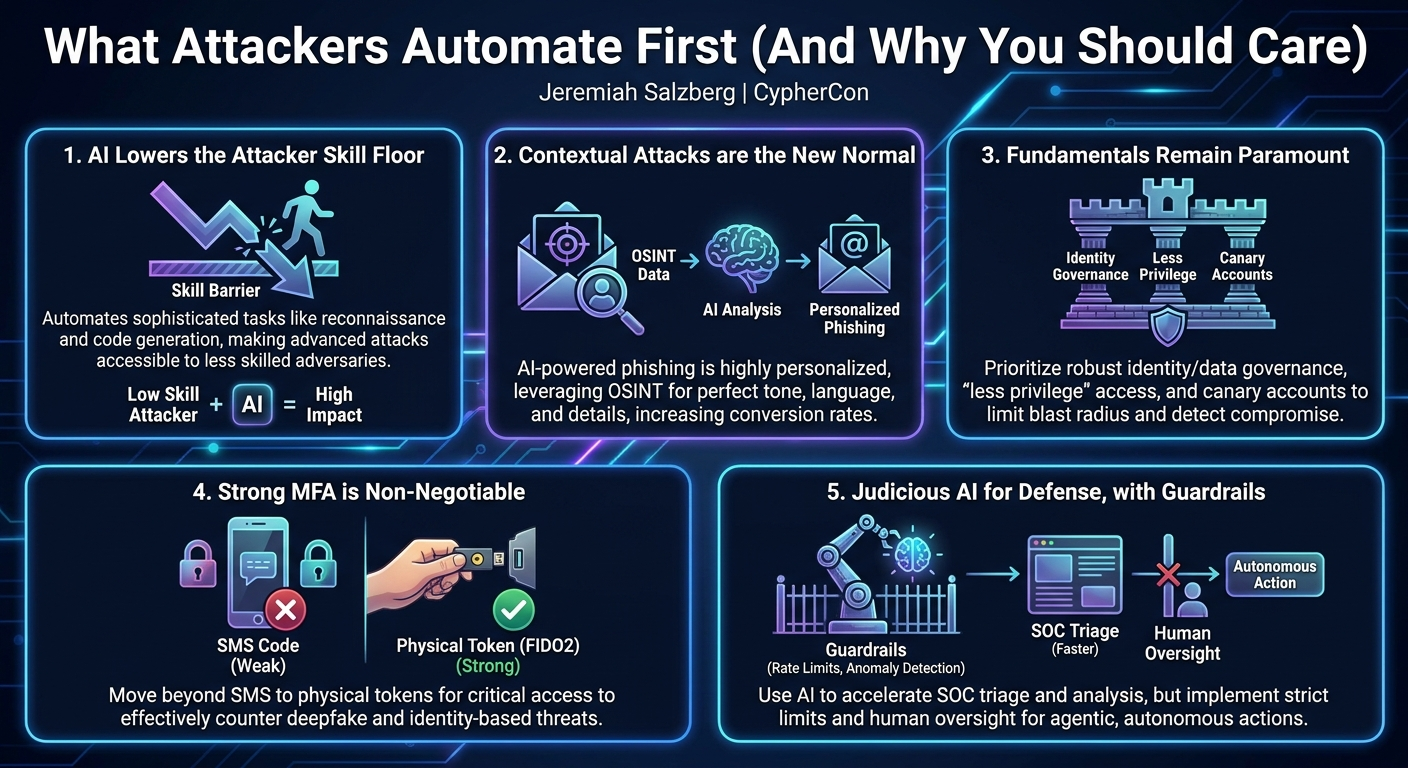
- AI Lowers the Attacker Skill Floor: Generative AI dramatically increases the efficiency and sophistication of attacks, making advanced techniques accessible to a wider range of adversaries by automating reconnaissance, social engineering, and code generation.
- Contextual Attacks Are the New Normal: AI-powered phishing and social engineering are highly personalized, leveraging OSINT to match company tone, language, and individual details, leading to higher conversion rates and making traditional defenses less effective.
- Fundamentals Remain Paramount: Core security practices such as robust identity and data governance, implementing "less privilege," minimal system builds, and utilizing canary accounts are more critical than ever to limit blast radius and detect compromise.
- Strong MFA is Non-Negotiable: Move beyond SMS-based MFA to more secure physical tokens (e.g., FIDO2, YubiKeys) and extend strong authentication to critical business-privileged access points to counter deepfake and identity-based attacks.
- Judicious AI for Defense, with Guardrails: AI can significantly aid defenders by accelerating SOC triage and analysis. However, allowing agentic AI to take autonomous actions requires careful risk assessment, strict guardrails (like rate limiting and anomaly detection), and human oversight to prevent unintended consequences.
- Beware of False Security and Skill Erosion: Over-reliance on AI security tools without understanding their limitations or maintaining human analytical skills can lead to a dangerous false sense of security and a decline in foundational cybersecurity talent. Data classification, a long-standing challenge, is an area where AI shows significant promise for genuine defensive improvement.
About the Speaker(s)
Jeremiah Salzberg is the Chief Security Technologist at CDW. With over 30 years of experience in the cybersecurity industry, he has a diverse background spanning roles such as pentester, incident responder, and even CISO. Salzberg's current responsibilities include advising customers on security strategy, speaking at conferences, and notably, overseeing a security lab at CDW where vendors' products are rigorously tested in "deathmatch style" scenarios to determine their real-world effectiveness. He humorously notes that while he once aspired to the CISO role, he found it to be "half budget and politics," areas he admits to "sucking at," preferring the more technical aspects of security. His extensive practical experience provides him with a unique and grounded perspective on evolving threats and effective defensive strategies.
Reviews
Dr. Zero (Offensive Security Researcher) — SOLID
Salzberg isn't wrong, but he's about 18 months late to the 'LLMs write phishing emails' revelation. It's a pragmatic threat briefing that successfully strips away the vendor hype, but if you're looking for novel research, you're in the wrong room. Solid medicine for executives, but researchers can sleep in.
Heather Calloway (CISO) — STRONG ACCEPT
Salzberg strips the vendor hype away from offensive AI, clearly defining how large language models erase the attacker skill floor for reconnaissance and social engineering. This is a highly practical briefing that gives leadership a concrete mandate to stop relying on attacker inefficiency for detection and start implementing structural controls.