Filtering the Noise: Crafting an Actionable Threat Feed from Community-Shared Intelligence
JJ Josing (Principal Threat Researcher · Retail and Hospitality ISAC)
Overview
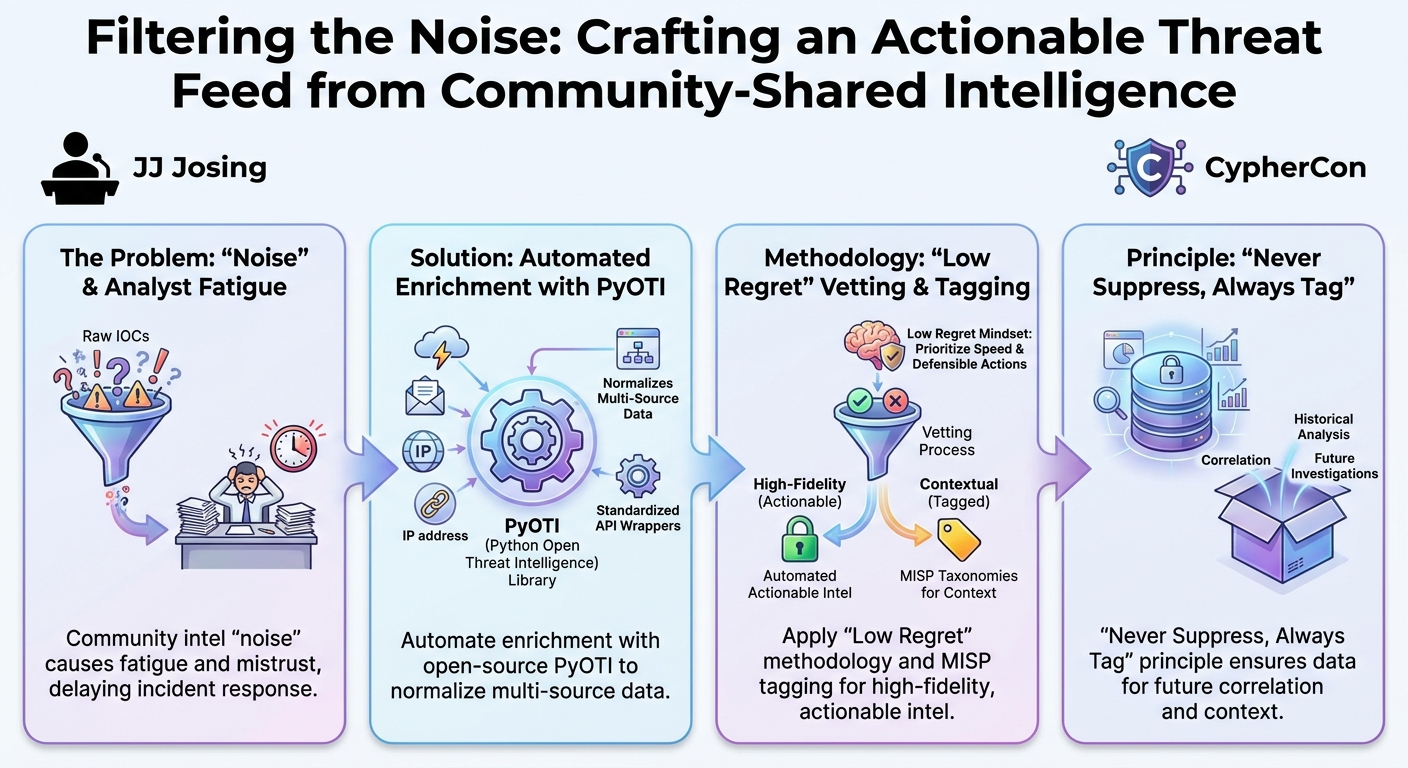
In the rapidly evolving landscape of cyber threats, the sheer volume of shared threat intelligence can often become a double-edged sword. While collaboration and information sharing are paramount for defense, the deluge of raw, uncontextualized indicators of compromise (IoCs) frequently leads to analyst fatigue, mistrust, and ultimately, delayed incident response. JJ Josing, Principal Threat Researcher at the Retail and Hospitality ISAC (RH-ISAC), tackles this critical challenge in his CypherCon talk, "Filtering the Noise: Crafting an Actionable Threat Feed from Community-Shared Intelligence." Josing illuminates the pitfalls of low-fidelity threat feeds and presents a robust, scalable, and automated methodology for transforming raw indicators into high-fidelity, actionable intelligence.
Key moments
- 5:30 Challenges of shared intelligence feeds: noise, fatigue
- 7:40 Low Regret Methodology for automated threat action
- 10:40 Introducing PyOTEL: open-source threat intelligence library
- 12:20 Detailed multi-source enrichment services and application
- 18:10 Community intelligence sharing and automated vetting workflow
- 25:40 Strategies for tuning enrichment and vetting requirements
- 29:50 Key outcomes and quality lessons for intelligence sharing
Filtering the Noise: Crafting an Actionable Threat Feed from Community-Shared Intelligence
Speakers: JJ Josing, Principal Threat Researcher, Retail and Hospitality ISAC
Conference: CypherCon
YouTube: https://www.youtube.com/watch?v=EnfvwpXwdgo
Overview
In the rapidly evolving landscape of cyber threats, the sheer volume of shared threat intelligence can often become a double-edged sword. While collaboration and information sharing are paramount for defense, the deluge of raw, uncontextualized indicators of compromise (IoCs) frequently leads to analyst fatigue, mistrust, and ultimately, delayed incident response. JJ Josing, Principal Threat Researcher at the Retail and Hospitality ISAC (RH-ISAC), tackles this critical challenge in his CypherCon talk, "Filtering the Noise: Crafting an Actionable Threat Feed from Community-Shared Intelligence." Josing illuminates the pitfalls of low-fidelity threat feeds and presents a robust, scalable, and automated methodology for transforming raw indicators into high-fidelity, actionable intelligence.
The core problem addressed is the operational harm caused by the overwhelming "noise" in community-shared intelligence. Without proper vetting and enrichment, security teams are forced to manually triage thousands of indicators, many of which lack context, industry relevance, or sufficient confidence to warrant action. Josing’s presentation offers a practical blueprint for organizations to implement a proactive defense strategy. By leveraging open-source tooling, a custom Python library, and a meticulously defined enrichment and vetting pipeline, his approach aims to prevent low-fidelity indicators from ever reaching the operational pipeline, thereby empowering defenders to act decisively and efficiently.
Background
▶ Watch: Challenges of shared intelligence feeds: noise, fatigue (5:30)
The foundation of modern cyber defense often lies in collaborative intelligence sharing. Information Sharing and Analysis Centers (ISACs), like the Retail and Hospitality ISAC (RH-ISAC) where Josing works, were established in the late 1990s under a presidential directive. Their mandate is to provide a safe, secure space for critical infrastructure owners and operators to share information about threats and vulnerabilities. A primary goal of ISACs is the collection, analysis, and dissemination of actionable threat intelligence that members can readily use. This process is frequently facilitated by platforms like MISP (Malware Information Sharing Platform).
MISP is an open-source threat intelligence platform, developed by the Computer Incident Response Center of Luxembourg and financed by the EU. It has been instrumental for over a decade in enabling the sharing of structured threat intelligence, typically in STIX or MISP standard formats. MISP's robust API and Python library (PyMISP) allow for extensive integrations with existing security tools, providing flexibility for members to consume intelligence in ways that suit their environments.
However, the reality of shared intelligence feeds presents significant challenges. Organizations are often inundated with large volumes of bare indicators, arriving with uneven quality from mixed sources, such as automated scrapers of public forums like X (formerly Twitter) or Reddit. While many of these indicators may be technically true, they are often operationally harmful due to a critical lack of context, industry relevance, or confidence. This leads directly to analyst fatigue, which in turn breeds mistrust in the intelligence feed. The manual triage required for thousands of indicators creates bottlenecks and burnout, causing shared intelligence to be ignored, generating false positives, and ultimately delaying incident response. Josing highlights this issue with concrete numbers from the RH-ISAC community, noting an average of nearly 9,000 tactical indicators shared per quarter over the last year. Ingesting and actioning such a volume without a vetting process is unsustainable.
To address this, Josing draws inspiration from the Low Regret Methodology developed by the Johns Hopkins University Applied Physics Laboratory. This methodology focuses on identifying defensive actions that are justifiable regardless of whether a threat assessment ultimately proves correct. It prioritizes speed and automation over the certainty typically associated with traditional manual triage. The core insight is that delaying action to achieve complete certainty about maliciousness can entirely negate the value of time-sensitive intelligence. The research found that approximately 33% of all threat intelligence can be automatically evaluated as "low regret," meaning actioning the indicator would be extremely unlikely to disrupt operations, even with some uncertainty. Conversely, a "high regret" indicator, such as blocking an IP address belonging to a legitimate Microsoft 365 service, carries a high potential for operational risk and widespread disruption. The objective is to shift the focus from whether an action should be automated to when an automated action should be taken.
Key Findings
▶ Watch: Introducing PyOTEL: open-source threat intelligence library (10:40)
Josing’s work at the RH-ISAC has demonstrated that the principles of the Low Regret Methodology can be effectively adapted and scaled to create a high-fidelity, actionable threat feed. His process focuses on identifying known bad threats—indicators that already have signatures, appear on reputation lists, or are otherwise unequivocally malicious. This approach shifts an organization from a reactive to a more proactive defensive posture.
A significant finding from the RH-ISAC’s implementation is the high percentage of shared intelligence that, after enrichment and vetting, is identified as high-fidelity. Over the last year, the vetting rates across quarters were: 44% (Q1), 38% (Q2), 53% (Q3), and 54% (Q4). These figures underscore the substantial amount of actionable intelligence that can be extracted from community feeds when a robust filtering process is applied.
Central to achieving this scale and efficacy is the development of the Python Open Threat Intelligence (PyOTI) library. This open-source, lightweight library normalizes multi-source enrichment by providing standardized API wrappers for numerous intelligence services. PyOTI allows organizations to programmatically query dozens of different intelligence sources, aggregate the results, and apply consistent tagging, significantly reducing the development time typically required to integrate with disparate APIs. This foundational tool enables the automated enrichment and vetting process that is critical for filtering the noise and delivering consistently useful intelligence.
Technical Deep Dive
▶ Watch: Detailed multi-source enrichment services and application (12:20)
The technical core of Josing’s solution revolves around automated enrichment, sophisticated tagging, and a structured vetting process, all underpinned by the Python Open Threat Intelligence (PyOTI) library.
The PyOTI Library: Normalizing Multi-Source Enrichment
Recognizing the pain point of integrating with dozens of disparate intelligence APIs, Josing developed PyOTI. This open-source, lightweight Python library simplifies the process of querying various threat intelligence services. Its only dependencies are requests and aiodns, ensuring minimal overhead. PyOTI functions as a modular API framework, providing wrappers for nearly three dozen different intelligence APIs and services. A key feature is its standardized, machine-readable JSON output, meaning that regardless of the native output format of the queried API, PyOTI returns results in a consistent JSON structure, making programmatic parsing and aggregation straightforward.
Using PyOTI is designed for accessibility, requiring just a few lines of code:
- Import your API key.
- Instantiate the relevant class for the service.
- Set the target indicator (e.g., URL, IP address).
- Call the appropriate
check_method (e.g.,check_URL,check_indicator). - Parse the returned JSON.
This simplicity allows even non-programmers to quickly leverage advanced enrichment capabilities, shifting focus from API integration to intelligence analysis.
Comprehensive Enrichment Services
Josing's process incorporates a wide array of enrichment services, chosen for their coverage in identifying known bad indicators and setting confidence levels. Different indicator types are routed through specific services:
- Email Addresses:
- Email domain spoofability checks: Determine if the domain can be easily impersonated.
- Disposable email address services: Identify temporary or throwaway email domains.
- EmailRep: Provides reputational intelligence.
- Cisco Umbrella: Offers domain risk scoring.
- DNS Blocklists (DNSBLs): Checks against lists of known malicious domains.
- VirusTotal: Used to ascertain domain age (though any WHOIS service could be used).
- Google Safe Browsing: Utilizes its API to check if URLs or domains are on blocklists.
- IP Addresses:
- AbuseIPDB: Provides abuse confidence scores.
- GreyNoise Riot (now Business Services Intelligence): Critically, this service helps distinguish between legitimate cloud infrastructure (e.g., Microsoft 365 IP addresses, considered "trust level one" and ignorable) and cloud IPs leased to customers (e.g., Azure VPS), which may host malicious activity. This is vital for avoiding high-regret blocks.
- Reputation Blacklists: Such as Spamhaus, SpamCop, and Barracuda Central.
- Legitimate Services Abused: Identifies IPs associated with commonly abused platforms like SendGrid, Amazon SES, Adobe, or DocuSign.
- URLs:
- Google Safe Browsing: Checks for known malicious URLs.
- File Hashes:
- Hashlookup (from CIRCL.LU): A software registry list that collects hashes of benign files included with operating systems (Windows, Linux distros). This helps identify known good files that should not be actioned.
- VirusTotal: Provides threat classification labels and a "known software distributor" metadata flag, which is crucial for identifying potential false positives (e.g.,
cmd.exedistributed by Microsoft).
MISP Taxonomies and PyOTI Tagging
To make the enriched data machine-readable and actionable, Josing uses MISP taxonomies. These are standard classification systems that employ a namespace:predicate="value" format for tagging. This structure allows for granular control over automated decisions, enabling filters for specific namespaces, predicates, or values.
Josing developed a custom PyOTI taxonomy to represent the enrichment results within MISP. Examples of these tags include:
pyoti:abuseipdb="high": Indicates a high abuse confidence score from AbuseIPDB.pyoti:umbrella_investigate="medium": Shows a medium risk score from Cisco Umbrella.pyoti:spamhaus="phish": Flags an indicator as appearing on Spamhaus's phishing blocklist.pyoti:virustotal="new-domain": Denotes a domain registered less than 30 days ago.pyoti:hashlookup="medium-trust": For a file hash found in Hashlookup with a medium trust level.pyoti:virustotal="known-distributor": Identifies a file distributed by a known software vendor (e.g., Microsoft).pyoti:greynoise="trust-level-1": Marks an IP as legitimate cloud infrastructure (e.g., Microsoft 365).pyoti:asn="sendgrid-ip": Categorizes an IP as belonging to a legitimate but often-abused service like SendGrid.
The goal of this detailed tagging is to provide immediate, unambiguous context to intelligence consumers, eliminating the need for analysts to infer intent or provenance from raw indicators.
RH-ISAC Community MISP Workflow
Josing outlines the RH-ISAC's robust intelligence sharing workflow:
- Ingestion: Intelligence is shared by members through various channels: direct MISP logins, automated MISP-to-MISP pushes, email templates parsed by automation, a dedicated Slack IOC channel, and a forum-based web app.
- Centralized Processing: Josing's team pulls all shared intelligence into their central MISP instance.
- Enrichment: Every indicator passes through the automated enrichment process, leveraging PyOTI and the described services.
- Vetting: A subsequent automated vetting setup filters out both known bad and known good indicators based on the enrichment tags.
- Dissemination: Members consume the vetted intelligence by logging into MISP, integrating via API, or syncing with their own MISP instances.
This structured workflow ensures that all community-shared intelligence benefits from consistent, automated processing before it reaches operational teams.
Demo / Proof of Concept
▶ Watch: Strategies for tuning enrichment and vetting requirements (25:40)
Josing illustrates the practical application of his methodology through conceptual walkthroughs of indicator processing, covering both the identification of known malicious indicators and the handling of potential false positives.
Known Bad IoC Identification (Domain Example)
Consider a domain submitted to the feed. The enrichment process might yield several hits:
- Domain Age: VirusTotal (or similar) indicates the domain was registered less than 30 days ago. This is tagged as
pyoti:virustotal="new-domain". - Risk Score: Cisco Umbrella assigns a medium risk score. This is tagged as
pyoti:umbrella_investigate="medium". - Reputation: The domain appears on the Spamhaus phishing blocklist. This is tagged as
pyoti:spamhaus="phish".
Based on these enrichment hits, if the domain meets the RH-ISAC's defined criteria for low regret (e.g., new domain and medium risk and on a blocklist), the indicator is marked as vetted by adding a vetted tag. This signifies that it can be safely actioned by members.
Handling False Positives
Equally crucial is the ability to identify and contextually represent benign indicators to prevent false positives:
- Benign File Hashes (e.g.,
powershell.exe): - Running
powershell.exethrough Hashlookup might return a "medium trust" score, tagged aspyoti:hashlookup="medium-trust". - VirusTotal might flag it with a "file distributed by Microsoft" (known distributor) tag, represented as
pyoti:virustotal="known-distributor".
These tags immediately signal that while the hash might appear in some alerts, it's likely benign.
- Legitimate Cloud Infrastructure (e.g., Microsoft 365 IP):
- An IP address submitted might be identified by GreyNoise Riot as a Microsoft 365 IP, with a "trust level 1" indicating it's reasonably ignorable. This is tagged as
pyoti:greynoise="trust-level-1". This prevents blocking critical business services.
- Often Abused but Legitimate Services (e.g., SendGrid IP):
- An IP identified through its ASN as belonging to SendGrid is tagged as
pyoti:asn="sendgrid-ip". While SendGrid can be abused, this tag provides context, allowing organizations to decide if they want to block it based on their specific risk appetite.
Pseudo-Code Walkthrough for Enrichment and Vetting Logic
Josing provides pseudo-code examples to inspire automation. For hash enrichment, the process involves:
- Defining Services: Select desired services (e.g., Hashlookup, VirusTotal).
- Enrichment Function: Create a function to query these services for a given hash, storing results in a dictionary.
- Tagging Logic: Define a function to convert integer scores (e.g., from Hashlookup) into standardized string tags (e.g.,
low,medium,high) to avoid tag proliferation. - Applying Tags: Iterate through each attribute (hash), retrieve enrichment data, apply the appropriate
pyoti:tags based on scores and findings (e.g.,pyoti:hashlookup="medium-trust",pyoti:virustotal="known-distributor").
For the vetting deposition logic (domain example), the pseudo-code outlines a decision tree:
- If a domain has a risk score less than 50 (from Cisco Umbrella), OR it's on any DNS blocklist, OR Google Safe Browsing has intel on it, OR it's a new domain (registered <30 days ago), then it is marked as
vetted(a low-regret indicator). - If none of these conditions are met, the indicator is not marked as vetted, signifying it lacks sufficient confidence for automated action.
This systematic approach provides valuable context to members, enabling them to confidently ingest vetted indicators into their SIEMs, endpoint detection tools, or other security controls, moving beyond mere lists of domains to understanding why a domain should be blocked.
Defensive Implications
▶ Watch: Key outcomes and quality lessons for intelligence sharing (29:50)
Josing emphasizes several critical strategies for defenders to effectively leverage and tune a high-fidelity threat intelligence feed:
Tuning Requirements
- Minimum Enrichment Sources: Always set a minimum number of enrichment sources, ideally at least two. This prevents over-reliance on a single source, ensuring continuity if an API subscription fails or a service experiences downtime.
- Define Thresholds: Establish clear thresholds for confidence and reputation scores. For example, a domain with a low-risk score that appears on a blocklist might not warrant action, or a high abuse confidence score from AbuseIPDB should be overridden if the IP belongs to legitimate Gmail infrastructure. These thresholds must align with an organization's specific risk appetite.
- Allow Lists: Maintain allow lists for benign files, legitimate cloud infrastructure, and commonly abused but essential services. Josing recommends exploring projects like LoLBAS and Living Off Trusted Sites as starting points for building these allow lists. These resources help identify trusted binaries, domains, and services that should generally not be blocked outright, but whose correlation with other suspicious activity might warrant closer investigation.
"Never Suppress, Always Tag"
A fundamental principle is to never suppress or delete intelligence. Instead, always tag it. Even if an indicator isn't immediately actionable for blocking, it can still be valuable for correlation, pivoting during investigations, or providing historical context. For example, knowing the process tree of cmd.exe spawning malware, even if the cmd.exe hash itself isn't blocked, provides crucial investigative data. Bringing everything in and tagging it appropriately allows for richer historical analysis.
"When in Doubt, Don't Vet It"
If there's uncertainty about an indicator, it's safer not to mark it as vetted for automated action. Organizations can start with stricter vetting requirements (e.g., only blocking domains with a high-risk score and appearing on multiple blocklists) and gradually loosen them over time. Josing suggests deploying new vetting rules in audit mode first, observing their impact before implementing actual blocking. This iterative tuning process is crucial, as APIs change, new threats emerge, and the threat landscape constantly evolves. Tuning is not a one-time configuration but an ongoing, living process.
Case Study: Dual-Use Risk (Amazon/SendGrid IPs)
Josing highlights a case study involving legitimate services with dual-use risk, such as Amazon and SendGrid IPs. While these services can be abused, blocking them outright can cause significant operational disruption. With only about 203 such abuse-legit IPs shared across all of 2025 in the RH-ISAC community, the impact of not blocking them is minimal. The RH-ISAC's approach is to tag these IPs but not mark them as vetted. This allows members who have a higher risk tolerance or specific use cases to include these indicators in their queries by adding the relevant tags, while not forcing a block on all members. This flexible approach respects diverse operational needs and risk profiles.
The RH-ISAC's approach has led to a highly actionable indicator feed, with nearly 150 members integrated to automatically pull intel into numerous different security tools. This has significantly reduced analyst triage time, freeing them from manual copy-pasting and enabling them to focus on higher-value activities like collaborative working groups. The overall result is increased trust in shared intelligence, evidenced by nearly 10 members automating their intelligence sharing into the RH-ISAC MISP. Josing hopes this scalable model can benefit other ISACs, with their engineering team already supporting integrations with over 47 different security tools.
Key Takeaways
- Transform Raw Indicators into Actionable Intelligence: The primary goal is to convert noisy, low-fidelity indicators into high-fidelity, contextualized threat intelligence that can be operationalized at scale.
- Embrace Automation and Open-Source: Leverage automated enrichment and vetting processes, utilizing open-source tools like MISP and custom libraries like PyOTI, to achieve scalability and reduce manual effort.
- Context is King: Implement robust taxonomies and tagging (e.g.,
pyoti:abuseipdb="high",pyoti:greynoise="trust-level-1") to provide immediate context, reduce analyst fatigue, and enable machine-readable decision-making. - Adopt a Low Regret Mindset: Prioritize speed and defensible actions, allowing for automated blocking of indicators unlikely to cause operational disruption, even with some uncertainty.
- Never Suppress, Always Tag: Do not discard or ignore intelligence. Instead, tag all indicators appropriately, preserving valuable data for correlation, historical analysis, and future investigations.
- Tuning is Continuous: Threat intelligence feeds require ongoing tuning, adjustment of thresholds, and maintenance of allow lists to adapt to evolving threats and changes in the technical landscape.
About the Speaker(s)
JJ Josing is the Principal Threat Researcher at the Retail and Hospitality ISAC (RH-ISAC). He is a strong advocate for open-source tooling, both as a user and a contributor, and a firm believer in an "automation-first" approach to scalable intelligence sharing solutions. His expertise includes managing MISP instances, troubleshooting integrations, and ensuring smooth intelligence pipelines. Josing's technical intelligence operations involve deep dives into emerging threats and operationalizing intelligence through MISP integrations and enrichment pipelines. A native of Milwaukee, Wisconsin, he is an enthusiast of cheese curds and a self-proclaimed professional milk drinker. Outside of his online work, Josing enjoys lifting weights, playing music, and wandering in the woods – activities he recommends for combating burnout and maintaining sanity.
Reviews
Dr. Zero (Offensive Security Researcher) — STRONG ACCEPT
Josing tackles the dumpster fire of community CTI feeds and actually builds a working pipeline to filter the noise. It isn't groundbreaking exploit research, but his open-source PyOTI library and 'Low Regret' automated vetting will save SOC analysts thousands of hours of mindless triage. If you run a MISP instance, you need to implement this yesterday.
Heather Calloway (CISO) — STRONG ACCEPT
Every CISO buys threat feeds, but most of us just pipe that noise directly into the SOC and watch our analysts burn out. Josing maps out a practical, automation-first approach to intelligence triage that respects operational realities. The underlying 'low regret' philosophy is exactly how leadership needs to frame automated response.