What the Scope? Sh** my Consultant | Client Says
Qasim Ijaz, Luke McOmie
Overview
In their CypherCon talk, "What the Scope? Sh my Consultant | Client Says," seasoned offensive security expert Luke McOmie and cybersecurity director Qasim Ijaz deliver a candid and often humorous exposé on the pervasive inefficiencies, misconceptions, and outright "stupid stuff" that plague the penetration testing and red teaming industry. Drawing from decades of experience on both the consultant and client sides, McOmie and Ijaz dissect the systemic issues that lead organizations to waste substantial security budgets while failing to achieve meaningful improvements in their security posture.
Key moments
- 0:00 Introduction and talk purpose
- 8:15 The dangers of underscoping security tests
- 12:15 Budget is the primary driver for security
- 16:00 Why disabling EDR during pentests is problematic
- 26:00 Actionable reporting and knowledge transfer
- 38:00 How vulnerability risk ratings mislead organizations
- 50:00 Push for transparent Statements of Work (SOW)
- 60:30 Career advice: focus on hands-on experience
What the Scope? Sh** my Consultant | Client Says
Speakers: Qasim Ijaz, Director of Cybersecurity at a healthcare company; Luke McOmie, Founder of Sky Talks
Conference: CypherCon
YouTube: https://www.youtube.com/watch?v=2s7QKw80Qwc
Overview
In their CypherCon talk, "What the Scope? Sh** my Consultant | Client Says," seasoned offensive security expert Luke McOmie and cybersecurity director Qasim Ijaz deliver a candid and often humorous exposé on the pervasive inefficiencies, misconceptions, and outright "stupid stuff" that plague the penetration testing and red teaming industry. Drawing from decades of experience on both the consultant and client sides, McOmie and Ijaz dissect the systemic issues that lead organizations to waste substantial security budgets while failing to achieve meaningful improvements in their security posture.
The core of their discussion revolves around the critical need for transparency, realistic scoping, and a shift from compliance-driven checkbox ticking to genuine, risk-informed security validation. They argue that many common practices, often mistaken for industry best practices, actively undermine the effectiveness of security assessments. The talk aims to provide actionable insights for both service providers and their clients, fostering a more collaborative and impactful approach to offensive security that delivers measurable value and strengthens an organization's true defensive capabilities.
This article delves into the speakers' observations, highlighting the technical and strategic missteps that prevent organizations from getting the most out of their security investments. It outlines key findings, technical deep dives into specific vulnerabilities and bypasses, and crucial defensive implications that security professionals can immediately apply to enhance their programs.
Background
▶ Watch: Introduction and talk purpose (0:00)
The impetus for this talk stems from the speakers' extensive and varied careers in offensive security. Luke McOmie, known as "Pyro," brings decades of experience as an offensive security consultant and founder of Sky Talks, while Qasim Ijaz, currently a Director of Cybersecurity overseeing both red and blue teams for a healthcare company, offers the invaluable perspective of a former consultant turned client. Their combined experiences have revealed a troubling pattern: many practices in offensive security testing have become entrenched, despite being ineffective or even counterproductive.
A significant problem highlighted is the lack of transparency in the security consulting industry. Clients often spend vast sums—Ijaz mentions Black Hat booths costing $250,000 and client "penthouse" budgets of $250,000—without a clear understanding of what they are truly paying for. Generic Statements of Work (SOWs) that lack specific detail about time allocation, methodologies, or expected outcomes are common, leading to consultants "pulling generic [stuff] from AI or from GitHub" (05:00) rather than providing tailored, impactful services.
One of the most critical areas of concern is scoping. The speakers identify two pervasive issues: over-scoping and under-scoping. Over-scoping often occurs when clients or consultants define the scope based on an arbitrary metric like the number of IP addresses for an internal penetration test. McOmie argues that a real-world attacker doesn't target every machine; they seek high-value assets. Consequently, such tests often devolve into mere vulnerability scanning, which clients could perform much cheaper in-house. Conversely, under-scoping is frequently driven by compliance requirements, such as PCI DSS. Organizations may limit a penetration test strictly to their PCI enclave, ignoring potential attack vectors from the broader corporate network. Ijaz critically labels Governance, Risk, and Compliance (GRC) as often representing the "least legal minimal viable solution" (09:00), which rarely equates to robust security.
Another significant issue is the maturity mismatch between client expectations and their actual security posture. Many organizations, inspired by advanced red team operations, demand sophisticated ethical espionage engagements when they haven't even implemented basic security controls or performed foundational vulnerability scanning and penetration testing. This results in a colossal waste of budget, as the advanced testing uncovers fundamental weaknesses that should have been addressed long ago. The speakers emphasize that budget is the fundamental driver of any security program, and consultants must be transparent about what can be achieved within a client's financial constraints. The key is to focus on what keeps the client up at night, ensuring every dollar spent delivers measurable, impactful value.
Key Findings
▶ Watch: Budget is the primary driver for security (12:15)
The talk unearths several critical findings about the state of offensive security testing:
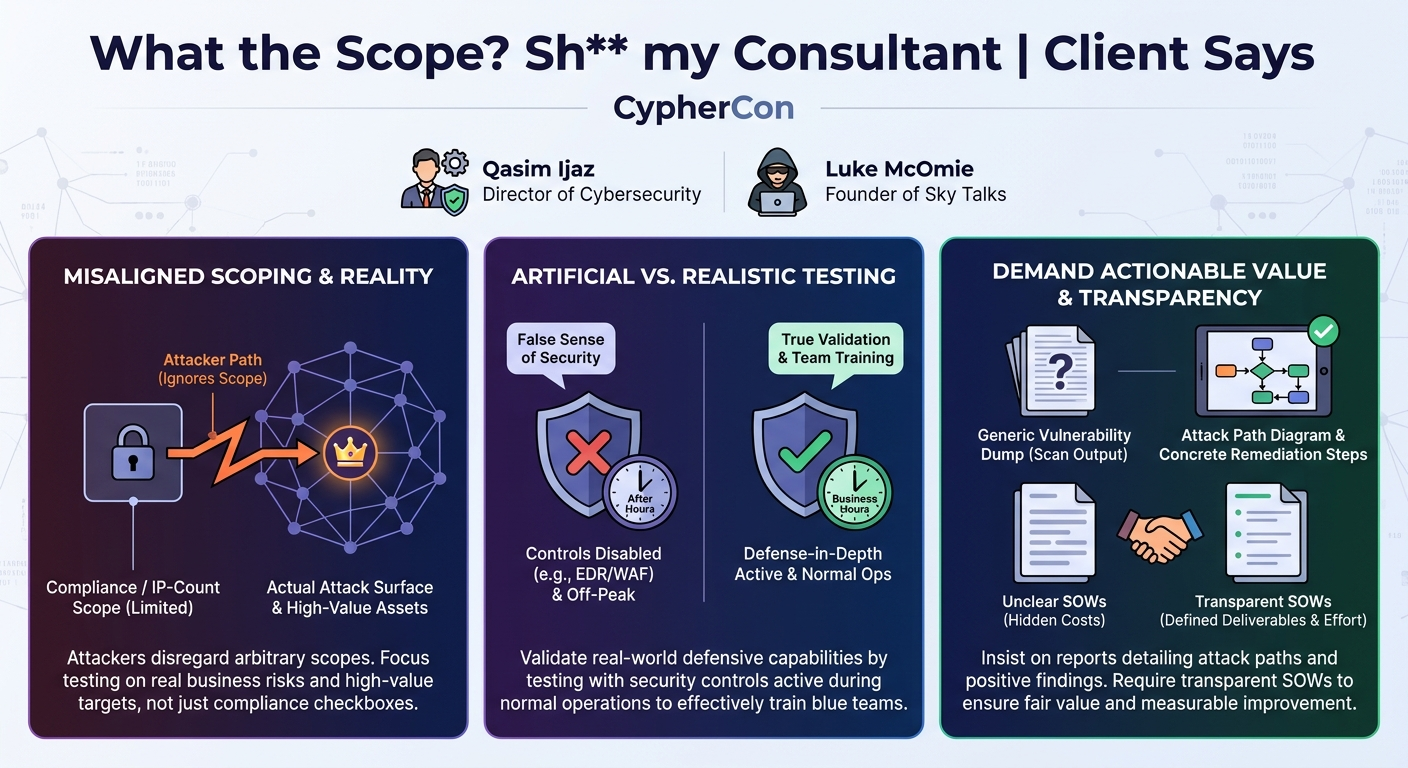
- Scoping Misconceptions Undermine Effectiveness: Both over-scoping and under-scoping are rampant. Over-scoping, such as defining an internal penetration test by the number of IP addresses, often leads to generic vulnerability scanning rather than targeted, realistic attack simulations. Under-scoping, particularly in compliance-driven assessments like PCI, limits testing to isolated enclaves, ignoring lateral movement paths from the broader, less secure network. The fundamental flaw is that malicious actors disregard predefined scopes (06:00).
- Maturity Mismatch Leads to Wasted Budget: Many organizations, despite lacking basic security hygiene (e.g., vulnerability scanning, foundational pen testing), demand advanced red teaming services. This premature escalation of testing results in expensive engagements that merely uncover fundamental vulnerabilities, wasting significant budget that could be better spent on foundational security (10:00).
- Compliance ≠ Security: Adhering to regulatory requirements (e.g., PCI) often represents the "least legal minimal viable solution" (09:00). Compliance-focused testing frequently fails to provide a true picture of an organization's overall security posture, as it prioritizes checkboxes over comprehensive risk assessment.
- The Detriment of Disabling Controls: Clients frequently ask consultants to disable security controls like Endpoint Detection and Response (EDR) or Web Application Firewalls (WAFs) during testing (16:00). While selective disabling might be justified for specific functional testing (e.g., a developer's application without WAF), a blanket disablement defeats the purpose of validating an organization's defense-in-depth strategy and real-world detection capabilities.
- The "Nobody Hacks Us" Fallacy Persists: Despite overwhelming evidence, some businesses still believe they are not targets (24:00). The speakers emphasize that any organization connected to the internet possesses resources (bandwidth, data) that are valuable to access brokers and threat groups, regardless of industry.
- Actionable Reporting is a Rarity: Many penetration test reports are criticized as generic vulnerability assessment dumps (28:00), often resembling a Nessus scan output with console screenshots. They frequently lack crucial details about how an attacker achieved compromise, the full attack path, and fail to highlight positive security measures (19:00) that the client has successfully implemented. Consultants withholding zero-day details for CVEs without client involvement is also a significant concern (26:00).
- MFA is Not a Panacea: While crucial, Multi-Factor Authentication (MFA) is often implemented without adequate user training or defense-in-depth, making it susceptible to social engineering bypasses (e.g., push fatigue, AI-driven social engineering) (30:00). The human element remains the weakest link.
- Risk Rating Discrepancies: Standardized CVSS scores often do not accurately reflect the real-world impact or exploitability of vulnerabilities within a specific organizational context. An example cited is lack of SMB signing and broadcast protocols, which might receive a low CVSS score (3.2-3.6) but can lead to Domain Administrator (DA) compromise in under 10 minutes (38:00). Risk ratings must be tailored to the client's environment and impact (40:00).
- Impact Aversion Creates Unrealistic Testing: Clients frequently impose severe restrictions on testing, such as limiting it to after-hours or requiring the shutdown of critical systems, due to fear of disruption (42:00). This creates an artificial testing environment that does not reflect real-world attack scenarios or user behavior.
- Lack of SOW Transparency Leads to Poor Value: Generic Statements of Work from consulting firms often obscure the actual time allocated to technical testing, reporting, project management, and quality assurance. This lack of transparency makes it impossible for clients to compare services effectively and often results in them paying premium prices for junior talent or minimal effort (48:00-52:00).
- The "Fresh Eyes" Trap: The common belief that organizations should switch security providers annually for "fresh eyes" is challenged. While new perspectives can be valuable, constant switching prevents the development of a programmatic security approach where maturity trends can be tracked and built upon year-over-year. Long-term partnerships allow consultants to gain deep environmental knowledge, leading to more efficient and impactful testing (54:00).
Technical Deep Dive
▶ Watch: Actionable reporting and knowledge transfer (26:00)
While the talk emphasizes strategic and process-oriented issues, it touches upon several technical concepts that underpin the speakers' arguments:
- Targeted Internal Pen Testing vs. Vulnerability Scanning: McOmie differentiates between a true internal penetration test and a mere vulnerability scan. A real pen test involves identifying and targeting high-value assets within a network, such as domain controllers, critical databases, or intellectual property stores, rather than indiscriminately scanning every IP address (07:00). This approach mimics a sophisticated attacker's methodology, focusing on impact.
- PCI Segmentation and Lateral Movement: The discussion on PCI compliance highlights the technical challenge of network segmentation. While designed to isolate cardholder data environments (CDEs), an exclusive focus on testing only the CDE and its segmentation controls often overlooks potential lateral movement paths from the less secure corporate network into the CDE. Attackers could exploit vulnerabilities outside the CDE to pivot into the supposedly isolated environment, a scenario missed by narrow scope (08:00).
- Operational Technology (OT) and Internet of Things (IoT) Security: The speakers delve into the unique challenges of OT environments, particularly in manufacturing. These often feature antiquated operating systems and hardware (e.g., 15-year-old systems) that are end-of-life, unsupported, and difficult to back up or replace (22:00). Despite being air-gapped from the internet, they remain vulnerable to malicious insiders or nation-state threats via physical vectors like USB drives (e.g., Stuxnet, Flame). The technical stagnation of OT contrasts sharply with the rapid advancement of IT security.
- MFA Bypass Techniques: The talk acknowledges the prevalence of MFA bypasses. Beyond simple user error (e.g., Jenny accepting a push notification without understanding its context), the speakers mention more sophisticated techniques, including social engineering facilitated by Large Language Models (LLMs). These AI models can craft convincing social engineering lures to trick users into providing MFA codes or confirmations (30:00). Ijaz specifically recommends moving towards fish-resistant MFA (34:00), implying methods like FIDO2/WebAuthn, which inherently resist phishing.
- Data Classification in the Age of AI: McOmie delivers a "rant" on the critical, yet often neglected, practice of data classification. He points out that while government standards (e.g., ISO, NIST, CIS v8.1) have long mandated data classification, many corporations fail to properly label documents, data shares, and data stores (32:00). The advent of AI tools like Copilot and ChatGPT exacerbates this problem. Without proper classification, sensitive or proprietary data fed into these LLMs can be exposed or misused, creating significant data leakage risks due to the "super early, super aggressive adopters" (33:00) of new, inadequately secured technology.
- Misinterpretation of Vulnerability Scores (CVSS): A key technical point is the disconnect between CVSS scores and actual risk. The example of lack of SMB signing and broadcast protocols in an Active Directory environment illustrates this. While often rated low (CVSS 3.2-3.6), these weaknesses can be trivially exploited using tools like Responder to capture credentials and perform relay attacks, leading to Domain Administrator (DA) compromise in under 10 minutes (38:00). The initial low score was due to the absence of easy-to-use attack tools at the time of discovery; however, these scores rarely get updated to reflect the evolution of exploitation techniques.
- Network Infrastructure Weaknesses: McOmie recounts an incident where a penetration test caused a bank's network to crash (43:00). The underlying technical issue was the use of hubs instead of switches for network infrastructure. When a traffic attack (likely a broadcast storm or excessive traffic generation) was initiated, the hubs mirrored all traffic to all connected devices, exhausting network resources and causing a denial of service. This exposed a critical, antiquated infrastructure component that had been neglected for 25 years.
- False Positives and Remediation: Ijaz provides a technical example of a false positive in a report: SSH servers deemed "critical" for being "open to the world" (34:00). Upon investigation, these servers utilized public/private key pairs and IP whitelisting, rendering them secure. Such technical inaccuracies in reporting erode trust and waste significant remediation efforts on non-issues.
Demo / Proof of Concept
▶ Watch: How vulnerability risk ratings mislead organizations (38:00)
The talk "What the Scope? Sh** my Consultant | Client Says" is primarily a conceptual and anecdotal presentation, drawing on the speakers' extensive real-world experiences and observations. It does not feature a live demonstration or a technical proof of concept in the traditional sense. Instead, the speakers rely on compelling stories and examples from their careers to illustrate the common pitfalls and effective strategies discussed.
Defensive Implications
▶ Watch: Career advice: focus on hands-on experience (60:30)
The insights shared by McOmie and Ijaz offer critical guidance for security defenders looking to maximize the value of their offensive security investments:
- Prioritize Risk-Based Scoping: Defenders must move beyond compliance-only or IP-count-based scoping. Instead, focus on high-value assets, critical business processes, and the most impactful attack scenarios that keep executives "up at night" (14:00). Be transparent with consultants about budget and what truly matters to the business.
- Validate Defense-in-Depth, Don't Disable Controls: Resist the urge to disable security controls like EDR or WAF for testing. While specific, limited disablement might be justified for certain test objectives (e.g., application logic without WAF), the default should be to test against real-world conditions with all controls active. This approach validates the effectiveness of the entire defense-in-depth strategy and trains blue teams to detect and respond to actual threats (16:00).
- Demand Actionable, Contextual Reporting: Insist on reports that go beyond generic vulnerability lists. Reports should clearly articulate the attack paths used, explain how vulnerabilities were exploited, and provide concrete, actionable remediation steps. Crucially, reports should also highlight positive security measures (19:00) and progress made, demonstrating ROI to executives. Consultants should not withhold details about zero-days or attack methodologies from the client (26:00).
- Tailor Risk Ratings to Your Context: Do not blindly accept generic CVSS scores. Work with consultants to re-evaluate and tailor vulnerability risk ratings based on your organization's specific environment, existing compensating controls, and actual business impact. A low CVSS score (e.g., SMB signing) might be a critical risk for your network (40:00).
- Embrace Realistic Testing Conditions: Allow penetration tests to occur during business hours and under real-world operating conditions where users, devices, and traffic are active. This provides a far more accurate assessment of security posture and offers invaluable opportunities to train internal blue teams and network operations teams by observing live attack traffic and detection events (46:00). Avoid artificially changing the security posture before or during testing (47:00).
- Scrutinize Statements of Work (SOWs): Demand complete transparency in SOWs. These documents should clearly detail the time allocated to each phase of the assessment (e.g., technical testing, reporting, project management, QA), the level of expertise of the personnel performing the work, and the specific deliverables (48:00-52:00). This enables informed decision-making and ensures fair value for money.
- Adopt a Programmatic Security Approach: Instead of annual, point-in-time penetration tests with rotating vendors, consider establishing a programmatic, ongoing security assessment strategy with a trusted partner. This allows for continuous improvement, tracking of security maturity trends year-over-year, and better return on investment by building upon previous findings and environmental knowledge (54:00).
- Foster Transparency and Collaboration: Proactively share internal intelligence with your consultants, such as BloodHound data, Nessus scan results, and asset inventories. This "white box" approach allows consultants to bypass initial reconnaissance, focus directly on high-impact testing, and deliver more efficient and effective results (53:00).
- Beyond New Technology: Basic Block and Tackle: Don't get swept up in the hype of the newest security technologies (e.g., "AI-enabled workforce"). Re-emphasize foundational security practices like data classification (ISO, NIST, CIS v8.1) and continuous user security awareness training (32:00). These basic controls often prevent sophisticated attacks and mitigate the risks associated with new, rapidly adopted technologies.
- Invest in Fish-Resistant MFA: Move beyond basic push-notification MFA to more robust, fish-resistant MFA solutions (e.g., FIDO2/WebAuthn) to counter sophisticated social engineering and phishing attacks (34:00).
Key Takeaways
- Strategic Scoping is Paramount: Define penetration test scopes based on actual business risk, budget, and high-value targets, rather than arbitrary IP counts or minimal compliance requirements. Attackers don't respect scope.
- Demand Actionable & Transparent Reports: Insist on reports that clearly detail attack paths, methodologies, and provide specific remediation steps. Reports should also highlight positive security controls and progress, serving as a teaching tool for internal teams.
- Test in Real-World Conditions: Validate defense-in-depth by testing with security controls active and during normal business hours. Use these engagements to actively train and mature your internal blue and network teams.
- Budget Drives Security Investment: Recognize that budget is the primary constraint for any security program. Consultants and clients must be transparent about financial limitations to ensure investments are prioritized for maximum measurable value.
- Scrutinize Consultant Transparency: Demand detailed Statements of Work (SOWs) that outline time allocation, expertise levels, and deliverables for each stage of an assessment to ensure fair value and competitive comparison.
- Embrace Programmatic Security: Move away from annual, point-in-time assessments with rotating vendors. A programmatic approach with a consistent, trusted partner allows for continuous improvement, better trend tracking, and deeper environmental understanding over time.
About the Speaker(s)
Luke McOmie (known as "Pyro") is a highly experienced offensive security professional with decades of experience in penetration testing and professional consulting. He is the founder of Sky Talks and has a long history as a Defcon goon for 23 years. McOmie is recognized as one of the "303 guys" from Colorado, known for their contributions to the security industry. His insights are drawn from extensive hands-on experience in breaking into diverse environments.
Qasim Ijaz (known as "Q") brings a dual perspective to the security landscape. He currently serves as the Director of Cybersecurity at a healthcare company, where he oversees both red (offensive) and blue (defensive) security teams. Prior to this role, Ijaz worked as a security consultant, giving him a unique understanding of the challenges and expectations from both the service provider and client viewpoints. He is also actively involved in teaching and community engagement, including with Encompass.
Reviews
Dr. Zero (Offensive Security Researcher) — SOLID
This is a necessary therapy session for the industry, but let's be honest: we've been shouting 'compliance isn't security' since the early 2000s. McOmie and Ijaz do a solid job dismantling the garbage penetration testing complex, but if you're a seasoned practitioner, you already know this script. Good medicine for a director buying their first assessment, but background noise for the rest of us.
Heather Calloway (CISO) — MUST SEE
This session is a necessary audit of how we waste budget on offensive security engagements. The speakers correctly identify that bad scoping and generic SOWs represent a failure of vendor management, not just a failure of testing. It's required viewing for anyone who approves third-party security assessments or manages compliance-driven testing.