Beyond the Firewall: Responding to Cyber Incidents in Industrial Control Systems
Chriss Hansen
Overview
In his CypherCon talk, "Beyond the Firewall: Responding to Cyber Incidents in Industrial Control Systems," Chriss Hansen delivers a critical examination of incident response (IR) methodologies within Operational Technology (OT) and Industrial Control Systems (ICS) environments. Hansen, a seasoned security operations manager and incident response lead, highlights the profound differences between responding to cyber incidents in traditional IT networks versus the highly specialized and often physically impactful world of OT. The talk underscores that while foundational IR theories remain consistent, their application in OT demands a "safety first" approach, deep domain expertise, and a keen awareness of the potential for real-world physical consequences, ranging from infrastructure disruption to loss of life.
Key moments
- 2:30 Laying groundwork: Industrial control systems hacks history
- 18:00 Key difference: IT vs. OT incident response speed and recovery
- 26:00 Understanding OT's availability priority in incidents
- 32:00 Geopolitical conflicts driving cyber warfare in OT
- 36:00 Proactive defense: Validating OT environments with purple teaming
- 39:00 Challenges of OT penetration testing and passive reconnaissance
- 46:00 Local resources: Free incident response from Wisconsin Cyber Response Team
- 52:00 Q&A: Why active network scans fail in OT environments
Beyond the Firewall: Responding to Cyber Incidents in Industrial Control Systems
Speakers: Chriss Hansen, Security Operations Manager, Veolia North America & Co-founder, Aetherwolf Security
Conference: CypherCon
YouTube: https://www.youtube.com/watch?v=A9CGlaUEahM
Overview
In his CypherCon talk, "Beyond the Firewall: Responding to Cyber Incidents in Industrial Control Systems," Chriss Hansen delivers a critical examination of incident response (IR) methodologies within Operational Technology (OT) and Industrial Control Systems (ICS) environments. Hansen, a seasoned security operations manager and incident response lead, highlights the profound differences between responding to cyber incidents in traditional IT networks versus the highly specialized and often physically impactful world of OT. The talk underscores that while foundational IR theories remain consistent, their application in OT demands a "safety first" approach, deep domain expertise, and a keen awareness of the potential for real-world physical consequences, ranging from infrastructure disruption to loss of life.
The presentation serves as a stark reminder that the stakes in OT security are exponentially higher than in typical IT breaches. Hansen meticulously builds a case for why organizations must overhaul their security strategies, emphasizing the urgent need for robust segmentation, comprehensive visibility, and collaborative efforts between IT and OT teams. By revisiting landmark ICS attacks like Colonial Pipeline, Stuxnet, and NotPetya, he illustrates the evolving threat landscape and the increasingly sophisticated tactics employed by nation-states and cybercriminals, who are now specifically targeting the unique vulnerabilities of industrial systems. This talk is essential for any cybersecurity professional grappling with the complexities of securing critical infrastructure and industrial processes.
Background
▶ Watch: Laying groundwork: Industrial control systems hacks history (2:30)
Hansen initiates his discussion by grounding the audience in the grim history of significant cyber incidents impacting industrial control systems, establishing a crucial context for the unique challenges of OT incident response. He begins with the Colonial Pipeline attack in 2021, a ransomware incident that caused an estimated $4.4 million in damages and led to a national emergency across 17 U.S. states due to fuel shortages. This event underscored the critical need for segmenting IT and OT networks, as many organizations at the time had fully integrated environments, allowing easy lateral movement for attackers. The Colonial Pipeline incident highlighted the lack of visibility into OT networks and the devastating physical implications of cyberattacks on critical infrastructure, moving beyond mere data theft to tangible disruptions in daily life.
The narrative then shifts to Stuxnet, a groundbreaking cyberweapon discovered in 2010. Stuxnet was the first recorded instance of cyber warfare causing physical damage on a global scale, destroying approximately 1,000 centrifuges in Iran's nuclear program. Hansen emphasizes that Stuxnet fundamentally altered the understanding of cyberattacks, proving that theoretical physical harm could become a devastating reality. This sophisticated attack, developed over months, continuously pushed the boundaries of physical damage, revealing a new era of state-sponsored cyber capabilities.
Following Stuxnet, Hansen delves into NotPetya (2017), an attack estimated to have caused $10 billion in damages. NotPetya marked a significant shift from traditional ransomware, which focused on extortion and encryption, to a pure wiper designed for destruction. Primarily targeting Ukrainian networks, NotPetya spread globally within 24 to 48 hours, crippling hospitals, banks, and major corporations like Maersk. Hansen shares an intriguing detail: early research suggested the malware would not encrypt systems with Russian language packs installed, indicating its nation-state origin (widely attributed to Russia) and specific targeting. The Maersk recovery story, involving shipping a single surviving domain controller across the world, exemplifies the catastrophic scale and recovery challenges posed by such wipers.
Hansen attributes the escalating threat landscape to the sheer profitability of cybercrime, noting that if it were a country, cybercrime would rank as the third-largest GDP globally, surpassing many national economies. This economic incentive fuels a dedicated and collaborative network of cybercriminals, necessitating a robust and specialized approach to incident response in OT environments. The historical progression of these attacks – from financial extortion to physical damage and outright destruction – lays the groundwork for understanding why OT incident response cannot simply mirror IT practices.
Key Findings
▶ Watch: Understanding OT's availability priority in incidents (26:00)
Hansen's talk reveals several key findings concerning the distinct nature of incident response in OT environments, fundamentally differentiating it from traditional IT security. The core insight is that while the underlying principles of investigation (root cause analysis, anomaly detection) remain consistent, the execution and priorities diverge significantly when dealing with industrial control systems.
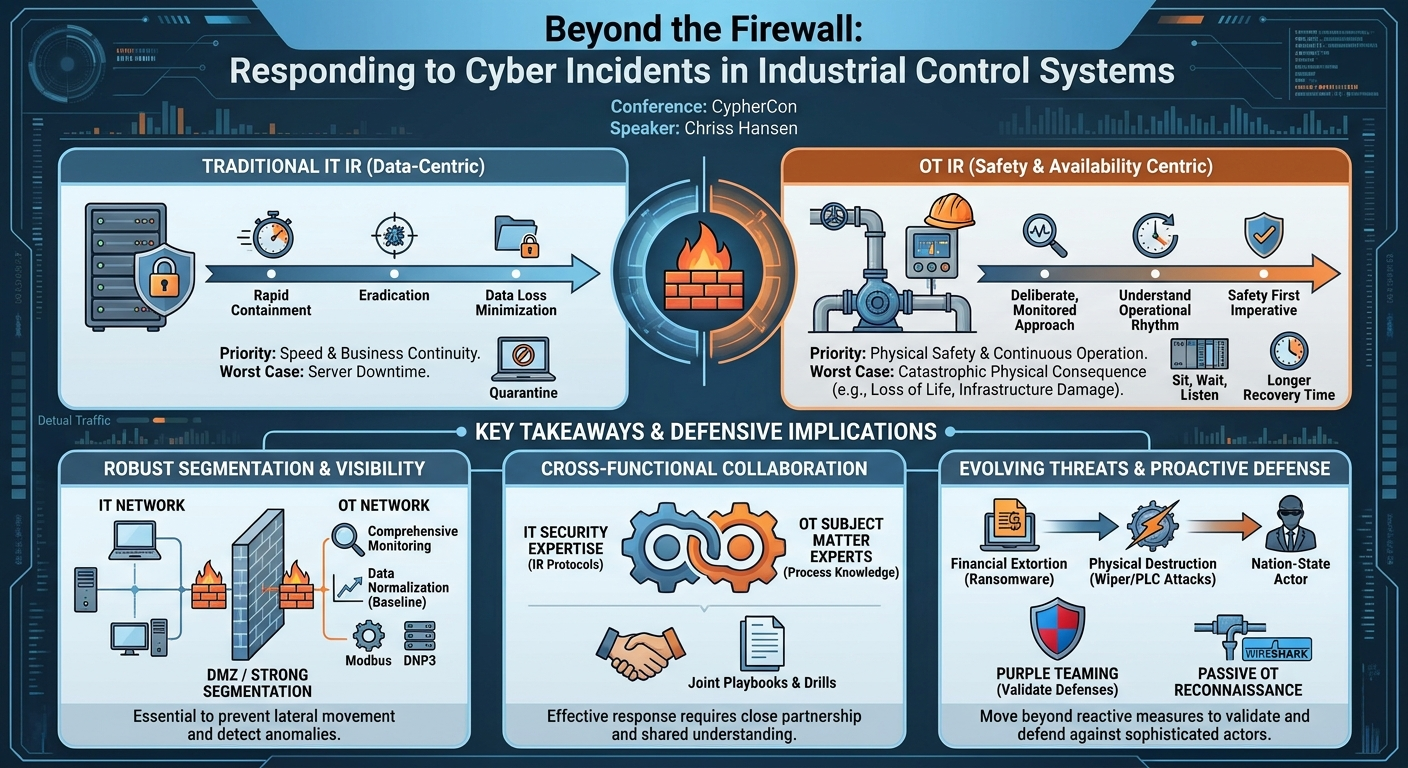
- Divergent Incident Response Priorities: In IT, speed is paramount; rapid containment and eradication are critical to minimize data loss and business disruption. In OT, however, the primary concern is availability and safety. Quarantining a system too quickly without understanding its operational rhythm can lead to catastrophic physical consequences, including fires, equipment damage, or even loss of human life. Therefore, OT incident response often necessitates a more deliberate, "sit, wait, listen, and understand" approach, leading to longer recovery times (e.g., Colonial Pipeline took two weeks for full operational recovery, despite cyber issues being resolved in days).
- The "Safety First" Imperative: Hansen repeatedly emphasizes that "the worst day in IT is a server dies," while "the worst day in OT is someone could die." This stark contrast highlights that complacency in OT is unacceptable. Every action in an OT incident must prioritize physical safety and continuous operation, even if it means accepting a prolonged presence of an adversary under strict monitoring.
- Criticality of Segmentation and Visibility: The Colonial Pipeline incident starkly exposed the dangers of integrated IT/OT networks. Hansen advocates for robust segmentation (beyond simple VLANs), DMZs, and comprehensive monitoring to gain visibility into OT networks. Knowing what's on the network and establishing a baseline of "normal" behavior is foundational for detecting anomalies and responding effectively.
- The Need for Joint IT/OT Teams: Effective OT incident response demands close collaboration between IT security professionals and OT subject matter experts. OT personnel possess invaluable knowledge of industrial processes, system normalization, and operational implications, while IT teams bring expertise in incident response protocols and methodologies. Hansen stresses the importance of running joint playbooks and practice drills to ensure seamless coordination.
- Evolving Threat Actor Sophistication: While many initial compromises in OT might be from "script kiddies" who gain access but don't know how to leverage OT systems (rendering them a "low" threat despite persistence), Hansen warns of a growing trend of nation-state actors and advanced threat groups specifically targeting PLCs and other OT components. The recent Poland energy grid attack, which directly targeted PLCs and manipulated operational reporting to show "all clear" while systems were failing, exemplifies this elevated sophistication and malicious intent.
- Passive and Deliberate OT Pentesting: Unlike aggressive IT penetration tests, OT pentesting requires a highly passive and cautious approach. Active scans can destabilize finicky legacy systems. Instead, methodologies focus on passive listening (Wireshark), understanding protocols (Modbus, DNP3, OPC, MQTT), and identifying vulnerabilities in specific PLC versions. The goal is to identify weaknesses without risking operational disruption, often relying on vulnerability assessments rather than live exploitation.
These findings collectively paint a picture of an OT security domain that demands specialized knowledge, a different risk calculus, and a deeply integrated, safety-conscious operational approach to incident response.
Technical Deep Dive
▶ Watch: Proactive defense: Validating OT environments with purple teaming (36:00)
The technical core of Hansen's talk lies in dissecting the incident response lifecycle through the dual lenses of IT and OT, highlighting where methodologies converge and diverge. He explains that while the foundational investigation theory remains the same—preparation, identification, containment, eradication, recovery, and lessons learned—the practical application varies drastically.
In IT environments, incident response is characterized by speed and aggressive containment. If an anomaly is detected, immediate quarantine of affected systems is often the default action to prevent further spread or data exfiltration. This rapid reaction is crucial given the instantaneous nature of modern threats like info-stealers and MFA bypass techniques.
Conversely, OT incident response is inherently more deliberate. Hansen uses the analogy of a Programmable Logic Controller (PLC), which "does one thing and does it really well," like a perfect Wii baseball pitcher. These devices often operate in precise sequences (A, B, C, D). Disrupting one component through premature quarantine can have cascading and catastrophic physical effects, potentially leading to fires, equipment damage, or loss of life. Therefore, the immediate reaction of containment is often replaced by a phase of careful monitoring and understanding before any action is taken. Recovery times in OT are also significantly longer, not just for cyber remediation but for restoring physical operations, as seen with Colonial Pipeline's two-week recovery.
Hansen introduces key OT terminology:
- PLCs (Programmable Logic Controllers): Industrial computers that control specific processes, often performing repetitive tasks with high reliability.
- HMIs (Human Machine Interfaces): Touchscreens or graphical interfaces that allow operators to interact with and monitor industrial machinery.
- SCADA (Supervisory Control and Data Acquisition) networks: Systems used for controlling and monitoring industrial processes remotely.
- IACS (Industrial Automation and Control Systems): A broader term encompassing various control systems and their associated instrumentation.
He discusses common OT protocols like Modbus, DNP3, OPC, and MQTT. MQTT, in particular, is noted for its use in IoT devices and its potential for data transfer, emphasizing the need for normalization and monitoring of such traffic to detect anomalies, especially from devices like cameras.
A crucial technical point is the "severity escalation" thought exercise. Hansen illustrates that an external actor gaining unauthorized access and persistence to a SCADA device in a production water filtration facility, while seemingly critical in an IT context, might be deemed "low" severity in OT if the actor lacks the specialized knowledge to leverage that access for physical disruption. This highlights that many threat actors, born after Y2K, are unfamiliar with legacy OT systems (Windows 7, XP) and their unique operational logic, making specialized expertise a significant defensive advantage. However, this advantage is eroding.
The talk details the Poland energy grid attack as a prime example of evolving threat sophistication. This attack was notable for directly targeting PLCs and employing a wiper malware that provided false "all clear" reports to operators while causing actual outages. This "loss of view" capability is particularly insidious, as it undermines the trustworthiness of monitoring dashboards, forcing responders to validate system status through physical presence—a significant challenge for geographically dispersed infrastructure.
Hansen strongly advocates for purple teaming as a proactive security measure. This methodology involves red teams (attackers) and blue teams (defenders) working collaboratively with an exercise coordinator to validate environmental defenses. Using tools like Scythe, an open-source platform for emulation and testing, organizations can simulate real-world threat actor TTPs (Tactics, Techniques, and Procedures), map them to frameworks like MITRE ATT&CK or NIST, and continuously refine detection and prevention capabilities. The emphasis is on practical validation over theoretical assumptions, documenting accepted risks, and implementing compensating controls.
OT pentesting is presented as a highly specialized and cautious endeavor. Unlike IT pentests that might involve aggressive port scanning, OT pentesting often relies on passive reconnaissance, using tools like Wireshark to listen to network traffic and identify protocols, operating systems, and potential vulnerabilities without risking system instability. The goal is to define specific scopes, such as pivoting from IT to OT, rather than broad, disruptive scans. Hansen notes that legacy OT equipment, while often seen as a vulnerability, can sometimes be a "saving grace" because many modern threat actors lack the expertise to exploit older systems.
Finally, Hansen teases future work on man-in-the-middle (MiTM) malware for Modbus, developed with fellow OT specialist Oriniskin. This malware can mirror operational information, making systems appear healthy while physical processes are being disrupted (e.g., water overflowing at a substation). This highlights the ongoing evolution of threats specifically designed to deceive OT operators and underscores the urgent need for advanced detection and validation mechanisms.
Demo / Proof of Concept
▶ Watch: Challenges of OT penetration testing and passive reconnaissance (39:00)
While this particular talk does not feature a live demonstration, Chriss Hansen teases a future presentation that will include a live attack and defense demonstration related to Operational Technology. He mentions collaborating with another OT specialist, Oriniskin, on developing man-in-the-middle (MiTM) malware specifically for Modbus protocols.
This prospective demo would showcase how such malware could mirror operational information, presenting a deceptive "all clear" status on control dashboards while actual physical processes are being disrupted. As Hansen describes, this could mean "life is good, everything's on your power grid is great," while in reality, a water substation is overflowing or cities are being flooded. The intent is to illustrate the critical challenge of loss of view and the inability to trust normalized data when an adversary is actively manipulating telemetry. While not part of this talk, the concept of this future demo serves to highlight a significant emerging threat vector in OT environments.
Defensive Implications
▶ Watch: Q&A: Why active network scans fail in OT environments (52:00)
The insights shared by Chriss Hansen offer critical guidance for defenders operating in or adjacent to OT environments, emphasizing a strategic overhaul rather than incremental adjustments. The primary defensive implications revolve around establishing robust foundational security, fostering collaboration, and adopting specialized methodologies.
- Strict IT/OT Segmentation and DMZs: The most fundamental defense is to enforce strict network segmentation between IT and OT environments, going beyond basic VLANs to implement robust isolation and DMZs (Demilitarized Zones). This prevents lateral movement from compromised IT systems into critical OT infrastructure, a lesson learned painfully from incidents like Colonial Pipeline.
- Comprehensive Visibility and Normalization: Defenders must establish comprehensive monitoring and visibility into their OT networks. This involves identifying all devices, understanding their normal operational behavior, and normalizing data to create baselines. Without a clear understanding of what "normal" looks like, detecting anomalies and malicious activity is nearly impossible. This includes monitoring OT-specific protocols like Modbus, DNP3, OPC, and MQTT.
- Cross-Functional IT/OT Collaboration: Building strong, collaborative relationships between IT security teams and OT subject matter experts is paramount. IT professionals bring incident response expertise, while OT personnel provide critical operational context. Joint playbook development, practice drills, and regular audits are essential to ensure both teams understand their roles, communication protocols, and the unique priorities of OT (safety and availability).
- Adopt a "Safety First" Incident Response Philosophy: Defenders must internalize that in OT, physical safety and system availability supersede rapid containment. Incident response playbooks for OT should prioritize understanding the operational impact and potential physical consequences before initiating any disruptive actions like quarantining. This often means a more deliberate, monitored approach to containment.
- Proactive Security Through Purple Teaming: Implementing purple teaming exercises is a highly effective proactive measure. By simulating real-world threat actor TTPs (using tools like Scythe) against OT environments, organizations can validate their existing defenses, identify gaps, build specific detection capabilities, and document accepted risks. This continuous feedback loop strengthens both red and blue teams.
- Specialized OT Penetration Testing: Traditional IT pentesting methods are often too aggressive and can destabilize finicky OT systems. Defenders should insist on passive reconnaissance techniques for OT pentests, focusing on listening to network traffic (e.g., with Wireshark), identifying protocols, and assessing vulnerabilities without active exploitation. Scoping must be precise, prioritizing the identification of IT-to-OT or OT-to-IT pivot points.
- Address Legacy System Challenges and Advantages: While legacy equipment can be vulnerable, it also presents a unique defensive advantage due to many modern threat actors' unfamiliarity with older operating systems (Windows 7, XP) and industrial hardware. However, defenders must still identify and mitigate known vulnerabilities where possible, and implement compensating controls for unpatchable systems.
- Geopolitical Awareness and Threat Intelligence: Given the increasing intertwining of cyber and state actions, defenders must stay acutely aware of geopolitical conflicts. Hansen notes a 44% increase in attacks from Iran on US infrastructure since the Middle East conflict began. Organizations should adjust security strategies to proactively monitor global events, potentially implementing measures like geo-fencing or targeted threat intelligence to pre-empt attacks from specific nation-state actors or activists.
- Leverage External Resources: Organizations, especially government entities or underfunded sectors, should leverage free resources like the Wisconsin Cyber Response Team for incident response, proactive security assessments, and playbook validation. This external support can be crucial for building resilience against evolving threats.
By adopting these defensive implications, organizations can move "beyond the firewall" to build a more resilient and safety-conscious security posture for their critical industrial control systems.
Key Takeaways
- OT Incident Response Prioritizes Safety and Availability: Unlike IT, where speed is paramount, OT incident response must prioritize physical safety and continuous operation, often necessitating a deliberate, cautious approach to avoid catastrophic physical consequences.
- Robust Segmentation is Non-Negotiable: Strict network segmentation and DMZs between IT and OT environments are essential to prevent lateral movement of threats and protect critical industrial processes. Simple VLANs are insufficient.
- Visibility and Data Normalization are Foundational: Comprehensive monitoring of OT networks, understanding normal operational baselines, and normalizing data are critical for detecting anomalies and responding effectively to threats.
- Collaboration Between IT and OT is Crucial: Effective OT security requires close partnership between IT security teams and OT subject matter experts, supported by joint playbooks, training, and regular audits.
- Proactive Security (Purple Teaming) is Essential: Employing purple teaming methodologies to simulate real-world attacks and continuously validate defenses is key to building resilience against sophisticated adversaries.
- Geopolitical Context Drives Cyber Threats: Global conflicts directly influence the cyber threat landscape, requiring organizations to actively monitor geopolitical events and adjust their security strategies to anticipate and defend against emerging nation-state and activist threats.
About the Speaker(s)
Chriss Hansen is a prominent figure in cybersecurity, specializing in industrial control systems and incident response. He currently serves as a Security Operations Manager at Veolia North America, where he works with energy services and other critical infrastructure. Beyond his corporate role, Hansen is a co-founder of Aetherwolf Security, a company offering OT assessments and pentesting services.
His commitment to community and public service is evident in his role as an Incident Response Lead for the Wisconsin Cyber Response Team, where he assists state, local, tribal, and territorial entities with cyber incidents ranging from ransomware to phishing, often free of charge. Additionally, Hansen contributes to the US Coast Guard Auxiliary and advises DC 608, the local Madison Defcon group, focusing on education, incident response, and cybersecurity. He is a strong advocate for proactive security measures like purple teaming and emphasizes the critical importance of a "safety first" mindset in OT environments.
Reviews
Dr. Zero (Offensive Security Researcher) — SOLID
Competent but painfully basic. Hansen knows his domain, but giving another OT talk that rehashes Stuxnet, NotPetya, and Colonial Pipeline is the ICS equivalent of a 'Hello World' tutorial. If you've never spelled SCADA before, it's useful; if you do this for a living, you can sleep in.
Heather Calloway (CISO) — SOLID
This is a foundational briefing on why standard IT incident response playbooks will cause physical disasters if blindly applied to operational technology (OT). It provides a practical framework for bridging the IT/OT divide, making it required viewing for any security leader who has recently inherited a manufacturing floor, utility, or critical infrastructure environment.