Don’t waste your time (in this talk)
Jeremy Bauer
Overview
In his CypherCon talk, "Don’t waste your time (in this talk)," Jeremy Bauer, the CISO at Molson Coors, challenges conventional wisdom in cybersecurity by arguing that many commonly implemented controls are "dumb" and fail to genuinely reduce risk. Bauer leverages his two decades of experience in information security to advocate for a paradigm shift: moving away from a checklist mentality and isolated control deployment towards a holistic, system-oriented approach that prioritizes measurable outcomes, human behavior, and attacker adaptation. The central thesis is that security professionals often waste time and resources on controls that don't work, or even create new problems, because they measure the wrong things and fail to understand the complex interactions within their organizational ecosystem.
Key moments
- 2:16 Introduction and core thesis: effective controls.
- 3:20 What makes a security control 'dumb'?
- 10:00 How to truly measure control effectiveness.
- 12:00 Four behaviors of smart, effective security controls.
- 26:00 Replacing 'dumb' controls with smarter alternatives.
- 31:20 Key metrics for measuring control effectiveness.
- 32:40 Reasons why 'dumb' controls are still implemented.
- 34:50 Q&A: Intrinsic motivation for security behavior.
Don’t waste your time (in this talk)
Speakers: Jeremy Bauer, CISO, Molson Coors
Conference: CypherCon
YouTube: https://www.youtube.com/watch?v=Mt7WJYseQGY
Overview
In his CypherCon talk, "Don’t waste your time (in this talk)," Jeremy Bauer, the CISO at Molson Coors, challenges conventional wisdom in cybersecurity by arguing that many commonly implemented controls are "dumb" and fail to genuinely reduce risk. Bauer leverages his two decades of experience in information security to advocate for a paradigm shift: moving away from a checklist mentality and isolated control deployment towards a holistic, system-oriented approach that prioritizes measurable outcomes, human behavior, and attacker adaptation. The central thesis is that security professionals often waste time and resources on controls that don't work, or even create new problems, because they measure the wrong things and fail to understand the complex interactions within their organizational ecosystem.
Bauer's presentation is a call to action for security leaders to critically evaluate their existing control sets and adopt a more strategic, outcome-driven methodology. He proposes a framework for assessing controls based on their impact on user behavior, their resilience to evolving threats, and their ability to function effectively within a dynamic environment. By focusing on "fewer, more effective controls designed with the whole system in mind," Bauer asserts that organizations can achieve better security posture, optimize resource allocation, and ultimately save valuable time and effort in the constant battle against cyber threats. This talk is highly relevant for any security professional grappling with the efficacy of their security investments and seeking to build a more adaptable and truly resilient defense.
Background
▶ Watch: Introduction and core thesis: effective controls. (2:16)
Bauer opens his talk by sharing a personal journey of implementing "dumb controls" over his 20-year career in information security. He highlights the pervasive issue of security measures that are technically correct but practically ineffective, often leading to a cycle of repeated incidents despite significant investment. A prime example cited is the Log4j vulnerability, a widespread supply chain attack that exposed critical flaws in how organizations manage third-party code. Bauer notes the ironic response from some security vendors claiming their AI stopped an "AI attack," when in reality, it was a fundamental supply chain failure exacerbated by automated updates without proper change control and excessive permissions. This illustrates a core problem: a disconnect between a control's intended purpose and its actual impact within a complex system.
The fundamental issue, according to Bauer, is that many security problems are not new but rather "the same problem over and over again," consistently violating basic security principles. He defines risk as "the probability that you incur a loss," a combination of vulnerabilities, threats, event frequencies, and loss magnitude. A control, by this definition, is something that reduces risk. Consequently, a "dumb control" is one that does not actually reduce risk, despite being implemented. Bauer recounts an anecdote from his time at Foot Locker with a colleague, John, where they debated the "technically correct" answer to a security problem versus a solution that would actually work in practice. This experience underscored his realization that security teams often prioritize controls that "make us feel good" or satisfy a technical ideal, rather than those that genuinely move the needle on risk reduction.
He uses the example of a security incident where someone installed unauthorized software. The typical "dumb" responses often include disabling software installation entirely or implementing more user training. Bauer argues that these responses, while seemingly logical, often fail because they don't account for the broader system or human behavior. He further illustrates this with the concern over generative AI tools potentially exfiltrating intellectual property (IP). A common response might be to block unsanctioned AI tools via a web proxy. While this might show a reduction in "hits" to these tools (e.g., from 1,700 down to zero), users will inevitably bypass the control by using personal devices, home computers, or even integrated development environment (IDE) add-ons. This "solution" then creates new, unaddressed risks like increased cloud costs, shadow IT, and data loss prevention (DLP) problems, effectively turning one risk into four. This highlights the critical flaw in measuring control effectiveness purely by deployment or configuration, rather than by its true impact on the overall risk landscape.
Key Findings
▶ Watch: How to truly measure control effectiveness. (10:00)
Bauer's core message is that effective security requires a fundamental shift in how organizations perceive and implement controls. He identifies several key findings that underpin his argument against "dumb controls":
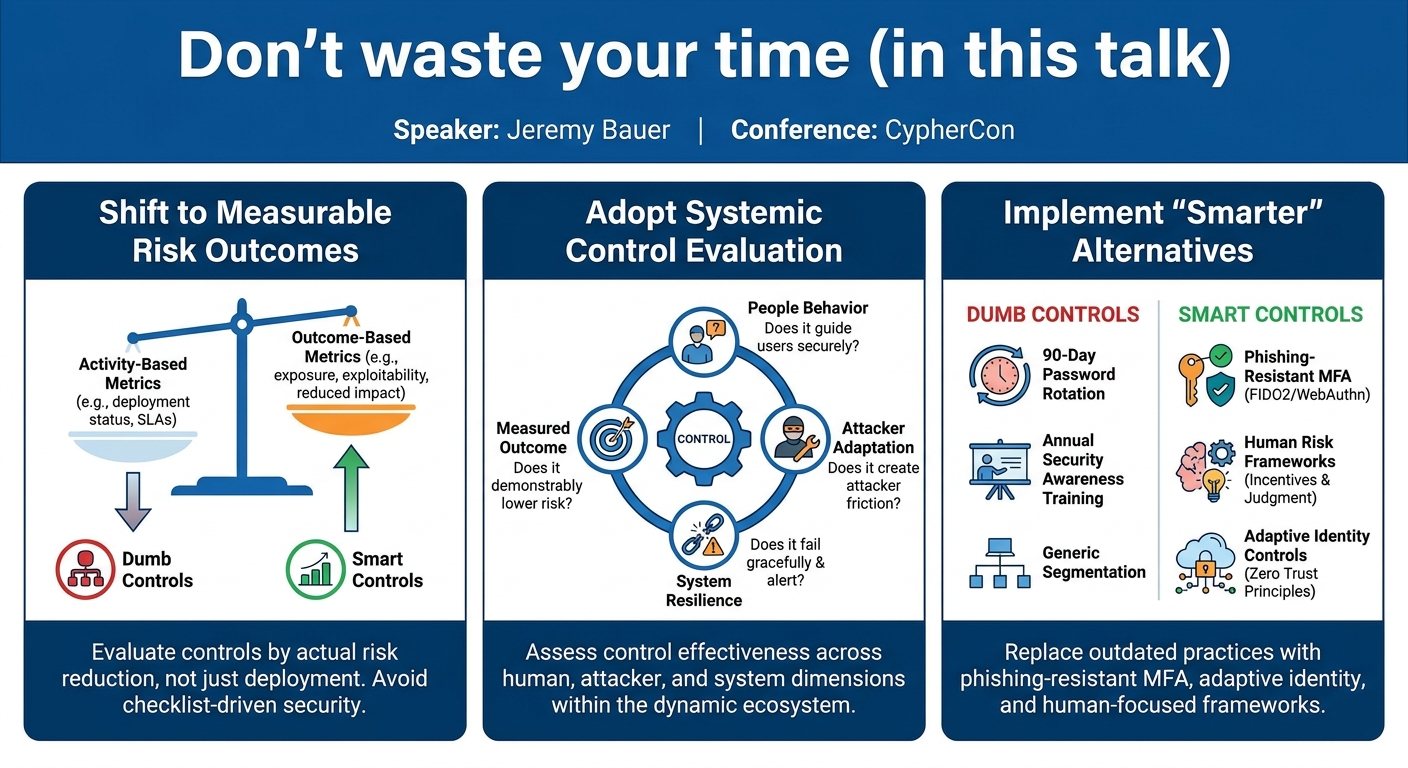
- Controls Must Be Evaluated by System-Wide Outcome, Not Local Optimization: The most critical finding is that controls should not be assessed in isolation or based on their mere deployment status. Instead, their effectiveness must be measured by whether the "system is actually seeing less risk." This means moving beyond metrics like "control deployed (check)" or "configured as designed (check)" to understanding the actual reduction in the probability or impact of negative events. He emphasizes that controls operate within a dynamic ecosystem where people are busy, attackers are adapting, and system conditions are constantly changing or degrading.
- Four Dimensions of a "Smart" Control: Bauer proposes a comprehensive framework for evaluating controls based on four critical aspects:
- People Behavior: How users react to the control. Do they bypass it? Does it guide them towards a secure path naturally?
- Attacker Adaptation: How attackers change their tactics in response to the control. Does the control create expected friction for adversaries, or is it easily circumvented?
- Resilience to System Issues: How the control performs under stress or when underlying systems break. Does it fail gracefully and alert on its failure?
- Measured Outcome Against Risk: Does the control genuinely reduce the probability of an incident, lessen its impact, or speed up recovery?
- The System Always Pushes Back (Feedback Loops and Time Delays): Controls do not exist in a vacuum. They interact with people, other systems, and the dynamic environment. This interaction creates feedback loops – both reinforcing (snowballing effects, like automation leading to more time for automation) and balancing (controls counteracting risk, but also potentially leading to less perceived need for controls). Critically, time delays hide failure, meaning that the negative consequences of a poor control decision made today might not manifest for months or even years, leading to a false sense of security (e.g., budget cuts, firewall rule erosion).
- Not Everything Needs a Technical Control; Trust is a Cost: Bauer argues that an over-reliance on technical or procedural controls often stems from a lack of trust in people, which can slow down operations. He introduces the concept of smart trust, which is an investment in human judgment. Instead of imposing controls, organizations can foster better security by:
- Clarifying decision rights: Who is empowered to make which decisions?
- Aligning incentives: Guiding human behavior towards secure practices through recognition and motivation, rather than punishment.
- Changing success metrics: Shifting from activity-based metrics (e.g., patching SLAs) to outcome-based metrics (e.g., exposure and exploitability).
These findings collectively urge security professionals to adopt a more critical, analytical, and system-level perspective on their security posture, moving beyond superficial compliance to genuine risk reduction.
Technical Deep Dive
▶ Watch: Replacing 'dumb' controls with smarter alternatives. (26:00)
Bauer's technical deep dive isn't about specific exploits or vulnerabilities, but rather a meta-discussion on the architecture of security controls and their integration into the broader organizational system. He meticulously dissects the four dimensions of an effective control, using illustrative examples to highlight common pitfalls and smarter alternatives.
1. People Behavior: The Human Element in Control Efficacy
Bauer stresses that controls are not just technical mechanisms; they interact directly with human behavior. If a control makes the secure path difficult, users will find ways around it. His example of blocking generative AI tools (like ChatGPT) with a web proxy is highly relevant. While a tool like Wiz might confirm the proxy is configured and deployed, users will simply switch to personal devices or integrated tools that bypass the corporate network, inadvertently creating shadow IT and DLP risks. The core principle here is to guide behavior naturally by making the secure path the easy path.
He critically analyzes security awareness training for phishing, a ubiquitous control. Bauer points out the inherent contradiction: corporate emails train users to click links, while security training tells them not to. This creates a confusing incentive structure. The system context further complicates this: high email volume, time pressure on employees, and the decay of training effectiveness over time. Furthermore, reporting friction (e.g., hard-to-find report buttons on mobile) hinders user engagement. When attackers adapt to vishing (voice phishing), traditional email-focused training becomes irrelevant, yet organizations often double down on "more awareness training" rather than adapting their controls to the new threat vector. This demonstrates a failure to understand how people react to controls and how those reactions affect overall risk.
2. Attacker Adaptation: The Evolving Adversary
Effective controls must anticipate and create friction for adaptive attackers. Bauer notes that if a control is easily circumvented, it's effectively useless. He cites the example of an encryption tool that makes data hard to read. An attacker might simply use Intune to wipe the device, bypassing the encryption entirely. The point is that attackers will always seek the path of least resistance. A control's effectiveness is diminished if it doesn't account for alternative attack vectors or the attacker's ability to leverage existing, trusted tools. The shift from email phishing to vishing (which Bauer notes has seen an 11% increase in some reports, while email phishing might be down to 4%) is a clear demonstration of attacker adaptation rendering a control (email awareness training) less effective. Organizations rarely implement monthly vishing tests, revealing a gap in adapting their defensive measures to evolving threat tactics.
3. Resilience to System Issues: Controls Under Stress
Controls must be robust and provide visibility into their operational status. Bauer shares a stark personal anecdote: a belief that security cameras were on a segmented VLAN, only to discover later that they routed to a flat network. This "oops" moment highlights how controls can fail silently and create a false sense of security. He uses the analogy of Jurassic Park's T-Rex fence: if the fence is off but nobody knows, disaster is imminent. Controls need to "fail gracefully" and, crucially, "tell you when they're broken." This necessitates continuous monitoring and testing of control efficacy, not just deployment status.
4. Measured Outcome Against Risk: The Ultimate Litmus Test
The paramount measure of a control is its actual impact on risk. Does it reduce the probability of impact? Does it lessen the impact magnitude? Does it enable faster recovery or quicker attacker removal? Bauer criticizes common metrics like "control deployed" or "audit pass" as insufficient. He advocates for a shift from "local optimization traps" to understanding the outcomes created by the entire system.
Principles for Smarter Controls:
- Interacting Controls: Controls affect users, systems, and attackers as a whole. More controls for more risk can lead to less productivity and user bypass.
- Feedback Loops: Security systems exhibit reinforcing (e.g., automation snowballing) and balancing (e.g., more controls leading to less perceived risk, then less controls) loops. Understanding these dynamics is crucial.
- Time Delay Hides Failure: Decisions made today (e.g., budget cuts, firewall rule erosion) might not show their negative impact for months or years, leading to complacency. Firewall rule erosion specifically refers to the gradual weakening of network segmentation policies as new exceptions and openings are added over time without proper review, turning a strict guard into a porous one.
- Trust as a Cost, Judgment as an Investment: Instead of implementing controls out of distrust, invest in training judgment, clarifying decision rights, aligning incentives, and changing success metrics. For instance, shifting from a 15-day patching SLA (which incentivizes patching everything quickly, regardless of criticality) to exposure and exploitability measures (focusing on patching critical vulnerabilities on critical assets exposed to attack paths) is a smarter approach.
Bauer concludes this section by contrasting "dumb" controls like 90-day password rotation (which he hopes no one is still doing), annual security awareness training, and generic network segmentation with "smarter" alternatives like phishing-resistant MFA, human risk frameworks (focusing on incentives), adaptive identity controls (Zero Trust principles applied contextually, e.g., in OT networks), and continuous control testing. These smarter controls prioritize user ease, attacker friction, resilience, and measurable risk reduction.
Demo / Proof of Concept
▶ Watch: Key metrics for measuring control effectiveness. (31:20)
While Jeremy Bauer's talk, "Don’t waste your time (in this talk)," does not feature a traditional live demonstration or proof of concept in the sense of showing a technical tool or exploit, it effectively uses numerous real-world scenarios and counter-examples to illustrate its core arguments. Instead of a software demo, Bauer's "proof" lies in the logical dissection of common security practices and their observed failures in practical, operational environments.
For instance, his detailed breakdown of the generative AI web proxy blocking scenario serves as a conceptual proof of concept for how a seemingly effective control can be easily bypassed by users, creating new, unforeseen risks like shadow IT and DLP issues. Similarly, his analysis of phishing awareness training versus the reality of corporate email links or the rise of vishing demonstrates how attacker adaptation renders static controls ineffective. The anecdote about discovering unsegmented security cameras thought to be isolated acts as a powerful "proof" of silent control failure. These narrative examples, drawn from his extensive experience as a CISO, function as compelling illustrations of the principles he espouses, effectively demonstrating the "dumbness" of certain controls and the "smartness" of others through logical consequence rather than live code.
Defensive Implications
▶ Watch: Q&A: Intrinsic motivation for security behavior. (34:50)
Bauer's talk provides a robust framework for defenders to re-evaluate and strengthen their security posture, shifting from a reactive, checklist-driven approach to a proactive, outcome-focused strategy.
- Re-evaluate Control Efficacy Through a Systemic Lens: Defenders must move beyond simply checking if a control is deployed or configured. Instead, they need to ask: "Is this control actually reducing risk in the context of our entire system?" This involves assessing how controls interact with users, other systems, and the evolving threat landscape. For example, instead of just deploying endpoint detection and response (EDR), measure if it demonstrably reduces the mean time to detect (MTTD) and mean time to respond (MTTR) for specific threat types.
- Prioritize Human Behavior and Incentives: Acknowledge that people are often the weakest link, but also the most adaptable. Instead of blaming users or relying solely on annual security awareness training (which Bauer deems largely ineffective), defenders should adopt human risk frameworks. This involves understanding user motivations, making the secure path the easiest path, clarifying decision rights, and aligning incentives to encourage secure behaviors. For instance, rather than just telling users not to click, implement a user-friendly, one-click reporting mechanism for suspicious emails and reward proactive reporting.
- Embrace Phishing-Resistant MFA: This is a concrete example of a "smart control" Bauer advocates. Technologies like FIDO2/WebAuthn or certificate-based authentication offer superior security compared to traditional MFA methods (e.g., SMS, push notifications) because they are inherently resistant to common phishing tactics. Implementing these makes authentication easier for users while significantly increasing friction for attackers.
- Implement Adaptive Identity Controls (Zero Trust Principles): Generic network segmentation, particularly the erosion of firewall rules over time, is identified as a "dumb control." Defenders should instead adopt Zero Trust principles, focusing on adaptive identity and access management. This means segmenting "where it matters" (e.g., isolating operational technology (OT) networks from IT networks) and enforcing granular, context-aware access policies. For example, requiring MFA and device verification for administrative access to critical systems, rather than relying solely on network boundaries.
- Shift from Patching SLAs to Exposure and Exploitability Metrics: Traditional patching Service Level Agreements (SLAs) can incentivize rapid patching of all vulnerabilities, regardless of their criticality or actual exposure. Defenders should instead measure exposure and exploitability. This involves identifying critical assets, understanding their attack paths, and prioritizing patching efforts based on vulnerabilities that are actively being exploited or pose the highest risk to the organization's most valuable assets. Tools that integrate vulnerability management with asset criticality and threat intelligence can facilitate this.
- Implement Continuous Control Testing: Relying on periodic audits or manual checks is insufficient. Defenders need continuous control testing to ensure that security controls are functioning as intended at all times. This can involve automated penetration testing, breach and attack simulation (BAS) platforms, or regular configuration audits that go beyond mere deployment checks to validate actual effectiveness.
- Measure Control Avoidance and Adaptation Speed: Actively seek data on how often users bypass controls (e.g., through surveys, incident reports). Also, measure the organization's adaptation speed—how quickly security teams can detect and respond to new attacker behaviors or control failures. This allows for proactive adjustments to controls and strategies.
- Understand and Plan for Control Failure Modes: Design controls to "fail gracefully" and, critically, to alert security teams when they are not working. This proactive notification is essential for maintaining a strong security posture and preventing silent failures that can lead to significant breaches.
- Navigate Organizational Constraints Strategically: Bauer acknowledges that "dumb controls" persist due to audits, executive reassurance, familiarity, and low political cost. Defenders must learn to communicate the limitations of these controls and advocate for smarter alternatives, framing the conversation around tangible risk reduction and operational efficiency, even when faced with entrenched organizational inertia. This requires strong communication and influencing skills, translating technical efficacy into business value.
Key Takeaways
- Focus on Measurable Outcomes, Not Just Intentions: Evaluate security controls based on whether they actually reduce risk, not just if they are deployed or configured.
- Embrace Systemic Thinking: Understand that controls interact with the entire organizational ecosystem, including human behavior, attacker adaptation, and system resilience.
- Challenge "Dumb" Controls: Critically re-evaluate traditional practices like 90-day password rotations and generic annual security awareness training, as they often fail to deliver real value.
- Prioritize "Smarter" Controls: Implement effective alternatives such as phishing-resistant MFA, adaptive identity controls (Zero Trust), and human risk frameworks that incentivize secure behavior.
- Invest in Judgment, Not Just Controls: Foster a culture of "smart trust" by training judgment, clarifying decision rights, and aligning incentives, rather than solely relying on technical controls.
- Measure Exposure and Adaptability: Shift metrics from activity-based (e.g., patching SLAs) to outcome-based (e.g., exposure, exploitability, control avoidance, and adaptation speed).
About the Speaker(s)
Jeremy Bauer is the CISO at Molson Coors, a global beverage company. With over 20 years of experience in information security, Bauer has a deep understanding of the challenges organizations face in protecting their assets. His background includes service in the United States Air Force, where he learned the critical importance of "controller judgment" – the ability to make informed decisions based on circumstances, even when checklists are in place. He is a strong advocate for fostering intrinsic motivation and building trust within an organization's security culture, believing these are more effective than punitive measures or short-term incentives. Bauer's insights are drawn from real-world application and a critical examination of conventional security wisdom.
Reviews
Dr. Zero (Offensive Security Researcher) — SOLID
Bauer gets points for calling out compliance theater and proxy-blocking bullshit. But this is mostly a CISO therapy session reciting things any competent defender already knows: 90-day password expiration is dead, FIDO2 is mandatory, and users will always bypass friction. Solid baseline for a management track, but zero new ground broken.
Heather Calloway (CISO) — MUST SEE
This is a highly pragmatic session on dismantling compliance theater and reallocating budget toward controls that survive contact with the business. Bauer correctly diagnoses that we fail not because we lack controls, but because we optimize for audit checkboxes rather than attacker friction. It is a necessary reset for any security leadership team struggling to prove the ROI of their program to the board.