Inside the Mind of a Game Hacker
Eric Boyd, Jaxon Boyd
Overview
In "Inside the Mind of a Game Hacker," Eric Boyd, a seasoned technology consultant, and his son Jaxon Boyd, an experienced young game modder and hacker, take the audience on a journey through the world of video game exploitation. The talk, delivered at CypherCon, delves into the motivations, methodologies, and mindsets behind hacking games, drawing direct parallels to enterprise security. Through live demonstrations on a custom-built, intentionally vulnerable game, the Boyds illustrate how common hacking techniques—from memory manipulation and automation to reverse engineering and API exploitation—are applied.
Key moments
- 4:30 Motivation: Why people hack video games
- 10:00 Understanding the hacker's mental model
- 15:00 Demo: Manipulating game memory with Cheat Engine
- 20:00 Demo: Reverse engineering game code with dnSpy
- 26:00 Exploiting web-based games and API vulnerabilities
- 35:30 Why anti-cheat systems often fail
- 38:00 Professional and personal lessons from game hacking
- 47:00 Live demo: Exploiting web game API for points
Inside the Mind of a Game Hacker
Speakers: Eric Boyd, Founder/Principal Consultant at responsiveX; Jaxon Boyd
Conference: CypherCon
YouTube: https://www.youtube.com/watch?v=-zZxzT_HH-I
Overview
In "Inside the Mind of a Game Hacker," Eric Boyd, a seasoned technology consultant, and his son Jaxon Boyd, an experienced young game modder and hacker, take the audience on a journey through the world of video game exploitation. The talk, delivered at CypherCon, delves into the motivations, methodologies, and mindsets behind hacking games, drawing direct parallels to enterprise security. Through live demonstrations on a custom-built, intentionally vulnerable game, the Boyds illustrate how common hacking techniques—from memory manipulation and automation to reverse engineering and API exploitation—are applied.
The core premise of the presentation is that the adversarial nature of game environments, where clients are inherently untrusted, provides an invaluable training ground for understanding and defending against real-world enterprise threats. Jaxon, who began his hacking journey with Minecraft at age five, provides a fresh, practical perspective on identifying and exploiting game vulnerabilities, while Eric frames these insights within a professional cybersecurity context. The talk emphasizes that the creativity and problem-solving skills honed in game hacking are not only entertaining but also crucial for developing the next generation of cybersecurity professionals.
This talk is particularly relevant for cybersecurity professionals, developers, and even parents, as it demystifies game hacking and highlights its broader implications. It serves as a powerful reminder that fundamental security principles—like server-side validation and assuming a hostile client—are universal, whether protecting a virtual economy or a corporate network. By dissecting the common attack vectors in games, the Boyds provide actionable intelligence for improving security postures in any distributed system, ultimately advocating for fostering curiosity and exploration in technology from a young age.
Background
▶ Watch: Motivation: Why people hack video games (4:30)
The motivation behind hacking games is multifaceted, ranging from pure curiosity and the desire to "flex" one's skills, to automating tedious tasks, and even significant financial gain. Jaxon Boyd highlights the enjoyment of "doing things you're not supposed to do" and the satisfaction of injecting custom code through mods. Eric Boyd further categorizes these motivations: curiosity (exploring how things work), automation (grinding repetitive tasks in games like Runescape), ego/prestige (showing off capabilities), and financial incentives (selling in-game items, accounts, or skins for real-world money). The latter, Eric warns, represents the "dangerous side" due to potential theft of in-game assets.
Games are exceptionally fertile ground for exploitation for several key reasons. Firstly, they operate in an untrusted client environment, often referred to as a hostile client. The game client runs on a user's machine, granting the user full control over its execution, memory, and network communications. Secondly, the presence of massive financial incentives, especially in games with thriving in-game economies, makes them attractive targets for malicious actors. Finally, the real-time constraints and complex interactions within games create numerous opportunities for timing attacks, race conditions, and logic flaws. As Eric states, games serve as "great labs for exercising your ability" to find and exploit vulnerabilities.
When approaching a game for exploitation, Jaxon's methodology begins with a deep understanding of its mechanics. This involves observing how elements interact, identifying potential weaknesses, and looking for ways to combine exploits—such as duplicating items or generating infinite currency—to achieve unintended outcomes. The process often involves detailed note-taking, recording gameplay, capturing screenshots, and researching existing exploits online. Crucially, most game exploits are not novel "zero-day" hacks but rather "boring bugs" that players creatively leverage. The true skill lies in identifying trust boundaries within the game's architecture and pushing their limits.
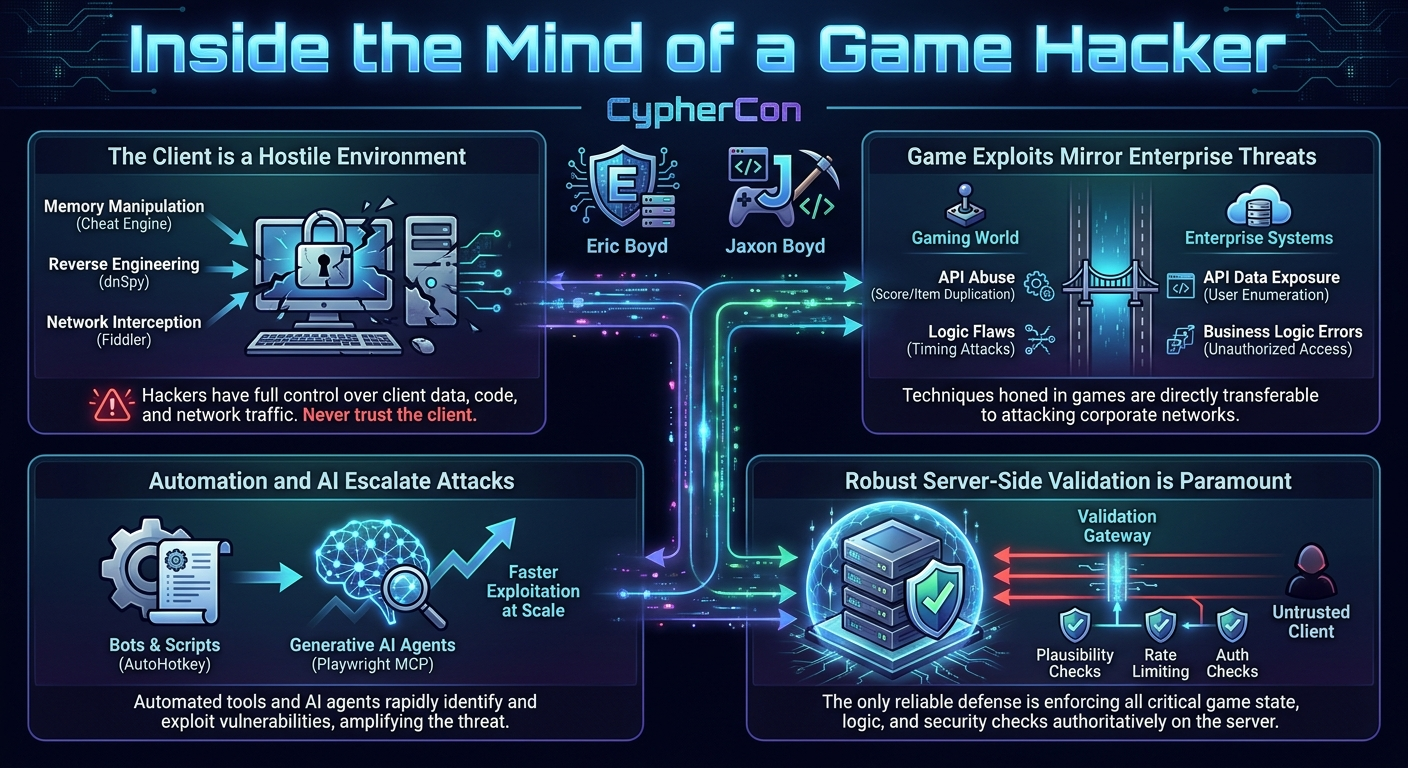
The mental model adopted by game hackers is one of profound skepticism: "If you can see it, it's a lie." Every visible element in a game—scores, physics, timers, inventory—is assumed to be manipulable data or code. Hackers actively seek client-side elements that might lack server-side validation or exploit latency in network communication. From an architectural perspective, modern multiplayer games resemble enterprise systems, comprising a hostile client (managing data, memory, code, and networking), a game server (handling data, APIs, and gameplay execution), and various identity services and third-party integrations. This architectural similarity is what makes game hacking techniques so directly transferable to enterprise security.
Key Findings
▶ Watch: Demo: Manipulating game memory with Cheat Engine (15:00)
The presentation underscores several key findings regarding game security and its broader implications:
- Client-Side Trust is a Fallacy: The fundamental principle demonstrated is that any data or logic residing on the client machine cannot be trusted. Hackers have full control over the client's memory, code, and network interactions, making it a hostile environment. Attempts to modify client-side values (like web coins with Cheat Engine) are often reverted if the server performs proper validation, but client-side logic can still be manipulated through reverse engineering.
- Server-Side Validation is Paramount: The talk explicitly shows that exploits targeting client-side memory or code manipulation often fail if the game server robustly validates all player actions and data. When direct memory edits don't persist, it's a strong indicator that the server is the authoritative source, reinforcing the critical need for server-side checks on all inputs, scores, and game states.
- Automation and Bots are Ubiquitous and Powerful: Simple tools like AutoHotkey or TinyTask can automate repetitive tasks, turning "grinding" into an effortless operation. This highlights how even basic scripting can significantly alter gameplay and generate resources. The mention of Playwright and its AI-driven MCP server also points to the escalating threat of sophisticated, automated exploitation in web-based games and enterprise applications.
- Reverse Engineering Unveils Vulnerabilities: Tools like dnSpy (for .NET applications) allow attackers to decompile, inspect, and even recompile game binaries. This process reveals underlying game logic, API calls, and potential client-side weaknesses. While direct modification of client-side code might not always bypass server-side checks, it provides critical intelligence for developing more advanced exploits or creating custom mods.
- Network Traffic is a Rich Attack Surface: Intercepting and manipulating network requests (using browser developer tools, Fiddler, or Wireshark) is a primary method for interacting with game APIs. This allows attackers to understand how the client communicates with the server, replay requests, modify parameters (e.g., adding arbitrary points), and enumerate sensitive information (like sequential user IDs). This directly exposes vulnerabilities in API design and server-side handling of requests.
- Anti-Cheat Measures are an Arms Race: Anti-cheat systems, especially those operating at the kernel level, increase the difficulty for cheaters. However, they do not eliminate cheating. Instead, they often push attackers to develop more advanced and sophisticated techniques, leading to a continuous escalation in the cat-and-mouse game between defenders and attackers.
- Game Hacking Techniques Directly Map to Enterprise Security: Perhaps the most significant finding is the explicit correlation between game hacking methodologies and enterprise cybersecurity threats. Concepts like untrusted clients, automation abuse (now amplified by generative AI), logic flaws, and identity manipulation are universal attack vectors. Understanding these in the context of games provides a practical framework for defending complex enterprise systems, mapping directly to frameworks like MITRE ATT&CK and OWASP Top 10.
Technical Deep Dive
▶ Watch: Exploiting web-based games and API vulnerabilities (26:00)
The core of the technical deep dive revolved around demonstrating various exploitation techniques on "Webcoins 95," a custom-built clicker game themed around the 90s internet. This game was intentionally designed with numerous vulnerabilities to facilitate ethical hacking demonstrations. It existed in both a Windows desktop (.NET) client and a web-based version, showcasing how different environments present similar attack surfaces.
Client-Side Memory Manipulation with Cheat Engine
Jaxon first demonstrated client-side memory manipulation using Cheat Engine, a popular free tool for monitoring and modifying the memory of running applications.
- Process Attachment: Cheat Engine was attached to the running "Webcoins 95" Windows client process.
- Value Search: Jaxon searched for the current in-game currency value (e.g., 975 web coins) in memory. This typically returns a large number of potential memory addresses.
- Value Refinement: To narrow down the correct address, Jaxon clicked the "Hack" button in the game to change the coin value, then performed a "Next Scan" in Cheat Engine for the new value. This iterative process quickly identifies the specific memory address holding the visible coin count.
- Memory Modification: Once identified, the memory address's value was directly edited in Cheat Engine (e.g., to 2500).
The immediate effect was a visual update of the coin count in the game's UI. However, upon clicking the "Hack" button again, the score reverted to its original, server-validated value. This demonstrated that while client-side memory can be altered, robust server-side validation prevents these changes from persisting, highlighting a crucial defensive mechanism.
Automation and Botting
Eric and Jaxon then explored automation using simple botting tools.
- AutoHotkey: This free, open-source scripting utility was used to create a simple script that automatically clicked the "Hack" button 200 times. This instantly boosted the in-game score without manual interaction.
- TinyTask: Jaxon mentioned TinyTask as another tool he uses, which records and plays back user inputs, simplifying the automation of repetitive tasks like farming in Minecraft.
- TamperMonkey: For web applications, TamperMonkey allows users to inject custom JavaScript to automate browser actions or modify web page behavior.
- Playwright and Generative AI: Eric introduced Playwright, a powerful web UI automation tool designed for testing, but highly effective for exploitation. He highlighted the Playwright MCP Server, which integrates generative AI, allowing users to automate complex web interactions using natural language commands, without writing explicit Playwright scripts. This signifies a new frontier in automation abuse, where AI agents can rapidly explore and exploit vulnerabilities.
Reverse Engineering and Code Modification with dnSpy
Eric demonstrated reverse engineering and code manipulation on the .NET desktop client using dnSpy.
- Decompilation: dnSpy was used to decompile the game's .NET assemblies (DLLs) back into readable C# code.
- Logic Inspection: Eric navigated to the
Catalogclass, which statically listed game upgrades (e.g., the "56k modem" costing 50 coins and providing a 1x multiplier). He attempted to modify this to cost 1 coin and provide a 1000x multiplier. - Recompilation and Saving: After editing the code, Eric recompiled the modified assembly and saved it back to disk, replacing the original game DLL.
- Outcome: Upon restarting the game and attempting to purchase the modified upgrade, it still deducted the original 50 coins and did not grant the 1000x multiplier. This indicated that the game's shop data was being pulled from a server-side API, not solely relying on the client-side static catalog.
- Targeting Client-Side Logic: Eric then showed a more effective target: the
recalculate_bonusesmethod within another assembly (webcoins.Assembly). This method contained the client-side logic for how bonuses were applied. By editing this method to add a fixed 1000 coins per click, and recompiling the DLL, an attacker could manipulate the client's displayed score calculation, assuming the server didn't validate the resulting score comprehensively. (Due to a live demo glitch, this specific recompile wasn't fully shown to work, but the principle was clearly laid out). Eric also mentioned using dnSpy for bypassing software activation logic by changing a method to always returntrue.
Network Manipulation and API Exploitation
The web version of "Webcoins 95" was used to demonstrate network manipulation via browser developer tools (F12).
- Intercepting API Calls: By monitoring the network tab, Eric showed calls from the JavaScript client to the game's backend APIs. These calls revealed player tokens, shop information, and other game state data.
- Sequential ID Enumeration: A common API vulnerability was highlighted: the
/players/{id}endpoint allowed enumeration of users by sequential IDs (e.g.,/players/1,/players/2). This exposes user data that should ideally be protected by more robust authorization. - Request Replay and Modification: Eric demonstrated crafting and sending custom API requests using a tool (likely Postman or similar, shown in a separate window). He showed a request to "submit clicks" for a specific user and, more dramatically, a request to add an implausible number of points (e.g., 99,999) to a user's score.
- Server-Side Defense (Plausibility Checks): When attempting to add 99,999 points, the server responded with a
429 Too Many Requestsstatus code and an error message: "This score is implausible." This illustrated a critical server-side defense mechanism: rate limiting and plausibility checks to prevent impossible or excessively rapid actions, thereby mitigating direct API abuse.
Identity Manipulation
The presence of tokens in API responses and serialized IDs of users pointed to potential identity manipulation vectors. While not fully exploited in the demo, the concept was raised that attackers could seek ways to impersonate other users or gain unauthorized permissions by manipulating these identity-related elements.
Overall, the technical deep dive provided a hands-on, ethical look at how various client- and network-based attack vectors are applied in gaming, and how critical server-side defenses are in mitigating them.
Demo / Proof of Concept
▶ Watch: Why anti-cheat systems often fail (35:30)
The entire talk served as an extended, ethical demo and proof of concept using the custom-built game "Webcoins 95." To avoid ethical issues associated with exploiting live, commercial games, Eric and Jaxon developed this game specifically for the conference, incorporating numerous vulnerabilities they intended to showcase. The game was made available in two versions: a Windows desktop client built with .NET and a web-based client, allowing for diverse demonstration scenarios.
The "Webcoins 95" game itself was a simple clicker game with a 90s internet theme, featuring a "Hack" button to earn coins, a shop for upgrades (e.g., 56k modems, T1 lines), a daily bonus, and a global leaderboard. This straightforward design provided a clear and understandable environment for demonstrating complex hacking concepts.
Key demonstrations during the talk included:
- Client-Side Memory Manipulation: Jaxon used Cheat Engine to attach to the Windows client and successfully locate and visually alter the in-game currency value in memory. This immediate visual change, followed by its reversion upon server interaction, effectively demonstrated the concept of an untrusted client and the necessity of server-side validation.
- Automation: An AutoHotkey script was run live, automatically clicking the "Hack" button multiple times, rapidly increasing the score without manual input. This illustrated the ease with which repetitive tasks can be automated, a common practice in gaming for "grinding."
- Reverse Engineering (Attempted): Eric used dnSpy to decompile the .NET game assemblies, inspect the code, and attempt to modify upgrade costs and multipliers. While the specific attempt to modify static shop data failed due to server-side API calls, the process demonstrated how attackers can analyze and attempt to alter client-side game logic. The intent to modify the
recalculate_bonusesmethod further solidified the concept of targeting client-side computation. - Network and API Exploitation: Using browser developer tools (F12) on the web version of "Webcoins 95," Eric showed how to observe and understand the game's API calls. He then demonstrated manipulating these APIs by attempting to add an implausibly high number of points to a player's score. The server's response (a
429error with "score is implausible") served as a live demonstration of effective server-side plausibility checks. The enumeration of sequential player IDs via API calls was also showcased as a common vulnerability.
The custom game allowed for a safe and interactive environment, enabling the audience (who could also play the web version) to witness and even attempt some of the exploits, reinforcing the practical relevance of the presented techniques.
Defensive Implications
▶ Watch: Live demo: Exploiting web game API for points (47:00)
The insights gained from game hacking offer profound defensive implications for enterprise security, as the core challenges—untrusted clients, complex distributed systems, and motivated adversaries—are strikingly similar.
- Assume the Client is Hostile: The most critical takeaway is to never trust the client. Any code, data, or state managed on the client machine should be considered compromised. This means all critical game logic, financial transactions, and player actions must be validated and enforced on the server. As Eric states, "If your system trusts the client... you're already compromised."
- Robust Server-Side Validation: This is non-negotiable. Every piece of input, every action, and every state change initiated by the client must be thoroughly validated on the server. This includes:
- Plausibility Checks: As demonstrated with the "implausible score" API response, servers should verify if actions (e.g., earning 99,999 points instantly) are logically possible within the game's rules. This prevents exaggerated or impossible values from being accepted.
- Rate Limiting: Implement rate limits on API endpoints to prevent rapid-fire, automated requests that exceed normal user behavior, mitigating botting and brute-force attacks.
- Authorization and Authentication: Ensure proper checks are in place so users cannot impersonate others or access resources they are not authorized for, especially when dealing with sequential IDs or tokens.
- Secure API Design: APIs are a primary attack vector. Designers should avoid easily enumerable sequential IDs, implement robust authentication and authorization mechanisms (e.g., using UUIDs instead of incremental IDs), and validate all request parameters rigorously. Error messages should be generic to avoid leaking sensitive information about the backend.
- Understanding Automation Threats: The ease of creating bots with tools like AutoHotkey or Playwright highlights the need for defenses against automation abuse. With the rise of Generative AI and Agentic AI, these threats are amplified. AI agents can rapidly identify and exploit flaws at an unprecedented pace. Defenders must implement rigorous monitoring, anomaly detection, and governance in their environments to counteract these sophisticated automated attacks.
- Limitations of Anti-Cheat/EDR: While anti-cheat systems (analogous to Endpoint Detection and Response - EDR in enterprises) can raise the bar for attackers, they operate within the hostile client environment. They are part of an arms race, pushing attackers to develop more advanced techniques rather than eliminating the threat entirely. A multi-layered defense strategy, with a strong emphasis on server-side security, is essential.
- Mapping to Enterprise Security Frameworks: The attack vectors discussed—client-side trust, insider threats, automation abuse, logic flaws, and network manipulation—map directly to established enterprise security concerns. Organizations should leverage frameworks like the MITRE ATT&CK matrix and the OWASP Top 10 (including specific lists for Web, API, and LLM/AI agents) to identify and mitigate these risks in their own applications and infrastructure. The creativity of game hackers in finding "boring bugs" and exploiting them underscores the importance of thorough code review, penetration testing, and secure development practices.
- Fostering Curiosity in the Next Generation: Beyond technical controls, Eric emphasizes the importance of encouraging curiosity and exploration in youth. Jaxon's early attempts to bypass Xbox family safety settings (by changing the system clock) and his creative modding activities demonstrate critical thinking and problem-solving skills vital for future cybersecurity roles. Parents and mentors should nurture this inquisitive spirit, viewing "hacking" as a learning opportunity rather than solely a transgression, as it builds the foundational mindset for effective defense.
Key Takeaways
- Never trust the client: Any data or logic on the client machine is susceptible to manipulation; all critical validation and game state enforcement must occur on the server.
- Server-side validation is paramount: Implement robust plausibility checks, rate limiting, and comprehensive input validation on all API endpoints to prevent client-side exploits from impacting the authoritative game state.
- Game hacking techniques directly apply to enterprise security: The methods used to exploit games (memory manipulation, automation, reverse engineering, API abuse) are analogous to common attack vectors against enterprise applications and distributed systems.
- Automation threats are evolving: Tools like AutoHotkey and Playwright, especially when combined with generative AI, enable rapid and sophisticated exploitation, necessitating advanced monitoring and governance strategies.
- Anti-cheat systems are an arms race, not a silver bullet: While they deter casual cheaters, determined adversaries will find ways around them, reinforcing the need for foundational server-side security.
- Encourage curiosity and creative problem-solving: Fostering exploration and understanding of how systems work in the next generation, even through activities like game modding, cultivates critical thinking skills essential for future cybersecurity professionals.
About the Speaker(s)
Eric Boyd is a seasoned technology consultant and the founder of responsiveX, a technology consultancy. His professional work focuses on helping customers build secure distributed, mass-scale solutions, particularly within Microsoft Azure, a field he has been involved with since 2012. He describes himself as not currently a gamer, though he spent time gaming in his youth with titles like Doom, Duke Nukem, Quake, and Counter-Strike. In this talk, Eric provides the professional cybersecurity context for game hacking techniques.
Jaxon Boyd is a young, experienced game modder and hacker who has been engaged with video games since the age of five, with Minecraft being his game of choice. He is particularly interested in modding games to inject custom code and automating repetitive tasks like farming in games. Jaxon brings a practical, hands-on perspective to the talk, sharing his personal experiences and demonstrating various game exploitation techniques.
Reviews
Dr. Zero (Offensive Security Researcher) — WEAK
A father-son duo runs Cheat Engine and AutoHotkey against a mock game they built themselves to teach us that we shouldn't trust the client. It's an entry-level awareness session wrapping 20-year-old web security concepts in a gaming skin. Cute family project, but absolutely doesn't belong on a professional conference stage.
Heather Calloway (CISO) — SOLID
A well-executed educational session that uses game hacking as a pedagogical tool for fundamental application security. While the core lessons on client-side trust are AppSec 101, the demonstration of LLM-driven automation tools highlights an evolving threat to public-facing enterprise APIs.