Detection to Decision: Agentic AI at the Edge for Security Operations
John Platais
Overview
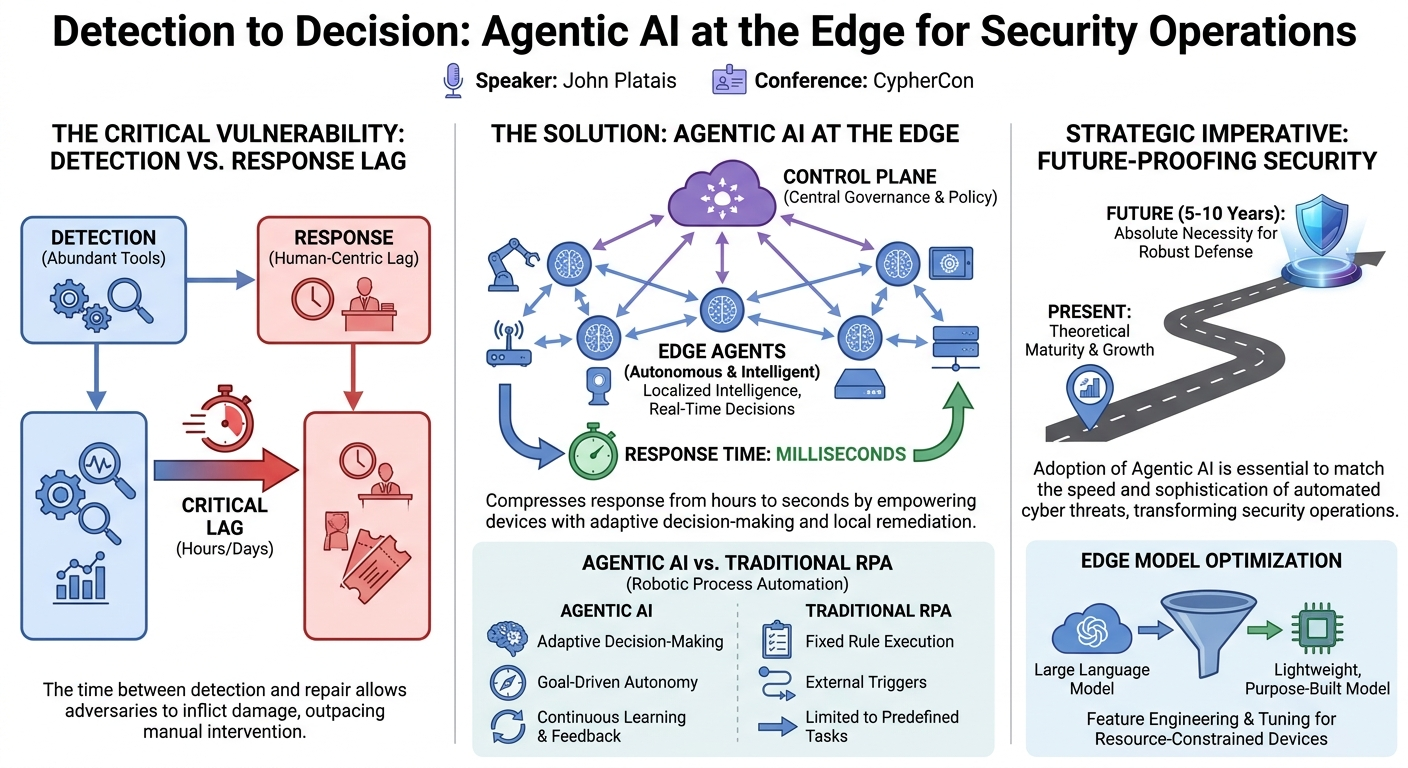
In his CypherCon talk, John Platais, a seasoned leader in data science, AI ops, MLOps, and automation, delves into the transformative potential of Agentic AI at the Edge for revolutionizing cybersecurity operations. The core premise of his presentation is that while organizations have invested heavily in sophisticated detection systems—ranging from endpoint to network and extended detection solutions—the critical vulnerability lies not in identifying threats, but in the protracted delay between detection and effective remediation. This lag, often measured in hours or even days, grants adversaries ample time to escalate attacks and inflict significant damage.
Key moments
- 2:00 The core security problem: detection vs. response lag
- 5:00 Agentic AI architecture: local ML, policy, action
- 12:00 Agentic AI vs. traditional automation: goal-driven autonomy
- 15:00 Use cases: detecting abnormal behavior from authorized users
- 17:00 Governance: balancing autonomy with human control
- 21:00 Why Agentic AI is essential within five years
- 26:00 Q&A: Optimizing AI models for edge devices
Detection to Decision: Agentic AI at the Edge for Security Operations
Speakers: John Platais
Conference: CypherCon
YouTube: https://www.youtube.com/watch?v=MzgmmwJXKvo
Overview
In his CypherCon talk, John Platais, a seasoned leader in data science, AI ops, MLOps, and automation, delves into the transformative potential of Agentic AI at the Edge for revolutionizing cybersecurity operations. The core premise of his presentation is that while organizations have invested heavily in sophisticated detection systems—ranging from endpoint to network and extended detection solutions—the critical vulnerability lies not in identifying threats, but in the protracted delay between detection and effective remediation. This lag, often measured in hours or even days, grants adversaries ample time to escalate attacks and inflict significant damage.
Platais posits that the current human-centric response model, characterized by alert-to-ticket workflows and manual intervention, is fundamentally outpaced by the speed and automation employed by modern attackers. His solution introduces a paradigm shift: deploying intelligent, autonomous AI agents directly at the network edge. These agents are designed to make real-time, adaptive decisions, effectively acting as "mini computerized SOC engineers" on every device. This approach aims to dramatically compress response times from minutes or hours to mere seconds or milliseconds, thereby closing the critical window of opportunity for attackers and fortifying an organization's defensive posture in increasingly distributed and complex environments.
The talk not only outlines the architectural necessities for such a system but also differentiates Agentic AI from traditional automation, emphasizing its capacity for continuous learning, goal-driven autonomy, and contextual understanding. Platais acknowledges the theoretical nature of much of this work today, highlighting the substantial growth and maturity still required. However, he firmly asserts that the adoption of Agentic AI is not merely an aspiration but an absolute necessity for robust security operations within the next five to ten years, underscoring its role in adapting to a threat landscape where automated attacks demand equally automated, intelligent defenses.
Background
▶ Watch: The core security problem: detection vs. response lag (2:00)
The landscape of modern cybersecurity is defined by a paradox: an abundance of detection capabilities coupled with a persistent struggle in rapid response. John Platais highlights that organizations routinely invest in advanced Endpoint Detection and Response (EDR), Network Detection and Response (NDR), and Extended Detection and Response (XDR) systems. These tools excel at identifying malicious activities, generating alerts, and providing rich telemetry. Yet, the critical flaw in the contemporary security model is the "time between detection and repair." This period, during which an alert is generated but before an effective countermeasure is deployed, is precisely where adversaries thrive, leveraging it to execute lateral movement, exfiltrate data, or deploy ransomware.
Platais vividly illustrates this by describing common organizational workflows: an alert triggers a ticket, which then joins a queue of potentially dozens of other tasks for a security engineer. This process can leave systems vulnerable for hours, or even days, not due to a lack of skill or well-structured environments, but simply because human intervention introduces inherent delays. This problem is exacerbated by the increasingly distributed nature of modern IT environments, which have moved beyond centralized data centers to encompass vast networks of cloud resources, remote workers, and a proliferation of Internet of Things (IoT) devices. Each of these endpoints represents a potential point of compromise, making centralized, human-driven response increasingly inefficient and unsustainable.
The speaker draws a sharp contrast between the defensive and offensive capabilities in the current threat landscape. Attackers, he notes, have already embraced automation. Tools like Open Claw, for instance, enable the creation of "artificial hackers" that can run 24/7, continuously adapting their attack vectors based on target system responses. This means adversaries operate at machine speed, while defenders often remain tethered to human response times. Platais emphasizes that while detection has matured significantly, the response mechanism has not kept pace. The advent of AI and edge computing, however, offers a new pathway to local autonomy, making self-healing systems and rapid, intelligent remediation viable in ways that were previously impossible. His own prior experience, where his team deployed an agentic agent to 40,000 global systems for intelligent, human-free repairs, serves as a testament to the foundational possibility of this approach, laying the groundwork for its application in security.
Key Findings
▶ Watch: Agentic AI vs. traditional automation: goal-driven autonomy (12:00)
Platais's talk presents several key findings and contributions centered on the application of Agentic AI to overcome the limitations of traditional cybersecurity response. The overarching discovery is that autonomous, intelligent agents deployed at the edge can drastically reduce the mean time to respond (MTTR) to security incidents, shifting it from hours or days to seconds or milliseconds. This is achieved by empowering individual devices to make adaptive decisions and execute immediate remediation actions locally, effectively acting as a decentralized security force.
A fundamental finding is the critical distinction between Agentic AI systems and traditional Robotic Process Automation (RPA). While RPA can simulate human behavior and automate repetitive tasks, it typically requires external triggers and lacks true autonomy. Agentic systems, conversely, are characterized by:
- Adaptive Decision-Making: They can analyze real-time conditions and choose the most appropriate action without explicit, pre-programmed rules for every scenario.
- Real-Time Problem Solving: Agents are equipped to address emerging threats on the fly, rather than waiting for human analysis or centralized commands.
- Feedback Loops and Continuous Learning: These systems are designed to continuously learn from their environment and past actions, refining their models and improving their effectiveness over time.
- Goal-Driven Autonomy: Agentic systems operate with a defined goal, calculating the likelihood of achieving it and estimating the impact of their decisions. This allows them to prioritize actions and optimize outcomes.
- State Maintenance and Contextual Understanding: Unlike traditional automation that often assumes an ideal starting state, agentic systems understand the "common state" of a system, enabling more accurate anomaly detection by recognizing genuine deviations from the current normal, rather than a static baseline. This is crucial for adapting to evolving network conditions and user behaviors.
Platais highlights that this approach enables capabilities such as isolating compromised devices (e.g., an IP camera scanning a network) based on baseline deviations, detecting and neutralizing abnormal commands, segmenting networks, and even killing specific malicious processes on critical systems like Point of Sale (POS) terminals without shutting down the entire application, which is vital in high-availability environments like financial exchanges. Ultimately, the key finding is that by embedding intelligence directly into the operational fabric at the edge, organizations can build a more resilient and responsive security posture capable of matching the speed and sophistication of modern cyber threats.
Technical Deep Dive
▶ Watch: Use cases: detecting abnormal behavior from authorized users (15:00)
The architectural blueprint for Agentic AI at the edge, as described by John Platais, is designed for localized intelligence and rapid, autonomous action, while maintaining a crucial centralized oversight. This architecture comprises several interconnected layers:
At the very top is the Control Plane. This serves as the central brain for policy distribution, governance, and overall strategic direction. It dictates what actions agents are permitted to take and under what circumstances, defining the "human in the loop" thresholds. This centralized control ensures that autonomous agents operate within defined boundaries, balancing speed with risk management.
Below the Control Plane, at each individual edge node, resides the Edge Agent. This agent acts as a mini security system, collecting various signals such as NetFlow data, System Calls (Syscalls), and RF signals. These raw inputs are then fed into a Local Machine Learning Model. The critical difference here from traditional rule-based systems is that this model is not static; it is continuously learning and adapting to the local environment. Its goal is autonomous behavior, meaning it's empowered to determine the best course of action to solve a detected problem.
However, this local autonomy is not unchecked. Before an action is taken, the proposed decision by the local ML model is evaluated by a Policy Agent (or Policy Controller) on the edge node, which enforces the directives issued by the central Control Plane. This ensures that even autonomous actions align with organizational security policies. Only after this "gut check" does the decision pass to the Action Module (or Execution Node), which carries out the necessary remediation—be it isolating a device, killing a process, or reconfiguring network settings.
A vital component of this architecture is the constant feedback loop. Edge agents don't just act; they report back to the Control Plane in near real-time. This feedback is crucial for several reasons:
- Situational Awareness: The Control Plane gains a holistic view of distributed threats.
- Collective Learning: If one agent detects and remediates a novel threat, that new knowledge can be disseminated by the Control Plane to other agents across the network, enabling them to proactively defend against similar attacks. Platais uses the example of "a server farm of 50,000 servers and three suddenly see unusual behavior; it doesn't do a whole lot of good if you can't send it back to warn the other 49,997."
Platais further elaborates on the distinction between Agentic AI systems and traditional automation (RPA). Traditional RPA is often triggered by predefined events and executes fixed scripts, relying on an assumed "ideal state" of the system. Agentic systems, in contrast, maintain state, understanding the actual, often imperfect, "common state" of the environment. This allows for more sophisticated anomaly detection, as they can continuously recalculate what constitutes a "new normal" and identify deviations with greater accuracy. They are goal-driven, performing adaptive decisions, real-time problem-solving, and continuous learning through feedback loops.
A significant technical challenge addressed is the computational footprint of edge models. Platais emphasizes that deploying large language models (LLMs) with trillions of parameters directly at the edge is impractical. The solution lies in feature engineering and parameter tuning to create highly optimized, lightweight models capable of running on devices with kilobytes of memory, such as an IoT drill. This involves:
- Isolation of Critical Inputs: Focusing on the most pertinent data points for specific security use cases.
- Model Selection: Opting for smaller, purpose-built models (e.g., regression or smaller deep learning models) over general-purpose LLMs where appropriate. Agentic agents are designed to perform a limited set of 1-5 critical functions, not general intelligence.
- Seeding and Optimization: Starting with a more robust, larger model, then progressively eliminating parameters through iterative testing until the optimal balance of performance and size for the edge is achieved. This ensures that models are effective from day one, rather than waiting months for them to learn from scratch.
While acknowledging that a single off-the-shelf product doesn't exist today, Platais envisions an ecosystem built from various components, potentially leveraging open-source solutions. Examples of existing tools that provide some foundational capabilities include Apache Minifi (a lightweight edge agent) and IBM's Watson X (formerly Netcool Operations Insights), though these still typically rely on centralized intelligence rather than full edge autonomy. The evolution towards truly agentic systems will involve bringing more of the "brain" to the local device to enable immediate, intelligent responses.
Demo / Proof of Concept
▶ Watch: Why Agentic AI is essential within five years (21:00)
John Platais candidly acknowledges that the concept of a fully realized, enterprise-wide Agentic AI system for security operations is still largely theoretical and in its nascent stages. He states, "I have yet to see anybody really do this well. So, there is a lot of growth and maturity that has to occur." Consequently, the talk does not feature a live demonstration or a specific, functioning proof of concept.
Instead, Platais illustrates the potential of Agentic AI through a series of compelling theoretical use cases, painting a clear picture of how such systems would operate:
- Compromised IP Camera: Imagine an IP camera, normally used for surveillance, suddenly begins scanning the internal network. An agentic system, having established a baseline of the camera's normal behavior, would detect this significant deviation. Rather than merely alerting a human, the edge agent could autonomously isolate the camera from the network, preventing further lateral movement, while maintaining its core surveillance function for a limited time if policy allows.
- Abnormal Command Detection: In a scenario where an authorized user logs into a system, but then executes a series of highly unusual or unauthorized commands. A traditional access control system would simply validate the user. An agentic system, however, would recognize the abnormal command sequence—perhaps 87 logins in 13 minutes, or commands inconsistent with the user's role—and could autonomously block further command execution or temporarily suspend the user's privileges, flagging the incident for human review.
- Point of Sale (POS) Malware: A POS system, typically a simplistic device, becomes compromised by malware or firmware manipulation. An agentic agent on the POS system could detect the anomalous processes or unauthorized firmware adjustments. Crucially, instead of a drastic measure like shutting down the entire system (which is often unacceptable in high-availability environments like financial services, as Platais experienced with the Singapore stock exchange), the agent could intelligently kill select malicious processes while allowing legitimate transactions to continue, thereby isolating the threat without disrupting critical business operations.
- Network Disruption Prevention: By continuously monitoring network traffic and system states, an agentic system could identify early indicators of an impending denial-of-service attack or unusual traffic patterns, and proactively reconfigure network segments or apply micro-segmentation policies to prevent broader disruption.
These examples, while hypothetical, serve to highlight the core capabilities of Agentic AI: autonomous detection of novelty, intelligent decision-making based on context, and precise, localized remediation, all executed at machine speed to minimize attacker dwell time and impact.
Defensive Implications
▶ Watch: Q&A: Optimizing AI models for edge devices (26:00)
The advent of Agentic AI at the Edge carries profound implications for cybersecurity defenders, fundamentally shifting the paradigm from reactive, human-centric responses to proactive, autonomous defense.
Firstly, the most significant implication is the dramatic reduction in Mean Time To Respond (MTTR). By empowering edge devices with local intelligence and the authority to act, security operations can transition from detection-to-ticket workflows, which are inherently slow, to near-instantaneous, automated remediation. This directly addresses the critical window of vulnerability that attackers currently exploit, where "the time between detection and repair" is their greatest asset. Defenders will no longer be outpaced by automated attacks, as their own defenses will operate at machine speed, capable of responding in seconds or milliseconds.
Secondly, Agentic AI introduces a new layer of adaptive and intelligent threat containment. Traditional security relies heavily on static rules and signatures. Agentic systems, with their continuous learning and ability to maintain system state, can perform sophisticated anomaly detection by understanding the "new normal" of a device or network segment. This allows them to identify and respond to novel, zero-day threats or deviations in authorized user behavior (e.g., an authorized user performing highly unusual actions) that might bypass conventional defenses. The ability to isolate specific compromised processes or micro-segment networks locally means that a breach on one device doesn't necessarily escalate into a widespread organizational compromise, ensuring business continuity in critical environments.
Thirdly, this approach is particularly vital for securing distributed environments, including vast IoT deployments, cloud infrastructure, and remote workforces. The traditional model of funneling all telemetry to a central Security Operations Center (SOC) for human analysis becomes overwhelmed and introduces unacceptable latency in these sprawling ecosystems. Agentic agents provide localized security controls where they are most needed, enabling each device to contribute to its own defense and the collective security posture without constant reliance on a distant central authority.
However, implementing Agentic AI also necessitates a re-evaluation of governance and control. While autonomy is key, it must be goal-driven autonomy tempered by a centralized Control Plane. Defenders must meticulously define policies that dictate what actions agents can take autonomously and when human intervention ("human in the loop") is required. This involves establishing clear boundaries, acceptable risk profiles, and feedback mechanisms to continuously refine agent behavior. Security professionals will transition from being primary responders to becoming architects and overseers of these intelligent systems, designing policies, validating models, and handling complex escalations.
Finally, Platais emphasizes that this is not an immediate, turn-key solution but a strategic imperative for the future. Organizations must start experimenting and planning for this shift now, as Agentic AI will become an "absolute necessity" within the next five to ten years to maintain a robust and resilient security posture against an ever-evolving threat landscape. It represents an investment in future-proofing security operations, ensuring that defenses can match, or even anticipate, the sophistication of future attacks.
Key Takeaways
- The Critical Lag: The primary vulnerability in cybersecurity is the time delay between detecting a threat and effectively remediating it, not a lack of detection capabilities. This lag allows attackers, who leverage automation, to inflict significant damage.
- Agentic AI for Speed: Agentic AI at the edge drastically reduces response times from hours/days to seconds/milliseconds by enabling autonomous, intelligent decision-making and action directly on affected devices.
- Beyond Traditional Automation: Agentic systems differ from RPA by offering goal-driven autonomy, adaptive decision-making, continuous learning through feedback loops, and the ability to understand and maintain system state for accurate anomaly detection.
- Edge Intelligence with Central Governance: Security operations require a distributed architecture where lightweight ML models run on edge agents for local remediation, overseen by a central control plane that dictates policies and facilitates collective learning across the network.
- Strategic Imperative, Not Immediate Solution: While full-scale implementation is still maturing, Agentic AI is a fundamental shift that organizations must plan for and adopt within the next 5-10 years to effectively counter automated and sophisticated cyber threats.
- Focus on Optimized Models: Deploying Agentic AI at the edge necessitates highly optimized, purpose-built machine learning models (not large language models) that are fine-tuned for specific security use cases and can operate efficiently on resource-constrained devices.
About the Speaker(s)
John Platais is an experienced leader with over 15 years of expertise across diverse fields including data science, AI ops, MLOps, and agentic and RPA automation. His professional journey has spanned significant roles within the public sector, large fintech organizations, and most recently, a very large and distributed manufacturer. Notably, in a prior role, John and his team successfully developed and deployed an agentic agent to 40,000 systems globally, designed to perform intelligent repairs autonomously, without human intervention. This extensive background provides him with a unique perspective on leveraging advanced automation and AI to address complex operational challenges, particularly in the realm of cybersecurity.
Reviews
Dr. Zero (Offensive Security Researcher) — WEAK
Platais took 45 minutes to reinvent automated incident response, slapped the 'Agentic AI' buzzword on it, and admitted he doesn't actually have a working demo. It's a purely theoretical architecture pitch about running ML on edge nodes to isolate endpoints. We used to call this EDR, but I guess that doesn't get you a speaking slot at CypherCon anymore.
Heather Calloway (CISO) — SOLID
This is a structural preview of where SOC architecture is heading, but it lacks immediate operational utility. The speaker accurately diagnoses our MTTR problem, but the proposed solution—autonomous AI agents executing remediation on edge endpoints—introduces availability risks most enterprises cannot currently underwrite. Have your SOC director watch it for roadmap planning, but it does not require executive action today.