Strengthen cyber resilience for Entra ID and Microsoft 365
Vanessa Toves
Overview
In an era where organizations increasingly entrust their critical data and operations to cloud platforms, Vanessa Toves' CypherCon talk, "Strengthen cyber resilience for Entra ID and Microsoft 365," delivered a sobering yet essential message about the evolving threat landscape and the often-overlooked gaps in cloud data resilience. Toves, a seasoned Microsoft 365 solutions architect and a subject matter expert at Druva, systematically deconstructed common misconceptions and vulnerabilities within the Microsoft cloud ecosystem, particularly focusing on Entra ID (formerly Azure Active Directory) and Microsoft 365 services like SharePoint and OneDrive. Her presentation underscored that while cloud adoption offers immense benefits, it also introduces new complexities and demands a fundamentally different approach to cyber incident response and data protection.
Key moments
- 2:00 Speaker introduction and Microsoft 365 background
- 6:00 Digital Defense Report: 80% of attacks are identity-based
- 12:00 AI adoption increases threats, but recovery plans unchanged
- 14:30 Ask vendors: How are you protecting our data?
- 18:30 Entra ID: First validation and recovery priority
- 20:30 Data resilience: Beyond simple backup, using anomaly detection
- 29:30 Bulk recovery limitations and user prioritization for recovery
Strengthen cyber resilience for Entra ID and Microsoft 365
Speakers: Vanessa Toves
Conference: CypherCon
YouTube: https://www.youtube.com/watch?v=Pl0U7au7whs
Overview
In an era where organizations increasingly entrust their critical data and operations to cloud platforms, Vanessa Toves' CypherCon talk, "Strengthen cyber resilience for Entra ID and Microsoft 365," delivered a sobering yet essential message about the evolving threat landscape and the often-overlooked gaps in cloud data resilience. Toves, a seasoned Microsoft 365 solutions architect and a subject matter expert at Druva, systematically deconstructed common misconceptions and vulnerabilities within the Microsoft cloud ecosystem, particularly focusing on Entra ID (formerly Azure Active Directory) and Microsoft 365 services like SharePoint and OneDrive. Her presentation underscored that while cloud adoption offers immense benefits, it also introduces new complexities and demands a fundamentally different approach to cyber incident response and data protection.
The core of Toves' argument is that traditional backup strategies are no longer sufficient; organizations must embrace a holistic data resilience framework. This framework goes beyond mere data recovery, encompassing proactive measures like understanding the full data footprint, scrutinizing third-party vendor security, and adapting incident response plans to the unique characteristics of SaaS environments. The talk critically examined the impact of emerging technologies like Artificial Intelligence on an organization's threat surface, highlighting how rapid AI adoption often outpaces corresponding security and recovery planning.
Toves' insights are particularly pertinent for anyone involved in cyber incident response, SaaS administration, or identity platform management. She compellingly demonstrated that a significant disconnect exists between the perceived security of cloud platforms and the reality of sophisticated, hybrid attacks targeting these environments. By dissecting Microsoft's own Digital Defense Report and referencing specific threat actors like Storm-0501, Toves provided actionable intelligence for organizations to better prepare for, respond to, and recover from cyberattacks in their Microsoft cloud deployments, ultimately strengthening their overall cyber resilience.
Background
▶ Watch: Speaker introduction and Microsoft 365 background (2:00)
The rapid migration of enterprise operations to the Microsoft cloud ecosystem, encompassing Entra ID, Microsoft 365 applications like SharePoint, OneDrive, Power Apps, and Dynamics, has fundamentally altered the cybersecurity landscape. Historically, assumptions about data protection were rooted in on-premises infrastructure, where concepts like local backups and direct server access dictated recovery strategies. However, as Toves highlighted, the cloud introduces distinct challenges that many organizations have yet to fully address. For instance, SharePoint, originally conceived long before the advent of widespread ransomware attacks, was designed with basic version history and recycle bin functionalities that are inadequate for sophisticated, large-scale data corruption or deletion scenarios. These features merely iterate new versions, leaving corrupted data intact rather than facilitating a clean rollback.
The threat landscape itself has undergone a dramatic transformation. Toves cited alarming statistics from Microsoft's annual Digital Defense Report, which consistently reveals escalating attack sophistication and impact. The report indicates a significant surge in attacks combining encryption and exfiltration, rising from 16% to 30% over recent years. Even more critically, the percentage of landed attacks attributed to identity attacks—involving compromised credentials and token theft—skyrocketed from 42% to 80% in the 2025 report. This shift underscores the paramount importance of Entra ID as a primary target for adversaries. The speaker also referenced Storm-0501, an active hybrid threat actor that exemplifies the modern attack paradigm, moving fluidly between on-premises infrastructure, cloud data, and user endpoints. This complex interplay demands a holistic view of the "user data footprint," which now spans laptops, OneDrive, and cloud-based email.
A critical gap identified by Toves is the general lack of awareness regarding Microsoft's own digital defense insights, with only about 5% of conference attendees typically familiar with the report. This indicates a broader issue of under-informed decision-making within organizations. Furthermore, native logging capabilities in Microsoft 365, while present, are often tied to license tiers (e.g., E3 offering less retention than E5) and can be costly to retain long-term, requiring additional licenses for services like Purview or Sentinel and separate storage costs. This monetization of critical forensic data creates barriers to comprehensive incident investigation and recovery. The speaker also stressed that the burgeoning adoption of Artificial Intelligence (AI) tools, such as Copilot and Copilot Designer, without corresponding changes to governance and recovery practices, is introducing new, unmanaged threat vectors. AI developers, often connecting to a multitude of data sources from their laptops, inadvertently create extensive attack surfaces and may even store sensitive tokens or passwords insecurely. This confluence of evolving threats, inherent platform limitations, and insufficient organizational preparedness forms the critical background against which Toves presented her call for strengthened cyber resilience.
Key Findings
▶ Watch: AI adoption increases threats, but recovery plans unchanged (12:00)
Vanessa Toves' talk brought to light several critical findings that challenge conventional wisdom regarding cybersecurity and data resilience in the Microsoft cloud. These insights are not merely observations but expose fundamental gaps in current organizational strategies:
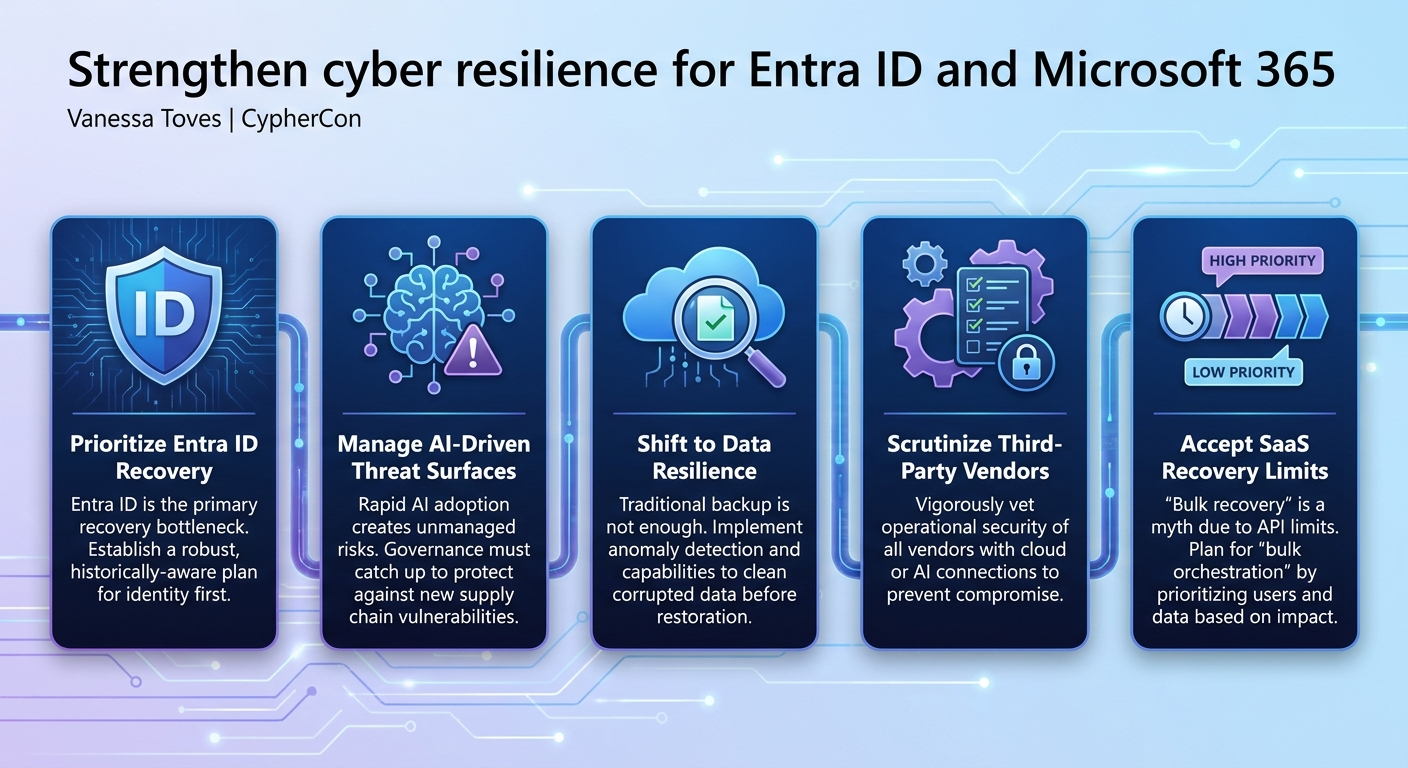
- Entra ID as the Primary Recovery Bottleneck: Toves unequivocally established that Entra ID is the single most critical component for recovery in a Microsoft cloud environment. Without a functional and trusted identity platform, all other recovery efforts for Microsoft 365 services are severely hampered, if not impossible. The talk highlighted that many organizations lack a specific, well-documented recovery plan for Entra ID, including understanding what constitutes a "good state" for their conditional access policies, user groups, and other configurations.
- The Digital Defense Report Disconnect: A significant finding was the pervasive lack of awareness (only ~5% of audiences) regarding Microsoft's annual Digital Defense Report. This indicates a substantial disconnect between the actionable threat intelligence provided by Microsoft and its adoption by organizations, leading to uninformed risk assessments and inadequate defensive postures against current attack trends like identity compromise and hybrid attacks.
- AI Adoption Outpacing Resilience Planning: The rapid and widespread adoption of AI tools (60-80% of companies) is creating vast, new, and often unmanaged attack surfaces. Toves found that organizations are investing in AI licenses but failing to adapt their recovery plans or governance practices to account for how AI developers connect to diverse data sources, potentially exposing sensitive data and creating new dependencies that are not integrated into existing disaster recovery frameworks.
- Beyond Backup: The Need for Data Resilience: Toves argued that traditional "backup" is insufficient; organizations require data resilience. This means having the ability not just to restore data, but to understand the timeline of an attack, identify the "last known good clean file," and effectively clean up corrupted data before restoration, particularly for services like SharePoint and OneDrive where versioning can perpetuate corruption. Advanced backup solutions are crucial for providing this historical data, anomaly detection, and granular recovery capabilities.
- Vendor Ecosystem as a Critical Threat Vector: A key finding was that third-party vendors, whether security solutions, data classification tools, or AI plugins, often pull organizational data out of the Microsoft cloud into their own SaaS environments. Toves stressed that organizations frequently overlook asking critical questions about these vendors' operational security practices, effectively creating potential "SolarWinds" type vulnerabilities by extending their trust boundary without proper vetting.
- SaaS Recovery Limitations and Prioritization: The concept of "bulk recovery" for SaaS applications is a myth due to API bandwidth limitations; instead, it's bulk orchestration (a queuing process). This finding highlights the necessity of prioritizing users and data for recovery based on business impact, rather than assuming all data can be instantly restored simultaneously.
These findings collectively underscore a systemic challenge: the complexity and dynamic nature of the Microsoft cloud environment demand a more sophisticated, proactive, and integrated approach to cybersecurity and resilience than many organizations currently employ.
Technical Deep Dive
▶ Watch: Ask vendors: How are you protecting our data? (14:30)
Vanessa Toves’ talk provided a granular look into the technical intricacies and often-overlooked vulnerabilities within the Microsoft cloud ecosystem, emphasizing the critical role of Entra ID and the nuances of data resilience across various Microsoft 365 services.
At the heart of Microsoft's cloud security posture lies Entra ID, which Toves stressed is the "first thing that has to be validated and recovered in an attack." Entra ID manages user identities, access controls, and crucial security policies like Conditional Access Policies. The challenge, as Toves pointed out, is that many organizations lack a clear understanding of what a "good state" looks like for their Entra ID configurations. During an incident, the ability to revert to a known-good configuration for user accounts, groups, and conditional access rules is paramount. This is where advanced backup solutions for Entra ID become indispensable, not just for recovery but for forensic analysis. These backups provide historical snapshots of configurations, allowing security teams to compare current, potentially compromised states with past known-good states. This historical data is vital for forensics, enabling the identification of unauthorized changes to policies or user permissions that might indicate compromise.
The discussion extended to the broader Microsoft 365 suite, including SharePoint, OneDrive, Power Apps, and Power Platform. Toves highlighted a fundamental design flaw in how these services handle data resilience in the face of modern attacks. SharePoint, for example, was not designed with ransomware in mind. Its version history and recycle bin features, while useful for accidental deletions, are insufficient for a ransomware attack. If a file is encrypted, restoring an earlier version simply creates another version, leaving the corrupted file in place. Effective recovery requires the ability to identify and delete corrupted versions first, then restore clean ones—a capability often beyond native M365 tools. This necessitates a "file level output" to pinpoint affected files, a feature typically provided by specialized data resilience platforms.
Logging and telemetry are foundational for incident response, but Toves exposed their limitations in the Microsoft cloud. The duration for which logs are retained is directly tied to an organization's license tier; E3 licenses offer significantly less log retention than E5. Furthermore, ingesting and storing these logs for extended periods often requires additional investments in services like Microsoft Purview or Microsoft Sentinel, incurring extra costs for storage. This monetization of critical forensic data can create blind spots for organizations operating on tighter budgets or less comprehensive licensing.
The rise of Artificial Intelligence (AI) tools, such as Copilot and Copilot Designer, introduces significant new attack vectors. Toves warned that AI developers, in their haste to integrate these tools, often connect to an extensive array of internal data sources—databases, file servers, SharePoint sites—from their local laptops. This expands the organization's attack surface dramatically. Furthermore, developers might inadvertently store sensitive API tokens or passwords in insecure locations, like plain text notepads on their machines, creating ripe targets for attackers. The integration of third-party plugins for AI solutions further compounds this risk, drawing a stark parallel to the SolarWinds supply chain attack. Organizations must establish rigorous governance over AI adoption, including a thorough understanding of all data connections and dependencies, and implement security protocols for developer workstations.
Regarding recovery processes, Toves debunked the myth of "bulk recovery" in SaaS environments. Due to inherent API bandwidth limitations imposed by SaaS providers like Microsoft, truly simultaneous recovery of massive datasets is not feasible. Instead, what occurs is bulk orchestration, where recovery tasks are queued and processed sequentially. This technical constraint has profound implications for incident response planning, necessitating careful prioritization of users and data for restoration to align with business continuity objectives. For instance, critical decision-makers and response teams should be prioritized over a large call center, at least in the initial stages of recovery.
Finally, Toves distinguished between Microsoft's native user behavior alerts (e.g., a user logging in from two geographically disparate locations within minutes) and the data-level anomaly detection offered by advanced data resilience solutions. While Microsoft provides valuable signals, specialized backup companies are increasingly incorporating sophisticated algorithms that analyze file metadata, content, and access patterns to detect anomalies like sudden encryption, mass deletion, or unusual alteration percentages. This provides a distinct and crucial signal for identifying the precise moment an attack began or when data integrity was compromised, aiding in the determination of the "last known good clean file" for recovery. This granular insight into data state changes is a technical capability that significantly enhances the effectiveness of cyber incident response.
Demo / Proof of Concept
▶ Watch: Data resilience: Beyond simple backup, using anomaly detection (20:30)
The talk did not feature a live technical demonstration or a proof of concept. Vanessa Toves' presentation was primarily an analytical and educational discourse, focusing on identifying critical gaps in cyber resilience for Microsoft Entra ID and Microsoft 365, and advocating for a strategic shift in how organizations approach data protection and incident response within these cloud environments. Her aim was to raise awareness and provide a framework for asking better questions and implementing more robust strategies, rather than showcasing a specific tool or exploit.
Defensive Implications
▶ Watch: Bulk recovery limitations and user prioritization for recovery (29:30)
The insights shared by Vanessa Toves carry significant defensive implications for organizations operating within the Microsoft cloud ecosystem. To bolster cyber resilience, defenders must adopt a multi-faceted approach that transcends traditional backup strategies and embraces a deeper understanding of the cloud's unique challenges.
Firstly, a fundamental shift in interdepartmental collaboration is paramount. Security and IT teams can no longer operate in silos. Toves emphasized the need to engage solutions architects to understand where sensitive data resides within complex enterprise applications built on SharePoint, Power Apps, and other M365 services. This cross-functional dialogue is crucial for developing accurate cyber incident response playbooks that account for the order of operations required to restore critical business applications and data. Without this, recovery efforts will be inefficient and potentially miss crucial data dependencies.
Secondly, organizations must become proactive consumers of threat intelligence. Regularly reviewing Microsoft's Digital Defense Report is not optional; it provides direct insights into the prevalent attack vectors and trends affecting the Microsoft ecosystem, such as the overwhelming shift towards identity attacks (80% of landed attacks). This intelligence should directly inform security investments and policy adjustments. Understanding active threat actors like Storm-0501 helps in tailoring defenses against hybrid attacks that target both cloud data and endpoints.
Thirdly, Entra ID must be treated as the crown jewel of identity infrastructure. Implementing a robust backup solution specifically for Entra ID is non-negotiable. This backup should provide not just recovery capabilities, but also historical data of configurations, including Conditional Access Policies, user groups, and settings. This historical context is vital for forensic analysis to determine the "good state" prior to an attack and to identify unauthorized modifications. Defenders should regularly audit Entra ID configurations and ensure that backup retention policies align with incident response needs for historical analysis.
Fourthly, the proliferation of AI tools and third-party integrations demands stringent vendor vetting and governance. Organizations must develop a comprehensive checklist to assess the security postures and operational practices of every vendor connecting to their Azure or Entra ID environments, or whose plugins are used with Copilot. Questions must extend beyond compliance certifications to inquire specifically about how vendors protect customer data in their SaaS environments. The SolarWinds analogy serves as a potent reminder of the supply chain risks introduced by external integrations. Internal governance for AI adoption must include clear policies on data access, developer practices (e.g., preventing insecure storage of API tokens), and understanding the full data landscape AI tools interact with.
Fifthly, understanding the technical limitations of SaaS recovery is critical for setting realistic expectations and planning. The concept of "bulk recovery" is a misnomer due to API bandwidth constraints, necessitating bulk orchestration and a tiered approach. Defenders should work with business leaders to prioritize users and data for recovery based on their impact on revenue and critical operations. For instance, tiering users into categories like "response team," "decision-makers," and "operational staff" allows for a strategic, phased recovery that maximizes business continuity.
Finally, the talk underscored the need for enhanced data resilience platforms that go beyond basic backup. These platforms should offer data-level anomaly detection to identify encryption, deletion, or modification patterns that Microsoft's native user behavior alerts might miss. Crucially, they must facilitate the cleanup of corrupted data (e.g., deleting ransomware-encrypted versions in SharePoint/OneDrive) before restoring clean versions, ensuring true recovery to a "last known good clean file." Furthermore, ensuring backups of sensitive user laptops (e.g., finance, legal, AI developers) is a simple yet often overlooked defense against data exfiltration and destruction.
By addressing these defensive implications, organizations can move from a reactive, technology-centric view of backup to a proactive, integrated strategy for cyber resilience that truly protects their critical assets in the Microsoft cloud.
Key Takeaways
- Entra ID is paramount for recovery: It is the foundational identity platform that must be secured and have a robust, historically-aware recovery plan in place before any other Microsoft 365 service.
- Embrace Data Resilience, not just Backup: Traditional backup is insufficient for modern threats like ransomware. Organizations need solutions that provide historical data snapshots, anomaly detection, and the ability to identify and clean corrupted data before restoring a "last known good clean file."
- AI Introduces Significant New Threat Vectors: Rapid AI adoption without corresponding changes to governance, security, and recovery planning creates extensive, unmanaged attack surfaces and supply chain risks, akin to a "SolarWinds" scenario.
- Scrutinize Third-Party Vendors: Any vendor connecting to your Azure/Entra ID or providing AI plugins must be thoroughly vetted for their operational security practices and data protection mechanisms to prevent them from becoming the next point of compromise.
- Understand SaaS Recovery Limitations: "Bulk recovery" is a myth; SaaS platforms employ "bulk orchestration" with API bandwidth limits. Organizations must prioritize users and data for recovery based on business impact to set realistic expectations and ensure critical operations are restored first.
- Collaborate and Educate Internally: Effective cyber resilience requires cross-functional collaboration (security, IT, solutions architects, legal) and a deep understanding of the organization's data footprint and critical dependencies, as well as awareness of Microsoft's own threat intelligence reports.
About the Speaker(s)
Vanessa Toves is a highly experienced Microsoft 365 solutions architect, deeply entrenched in the Microsoft ecosystem. Her career path has mirrored Microsoft's evolution into the cloud, having worked with early versions of SharePoint, SQL Server, and Microsoft's BI suite. Currently, she serves as a Subject Matter Expert at Druva, a company specializing in data protection and data resilience. In this role, Toves acts as a crucial liaison between product/engineering teams and end-users, advocating for practical solutions to real-world challenges, such as the long-standing need for robust backup solutions for Power BI and Power Platform. Her expertise lies in helping organizations understand the complexities of the Microsoft cloud and developing comprehensive strategies for data resilience and cyber incident response.
Reviews
Dr. Zero (Offensive Security Researcher) — WEAK
Vanessa Toves spent an hour explaining that native Microsoft 365 backups are inadequate and you need an 'advanced data resilience platform.' It's a Druva vendor pitch wrapped in a trenchcoat of generic cloud admin bullshit. Telling the audience to read the Microsoft Digital Defense Report and reminding them that API rate limits exist does not constitute a conference talk.
Heather Calloway (CISO) — SOLID
This is a vendor pitch wrapped in a resilience talk, but the underlying risk is real. Native Microsoft 365 recovery features will not save you from a targeted ransomware event, and API throttling makes rapid tenant-wide recovery impossible. It is a necessary reality check for any BCDR plan relying solely on Microsoft.