Hacking Your Career
Nathan Lasnoski
Overview
In an era defined by rapid technological advancement and an increasingly dynamic professional landscape, Nathan Lasnoski, Chief Technology Officer of the Microsoft consulting practice at IBM, presented a compelling and interactive talk at CypherCon titled "Hacking Your Career." This session transcended typical career advice, offering a deeply personal yet universally applicable framework for intentional career development and personal fulfillment. Lasnoski, who oversees a billion-and-a-half dollar consulting practice and leads AI implementation initiatives, posited that true career success is uniquely defined by each individual, emphasizing the critical importance of self-awareness and deliberate prioritization.
Key moments
- 2:00 Speaker introduction and talk overview
- 4:57 Three key goals for the session
- 6:40 Introducing the free "Priority Hack" app
- 10:30 Core exercise: Prioritizing life's aspects
- 13:40 Speaker's personal prioritization struggles
- 31:00 Career growth advice: joy, self-awareness, mentors
- 38:00 Q&A: First cyber security job advice
- 50:00 Audience comments: Robotics, mentors, mental health
Hacking Your Career
Speakers: Nathan Lasnoski, Chief Technology Officer, IBM
Conference: CypherCon
YouTube: https://www.youtube.com/watch?v=o94JYEFwG70
Overview
In an era defined by rapid technological advancement and an increasingly dynamic professional landscape, Nathan Lasnoski, Chief Technology Officer of the Microsoft consulting practice at IBM, presented a compelling and interactive talk at CypherCon titled "Hacking Your Career." This session transcended typical career advice, offering a deeply personal yet universally applicable framework for intentional career development and personal fulfillment. Lasnoski, who oversees a billion-and-a-half dollar consulting practice and leads AI implementation initiatives, posited that true career success is uniquely defined by each individual, emphasizing the critical importance of self-awareness and deliberate prioritization.
The core of Lasnoski's presentation revolved around navigating the emergent agentic economy—a future where artificial intelligence agents significantly reshape work, requiring individuals to adapt, reskill, and lead with greater intentionality. Rather than merely offering theoretical insights, Lasnoski engaged the audience with a unique, custom-built web application designed to facilitate real-time self-assessment. This interactive tool guided attendees through a series of timed questions and stack-ranking exercises, prompting introspection on personal values, professional aspirations, current skill sets (including AI proficiency and soft skills), and desired work environments.
The talk underscored that in a world where professional achievement can often mask personal dissatisfaction, "hacking your career" means actively designing a path that aligns with one's deepest priorities, fosters joy, and strategically prepares for future economic shifts. Lasnoski's approach provides a practical, actionable methodology for cybersecurity professionals and technologists to not only advance their careers but also to cultivate a more balanced and purposeful life.
Background
▶ Watch: Speaker introduction and talk overview (2:00)
The premise of "Hacking Your Career" stems from a fundamental challenge many professionals face: achieving external markers of success while experiencing internal dissatisfaction. Lasnoski openly shared his own journey, acknowledging periods of being "professionally successful but miserable," which fueled his passion for helping others avoid similar pitfalls. He observed a common disconnect between what individuals say they want from life and what their daily actions actually prioritize. This misalignment, he argued, is a significant barrier to sustained joy and fulfillment in both personal and professional spheres.
Lasnoski highlighted the profound impact of the evolving agentic economy, where AI-driven automation and intelligent agents are fundamentally altering job roles and organizational structures. He posits that the next decade will be defined by this transition, presenting leaders and individual contributors alike with critical choices: whether to downsize workforces (e.g., "lay off 20% of their firm when they're profitable") or to invest in reskilling their teams to thrive in this new landscape. This shift necessitates a proactive approach to career planning, moving beyond traditional skill acquisition to embrace adaptability, continuous learning, and a deep understanding of one's role in shaping this future.
The talk also built upon Lasnoski's prior experience in facilitating self-assessment. He initially conducted similar sessions using static methods like paper grids, but recognized the need for a more dynamic and engaging approach. This led to the development of his interactive web application, a tool designed to make the introspective process more immediate, less prone to overthinking, and ultimately more effective in revealing genuine priorities. For the CypherCon audience, this message resonated particularly strongly, as cybersecurity is a field characterized by constant evolution, high stress, and an urgent need for continuous adaptation and personal resilience.
Key Findings
▶ Watch: Introducing the free "Priority Hack" app (6:40)
Lasnoski's presentation revealed several critical insights for intentional career development, emphasizing a holistic approach that intertwines personal values with professional strategy:
- Success is Personal and Unique: There is no universal definition of career success. What brings joy or fulfillment to one person (e.g., climbing mountains, community service, building a startup) may differ entirely for another. The first step in "hacking your career" is to define what success means for you.
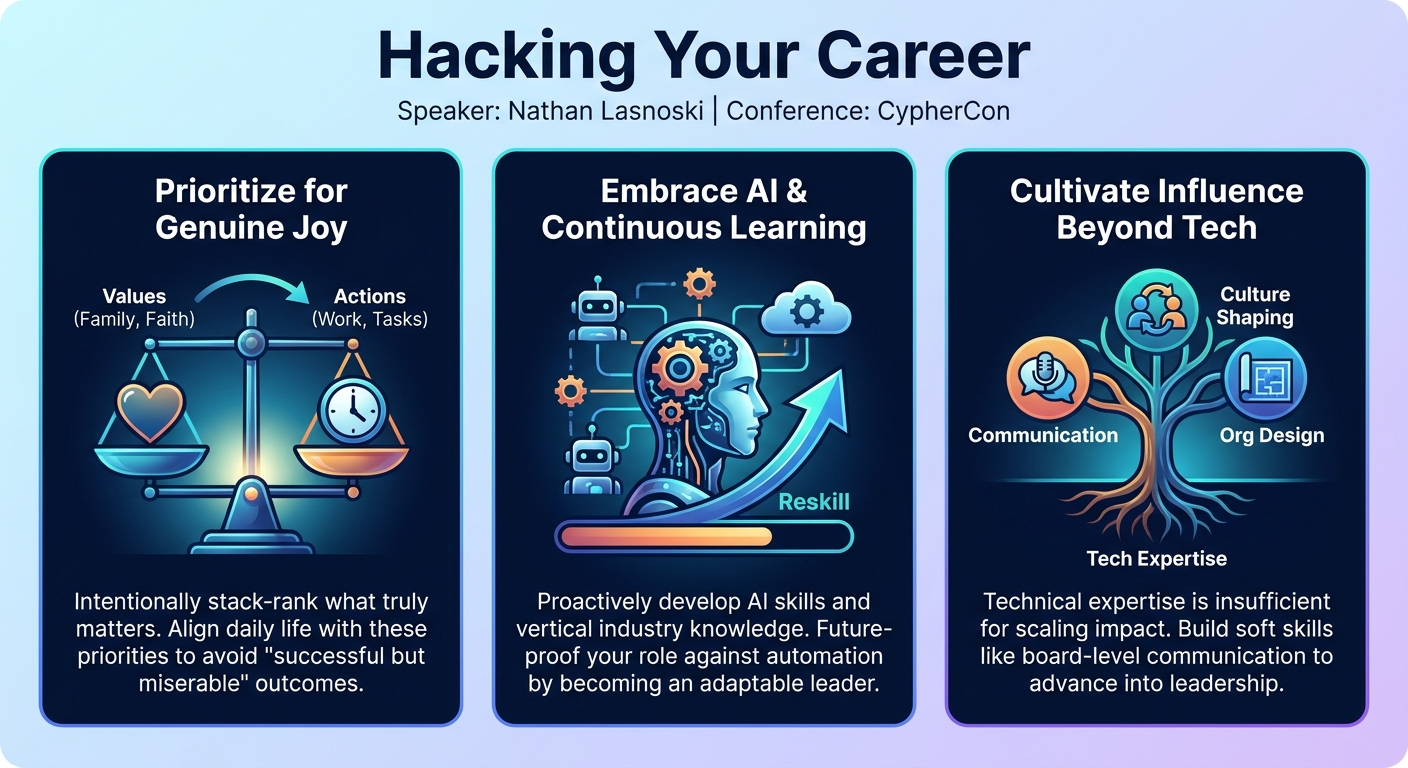
- Prioritization is the Bedrock of Joy: Understanding and intentionally prioritizing what is most important in life—be it family, faith, community, or work—is fundamental. Lasnoski stressed that recognizing the gap between "what you want your life to be about" and "what you actually do" is a powerful catalyst for change. His personal anecdotes, such as choosing work over a family walk or letting work creep into dedicated family time, powerfully illustrated this point.
- The Agentic Economy Demands Adaptation: The shift towards an agentic economy, driven by AI, is not just a technological change but an economic and cultural one. Individuals must actively seek roles within this new paradigm and leaders must prioritize reskilling and empowering their teams rather than purely cost-cutting measures.
- Vertical Understanding is Critical: In technology, simply being skilled in general tech is no longer sufficient. Industry-centric knowledge (e.g., FinTech, manufacturing, SaaS, EdTech, healthcare) is increasingly vital. Professionals need to understand how their technical expertise applies within specific business verticals to drive meaningful transformation.
- Soft Skills are Non-Negotiable for Growth: Beyond technical prowess, a robust set of soft skills is essential for career advancement, especially into leadership roles. Lasnoski highlighted skills like board-level communication, culture shaping, external thought leadership, and organizational design as crucial for scaling influence and impact beyond individual contribution.
- Leadership Emerges from Initiative: Promotion into leadership roles is rarely about waiting for an opportunity. It's about proactively stepping into ambiguity, identifying unmet needs, and bringing stability and forward movement. Leaders are often those who are "already doing it" before they are officially promoted, building trust through their actions.
- Mentorship and External Advisors are Essential: The speaker strongly advocated for having trusted individuals outside of one's immediate work environment (not HR or direct managers) who can offer honest, frank advice and coaching. This external perspective is crucial for identifying personal blind spots and making objective career decisions, especially during challenging periods.
- Joy Over Title: Chasing the next title or role without considering whether it brings genuine joy can lead to dissatisfaction. Lasnoski encouraged focusing on work that is intrinsically motivating and recognizing when one is unhappy, even if externally successful, to make courageous changes.
Technical Deep Dive
▶ Watch: Speaker's personal prioritization struggles (13:40)
The technical core of Lasnoski's talk was a custom-built, free web application designed to facilitate a dynamic and introspective career assessment. Dubbed the "career hacking app," this tool served as an interactive platform for users to evaluate their personal priorities, professional aspirations, skill sets, and readiness for the evolving economic landscape.
The application's design was intentionally gamified, featuring rapid, timed choices to encourage intuitive responses over overthinking, thereby revealing more authentic preferences. The user journey through the app comprised several distinct phases:
- Personal Priority Hack:
- Users began by making a series of fast-timed choices between various life priorities such as recreation, community, family, work, and faith. This initial phase aimed to quickly capture subconscious preferences.
- Following this, the app presented a stack-ranking exercise. This crucial step required users to explicitly rank "what you want your life to be about" versus "what you actually do." Lasnoski emphasized this as the most introspective part, highlighting potential discrepancies between aspiration and reality. For instance, he shared his own realization that despite wanting family and faith to be paramount, his actions often prioritized work, leading to a "natural disconnect."
- Professional Domain Assessment:
- Users selected their current functional domain (e.g., cyber security, tech management leadership).
- They then identified their current title or role.
- A key aspect was defining the environment where they thrive: options included corporate, small market consulting, enterprise consulting (like IBM), or a startup. This section recognized that different individuals flourish in different organizational cultures and structures. Lasnoski mentioned his preference for consulting due to varied customer engagements, contrasting it with those who prefer the stability of an enterprise or the rapid growth of a startup.
- Finally, users selected their preferred industry focus (e.g., FinTech, manufacturing, SaaS, EdTech). This emphasized the increasing importance of vertical understanding in technology, moving beyond generic tech skills to industry-specific knowledge.
- AI Usage & Skills Assessment:
- This section probed the user's current engagement with AI. Users assessed their level of AI usage in their daily work.
- Subsequent questions delved deeper into specific AI skills, aiming to provide a granular understanding of their proficiency in this critical area, preparing them for the agentic economy.
- Soft Skills Tree:
- Recognizing that "what got you here isn't going to get you there," this phase focused on soft skills. Users self-assessed their proficiency in areas vital for leadership and influence, such as board-level communication, culture shaping, external thought leadership, and organizational design. Lasnoski used his own growth from an individual contributor to a CTO role as an example, highlighting the shift from building things to influencing hundreds of projects and building frameworks.
The culmination of these assessments was a personalized "career hack packet." This output provided users with a summary of their self-judged priorities, a domain skill map, and suggested prioritized training programs tailored to their inputs. Lasnoski explicitly stated that the app was a V1, free to use, and did not collect any user data, reinforcing its purpose as a self-help tool. The design philosophy behind the application was to provide a structured, interactive, and immediate feedback mechanism for deep self-reflection, making the often-abstract process of career planning tangible and actionable.
Demo / Proof of Concept
▶ Watch: Career growth advice: joy, self-awareness, mentors (31:00)
The entire talk served as a live, interactive demonstration and proof of concept for Nathan Lasnoski's custom-built "career hacking app." Rather than a static presentation, attendees were invited to actively participate in the assessment process in real-time.
The demonstration began with the sharing of a QR code (LinkedIn initially, then the app's QR code), encouraging everyone to access the web application on their mobile devices. Lasnoski walked the audience through the user interface, explaining each step before they executed it. Users first encountered a "root access" prompt, then initiated the "start priority hack." The initial sequence involved rapid, timed multiple-choice questions, which Lasnoski explained were designed to elicit immediate, unfiltered responses, bypassing overthinking.
As the audience progressed, Lasnoski guided them through the subsequent, more introspective phases: the stack-ranking of "what you want your life to be about" versus "what you actually do," the selection of professional domain, role, preferred work environment (e.g., corporate, consulting, startup), and industry focus. He also demonstrated the sections on AI usage and specific AI skills, followed by the self-assessment of crucial soft skills. Throughout this live demo, Lasnoski shared his own experiences and results, illustrating the power of the tool to reveal personal and professional misalignments.
The interactive nature of the demo was highlighted by audience engagement, including questions about missing categories (e.g., "hardware" in functional domains) and requests to reshow the QR code. Lasnoski acknowledged these as valuable feedback points for improving the V1 application. The demonstration concluded with users receiving a personalized "career hack packet" containing their prioritized training program, skill maps, and a summary of their self-judgments. This immediate, tangible output served as the proof of concept, showing how the app could provide a structured framework for self-analysis and intentional career planning, making abstract concepts concrete and actionable for each participant.
Defensive Implications
▶ Watch: Audience comments: Robotics, mentors, mental health (50:00)
While "Hacking Your Career" is not a talk about traditional cybersecurity vulnerabilities or defense mechanisms, its insights offer profound defensive implications for individuals and organizations in the tech and security sectors. These implications center on protecting one's career trajectory, mental well-being, and organizational resilience against the challenges of a rapidly evolving landscape.
1. Defending Against Career Stagnation and Irrelevance:
In the face of the agentic economy, continuous learning and skill adaptation are paramount. Lasnoski's emphasis on assessing AI skills and understanding one's role in this new economic paradigm acts as a defense against becoming obsolete. Professionals must proactively identify and acquire the skills needed for future roles, rather than passively reacting to market shifts. The focus on vertical understanding (e.g., knowing FinTech cybersecurity vs. healthcare cybersecurity) helps professionals remain highly relevant and specialized, thus defending their market value.
2. Defending Against Burnout and Disillusionment:
Lasnoski's core message about prioritizing what truly matters and aligning actions with values is a critical defense against burnout. The personal anecdotes about setting boundaries (e.g., avoiding 7 PM work meetings, establishing "no media" evenings with family) are practical strategies for maintaining mental health and work-life balance. By intentionally stack-ranking priorities and recognizing disconnects, individuals can actively "defend" their personal time and well-being from the insidious creep of professional demands. The talk implicitly suggests that a career pursued without joy is a career susceptible to collapse, regardless of external success.
3. Defending Organizational Health and Talent Retention:
For organizations, the talk's insights provide a defensive playbook against talent drain and a disengaged workforce. Leaders who choose to reskill their teams for the agentic economy (as opposed to mass layoffs) are actively defending their institutional knowledge and fostering loyalty. Creating a culture where employees feel valued, can find joy in their work, and are supported in their growth (especially in soft skills like culture shaping and organizational design) acts as a powerful deterrent against high turnover and cynicism. The audience's suggestion of GRC (Governance, Risk, and Compliance) as a valuable pivot from a business background into security highlights an area where business acumen directly translates to organizational defense.
4. Defending Against Poor Career Choices:
The importance of mentorship and trusted external advisors is a defense mechanism against making uninformed or emotionally driven career decisions. Lasnoski stressed the need for "someone that can be honest with you about where you are that doesn't work for your company," as internal HR or managers might not always provide unbiased advice. This external perspective helps individuals navigate complex career crossroads (e.g., corporate vs. startup vs. consulting) with greater clarity and objectivity. The audience also highlighted robotics as a future growth area, indicating diverse avenues for career defense and expansion.
In essence, "Hacking Your Career" equips individuals with the tools and mindset to proactively "defend" their professional journey, ensuring it remains aligned with their personal values, adaptable to future challenges, and ultimately, a source of sustained joy and purpose.
Key Takeaways
- Prioritize Intentionally: Actively identify and stack-rank what truly matters in your life, then align your daily actions and career choices with those priorities to find genuine joy and fulfillment.
- Embrace the Agentic Economy: Proactively develop AI skills and adaptability to thrive in a future where artificial intelligence agents reshape work. Leaders should prioritize reskilling their teams.
- Cultivate Essential Soft Skills: Beyond technical expertise, master soft skills like board-level communication, culture shaping, and organizational design to scale your influence and advance into leadership roles.
- Seek Trusted Mentorship: Establish relationships with external advisors who can provide honest, unbiased career coaching and help you navigate professional challenges without internal biases.
- Choose Joy Over Title: Prioritize roles and work environments that bring you intrinsic satisfaction, rather than solely chasing titles or external success that may lead to misery.
- Commit to Continuous Self-Assessment: Regularly use tools or introspective practices (like the "career hacking app") to evaluate your current path, identify misalignments, and make intentional adjustments.
About the Speaker(s)
Nathan Lasnoski is the Chief Technology Officer (CTO) of the Microsoft consulting practice at IBM. In this significant role, he manages a substantial billion-and-a-half dollar consulting practice. Lasnoski is a recognized expert in the field of artificial intelligence, focusing on real-life AI implementations and leading Agentic skilling campaigns for IBM's internal employees. He also plays a crucial role in assisting external employers with their own AI adoption and transition strategies. Throughout his career, Lasnoski has demonstrated a passion for helping others navigate their professional journeys, sharing insights on career development, and publishing extensive content on AI adoption. His personal experiences and commitment to intentional living underpin his approach to career "hacking," making him a relatable and insightful speaker.
Reviews
Dr. Zero (Offensive Security Researcher) — HARD PASS
An IBM executive brought a timed web survey to a hacker con and called it a 'career hacking app.' If you want someone to look you in the eye and say 'agentic economy' without laughing, this is your slot. Otherwise, it's a sterile repackaging of every LinkedIn career post you've ever scrolled past.
Heather Calloway (CISO) — WEAK
This is a personal development seminar wrapped in AI consulting buzzwords. While practitioner burnout and talent retention are real organizational risks, an interactive web app for life prioritization does not substitute for structural leadership. Save this for early-career mentoring, but don't mistake it for a strategic talent plan.