Executive Panel: Architecture, Cybersecurity, & Artificial Intelligence
Grant Ecker, Nathan Lasnoski, Philip Finucane
Overview
This executive panel at CypherCon, featuring industry leaders Grant Ecker, Nathan Lasnoski, and Philip Finucane, delved into the transformative trends in architecture, cybersecurity, and artificial intelligence implementation. Organized by the Chief Architect Network, a 501c3 nonprofit dedicated to connecting architecture leaders and fostering talent, the discussion provided a high-level yet deeply technical perspective on how AI is reshaping organizational capabilities and posing new challenges and opportunities for security professionals. The panelists emphasized the urgency for businesses to adapt to these changes, highlighting that inaction could lead to significant competitive disadvantage.
Key moments
- 4:00 Panelist introductions and talk focus
- 6:00 Real-world AI agent success stories
- 12:15 Strategies for reliable AI-generated code and testing
- 22:00 Using AI to improve secure network design and provisioning
- 26:40 Leveraging LLMs for personal learning and home lab setup
- 36:00 Shifting developer roles: Leading AI agents, not just coding
- 47:00 The critical role of identity for AI agents and governance
Executive Panel: Architecture, Cybersecurity, & Artificial Intelligence
Speakers: Grant Ecker, Chief Architect at Ecolab; Nathan Lasnoski, CTO for the Microsoft consulting practice at IBM; Philip Finucane, CTO at CareCentrix
Conference: CypherCon
YouTube: https://www.youtube.com/watch?v=VWBPGU5IN-o
Overview
This executive panel at CypherCon, featuring industry leaders Grant Ecker, Nathan Lasnoski, and Philip Finucane, delved into the transformative trends in architecture, cybersecurity, and artificial intelligence implementation. Organized by the Chief Architect Network, a 501c3 nonprofit dedicated to connecting architecture leaders and fostering talent, the discussion provided a high-level yet deeply technical perspective on how AI is reshaping organizational capabilities and posing new challenges and opportunities for security professionals. The panelists emphasized the urgency for businesses to adapt to these changes, highlighting that inaction could lead to significant competitive disadvantage.
The conversation explored the practical applications of AI agents, their impact on efficiency and workforce dynamics, and the critical role of robust cybersecurity frameworks in an AI-driven world. From automating complex financial processes to revolutionizing software development and network provisioning, the talk offered concrete examples and strategic advice for navigating the rapidly evolving technological landscape. It underscored that while AI presents immense potential for innovation and acceleration, its successful and secure integration demands a fundamental shift in architectural thinking, operational processes, and talent development.
Background
▶ Watch: Panelist introductions and talk focus (4:00)
The Chief Architect Network, co-founded by Grant Ecker, serves as a crucial platform for architecture leaders to widen their perspectives, share best practices, develop leadership skills, and cultivate emerging talent within the cyber community. The panel's presence at CypherCon highlighted this commitment, aiming to engage with future technologists and ensure organizations are prepared for an increasingly complex digital future. The core premise of the network, and a recurring theme of the discussion, is that learning in today's fast-paced technological environment cannot be confined to static resources; continuous peer collaboration is essential.
The panelists stressed that the current era of rapid technological advancement, particularly with the advent of AI, necessitates an accelerated pace of adoption for businesses. Phil Finucane articulated this urgency, stating that companies choosing not to accelerate with this change risk their very survival, with the "name on the top of the building" eventually changing. This sentiment positioned the discussion not just as an exploration of new technologies, but as a critical call to action for leaders to push their organizations forward. The panel built upon a prior keynote delivered by the speakers, aiming to delve deeper into specific questions from the audience and their own prepared topics.
Key Findings
▶ Watch: Strategies for reliable AI-generated code and testing (12:15)
The panel revealed several key findings regarding the successful and secure implementation of AI:
- Transformative Efficiency through AI Agents: AI agents are already driving dramatic efficiencies in high-stakes environments. Nathan Lasnoski cited examples of a $1.5 trillion financial services organization processing approximately 1 million documents per month and a large insurance organization adjudicating claims, both achieving well over 50% straight-through processing. This frees human workers to focus on higher-value, more complex tasks.
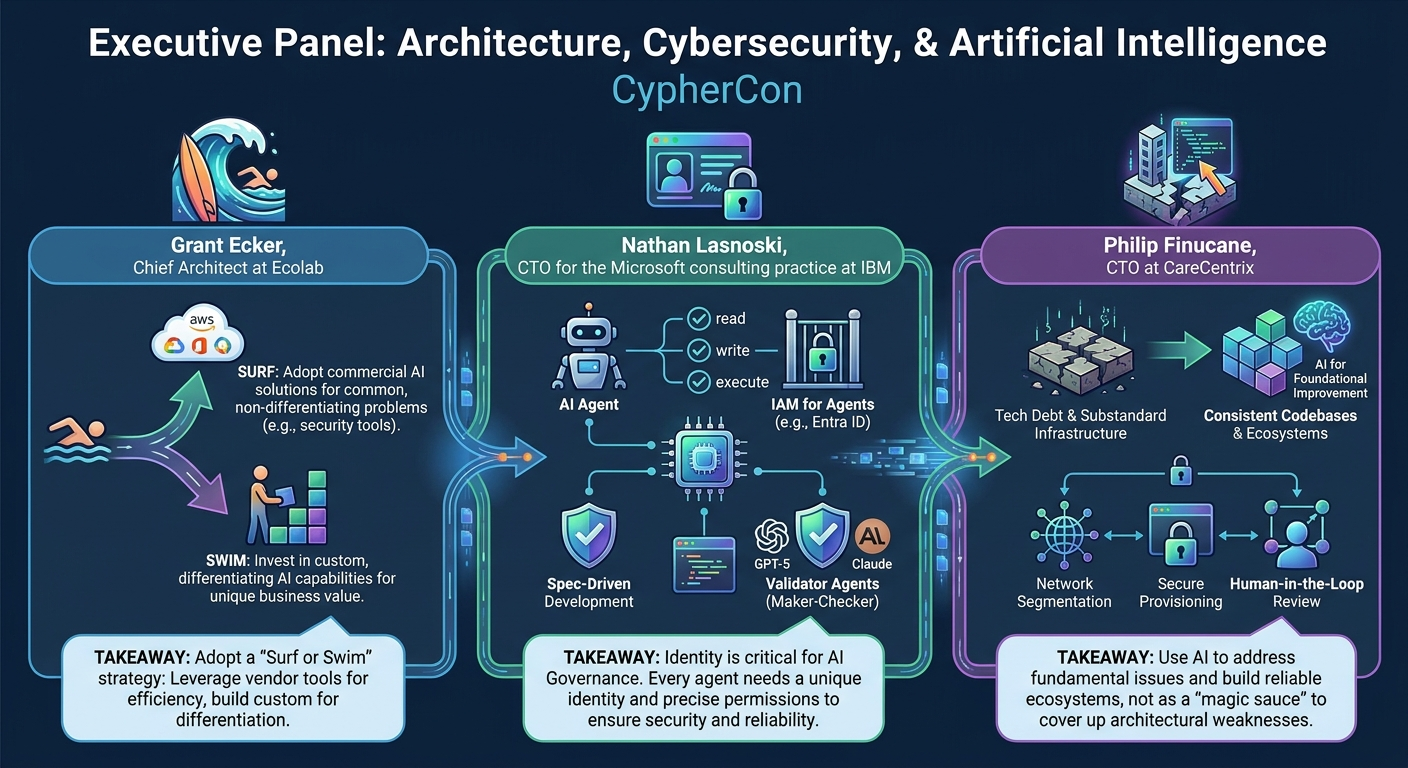
- AI for Foundational Improvement, Not Cover-ups: Philip Finucane strongly advocated for using AI to address deterministic problems, eliminate tech debt, and build consistent codebases and ecosystems, rather than employing it as a "magic sauce" to mask substandard infrastructure or network design. His personal mission is to build a healthcare ecosystem "just as good as any of the tech giants" by leveraging AI.
- Reliability as a Cornerstone: Ensuring the reliability and accuracy of AI-generated outcomes is paramount. Techniques highlighted include spec-driven development for clear system definitions and validator agents (a "maker-checker" technique or adversarial learning). This involves using different AI models, like GPT-5 and Claude, to test and validate each other's outputs, forming a "mixture of experts."
- AI as a Delegation Layer: Grant Ecker emphasized using AI as a "delegation layer" to design components and take tasks forward, with critical human review to ensure understandability, adherence to conventions, and reusability. This approach fosters trust in the codebase.
- Impact on Workforce and Skills: The panelists foresee a shift in the role of developers from primarily code writers to "Gru" – leaders who manage and direct AI "minions." This necessitates the development of T-shaped skills (deep expertise in one area, broad understanding of adjacent technologies and business context) and a culture of continuous experimentation and iteration.
- Identity as a Critical Enabler for AI Governance: The proliferation of AI agents elevates identity and access management (IAM) to a paramount concern. Nathan Lasnoski declared it a "golden moment" for identity professionals, as every agent will require an identity (e.g., Entra ID for agents) to interact securely within the enterprise environment. Robust permissioning structures are essential to mitigate the significant risks of over-privileged agents.
- Strategic "Surf or Swim" Approach: Organizations must discern when to leverage readily available vendor solutions ("surf the wave") for non-differentiating problems (like common security issues) and when to invest in building custom, differentiating AI capabilities ("swim against the wave"). AI is a "how," not a "what," and foundational investments (the "iceberg" below the surface) are crucial for scalable, horizontal AI.
Technical Deep Dive
▶ Watch: Using AI to improve secure network design and provisioning (22:00)
The panel provided concrete examples of AI's technical application across various domains, emphasizing both innovative solutions and critical security considerations.
Nathan Lasnoski detailed two significant agentic implementations in the financial services and insurance sectors. For a $1.5 trillion financial services organization, an AI agent system processes approximately 1 million documents a month to facilitate money transfers. This complex workflow involves several stages:
- Intake: Receiving requests from diverse formats.
- Classification: Matching requests to an ontology of actions.
- Extraction: Pulling raw data from documents.
- Accuracy Analysis: Determining if extracted data requires human-in-the-loop review or proceeds to straight-through processing.
- Transformation: Applying calculations (addition, subtraction, multiplication).
- JSON Mapping: Matching processed data to a JSON format for downstream system interaction.
A similar agentic system was deployed for a large insurance organization to adjudicate claims, dramatically accelerating processing times and escalating only the most complex or high-value claims to human adjusters. In both cases, the agentic design allows for modularity and reusability of components across different problems within the organizations.
To ensure the reliability of these AI systems, Nathan highlighted two key techniques:
- Spec-Driven Development: This methodology establishes a durable, explicit definition of what a successful system looks like, preventing "vibe coding" and providing a continuous feedback loop for AI-generated code.
- Validator Agents: Implementing a "maker-checker" technique where one agent builds or processes, and another, often using a different model, tests and validates the output. This involves adversarial learning and a "mixture of experts." Nathan specifically mentioned a recent Microsoft release where GPT-5 and Claude run in sequence, with Claude performing validation on GPT-5's output. These validator agents are "fantastic at finding problems in code" and security issues, acting as additional layers of quality assurance beyond human review.
Philip Finucane illustrated the practical power of AI for individual builders through his personal home lab project. Despite not being a "network guy," he leveraged ChatGPT to design and implement a sophisticated home network from scratch. His setup includes:
- Network Segmentation: For enhanced security and organization.
- pfSense Firewall: Running on Netgate hardware for robust network control.
- Proxmox: For virtualization, hosting various services.
- Git Server: For version control of his projects.
- Pi-hole: For network-wide ad blocking and DNS security.
- Monitoring System: For ecosystem health.
- WireGuard VPN: Enabling secure remote access to his home network, even from international locations like Peru.
Phil emphasized that ChatGPT helped him "bash through intractable problem after intractable problem," turning a $700 machine into a powerful development environment. This demonstrates how LLMs democratize complex technical tasks, acting as a "magic wand" for individuals. He also mentioned using markdown files within code repositories to provide detailed descriptions for LLMs, improving their ability to generate accurate code with correct signatures.
Regarding AI in cloud security, Nathan Lasnoski explained how AI agents can significantly improve the fundamental security of network design. In cloud environments like Azure, AI can provision secure deployments by creating agentic helpers that automate the setup of independent subscriptions, resource groups, and the application of network policies (including NSGs, firewalls, and routing rules). This directly aligns with best practices like Microsoft's Cloud Adoption Framework, which are often bypassed due to perceived complexity. AI agents can scale these secure provisioning processes, transforming what was once a slow, compromise-prone manual task into a rapid, compliant, and consistent operation.
Finally, the panel highlighted the emerging technical challenge and opportunity of agent identity. As AI agents become pervasive, each will require its own unique identity, distinct from human users. Platforms like Entra ID for agents are emerging to address this. The technical challenge lies in translating this agent identity into appropriate access permissions, determining what an agent can "talk to," and how a human's identity and permissions can safely instruct a potentially more powerful agent. This forms the "heart of the governance project" for many organizations.
Demo / Proof of Concept
▶ Watch: Shifting developer roles: Leading AI agents, not just coding (36:00)
While the panel did not feature a live, interactive demonstration of a specific tool or exploit, the speakers provided compelling real-world and personal proof-of-concept examples that underscored their key findings.
Philip Finucane's detailed account of building his sophisticated home lab serves as a powerful personal proof of concept for the "magic wand" capabilities of AI. He described how, despite lacking deep expertise in network engineering, he used ChatGPT as a constant guide to set up a robust network infrastructure including pfSense, Proxmox, a Git server, Pi-hole, and WireGuard VPN. This personal journey illustrated how AI can break down technical barriers, enabling individuals to tackle complex, multi-disciplinary projects that would have been previously impossible. His success in configuring WireGuard to securely access his home network from abroad, even enabling streaming of the NCAA tournament from Peru, vividly demonstrated the practical utility and transformative potential of AI as a personal technical assistant.
Nathan Lasnoski further reinforced the concept of AI as a learning and delegation tool by referencing OpenClaw and Copilot/Co-work. He acknowledged using OpenClaw for "benign personal tasks" as a "great example of learning to delegate to an AI agent." He noted that while OpenClaw itself might not be ready for enterprise due to lack of governance, tools like Copilot/Co-work are becoming safer as they integrate with enterprise frameworks, allowing for better control and organization. His advice to join "Frontier programs" for early access to such tools also implicitly encourages a hands-on, experimental approach as a form of ongoing proof of concept. These examples, though not live demos, concretely illustrated the practical applications and learning opportunities presented by AI in both personal and professional contexts.
Defensive Implications
▶ Watch: The critical role of identity for AI agents and governance (47:00)
The panel's discussion highlighted several critical defensive implications for cybersecurity professionals navigating the AI era:
- Prioritize Foundational Security: Philip Finucane's emphatic stance against using AI as a "magic sauce" to compensate for "substandard infrastructure" is a crucial defensive principle. Organizations must first address fundamental security issues, such as proper network segmentation, before layering AI solutions. Relying on AI to paper over architectural weaknesses creates greater vulnerabilities rather than true resilience.
- Strategic and Targeted AI Integration: Defenders should avoid the temptation to throw an "AI security blanket over everything." Instead, AI tools should be strategically deployed for specific, well-defined tasks where they excel, such as detection of outliers or automated threat analysis, within properly secured network segments.
- Automated Secure Provisioning in Cloud Environments: Nathan Lasnoski emphasized leveraging AI agents to enforce security best practices in cloud deployments. By using agentic helpers to automate the provisioning of secure cloud environments (e.g., creating independent Azure subscriptions, resource groups, and applying network policies with appropriate ingress/egress rules), organizations can ensure consistent security controls at scale, reducing the human error and compromises often seen in manual processes. This aligns with frameworks like the Microsoft Cloud Adoption Framework.
- Robust Agent Identity and Access Management (IAM): The rise of AI agents necessitates a paradigm shift in IAM. Cybersecurity teams must implement comprehensive permissioning structures and access control structures for every AI agent. As Nathan explained, every agent will require its own identity (e.g., using platforms like Entra ID for agents), and it's critical to define precisely what an agent can access and do, preventing the dangerous default of granting agents system-wide access with a mere instruction "not to do bad stuff." This is a "golden moment" for identity professionals to become enablers, not blockers, by securing the AI ecosystem.
- "Surf or Swim" for Security Tools: Grant Ecker's "surf or swim" metaphor applies directly to defensive strategies. For common, non-differentiating security problems, organizations should "surf" by adopting commercial AI security solutions from vendors. This allows internal security resources to "swim" and focus on developing custom, differentiating AI capabilities that address unique, high-value threats specific to their organization. This approach maximizes efficiency and impact.
- Maintain Human Oversight and Review: Despite the advancements in AI, the panel consistently stressed the importance of human review in AI workflows. Human oversight ensures that AI-generated code is understandable, follows conventions, and avoids creating hidden points of failure. This human-in-the-loop approach is crucial for validating AI outputs and managing the "chaos of the minions" to ensure desired outcomes and contain potential "blast radius" from errors.
- Avoid Overbuilding Custom Solutions: As an audience member (Greg) pointed out, and Nathan agreed, vendors are rapidly developing solutions for agent identity and AI frameworks (e.g., LangGraph, Azure Agent Framework). Defenders should be cautious not to "overbuild" custom solutions for problems that will soon be solved by major providers, reserving internal development for truly unique security challenges.
Key Takeaways
- AI agents are driving unprecedented efficiency, enabling over 50% straight-through processing in complex tasks like financial document handling and insurance claims adjudication, allowing human talent to focus on higher-value work.
- Reliability is paramount for AI adoption, requiring techniques like spec-driven development, validator agents (e.g., mixture of experts using GPT-5 and Claude for adversarial learning), and continuous human review to ensure accuracy and security.
- AI should be used to fix foundational issues and eliminate tech debt, rather than as a "security blanket" for substandard infrastructure, and deployed strategically for specific tasks like outlier detection.
- The role of technologists is evolving, shifting from mere code writers to "Gru" – leaders who leverage AI "minions" to drive innovation, requiring the development of T-shaped skills and a culture of experimentation.
- Identity and Access Management (IAM) is critical for AI governance, as every agent will require an identity (e.g., Entra ID for agents) with precisely defined permissions to mitigate risks and unlock opportunities securely.
- Organizations must adopt a "surf or swim" strategy for AI, utilizing commercial solutions for common problems and investing in custom development only for truly differentiating capabilities that align with core business strategy.
About the Speaker(s)
Grant Ecker is the Chief Architect at Ecolab and a co-founder of the Chief Architect Network, a 501c3 nonprofit dedicated to fostering collaboration and talent development among architecture leaders. He is passionate about the cyber community and guiding organizations through technological change.
Nathan Lasnoski serves as the CTO for the Microsoft consulting practice at IBM, overseeing a $1.5 billion practice in the Americas. An early adopter of AI, he is a veteran Microsoft MVP and specializes in agentic development, career growth, and helping organizations take their first steps into new technologies.
Philip Finucane is the CTO of CareCentrix, a healthcare company. With a background that includes time at Meta and as CTO for Farmville at Zynga, he is actively driving the adoption of AI to eliminate tech debt and build high-quality, fast-moving ecosystems within the highly regulated healthcare sector.
Reviews
Dr. Zero (Offensive Security Researcher) — WEAK
Three executives sat on a stage and rebranded decade-old OCR document pipelines as 'agentic workflows.' The only actual security signal here was a brief nod to non-human identity management, buried under LinkedIn-tier metaphors about surfing and Despicable Me.
Heather Calloway (CISO) — STRONG ACCEPT
This panel provides a mature, architectural look at enterprise AI adoption without the usual vendor hype. The focus on identity and access management for autonomous agents is exactly the signal risk committees need to hear right now.