Trends in Architecture, Cybersecurity, & AI Implementation
Grant Ecker, Adi Kaushal, Ravneet Grewal, Karan Dhawal
Overview
In an era defined by relentless technological advancement and market volatility, the traditional enterprise architecture model often struggles to keep pace. This talk, "Architecting for an Adapting Enterprise," delivered at CypherCon by leaders from the Chief Architect Network, delves into critical trends in architecture, cybersecurity, and AI implementation. The Chief Architect Network, a 501c3 nonprofit, volunteer, and vendor-neutral organization, brings together executive architecture leaders to foster knowledge sharing, talent development, and ultimately, drive organizational outcomes. The speakers highlight the inherent rigidity of many enterprise systems and advocate for a paradigm shift towards more adaptable, loosely coupled architectures capable of embracing rapid innovation, particularly in the burgeoning field of Artificial Intelligence.
Key moments
- 0:00 Introduction to Architecting for an Adapting Enterprise
- 6:00 Where enterprise architecture hinders or enables change
- 16:00 The Architecture Innovation Pipeline framework for new tech
- 23:00 Quantifying architecture value with impact stories
- 31:30 Hard truths about AI foundational investment
- 39:00 Connecting data quality to specific business outcomes
- 48:00 Preparing architects for the AI age
- 58:00 Final thoughts and call to action: networking is key
Trends in Architecture, Cybersecurity, & AI Implementation
Speakers: Grant Ecker, Chief Architect, Ecolab; Adi Kaushal, Architecture Leader, Ecolab; Karan Dhawal, Adjunct Faculty at Carnegie Mellon and Strategy Consultant at ZS
Conference: CypherCon
YouTube: https://www.youtube.com/watch?v=pNqiMyHtCTM
Overview
In an era defined by relentless technological advancement and market volatility, the traditional enterprise architecture model often struggles to keep pace. This talk, "Architecting for an Adapting Enterprise," delivered at CypherCon by leaders from the Chief Architect Network, delves into critical trends in architecture, cybersecurity, and AI implementation. The Chief Architect Network, a 501c3 nonprofit, volunteer, and vendor-neutral organization, brings together executive architecture leaders to foster knowledge sharing, talent development, and ultimately, drive organizational outcomes. The speakers highlight the inherent rigidity of many enterprise systems and advocate for a paradigm shift towards more adaptable, loosely coupled architectures capable of embracing rapid innovation, particularly in the burgeoning field of Artificial Intelligence.
The core challenge addressed is how organizations, traditionally not built for constant change, can evolve to remain competitive and secure. The discussion navigates the delicate balance between maintaining stable, tightly coupled core systems—such as Enterprise Resource Planning (ERP) solutions—and integrating agile, loosely coupled components like Large Language Models (LLMs). The speakers emphasize that this adaptability is not automatic but requires deliberate architectural thought and careful consideration, moving beyond a "police" mindset to one of enablement and strategic partnership with the business. This talk is crucial for cybersecurity professionals, architects, and business leaders seeking to understand how architectural decisions directly impact an enterprise's ability to innovate, secure its assets, and thrive under pressure.
Background
▶ Watch: Introduction to Architecting for an Adapting Enterprise (0:00)
Historically, Enterprise Architecture (EA) has often been perceived as a bureaucratic bottleneck, a "big boy in the room" that hinders rapid innovation and response to market pressures. This perception stems from EA's traditional role in enforcing standards, often based on outdated technologies or principles, leading to an "old guard" mentality. Architectures were designed for stability and control, prioritizing rigid adherence to established norms over agility. This approach, while ensuring consistency and mitigating certain risks, inadvertently created systems that were slow to adapt, making organizations vulnerable in dynamic environments.
The problem is exacerbated by the sheer speed of technological evolution. As new innovations emerge, such as Generative AI and advanced machine learning models, enterprises face a dilemma: how to integrate these powerful, yet rapidly changing, capabilities without destabilizing core operations or incurring prohibitive technical debt. The challenge lies in identifying where to maintain tight coupling—for instance, with foundational ERPs that serve as sources of truth—and where to embrace loose coupling, allowing for the flexible swapping of emerging technologies like different LLMs. Without this strategic differentiation, organizations risk either being left behind or making unsustainable investments in fleeting trends.
Furthermore, the speaker, Karan Dhawal, noted that while architecture review documents (ADRs) are produced, they often fail to translate complex technical decisions into business-understandable consequences. This communication gap contributes to the perception of EA as an administrative burden rather than a strategic enabler. The context of global operations, as highlighted by Adi Kaushal with an example of ERP challenges in Brazil, further complicates standardization efforts, demonstrating that local regulatory bodies and unique market requirements often necessitate deviations from global architectural principles. This intricate landscape underscores the need for a more pragmatic, business-aligned, and adaptable approach to enterprise architecture.
Key Findings
▶ Watch: The Architecture Innovation Pipeline framework for new tech (16:00)
The talk presented several critical findings on how to navigate the complexities of modern enterprise architecture:
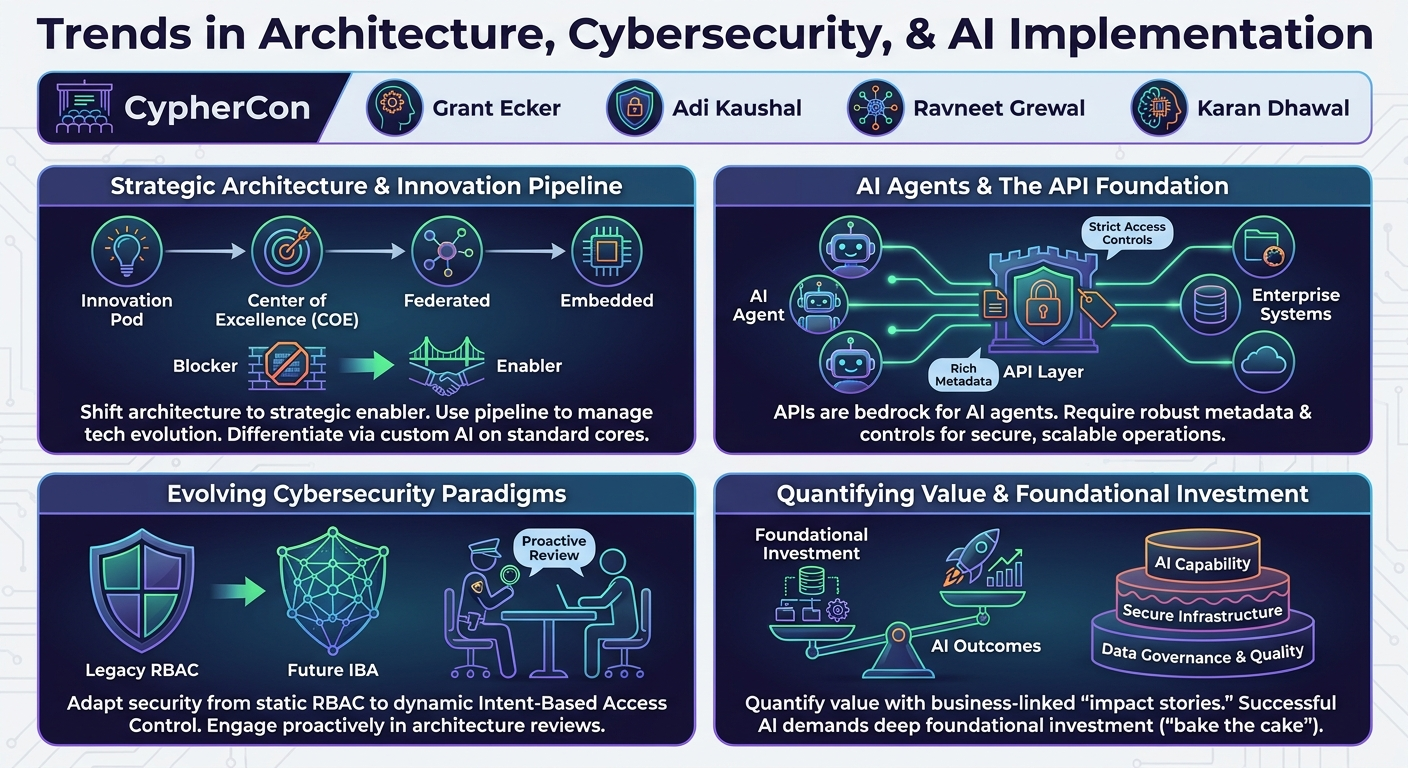
- Architecture as an Enabler, Not a Blocker: Enterprise Architecture, when correctly aligned with business outcomes, can be a powerful enabler of change rather than a hindrance. This requires EA teams to shed their "police" image and become strategic partners, focusing on guiding the organization towards success. By explaining architectural decisions (e.g., through Architecture Review Documents - ADRs) in terms of business consequences and value, EA can gain crucial buy-in.
- Strategic Differentiation through Innovation: Organizations should strategically differentiate through innovation in areas that provide a competitive edge, while standardizing commodity functions. For instance, while standard ERP systems like SAP offer built-in algorithms, true market differentiation often comes from custom-built AI algorithms plugged into these systems, tailoring capabilities like supply chain optimization.
- The Architecture Innovation Pipeline: Grant Ecker introduced a model for managing innovation, describing a journey from early "innovation pods" (exploring new technologies like Retrieval Augmented Generation - RAG 24 months ago) through Centers of Excellence (COEs), to eventually "federated" and "embedded" solutions that are readily consumable as standardized services (e.g., Microsoft Copilot for RAG today). Current areas like Agent to Agent (A2A) and Multi-Agent Coordination Platforms (MCP) are in the early innovation pod phase.
- The Pivotal Role of APIs for AI Agents: In the age of AI agents, well-documented and contextualized APIs are foundational. Karan Dhawal stressed that for agents to be successful, APIs must provide rich metadata, define their capabilities, and specify access controls, ensuring scalability and security of the enterprise architecture.
- Quantifying Architecture's Value: To overcome the perception of EA as a cost center, organizations must quantify its impact. This involves creating "impact stories" that clearly link architectural decisions (e.g., build vs. buy) to tangible business benefits like faster growth or cost savings. The concept of a "Value Engineer" within the IT team was proposed to scientifically develop these business cases.
- Evolving Security Paradigms: The cybersecurity landscape demands a shift from traditional security models like Role-Based Access Control (RBAC) to more dynamic approaches such as Intent-Based Access Control (IBA). While IBA is still evolving, it represents a crucial future direction for securing complex, agent-driven environments, requiring advanced monitoring and compensating controls. The panel acknowledged that 100% security is an unattainable goal, necessitating a focus on acceptable risk.
- The "Bake the Cake" Investment Truth: Leaders often resist the hard truth that achieving significant AI outcomes requires substantial foundational investment—not just "frosting and sprinkles." Building horizontal AI capabilities and robust data foundations is crucial, yet there's also a risk of misdirected spending on "pet projects" or misaligned "horizontals" that don't contribute to clear business outcomes. The challenge is compounded by the fact that the average CIO lifespan (18-22 months) is often shorter than the three-year maturity cycle of many data governance and platform projects, leading to a disconnect in accountability.
Technical Deep Dive
▶ Watch: Hard truths about AI foundational investment (31:30)
The discussion offered significant technical insights into how enterprises can adapt their architectures, particularly concerning AI integration and evolving security postures. A central theme was Grant Ecker's Architecture Innovation Pipeline, a framework designed to manage the lifecycle of emerging technologies within an organization. This pipeline progresses through distinct phases:
- Innovation Pod: This initial phase involves small, focused teams (innovation pods) exploring new technologies. Using Retrieval Augmented Generation (RAG) as an example, Ecker described how 18-24 months ago, organizations would experiment with different approaches—such as deploying Llama models in-house versus leveraging cloud solutions—to build RAG capabilities. This phase is characterized by experimentation, rapid prototyping, and a "bake-off" mentality to identify viable solutions.
- Center of Excellence (COE): As technologies mature and best practices emerge, the pipeline moves to a COE model. Here, 2-3 chosen solutions for specific use cases are refined. For instance, Llama might be standardized for private, sensitive data scenarios, while off-the-shelf products like the Microsoft 365 Graph could handle more generic RAG applications. The COE focuses on developing expertise and standardizing successful patterns.
- Federated: In this phase, the technology becomes more widely adopted across different application stacks. Solutions are integrated into a semantic layer across the broader organization, supported by the COE but federated out to various teams.
- Embedded: The final stage where the technology is fully standardized, readily usable, and transparently integrated into the enterprise's operations. Ecker noted that RAG has now reached this "embedded" phase, where users can simply upload a folder to Microsoft and request a chatbot that responds based on its content, without needing to understand the underlying RAG engineering.
However, the pipeline also acknowledges new frontiers. Ecker identified Agent to Agent (A2A) communication and Multi-Agent Coordination Platforms (MCP) as currently being in the early "innovation pod" phase, characterized by inflated expectations and ongoing challenges like hallucinations in generative AI.
Karan Dhawal emphasized the foundational role of APIs in enabling this agent-driven future. For AI agents to operate effectively and scale across an enterprise, APIs must be robustly designed with rich metadata. This metadata should clearly define what the API can do, its context, who is authorized to use it, and what agents are permitted to interact with it. Without this foundational layer, the scalability and security of agentic architectures are severely compromised.
In the realm of security, Adi Kaushal highlighted a crucial shift from Role-Based Access Control (RBAC) to Intent-Based Access Control (IBA). While RBAC grants permissions based on a user's role, IBA aims to track the intent associated with an agent or user, providing a more dynamic and context-aware security model. Although IBA is not yet fully mature, its evolution will require sophisticated monitoring, Site Reliability Engineering (SRE) practices, and the strategic deployment of compensating controls to manage inherent risks, as 100% security remains an elusive goal.
The panel also touched upon the complexities of multi-cloud strategies. While offering flexibility and avoiding vendor lock-in, multi-cloud adoption comes with significant trade-offs. Hyperscalers (e.g., AWS, Azure, GCP) design their solutions to keep customers within their respective ecosystems. Achieving native cross-cloud functionality requires substantial investment in a tooling ecosystem that can operate across diverse cloud environments, often reducing hyperscalers to mere infrastructure providers rather than fully leveraging their proprietary services. This decision impacts not only technology stacks but also talent acquisition and retention, as specialists may prefer working with specific cloud providers.
Finally, the speakers discussed the integration of custom AI with traditional systems. Karan Dhawal noted the trend of enterprises bringing in standard ERPs like SAP but then plugging in their own custom AI algorithms to achieve market differentiation in areas like supply chain or delivery optimization. This "bring your own AI" approach allows companies to leverage commodity software for core functions while building proprietary intelligence for competitive advantage.
Demo / Proof of Concept
▶ Watch: Connecting data quality to specific business outcomes (39:00)
While no live technical demonstration or proof of concept was presented during the talk, the speakers effectively illustrated their points with real-world business examples and architectural frameworks. Adi Kaushal provided compelling case studies from Sony Pictures and Sony Music, detailing how targeted innovation led to significant business outcomes. For Sony Pictures, a custom solution for vendor-managed inventory across major retailers resulted in a 17% reduction in inventory costs, amounting to $25 million. Similarly, Sony Music developed a custom digital warehouse management system to handle the complex many-to-many relationships of copyrights for songs and albums, which not only optimized their operations but also became an industry differentiator. These examples served as strong evidence for the principles discussed, demonstrating the tangible benefits of strategic architectural decisions and targeted innovation.
Defensive Implications
▶ Watch: Final thoughts and call to action: networking is key (58:00)
The talk offered crucial insights for cybersecurity professionals grappling with the accelerating pace of technological change and the integration of AI. The core defensive implication is the urgent need for adaptability in security practices. Grant Ecker drew a powerful metaphor, recalling the early days of cloud adoption where security teams, accustomed to physical firewalls, resisted cloud-native security models. The "what" of securing environments remains constant (e.g., protecting data, adhering to NIST frameworks), but the "how"—the specific technologies and methodologies—is rapidly evolving.
Cybersecurity teams must move beyond a "hero culture" where they are rewarded for stopping projects based on outdated security paradigms. Instead, they must take accountability for continuous learning and staying current with new architectures. Derailed projects due to security's lack of understanding of modern cloud or AI constructs are no longer acceptable. This implies a significant investment of time and resources in upskilling security analysts and architects, ensuring they understand the security implications of loosely coupled architectures, AI agents, and multi-cloud environments.
Key defensive actions include:
- Proactive Engagement in Architecture Reviews: Security teams should be integral to Architecture Review Boards (ARBs), providing recommendations rather than just approvals. Their role should shift from being blockers to enablers, helping to quantify risks associated with new solutions and determining acceptable risk levels for the enterprise.
- Securing the API Layer: With the rise of AI agents, APIs become critical attack surfaces. Defenders must ensure APIs have robust metadata, clear context, and stringent access controls to prevent unauthorized agent interactions and data exfiltration. This includes understanding which agents are allowed to use specific APIs and monitoring for anomalous behavior.
- Embracing Intent-Based Access Control (IBA): As security models evolve from RBAC to IBA, security professionals must begin exploring and implementing solutions that track the intent of users and agents. This will require advanced monitoring, Site Reliability Engineering (SRE) practices focused on security, and the strategic deployment of compensating controls to manage risks in a dynamic, intent-driven environment. The acknowledgment that 100% security is impossible means focusing on resilience and rapid response.
- Developing M&A Security Playbooks: Karan Dhawal highlighted the critical role of architecture teams in mergers and acquisitions (M&A). Cybersecurity professionals must collaborate with architects to develop comprehensive playbooks for assessing the security posture, identifying guardrails, and evaluating the risks and costs of integrating acquired entities into the broader enterprise. This proactive assessment can prevent inheriting significant security debt.
- Investing in Foundational Security for AI: While the business craves AI outcomes, security must advocate for investment in the underlying "cake"—the robust data governance, data quality, and secure data foundations necessary for trustworthy and secure AI. Without this, AI initiatives risk becoming major vectors for data breaches or compliance failures.
- Promoting Cross-Training: The traditional siloed view of architects (security, data, AI, enterprise) is dissolving. Security professionals are expected to understand broader architectural principles, including data governance, networking, and AI. This cross-training enhances their ability to identify and mitigate risks holistically across the enterprise.
Ultimately, defensive implications revolve around continuous adaptation, proactive engagement, and a deep understanding of how new technologies fundamentally alter the threat landscape and the "how" of security.
Key Takeaways
- Shift from Blocker to Enabler: Enterprise Architecture must transform from an administrative "police" function into a strategic enabler, actively guiding the business towards outcomes and communicating value through impact stories and business cases.
- Strategic Innovation and Standardization: Innovate aggressively for competitive differentiation (e.g., custom AI algorithms) and standardize commodity functions (e.g., core ERPs, off-the-shelf RAG solutions) to optimize resources and maintain agility.
- APIs are the Foundation for AI Agents: Robust, well-documented APIs with rich metadata and stringent access controls are critical for the secure and scalable deployment of AI agents in the enterprise.
- Evolve Security Practices: Cybersecurity professionals must adapt their "how" of security to keep pace with new architectures (e.g., cloud, AI agents), moving towards Intent-Based Access Control (IBA) and embracing continuous learning to avoid hindering innovation.
- Quantify Value and Invest Mindfully: Architectural and security initiatives must clearly articulate their business value (cost savings or growth) to secure funding. Leaders must commit to foundational investments ("bake the cake") for AI outcomes, understanding the long-term ROI challenges with projects like data governance.
- Cultivate Networks and Continuous Learning: Fostering internal communities of practice and external professional networks (like the Chief Architect Network or LinkedIn connections) is essential for architects and security professionals to stay current, share knowledge, and collectively navigate rapid technological change.
About the Speaker(s)
Grant Ecker is the Chief Architect at Ecolab and a key organizer for the Chief Architect Network. He plays a pivotal role in building executive tracks at conferences like CypherCon and is passionate about fostering collaboration and knowledge sharing among architecture leaders. He advocates for modernizing enterprise architecture to enable adaptability and leverages frameworks like the Architecture Innovation Pipeline to manage technology evolution.
Adi Kaushal serves as an Architecture Leader at Ecolab. He brings extensive experience in guiding organizations through architectural decisions, balancing strategic principles with practical business needs. Adi emphasizes aligning enterprise architecture with business capabilities and outcomes, advocating for cost optimization and making informed decisions based on market context and regulatory requirements. He highlights the importance of repositioning architecture groups as enablement organizations.
Karan Dhawal is an Adjunct Faculty member at Carnegie Mellon, where he teaches a chief data and AI course—a seven-month executive program designed for chief data and AI executives, now replicated across other universities like Berkeley and Chicago Booth. He also works for a strategy consulting company called ZS. Karan's expertise lies in data and AI strategy, emphasizing the value of data governance, data quality, and robust architecture boards. He is a strong proponent of using "impact stories" and "value engineers" to demonstrate the quantifiable business benefits of architectural decisions.
Reviews
Dr. Zero (Offensive Security Researcher) — WEAK
Three executives spent an hour reinventing the concept of basic software design and slapping 'AI' on it to justify their consulting frameworks. If you want to hear how 'Centers of Excellence' and 'Value Engineers' will magically secure your multi-agent architecture, knock yourself out, but there's zero actionable signal here.
Heather Calloway (CISO) — MUST SEE
This is a required watch for security leaders struggling to govern AI initiatives. It correctly frames AI adoption and agentic workflows as enterprise architecture challenges rather than just security tooling problems, offering a clear path to align with the business instead of blocking it.