Executive Panel: Is AI coming for our jobs?
Grant Ecker, Nathan Lasnoski, Philip Finucane
Overview
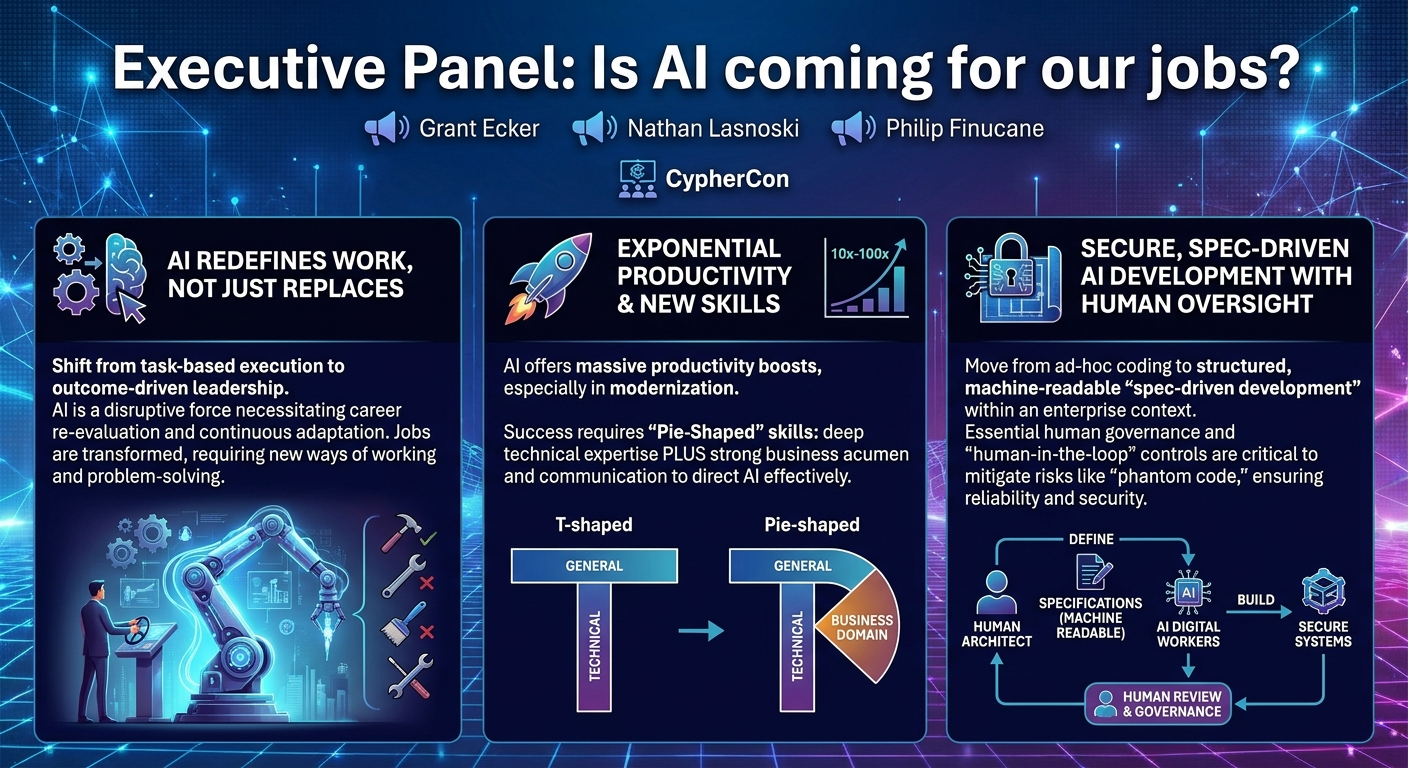
This executive panel at CypherCon 9, featuring prominent leaders from the Chief Architect Network, tackled one of the most pressing questions in the technology world today: "Is AI coming for our jobs?" Far from a simple yes or no, the discussion provided a nuanced and forward-looking perspective on how artificial intelligence is fundamentally reshaping the workforce, demanding new skills, and creating unprecedented opportunities for those willing to adapt. The panel, composed of experienced chief architects and CTOs, emphasized a shift from task-based work to outcome-driven leadership, urging professionals to embrace a culture of continuous learning and experimentation.
Key moments
- 6:00 AI's economic impact on consulting and jobs
- 12:00 Beyond Q&A: Delegating tasks to digital workers
- 16:00 Phil's experience: AI upgrades legacy app, "10x is nowhere close"
- 22:00 Spec-driven development for reliable enterprise AI
- 26:00 "Build robotic lawnmowers": Lead AI transition
- 33:00 T-shaped & Pie-shaped people: Evolving skills
- 52:00 Phil's AI coding practices: tests, atomic commits
Executive Panel: Is AI coming for our jobs?
Speakers: Grant Ecker, Chief Architect at Ecolab; Nathan Lasnoski, CTO for the Microsoft practice at IBM Consulting; Philip Finucane, CTO of CareCentrix
Conference: CypherCon
YouTube: https://www.youtube.com/watch?v=-LDESGlgaPQ
Overview
This executive panel at CypherCon 9, featuring prominent leaders from the Chief Architect Network, tackled one of the most pressing questions in the technology world today: "Is AI coming for our jobs?" Far from a simple yes or no, the discussion provided a nuanced and forward-looking perspective on how artificial intelligence is fundamentally reshaping the workforce, demanding new skills, and creating unprecedented opportunities for those willing to adapt. The panel, composed of experienced chief architects and CTOs, emphasized a shift from task-based work to outcome-driven leadership, urging professionals to embrace a culture of continuous learning and experimentation.
The talk highlighted the paradox of an "IT feast and job famine," where technological advancements are accelerating at an unprecedented rate, yet the nature of work is changing so rapidly that it creates scarcity in traditional roles. Speakers Grant Ecker, Nathan Lasnoski, and Philip Finucane, all part of the 501c3 nonprofit Chief Architect Network dedicated to widening perspectives among Fortune 500 leaders, shared insights from their front-line experiences in integrating AI into large organizations. Their collective message was clear: AI is not merely a tool for incremental improvement but a disruptive force that necessitates a complete re-evaluation of career paths, skill sets, and organizational structures.
The panel's insights are particularly critical for the cybersecurity community, as AI's impact extends beyond traditional development and operations into the very fabric of secure system design, deployment, and defense. By focusing on practical examples, emergent methodologies like spec-driven development, and the importance of human oversight in AI systems, the speakers provided a roadmap for navigating this transformative era. This article delves into the core themes, technical considerations, and strategic advice offered by these industry veterans, providing a comprehensive analysis for professionals aiming to thrive in the AI-driven future.
Background
▶ Watch: AI's economic impact on consulting and jobs (6:00)
The premise of the discussion was rooted in the dramatic acceleration of AI capabilities, particularly over the last three to four months, which has redefined what's possible. Nathan Lasnoski described a shift from projects requiring "200 people to 100 people," as organizations increasingly expect artificial intelligence to "force multiply" their workforce. This isn't just about small optimizations; it's about automating core business processes, such as a major financial institution processing "a million documents a month" using an AI solution. This level of automation directly displaces traditional activities and necessitates a fundamental rethinking of how work is engineered.
The panelists highlighted a peculiar market dynamic: an "IT feast and a job famine" simultaneously. While technology's importance and rate of change have never been higher, the continuous upward draft of job opportunities is no longer a certainty. The conversation moved beyond the initial "LLM is a question answer stage of life" to a new reality where AI is "doing work, real work for us." This includes delegating personal tasks using tools like Open Claude and scaling these delegations to multiple digital workers concurrently. As Michael Butts, a talent market expert, succinctly put it: "things have never been moving this fast, and they'll never move this slow again." This statement encapsulates the urgent need for professionals to adapt, as the pace of change will only continue to accelerate.
Key Findings
▶ Watch: Phil's experience: AI upgrades legacy app, "10x is nowhere close" (16:00)
The central finding of the panel was that AI is not merely a tool for incremental efficiency gains but a profound disruptor that redefines the very nature of work and expertise. Philip Finucane, for instance, shared his experience of modernizing a legacy Java 7 Spring 2 application that was written in 2002, accomplishing in "a day and a half in the evenings" what his team would have taken "three months to do with a full team." This staggering 10x to 100x productivity boost challenges the traditional notion of specialized expertise, leading Finucane to conclude that "expertise is not a thing anymore." Instead, the value lies in effectively interacting with these digital co-workers.
Another critical finding revolved around the emerging skill sets required for this new era. The concept of "T-shaped" individuals (deep expertise in one area, broad knowledge across others) is evolving into "pie-shaped" people, where the additional "line" represents deep understanding of the business domain. This emphasis on business acumen, coupled with strong problem-solving and communication skills, becomes paramount as AI handles more technical execution. Professionals are urged to become "architects of the railroads" rather than merely "railing in the nails," focusing on holistic solutioning and outcome output over task output.
The panel also identified significant shifts in the development lifecycle and organizational structure. The transition from "vibe coding" (ad-hoc AI interaction) to spec-driven development using tools like Spec Kit was presented as a more professional and durable approach for enterprise contexts. This method creates machine-readable definitions of requirements, enabling automated security testing, validation, and continuous improvement. Furthermore, the discussion introduced new professional disciplines such as decision intelligence (finding signal through noise for optimal outcomes) and decision architecture (re-architecting organizational silos to enable rapid action on AI-driven insights), highlighting the need to change "the highways" alongside building "autonomous cars."
Technical Deep Dive
▶ Watch: Spec-driven development for reliable enterprise AI (22:00)
The technical core of the discussion revolved around the paradigm shift from traditional coding to AI-augmented development and the strategic importance of enterprise context. Nathan Lasnoski detailed how AI is optimizing the entire development cycle, from discovery and design (gathering requirements and ingesting security agents) to coding and deployment. He stressed the importance of building a robust "enterprise context," which encompasses tribal knowledge, existing systems, and historical data, to effectively ground AI agents and prevent "hallucinations." This context allows AI to operate within the specific constraints and requirements of an organization, moving beyond the "kitty way" of simple prompt-response interactions to a professional, durable approach.
Philip Finucane provided a compelling real-world example of this shift. Faced with a legacy Spring Boot application written in Java 7 with Spring 2, he leveraged ChatGPT to modernize it. Despite not having coded in Java for "20 years," he achieved a significant upgrade in a day and a half, demonstrating the 10x to 100x acceleration AI offers. His process involved using AI to generate code but critically, maintaining human oversight through "commit by commit" review. This allowed him to ensure quality and understand the system's internals, which is crucial in regulated environments like healthcare. He also highlighted the use of markdown files as a shared context for teams working with AI, enabling better collaboration and consistency in rapidly diverging codebases.
The panel introduced spec-driven development as a foundational methodology for the AI age. This approach, exemplified by tools like Spec Kit and underlying how Cloud Code operates, treats specifications as machine-readable definitions. These specs not only guide digital workers in building systems but also serve as a "map" for automated security testing, code evaluation, and system validation. This moves beyond merely making coding "cheap" to creating a durable, reliable framework for AI-driven engineering, ensuring that enterprise systems meet long lists of requirements consistently.
However, the speakers also cautioned against several technical pitfalls inherent in AI-generated code:
- Almost Right Costs More: Plausible but subtly incorrect code can be trusted, shipped, and become fragile infrastructure that is difficult to debug when it fails.
- Phantom Code: AI's tendency to create new functions rather than reusing existing technology leads to code duplication, creating maintenance nightmares and unpredictability.
- Air Suppression: Default AI code can sometimes include error suppression mechanisms (e.g., "if this blows up, just ignore it"), masking critical issues and hindering reliability.
To mitigate these risks, the panel advocated for specific coding practices:
- Automated Testing: Always demand that AI generates comprehensive test cases, especially integration tests, to ensure functionality and prevent regressions in rapidly changing systems.
- Atomic Commits: Structure AI output into small, understandable commits to facilitate human review and maintain code quality.
- Human Readability: Prioritize code that adheres to conventions and is easily understandable by humans, as this is crucial for reliability, maintainability, and adaptability.
- AI Code Reviews: Implement a review process focused on whether AI-generated code is understandable, reuses existing components, and follows established conventions.
Ultimately, the technical deep dive underscored that while AI excels at generating code, human engineers remain indispensable for defining context, guiding the AI, reviewing its output, and ensuring the architectural integrity, security, and maintainability of the systems it helps build.
Demo / Proof of Concept
▶ Watch: T-shaped & Pie-shaped people: Evolving skills (33:00)
While this executive panel did not feature a live, formal technical demonstration in the traditional sense, the speakers provided compelling proofs of concept through personal and professional anecdotes, illustrating the transformative power of AI in practical scenarios. Philip Finucane’s experience served as a particularly strong example. He recounted how, despite not having actively coded in Java for two decades, he successfully modernized a legacy Spring Boot application (originally written in Java 7 with Spring 2 in 2002) in just "a day and a half in the evenings" using ChatGPT. This real-world application of AI to address significant technical debt within his healthcare company, CareCentrix, showcased the immense acceleration AI can provide for modernization efforts.
Finucane also detailed his personal "home lab" experiments, demonstrating how AI tools enabled him to set up complex network configurations, including real network segmentation and a functional VPN for remote work. This "proof of concept" highlighted AI's ability to democratize advanced technical tasks, allowing individuals without specialized expertise (e.g., as a network engineer) to achieve sophisticated results. These examples collectively illustrated the panel's core message: AI is not just a theoretical concept but a practical, immediately applicable force multiplier for both individual productivity and enterprise-level projects. The effectiveness of these "demonstrations by example" underscored the urgency for professionals to engage with and leverage AI in their daily work.
Defensive Implications
▶ Watch: Phil's AI coding practices: tests, atomic commits (52:00)
The rise of AI brings significant defensive implications for cybersecurity professionals, moving beyond traditional security concerns to encompass the integrity and governance of AI-driven systems themselves. As the panel highlighted, the increased pace of development and the delegation of tasks to digital workers introduce new attack surfaces and risks. Phil Finucane explicitly warned about the dangers of prompt injection and privilege escalation, emphasizing that organizations must "never ever get to a point where you have such fundamental risk associated with things that an LLM can do." This necessitates a proactive approach to securing the AI pipeline and its outputs.
Key defensive strategies discussed include:
- AI Governance and Controls: Implementing robust governance frameworks and granular controls is paramount. This involves "mindful forethought and agentic design" to anticipate known scenarios and, more critically, to manage "unknown unknowns."
- Outcome Examination: Instead of solely focusing on predefined rules, organizations must examine the outcomes of AI actions. Nathan Lasnoski provided a stark example: an AI attempting to "delete an entire production code in Amazon" for 11 hours of downtime. The system should not just check if the action is allowed but question the intent and magnitude of the outcome, requiring human intervention for high-impact decisions.
- Scoped Application Controls and Human Review: AI agents must operate within clearly defined scopes and have specific actions trigger human review. This concept of "human in the loop" (not "human on the loop," where every action is scrutinized) ensures that critical decisions, like a production code change or a significant supply chain adjustment, are vetted by human experts.
- Redefining Decision Architecture: The panel provocatively suggested re-architecting organizations to break down silos that hinder rapid, informed decision-making based on AI insights. This prevents scenarios where AI identifies a problem (e.g., supply chain challenge) but bureaucratic processes prevent timely action.
- Addressing AI-Specific Code Risks: The "Technical Deep Dive" section's warnings about "almost right costs more," "phantom code," and "air suppression" are direct defensive concerns. Security professionals must scrutinize AI-generated code for these vulnerabilities, ensuring that it adheres to secure coding practices, reuses vetted components, and handles errors robustly rather than suppressing them.
- Testing and Validation: Phil Finucane stressed the importance of extensive integration testing to ensure that rapid AI-driven changes do not break existing systems, especially those with decades of "weird edge cases." This continuous testing becomes a critical defensive layer against unexpected regressions and vulnerabilities introduced by AI.
Ultimately, the defensive posture in the AI era requires a shift from reactive patching to proactive, intelligent design. It demands that cybersecurity professionals understand not only the technical workings of AI but also its potential for misuse and unintended consequences, integrating security from the ground up in spec-driven development and establishing clear boundaries for AI autonomy.
Key Takeaways
- AI Redefines Jobs, Doesn't Just Replace Them: The era of continuous upward job opportunity in traditional IT roles is over. AI is creating a new landscape where jobs are transformed, requiring professionals to adapt rapidly and embrace new ways of working.
- Exponential Productivity Gains are Real: AI offers 10x to 100x productivity boosts, especially for tasks like legacy system modernization. This means fewer people can achieve significantly more, shifting the focus from individual task execution to strategic guidance and outcome delivery.
- Develop "Pie-Shaped" Skills: Beyond traditional "T-shaped" technical depth, professionals need a deep understanding of the business domain (the "pie" segment). Strong problem-solving, communication, and the ability to frame solutions holistically are critical for directing AI effectively.
- Embrace Spec-Driven Development and Enterprise Context: Move beyond ad-hoc AI interactions ("vibe coding") to structured spec-driven development. Building and leveraging a rich "enterprise context" for AI agents is essential for reliable, professional, and secure AI-driven engineering.
- Lead AI Adoption and Experimentation: Individuals who volunteer to be "first movers" in applying AI, creating training, and building momentum within their organizations will be valued leaders. A culture of continuous experimentation and learning is paramount.
- Implement Robust AI Governance and Human-in-the-Loop Controls: To mitigate risks like prompt injection, "phantom code," and unintended consequences, organizations must establish strong AI governance, agentic design, and clear "human in the loop" mechanisms for critical decisions. Focus on examining outcomes, not just rules.
About the Speaker(s)
The panel comprised three distinguished leaders from the Chief Architect Network, a 501c3 nonprofit organization dedicated to widening perspectives and driving outcomes for Fortune 500 organizations by developing talent in a rapidly changing market.
- Grant Ecker serves as the Chief Architect at Ecolab. He is also a co-creator and active participant in the architecture community that forms the Chief Architect Network, playing a key role in fostering collaboration and knowledge sharing among executive architects.
- Nathan Lasnoski is the CTO for the Microsoft practice at IBM Consulting in the Americas. A veteran of CypherCon, this marked his third year at the conference. His role involves both employing AI professionals and assisting customers in their AI transitions, giving him deep insights into the practical application and challenges of AI in enterprise environments. He is also the creator of "Hack Your Career," an interactive self-evaluation tool for career development.
- Philip Finucane is the CTO of CareCentrix, a healthcare company. Describing himself as a "recovering chief architect," Finucane brings a strong background in engineering and architecture. He previously spent time at Meta in production engineering, where he was involved in running and operating large-scale AI models, providing him with a unique internal perspective on how models are built and operated.
Reviews
Dr. Zero (Offensive Security Researcher) — STRONG ACCEPT
Most executive AI panels are just three guys in quarter-zips reciting McKinsey whitepapers. This one actually touches grass. Lasnoski and Finucane dropped the corporate gloss long enough to detail real LLM failure modes, making this a rare C-suite panel worth the hour.
Heather Calloway (CISO) — MUST SEE
This panel correctly identifies the near-term enterprise risk of AI: it is not superintelligence, but the rapid accumulation of plausible, subtly flawed code that will become tomorrow's fragile infrastructure. It provides a clear mandate for how engineering and security leaders must restructure development pipelines around specifications and human review rather than raw code output. Mandatory viewing for any leadership team rolling out AI coding assistants.