Panel: Access Through Mentors
Angelika Szymanowska (AI Model Training Writer · Handshake AI), George Wang (Chief Marketing Officer · PTP), Mary Grygleski (Global VP of the Western Hemisphere · AI Collective), Lorena Mejia (CEO · Unleashing The Lion In Us)
Overview
In an era defined by rapid technological advancement and an increasingly competitive professional landscape, the CypherCon panel titled "Access Through Mentors" offered a crucial exploration into the transformative power of mentorship. This session, featuring industry leaders Angelika Szymanowska, George Wang, Mary Grygleski, and Lorena Mejia, transcended typical career advice, delving into the profound impact mentorship has on individual growth, career trajectory, and the broader professional community. The panelists shared deeply personal experiences and practical strategies, illuminating why mentorship is not merely a beneficial networking tool but an essential catalyst for navigating the complexities of modern careers, particularly within the dynamic fields of cybersecurity and artificial intelligence.
Key moments
- 0:00 Panel introduction and speaker backgrounds
- 7:50 Mentorship's essential role for a mentee's growth
- 16:00 Mentor's perspective: giving back and reverse mentorship
- 25:00 Tactical tips for navigating a tough job market
- 30:00 Lorena's 'Big Four' for career development
- 34:00 Mentors share personal gains: cultural and generational insights
- 46:00 Fostering intentional and successful mentorship relationships
Access Through Mentors
Speakers: Angelika Szymanowska (AI Model Training Writer, Handshake AI); George Wang (Chief Marketing Officer, PTP); Mary Grygleski (Global VP of the Western Hemisphere, AI Collective); Lorena Mejia (CEO, Unleashing The Lion In Us)
Conference: CypherCon
YouTube: https://www.youtube.com/watch?v=do-6GpxmQ_A
Overview
In an era defined by rapid technological advancement and an increasingly competitive professional landscape, the CypherCon panel titled "Access Through Mentors" offered a crucial exploration into the transformative power of mentorship. This session, featuring industry leaders Angelika Szymanowska, George Wang, Mary Grygleski, and Lorena Mejia, transcended typical career advice, delving into the profound impact mentorship has on individual growth, career trajectory, and the broader professional community. The panelists shared deeply personal experiences and practical strategies, illuminating why mentorship is not merely a beneficial networking tool but an essential catalyst for navigating the complexities of modern careers, particularly within the dynamic fields of cybersecurity and artificial intelligence.
The discussion was framed as a vulnerable and engaging conversation, moving beyond simple advice to shared journeys of self-discovery and professional development. It highlighted the reciprocal nature of mentorship, demonstrating how both mentors and mentees gain invaluable insights, foster confidence, and build resilient networks. For early-career professionals, mid-level managers, and even seasoned executives, the talk underscored the critical role of guidance and support in fostering impact and achieving one's fullest potential. This article will dissect the core themes, practical methodologies, and overarching significance of effective mentorship as presented by these distinguished speakers.
Background
▶ Watch: Panel introduction and speaker backgrounds (0:00)
The modern professional landscape, especially within technology and cybersecurity, is characterized by constant evolution, complex skill requirements, and often opaque pathways to success. Many individuals entering these fields, like panelist Angelika Szymanowska who transitioned into cybersecurity later in life, find themselves without an established network or clear guidance. This lack of foundational support can lead to self-doubt, missed opportunities, and slower professional progression. Historically, formal mentorship programs were less common, as noted by George Wang, who reflected on his 35-year career where mentorship was not as formalized or openly discussed. This often left individuals to navigate their careers in isolation, relying heavily on immediate supervisors who might not always provide the holistic, unbiased perspective a dedicated mentor could offer.
Furthermore, the panelists highlighted specific challenges faced by underrepresented groups. Mary Grygleski shared her experience as one of the few women in software engineering in the 1990s, noting the absence of support networks like today's "Women in Tech" groups. This environment could foster self-inhibition and a questioning of one's own capabilities. The current job market, particularly for entry-level positions, presents additional hurdles, with Applicant Tracking Systems (ATS) often designed to filter out rather than identify suitable candidates, making human connection and advocacy more vital than ever. This context underscores why the traditional approach to career development is insufficient and why proactive engagement with mentorship has become a critical strategy for personal and professional resilience.
Key Findings
▶ Watch: Mentor's perspective: giving back and reverse mentorship (16:00)
The panel elucidated several key findings regarding the indispensable role of mentorship in career development:
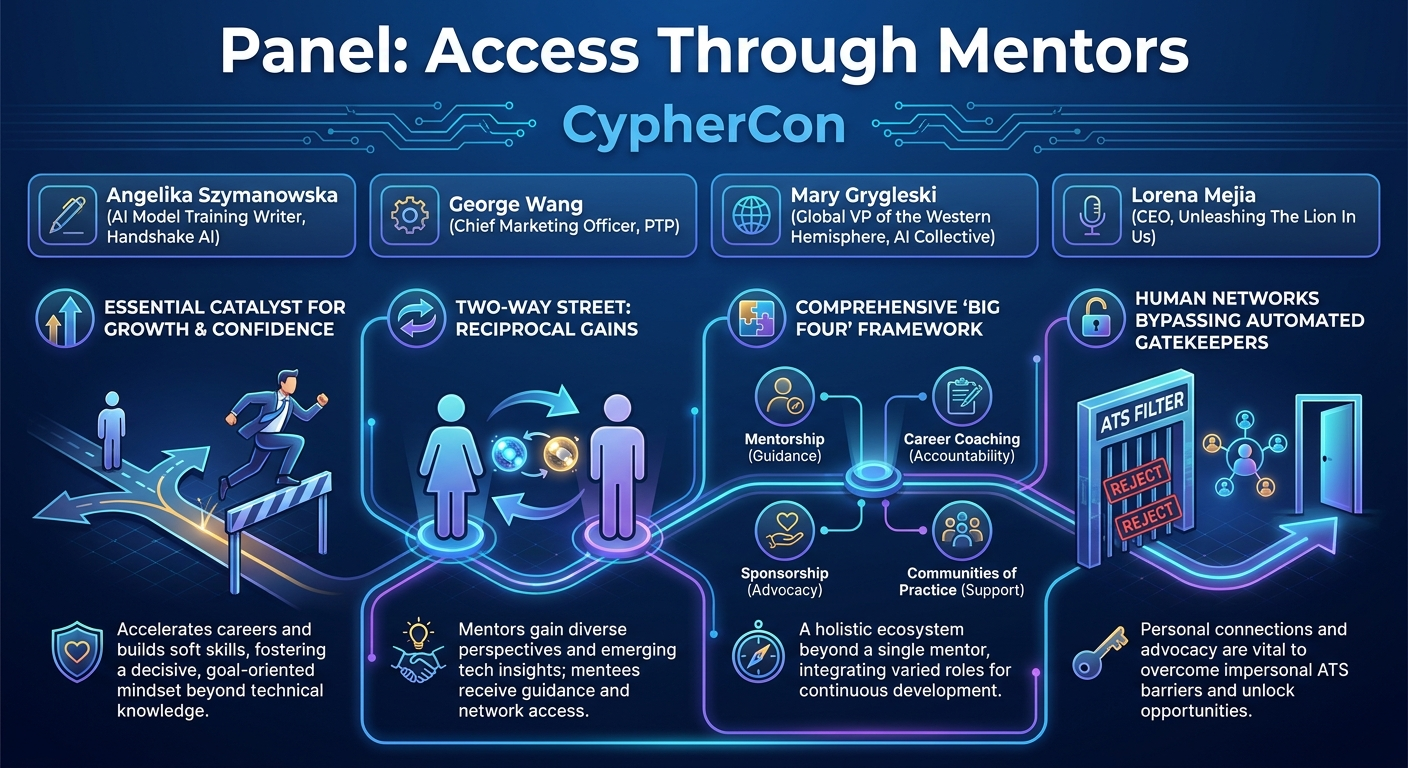
- Mentorship as an Essential Catalyst for Growth: Angelika Szymanowska emphasized that for someone entering cybersecurity later in life, mentorship was "not optional... it was essential." It provides a safe space for asking questions, making mistakes, and gaining practical knowledge not typically taught in academic settings.
- Mindset Transformation: Mentorship fundamentally shifts a mentee's mindset from hesitancy to confidence, maturity, and decisiveness. Angelika's personal journey from being intimidated by C-suite executives to confidently engaging with them illustrates this profound change, accelerating progress by fostering a goal-oriented, action-driven approach.
- Door-Opening and Network Expansion: A single mentor can unlock access to invaluable events, influential people, and environments that would otherwise be inaccessible. This ripple effect dramatically expands a mentee's professional network, leading to unforeseen opportunities.
- Reciprocal Benefits (Reverse Mentorship): Mentorship is not a one-way street. Mentors like George Wang and Mary Grygleski shared how they gain significant value, including diverse cultural perspectives, inspiration from mentees' challenging backgrounds, and staying current with rapidly evolving technologies (e.g., AI advancements like Open Claw, Nemo Claw) through younger generations.
- Importance of Genuine Connection and Intentionality: Both mentors and mentees must approach the relationship with genuine interest, intentionality, and a willingness to invest time and effort. As George stated, "If the person receiving it doesn't want help, it's really hard to change somebody."
- "The Big Four" Framework for Career Success: Lorena Mejia introduced a comprehensive framework for career building: Mentorship, Career Coaching, Sponsorship, and Communities of Practice. Each element plays a distinct yet interconnected role in guiding, holding accountable, advocating for, and supporting an individual's professional journey.
- Strategic Job Market Navigation: In a tough job market, especially for entry-level roles, internships and building a robust human network are paramount. George highlighted that many larger companies now recruit almost exclusively from their internship pools, and ATS talent systems often act as gatekeepers, making personal connections indispensable.
Technical Deep Dive
▶ Watch: Tactical tips for navigating a tough job market (25:00)
While this panel discussion did not delve into traditional cybersecurity protocols or software architectures, it offered a "technical deep dive" into the architecture of career development and the protocols of effective professional relationships. The speakers outlined specific strategies and frameworks that, when systematically applied, function as robust mechanisms for career advancement and resilience.
A core "technical" challenge discussed was the current job market's gatekeeping mechanisms, particularly Applicant Tracking Systems (ATS). George Wang explicitly stated that these systems are "designed to reject candidates, not to accept them." He described how ATS filters literally "reject resumes with the keywords" if they don't perfectly match the job description. This necessitates a strategic "optimization" approach for job seekers, including leveraging tools like ChatGPT to tailor resumes, though George cautioned against "fabrication." The "technical solution" to bypass these automated filters is the cultivation of a human network. As George emphasized, "You just have to find one or two people that are very well connected, and then they can kind of expose you to a lot of others." This human layer acts as an alternative "access control" mechanism, providing entry points that automated systems deny.
Lorena Mejia introduced a structured "framework" for career building, which she termed "The Big Four":
- Mentorship: This is the foundational layer, focusing on guidance, skill recognition (both technical and soft skills), confidence building, and pathway identification. Angelika's method of starting with a "specific ask" (e.g., "Could you give me feedback on a specific project?") creates immediate value and allows the relationship to "grow organically," akin to a phased deployment.
- Career Coaching: This component introduces an "accountability mechanism." A coach provides structured check-ins, sets tangible goals (e.g., "uploading your resume on LinkedIn," "personal rebrand"), and ensures follow-through. This functions like a project management methodology for personal branding and career progression.
- Sponsorship: This is a powerful "advocacy protocol." A sponsor is someone who, having observed an individual's work and growth, "sees your name in these rooms" when opportunities for projects, new jobs, or collaborations arise. They champion the individual, recognizing their expertise and potential, effectively acting as an internal referral system.
- Communities of Practice: These groups (e.g., Ginger Hacker, Women of Cybersecurity, ISSA) serve as "knowledge-sharing networks" and "support systems." They offer learning opportunities, shadowing programs, and peer support, functioning as decentralized learning and development hubs. Lorena highlighted that if a community doesn't exist, individuals should "build one," demonstrating a proactive "system design" approach to professional support.
Angelika's "protocol" for engaging mentors involves an iterative feedback loop: "I try to act on it and then report back with the results." This demonstrates a commitment to execution and allows the mentor to see the impact of their advice, reinforcing the relationship. The advice to "stop second-guessing myself" and become "more experimental and action-oriented" represents a shift from a "perfectionist" development cycle to an "agile" one, prioritizing movement and learning over paralysis. The panel also touched upon the "technicality" of cultural alignment, advising job seekers to ensure a company's "work culture is whether it's a corporate or private, but it lines up with you," emphasizing that a successful "system integration" of personal values and professional environment is crucial for long-term satisfaction.
Demo / Proof of Concept
▶ Watch: Mentors share personal gains: cultural and generational insights (34:00)
While the panel did not feature a traditional technical demonstration or a live proof of concept in the cybersecurity sense, the entire session served as a powerful proof of concept for the efficacy of mentorship through the lived experiences of the panelists.
Angelika Szymanowska's personal journey was a direct demonstration of the principles discussed. Entering cybersecurity after a decade in an unrelated field and learning English as a second language, she explicitly stated that mentorship "wasn't optional for me; it was essential." Her transformation from being "hesitant to speak up" and "overthinking every interaction" to becoming "more confident, mature, and more decisive," capable of "approach[ing] C-suite executives without hesitation," directly validated the talk's core message. Her ability to secure ten mentors, each providing different guidance (e.g., George for presentation practice, others for cloud security, incident response, threat modeling, startup ideas), showcased the practical application of building a diverse mentorship network. This narrative provided a compelling, real-world example of how strategic engagement with mentors can accelerate career progress and cultivate crucial soft skills like confidence and communication.
The collective experiences shared by George, Mary, and Lorena, detailing their roles as mentors, the challenges they overcame, and the diverse individuals they've guided, further reinforced the practical benefits. Mary's enjoyment of learning about new technologies like AI advancements ("Open Claw, Nemo Claw") from her mentees illustrated the "reverse mentorship" concept in action. This panel, therefore, demonstrated the human impact and career transformation enabled by mentorship, serving as a compelling, qualitative proof of concept for its methodologies.
Defensive Implications
▶ Watch: Fostering intentional and successful mentorship relationships (46:00)
In a cybersecurity context, "defensive implications" typically refer to strategies for protecting systems and data. However, in the context of this career-focused panel, the implications shift to career defense and building professional resilience against the "threats" of a volatile job market, skill obsolescence, and personal stagnation. Mentorship emerges as a critical defensive mechanism for individuals in the tech and cybersecurity fields.
- Mitigating Career Stagnation: The rapid pace of technological change means skills can quickly become outdated. Mentors, particularly those engaged in reverse mentorship, act as "early warning systems," exposing mentees (and even other mentors) to emerging technologies and industry trends (e.g., new AI developments). This proactive knowledge transfer helps individuals "patch" their skill gaps and adapt, preventing career obsolescence.
- Building a Resilient Professional Network: In an era where ATS talent systems can act as barriers, a strong human network is a vital "bypass mechanism." Lorena's "Big Four" framework emphasizes not just finding a job but building a sustainable career ecosystem. A sponsor, for instance, acts as an internal "advocate," defending a candidate's potential against automated filters or biases. Communities of practice provide a "collective defense" mechanism, offering shared learning, support, and informal job leads that circumvent traditional, often exclusionary, hiring channels.
- Developing "Soft Skill" Firewalls: Confidence, communication, and negotiation skills are crucial "soft skill firewalls" that protect individuals from self-doubt and enable them to navigate complex professional interactions. Angelika's journey demonstrated how mentorship directly cultivated these skills, allowing her to "approach C-suite executives without hesitation" and "advocate for myself." These skills are essential for "defending" one's value and negotiating favorable career terms.
- Strategic Vulnerability Management: Mentorship provides a "safe space" for "vulnerability assessment" – asking questions and making mistakes without fear of professional repercussion. This environment allows for early identification and correction of knowledge gaps or behavioral patterns that might otherwise hinder career growth. The ability to "make mistakes safely" is a foundational defensive strategy for learning and improvement.
- Protecting Against Market Volatility: George Wang's observation about corporate loyalty dwindling and the prevalence of layoffs underscores the need for individuals to be loyal to "family first" and build careers that are not solely dependent on a single employer. Mentorship and a strong network diversify an individual's professional "portfolio," offering alternative pathways and support during market downturns or unexpected career pivots. This diversified approach acts as a "risk mitigation" strategy against economic shocks.
In essence, mentorship equips individuals with the tools, knowledge, and network to proactively manage their career trajectory, adapt to change, and build a robust, resilient professional identity capable of navigating the inherent uncertainties of the modern tech landscape.
Key Takeaways
- Mentorship is a non-negotiable tool for career acceleration and personal growth in dynamic fields like cybersecurity and AI, offering a safe space for learning and developing confidence.
- Successful mentorship is a two-way street, benefiting both mentor and mentee. Mentors gain diverse perspectives and stay current with emerging technologies, while mentees gain guidance, network access, and a transformative mindset.
- Proactive engagement and intentionality are crucial for finding and sustaining mentorships. Mentees should make specific asks, demonstrate execution by acting on advice, and understand that relationships can evolve or end without a "lifetime contract."
- Leverage a comprehensive career development framework that extends beyond just a mentor, incorporating career coaches for accountability, sponsors for advocacy, and communities of practice for continuous learning and networking.
- Build a robust human network to counteract the limitations of automated hiring systems. Personal connections and advocacy are increasingly vital for navigating a challenging job market, especially for entry-level positions.
- Cultivate essential soft skills like confidence, communication, and negotiation. These skills, often refined through mentorship, are critical for advocating for oneself, reading professional dynamics, and achieving long-term career impact over just chasing titles.
About the Speaker(s)
- Angelika Szymanowska: A cybersecurity and software development student at Southern Illinois University and Wilbur Wright College, respectively. She works as an AI Model Training Writer at Handshake AI and is a mentee who openly shared her transformative journey, emphasizing mentorship's role in her confidence and career progression after a decade in a different field.
- George Wang: Chief Marketing Officer at Peterson Technology Partners, bringing 35 years of experience starting as a software engineer at Motorola, where he worked on the first digital cell phone. He has held diverse roles in product marketing, business development, and operations, including Chief Information Officer for the state of Illinois' education agencies. George is a passionate lifelong learner and mentor, serving on multiple boards and advocating for human connection in career development.
- Mary Grygleski: Currently on sabbatical but actively engaged as Global VP of the Western Hemisphere for the AI Collective, a grassroots think tank. With over 20 years in software engineering, development, and enterprise design, she transitioned to developer advocacy at IBM and DataStax, specializing in data streaming. Mary is a prolific international speaker and mentor, often learning about new technologies from her mentees.
- Lorena Mejia: The CEO and founder of "Unleashing The Lion In Us," a company dedicated to helping individuals find their voice and step into careers in cybersecurity and AI. She also serves as the WiCyS Career and Professional Director for the Chicago chapter and works as a Process Engineer for a Fortune 20 company, where she facilitates complex conversations around strategy, compliance, and privacy between technology teams and the business. Lorena served as the MC for this panel.
Reviews
Dr. Zero (Offensive Security Researcher) — WEAK
This is a live-action LinkedIn feed. Full stop. It’s harmless advice for a college freshman trying to land their first SOC analyst role, but it brings absolutely zero tactical value or new insight to a conference stage.
Heather Calloway (CISO) — SOLID
A well-executed panel on how practitioners can bypass broken HR filters through human networks. For security leaders, this is a reminder that our automated talent pipelines are failing us, and we must actively sponsor talent to fill our open headcount.