Executive Panel: Solutions, Strategy, & Delivery
Chad Doty (Sr. Director · Ecolab), Sandesh Gawali (Sr. Strategic CTO · Salesforce), Sandeep Nema (Head of Enterprise Architecture · Cook County)
Overview
This executive panel at CypherCon, featuring leaders from diverse industries, delved into the complex interplay of solutions, strategy, and delivery within modern organizations. The discussion, facilitated by the Chief Architect Network, aimed to dissect the common friction points that arise when ambitious strategies meet the realities of execution, particularly in an era of rapid technological advancement and pervasive AI enablement. The panelists explored critical questions surrounding the breakdown of strategy, the failure of well-intended solutions, the timing of architectural intervention, the impact of funding, and the ultimate measures of success beyond mere delivery.
Key moments
- 2:00 Panel introduction and Chief Architect Network overview
- 6:00 Why strategy often breaks before delivery begins
- 14:00 Identifying signals of drifting execution early
- 22:30 Architecture's role: early intervention and avoiding Shadow IT
- 32:30 Convincing executives to enhance funding for failing projects
- 43:30 Course correction strategies and AI's role in risk detection
- 52:00 Measuring beyond delivery: focusing on business outcomes and impact
Executive Panel: Solutions, Strategy, & Delivery
Speakers: Anup (Rev Group), Chad Doty (Sr. Director, Ecolab), Sandesh Gawali (Sr. Strategic CTO, Salesforce)
Conference: CypherCon
YouTube: https://www.youtube.com/watch?v=ugESZHR4p58
Overview
This executive panel at CypherCon, featuring leaders from diverse industries, delved into the complex interplay of solutions, strategy, and delivery within modern organizations. The discussion, facilitated by the Chief Architect Network, aimed to dissect the common friction points that arise when ambitious strategies meet the realities of execution, particularly in an era of rapid technological advancement and pervasive AI enablement. The panelists explored critical questions surrounding the breakdown of strategy, the failure of well-intended solutions, the timing of architectural intervention, the impact of funding, and the ultimate measures of success beyond mere delivery.
The core of the conversation revolved around the inherent challenges in aligning diverse stakeholders—from executives setting strategic visions to technical teams implementing solutions—and the crucial role of enterprise architecture in bridging these gaps. The panel emphasized that successful outcomes hinge not just on sound technical designs but equally on robust communication, adaptive processes, and a deep understanding of human factors. This talk is highly relevant for technology leaders, architects, project managers, and even security professionals striving to navigate the complexities of digital transformation and ensure that strategic intent translates into tangible, secure, and value-driven results.
Background
▶ Watch: Panel introduction and Chief Architect Network overview (2:00)
The Chief Architect Network, a 501c3 nonprofit, convened this panel with a mission to foster leadership, share best practices, and widen perspectives within the technology community. The foundational premise for the discussion was the accelerating pace of technological change, succinctly captured by the adage: "things have never been changing faster than they are today... and they will never change this slow again." This relentless evolution, particularly with the rise of AI, necessitates unprecedented agility in strategy and delivery.
The panelists addressed the persistent problem of strategy-delivery friction, where well-conceived plans often falter during execution. This systemic issue stems from several factors, including misaligned priorities, communication breakdowns, and a lack of continuous feedback loops. Traditional approaches to project management and architectural governance, while foundational, often struggle to keep pace with dynamic business needs and technological shifts. The panel aimed to dissect these challenges, offering insights into how organizations can better anticipate, identify, and mitigate the risks that jeopardize successful technology outcomes, moving beyond a purely technical lens to consider the broader organizational and human elements at play.
Key Findings
▶ Watch: Identifying signals of drifting execution early (14:00)
The panel identified several critical insights into the dynamics of strategy, solutions, and delivery:
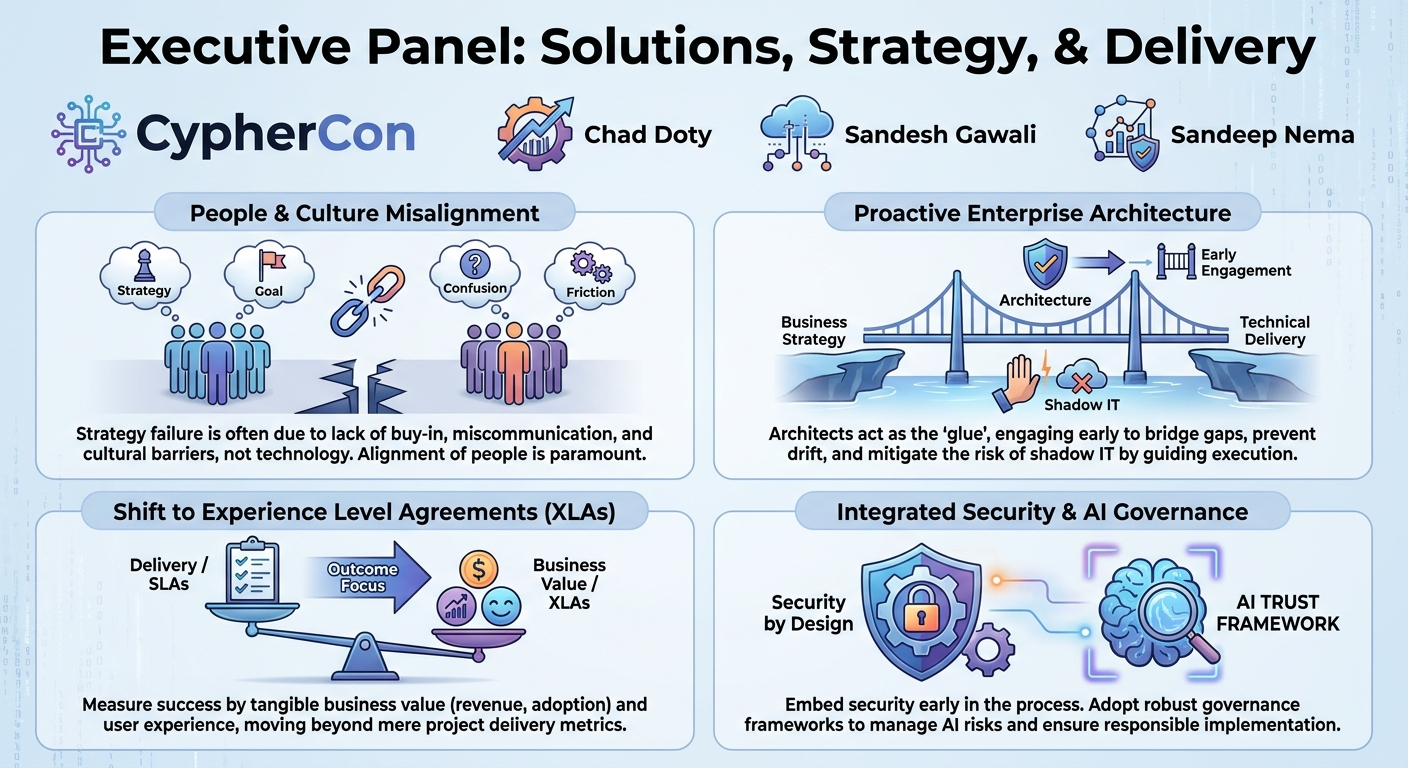
- People-Centric Breakdown of Strategy: The most significant finding was that strategy often breaks down at the people layer (07:00). While technology usually delivers what it promises and processes can be managed with guardrails, human understanding varies widely. This leads to misinterpretations of strategic directives and a lack of buy-in, causing delays and divergence from the intended path. Chad Doty highlighted that enterprise architects must "sell" the vision, providing artifacts and reference architectures to ensure clarity (08:00).
- Organizational Culture and Priority Alignment: Sandesh Gawali emphasized that organizational culture significantly influences strategy execution (09:00). Friction arises when executive buy-in for a strategy doesn't translate into aligned priorities for the execution teams, leading to pain points and eventual failure.
- The Specificity and Translation Gap: Sandesh also introduced the concepts of specificity and the translation layer as crucial friction points (10:00). The gap between "ambition" (strategic intent) and "execution intent" is where many well-intended solutions fall short.
- Continuous Strategy Refinement: Strategies are not static blueprints but require continuous refinement (13:00). As business priorities evolve (e.g., with AI adoption), the strategy must adapt, and this necessitates clear communication and understanding between business and technology teams.
- Early Warning Signals for Drift: Panelists identified key indicators that projects are drifting off course. A growth in exceptions (deviations from enterprise guidelines) signals inconsistent standardization, technical debt, and governance issues (17:00). Increased executive involvement in reviewing (rather than just approving) can also be a sign that execution is struggling (18:00). The emergence of shadow IT is a clear indicator that business units are bypassing official channels due to frustration (25:00).
- Architecture as the "Glue" and "Bus Driver": Anup described enterprise architecture as the "glue" that integrates business outcomes with final delivery (20:00). Architects have a continuous feedback loop role and must distinguish between exception requests (which weaken the product, e.g., waiving multi-factor authentication) and change requests (which strengthen it, e.g., enhancing encryption). They must be prepared to "stand in front of the bus" when a request fundamentally misaligns with the vision (21:00).
- Funding Challenges and Capabilities vs. Projects: Funding issues often arise when funnels change or when change requests are added without commensurate funding (28:00). Chad distinguished between funding a "project" versus funding "capabilities," advocating for the latter to enable more agile and adaptive investment (19:00).
- Beyond Delivery: Measuring Business Outcomes: The panel concluded that delivery should not be the sole scorecard (52:00). Leaders should measure success in terms of business outcomes—whether the solution achieved its intended purpose, such as increasing leads, reducing costs, or growing top-line revenue (53:00). Measuring exceptions and risks raised also provides a proactive view of project health.
Technical Deep Dive
▶ Watch: Architecture's role: early intervention and avoiding Shadow IT (22:30)
While the panel was executive-level, it touched upon several technical and architectural concepts crucial for effective strategy and delivery.
A key conceptual framework discussed was the three angles of the pyramid: people, process, and technology (09:00). The panelists agreed that while technology is often reliable, and processes can be designed with guardrails, the "people" aspect—encompassing organizational culture, understanding, and buy-in—is where strategy most frequently breaks down. This highlights the socio-technical nature of enterprise architecture, where human factors are as critical as technical ones.
Anup provided a concrete example from Mergers and Acquisitions (M&A) IT integration (11:00). Traditionally, integrating two organizations using Office 365 would involve migrating all data from one tenant to another. However, his team explored an alternative: creating a multi-tenant organization where both original tenants continue to operate, connected and trusting each other, while data replication occurs in the background. This approach, driven by business urgency, allows for faster delivery to the business and highlights a strategic pivot from a "well-beaten path" to an outcome-driven solution.
Chad introduced the concept of moving from Service Level Agreements (SLAs) to Experience Level Agreements (XLAs) in vendor agreements and internal project tracking (16:00). While SLAs focus on service metrics, XLAs measure outcomes. This shift enables enterprise architecture to monitor projects based on expected results rather than just process adherence. By setting "lines of control" for outcomes, architecture teams can be alerted when execution deviates significantly, allowing for timely intervention and adjustment, rather than micromanaging.
The discussion also highlighted the often-contentious role of Enterprise Architecture Review Boards (ARBs). Sandesh noted that ARBs are frequently perceived as bottlenecks by business and siloed teams (23:00). This perception can lead to teams circumventing the ARB, resulting in technical debt, inconsistent standardization, and the growth of shadow IT. The panel stressed that early and continuous involvement of enterprise architecture, coupled with transparent communication, is essential to prevent this late-stage intervention when issues are already entrenched.
The pervasive influence of AI adoption was a recurring theme. While AI is seen as a "new shiny tool," the panelists acknowledged its potential to accelerate execution and improve decision-making (47:00). AI tools can crunch data faster, providing better insights for executives. However, this requires careful consideration of governance and trust factors. Sandesh cited a partnership between Mastercard and Google, which developed an open-source AI trust framework (49:00). This example underscores the need for industry collaboration and standardized approaches to ensure responsible and secure AI implementation, particularly in regulated sectors like finance.
Finally, the panel reiterated the importance of Agile methodology, particularly the "fail fast" principle (43:00). This approach, combined with strong leadership support, allows for quick wins, early invalidation of assumptions, and rapid course correction. However, even with agile, transparent metrics tracking and clearly identified Key Performance Indicators (KPIs) are vital for in-flight projects, ensuring alignment between execution teams and leadership on evolving priorities (39:00).
Demo / Proof of Concept
▶ Watch: Course correction strategies and AI's role in risk detection (43:30)
This executive panel discussion focused on strategic and operational challenges and solutions, rather than demonstrating specific technologies or proof-of-concept implementations. Therefore, there was no live demo or technical proof of concept presented during the talk.
Defensive Implications
▶ Watch: Measuring beyond delivery: focusing on business outcomes and impact (52:00)
The insights from this executive panel carry significant implications for cybersecurity defenders, highlighting how organizational and architectural challenges directly impact an organization's security posture.
- Integrate Security Early and Continuously: The panel's emphasis on building quality into processes from the start directly applies to security (10:00). Waiting until the end to "build in security" is too late, often leading to costly rework, project delays, and increased vulnerabilities. Defenders must advocate for security by design and security as code, embedding security controls and reviews throughout the entire software development lifecycle (SDLC), not just as a final audit.
- Architects as Security Advocates: Architects are positioned as the "glue" between business outcomes and technical delivery (20:00). This makes them crucial allies for security teams. Architects must be empowered and trained to identify and challenge exception requests that weaken security (e.g., bypassing MFA, using weak passwords), distinguishing them from legitimate change requests that enhance the product (e.g., stronger encryption). They should "stand in front of the bus" when security non-negotiables are threatened (21:00).
- Combat Shadow IT Proactively: The frustration of business units with slow or costly official processes leading to shadow IT is a major cybersecurity risk (25:00). Shadow IT bypasses security controls, introduces unvetted technologies, and creates blind spots. Defenders, in collaboration with enterprise architecture, must engage with business units early, understand their needs, and offer secure, compliant, and agile solutions. Demonstrating the value and efficiency of official channels can mitigate the incentive for shadow IT.
- Governance and Trust for AI Security: The rapid adoption of AI presents new attack surfaces and ethical dilemmas. The mention of the Mastercard/Google AI trust framework (49:00) is a direct defensive blueprint. Defenders must champion the implementation of robust AI governance, focusing on data privacy, model integrity, bias detection, and secure deployment of AI systems. Understanding and applying such frameworks is critical to prevent AI-driven security incidents.
- Proactive Risk Management: The panel's call for early identification of risks and transparent communication with steering committees (44:00) is vital for security. Security teams should contribute to and monitor project risk registers, ensuring that potential security vulnerabilities or compliance issues are raised as "inklings of risk" rather than waiting for them to manifest as failures. This allows for proactive mitigation and informed decision-making by leadership.
- Balanced Scorecards Include Security Metrics: If project success is measured solely by delivery speed or budget, security can be deprioritized. Defenders must advocate for balanced scorecards that include key security and compliance metrics (e.g., number of vulnerabilities, compliance adherence, security incidents averted) as part of the overall business outcomes (52:00). This ensures security is recognized as a value driver, not just a cost center or a bottleneck.
Key Takeaways
- Strategy-delivery friction is often human-centric: Misunderstandings, lack of buy-in, and misaligned priorities among people are the primary causes of strategic plans failing, even more than technology or process issues. Strong organizational culture and clear communication are paramount.
- Proactive architecture is crucial for success: Enterprise architecture must engage early, act as the "glue" between business and delivery, and use outcome-based metrics like XLAs to monitor project health. This helps prevent technical debt, inconsistent standards, and the emergence of shadow IT.
- Security must be integrated and advocated for: Security cannot be an afterthought. Architects and defenders must work together to embed security by design, distinguish between product-weakening exceptions and product-strengthening change requests, and be prepared to challenge decisions that compromise security posture.
- Funding should align with capabilities and outcomes: Investment decisions should move beyond funding discrete "projects" to supporting long-term "capabilities." Funding discussions should be transparent, with business leaders taking responsibility for approving additional budget based on desired business outcomes.
- Embrace "fail fast" with strong leadership and AI: Agile methodologies and the principle of "fail fast" enable quicker learning and adaptation. Leveraging AI tools for data analysis, early risk identification, and adhering to established AI trust frameworks (e.g., Mastercard and Google's open-source initiative) are critical for navigating rapid technological change securely.
- Measure success by business outcomes, not just delivery: The ultimate scorecard for any solution or strategy should be its impact on core business objectives—such as top-line growth, cost reduction, customer adoption, and risk mitigation—rather than solely project delivery speed or adherence to initial budgets.
About the Speaker(s)
- Anup: A last-minute fill-in for the panel, Anup has been based in Milwaukee for approximately 18 years. He works for Rev Group, a company headquartered in Brookfield with manufacturing operations across the country, specializing in the production of fire trucks, ambulances, and RVs out of Indiana.
- Chad Doty: Currently a Sr. Director at Ecolab, Chad possesses a diverse and extensive background in technology and architecture. His career trajectory has spanned roles as a Java developer, app architect, enterprise architect, interim chief architect, and security architect, indicating a deep understanding across various technical and strategic domains. Most recently, he has been focused on digital employee experience, including the rollout of co-pilot and other AI solutions to enhance job efficiency.
- Sandesh Gawali: Based in the Chicago area for over 12 years and with 20 years of industry experience, Sandesh is a Sr. Strategic CTO within the CIO advisory group at Salesforce. He leads this group, with a specific focus on the healthcare, pharma, and BFSI (Banking, Financial Services, and Insurance) domains. His technical journey began as a Java open-source developer, contributing to the Linux kernel during his college days, with a background in C and C++. He evolved through roles as a solution architect and software architect, leading solution architecture groups for emergent platform solutions before his current role at Salesforce, where he primarily focuses on data and AI-related products, providing strategic advisory to customers for product adoption.
Reviews
Dr. Zero (Offensive Security Researcher) — HARD PASS
This is an hour of LinkedIn posts read aloud. When your panel's big revelation is the 'people, process, technology' triad and the suggestion that we should measure business outcomes, you're not doing architecture—you're doing corporate stand-up.
Heather Calloway (CISO) — SOLID
This panel covers standard enterprise architecture friction, focusing on why strategic plans break down at the execution layer. It's a competent discussion of shadow IT, technical debt, and funding models, though it covers familiar ground for mature security teams. Worth a selective listen for directors struggling to align their architecture review boards with business velocity.