The Importance of Being in Third Place
Robert Wagner
Overview
In his compelling CypherCon talk, "The Importance of Being in Third Place," Robert Wagner delivers a profound message about the often-overlooked crisis of professional isolation within the cybersecurity community and offers a potent antidote: the deliberate cultivation of "third places." Wagner, an advisory CISO and dedicated community builder, posits that while the industry thrives on brilliant, often neurodivergent minds, it simultaneously fosters environments ripe for loneliness and burnout. His presentation transcends typical technical discourse, delving into the sociological underpinnings of human connection and its critical role in individual well-being and collective resilience.
Key moments
- 2:00 Introduction: Why 'third place' is a profound compliment
- 6:00 Isolation's subtle harm and its prevalence in cyber security
- 9:40 What is a 'third place' and its alarming decline
- 14:00 How social capital builds trust and improves communities
- 28:00 Key ingredients for building successful, welcoming cyber communities
- 37:30 How local meetups foster career growth and self-sustaining support
- 41:30 Leaders and individuals: simple steps to combat isolation
The Importance of Being in Third Place
Speakers: Robert Wagner
Conference: CypherCon
YouTube: https://www.youtube.com/watch?v=kSN8KsDxzbk
Overview
In his compelling CypherCon talk, "The Importance of Being in Third Place," Robert Wagner delivers a profound message about the often-overlooked crisis of professional isolation within the cybersecurity community and offers a potent antidote: the deliberate cultivation of "third places." Wagner, an advisory CISO and dedicated community builder, posits that while the industry thrives on brilliant, often neurodivergent minds, it simultaneously fosters environments ripe for loneliness and burnout. His presentation transcends typical technical discourse, delving into the sociological underpinnings of human connection and its critical role in individual well-being and collective resilience.
Wagner's talk is a vital call to action for every cybersecurity professional, from individual contributors to leadership. It highlights how fostering genuine human connection in informal, welcoming spaces — "third places" — can dramatically improve mental health, enhance team effectiveness, and ultimately build more robust cybersecurity programs. By drawing on personal experiences, scientific studies, and practical examples like the wildly successful BurbSec meetups, Wagner illuminates a path towards a more connected, supportive, and effective professional ecosystem. This message is particularly salient in an era marked by increased remote work and persistent industry burnout, making it an indispensable guide for cultivating a healthier, more sustainable future for cybersecurity.
Background
▶ Watch: Introduction: Why 'third place' is a profound compliment (2:00)
The problem of professional isolation within cybersecurity is a pervasive, yet frequently unaddressed, challenge. Robert Wagner begins by sharing his own childhood experiences with loneliness, noting how isolation can feel normal long before it becomes overtly harmful, subtly eroding self-worth and even altering brain chemistry. He identifies this same pattern manifesting in the cybersecurity field, which often attracts individuals with unique intellectual gifts and a tendency towards introversion or neurodivergence. While these traits are superpowers for problem-solving in security, they can also exacerbate feelings of being an outsider, a sentiment many in the industry carried from their school days.
The inherent nature of cybersecurity work often involves long hours, intense focus, and sometimes solitary tasks, further contributing to disconnection. Compounded by the rise of remote work, the pressures of burnout, and the lingering effects of global events like COVID-19, the recipe for professional loneliness is potent. Wagner cites psychiatrist Robert Waldinger's research, which suggests that loneliness can be subtle and difficult to self-diagnose. Waldinger's checklist, which asks "who" would be there in various life scenarios (e.g., a crisis call, a road trip partner), helps individuals identify gaps in their social support networks—gaps that "third places" are designed to fill.
The concept of a third place, or third space, is a sociological term for environments that are neither home (first place) nor work (second place), but rather informal public spaces where people can gather, socialize, and build community. Historically, these spaces—like pubs, cafes, barbershops, or community centers—have been vital for civic life and social cohesion. However, Wagner notes a drastic decline in America's third places since the 1960s, leading to what former US Surgeon General Vivek Murthy termed an "epidemic of loneliness." Americans now have fewer close friends, belong to fewer groups, and spend less time in shared spaces. This decline in social capital—the value derived from social networks and mutual support—has profound implications beyond mere sadness. Wagner references sociologist Robert Putnam's study from the 1970s, which observed 20 newly decentralized Italian regional governments. Despite identical resources and goals, some regions thrived while others failed due to corruption and inefficiency. Putnam meticulously ruled out factors like education, political skill, or wealth, ultimately identifying one consistent variable in successful regions: participation in local choral societies. This seemingly innocuous activity fostered connection, trust, and civic engagement, proving that social infrastructure is as critical as physical infrastructure for a community's success. This background sets the stage for Wagner's argument that rebuilding these social ties is not just "feel-good" but a strategic imperative for the cybersecurity community.
Key Findings
▶ Watch: What is a 'third place' and its alarming decline (9:40)
Robert Wagner's talk distills several critical findings regarding the nature of human connection and its profound impact on individuals and professional communities, particularly in cybersecurity.
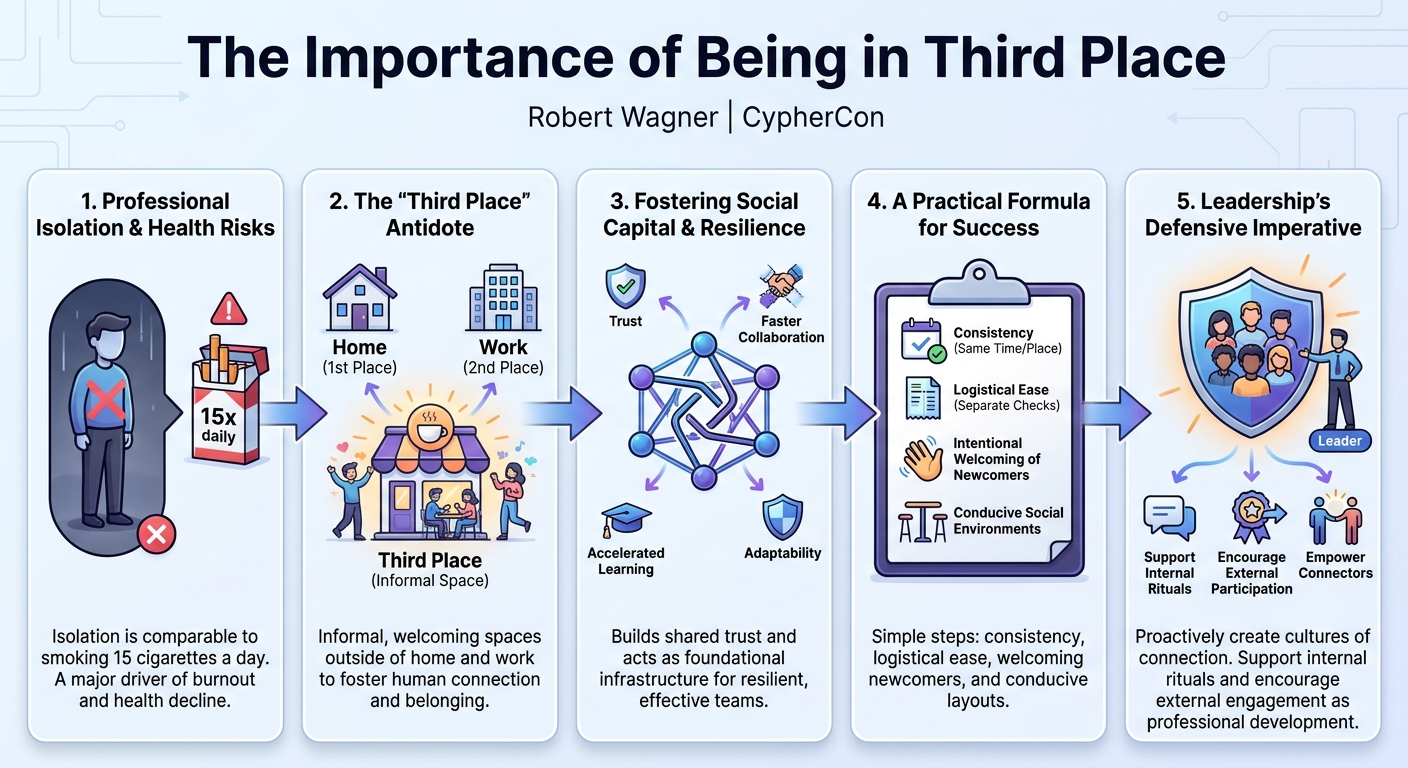
Firstly, professional isolation is not merely an emotional discomfort but a significant health risk. Wagner starkly illustrates this by stating that being socially isolated is as harmful to one's health as smoking 15 cigarettes a day. He cites the US Surgeon General, emphasizing that the mortality impact of social disconnection rivals that of obesity and other serious comorbidities. Conversely, belonging to just one group can reduce an individual's odds of dying in the next year by a remarkable 50%, with benefits compounding as one joins more groups. This statistic alone underscores the strategic importance of fostering community ties for the mental and physical well-being of cybersecurity professionals.
Secondly, social capital is a foundational infrastructure for community success and economic prosperity. Putnam's study on Italian regional governments demonstrated that higher social engagement, exemplified by participation in local choirs, led to increased trust, greater civic participation, and ultimately more efficient and less corrupt governance. This trust, rather than pre-existing wealth, was found to literally create wealth in these communities by lowering the cost of cooperation and greasing the wheels of collective action. In cybersecurity, this translates directly to teams that share not just intelligence but also trust, leading to faster learning, improved collaboration, and enhanced adaptability under stress. Communities with higher social capital also exhibit lower crime rates and greater economic mobility, reinforcing the idea that human connection is a fundamental societal building block.
Thirdly, the concept of a "third place" serves as a powerful antidote to professional isolation and burnout. These informal spaces, distinct from home and work, provide environments where individuals can simply "be" with others, fostering a sense of belonging without deadlines or expectations. Wagner highlights that for the often neurodivergent and introverted individuals drawn to cybersecurity, these spaces are crucial for being seen and valued. His personal journey, from a disconnected kid finding solace among "misfits" to building his own cybersecurity communities, exemplifies this finding.
Finally, Wagner identifies a practical "formula" for building successful, self-sustaining third places within the cybersecurity community, drawing from his experience with BurbSec:
- Consistency is king: Holding events on the same day of the month (e.g., first Thursday) ensures reliability and makes attendance easier to plan.
- Separate checks: A seemingly minor logistical detail, this prevents individuals from being stuck with large bills, a common deterrent for casual meetups.
- Welcoming environment: Actively making newcomers feel seen and included, such as through a collective "HEY!" greeting, transforms introverts' experiences and fosters immediate belonging.
- High tops over sit-downs: This architectural choice acts as a "social lubricant," encouraging movement, conversation flow, and broader interaction among attendees, rather than confining discussions to small groups.
These findings collectively underscore that fostering human connection through accessible, welcoming third places is not a peripheral activity but a high-leverage strategic imperative for building resilient individuals and, by extension, resilient cybersecurity programs.
Technical Deep Dive
▶ Watch: How social capital builds trust and improves communities (14:00)
While Robert Wagner's talk does not delve into traditional cybersecurity technical content like code or network protocols, it offers a profound technical deep dive into the sociological and psychological mechanisms that underpin effective human interaction and community building. This "technical" aspect lies in understanding the precise components and dynamics that make "third places" powerful tools for resilience in the cybersecurity industry.
At its core, the talk dissects the concept of social capital, which Wagner defines as "the value that comes from our relationships, these networks, shared norms, mutual support." This isn't merely about "who you know," but the qualitative strength and density of those connections. In a cybersecurity context, high social capital within a team or community translates into shared trust, which is a critical operational lubricant. When trust is present, individuals are more likely to ask for help, admit burnout, and support each other. This directly contributes to resilience—the ability of individuals and systems to recover from or adapt to difficulties. Without it, individuals suffer from isolation and burnout, and programs falter.
Wagner explains the mechanisms by which strong social capital improves various aspects:
- Collaboration Efficiency: When trust is established, collaboration becomes significantly "cheaper" and faster. The friction inherent in working with unfamiliar or untrusted individuals is reduced, allowing for quicker information flow and decision-making. This is crucial in fast-paced incident response or complex project environments.
- Accelerated Learning: Trust increases the willingness to share information and knowledge without fear of judgment. This accelerates learning within teams, as members are more open to both asking questions and offering expertise.
- Enhanced Adaptability: Teams with strong social bonds are better equipped to adapt under stress. The existing infrastructure of trust allows them to pivot, reallocate resources, and support each other more effectively during crises. This extends beyond immediate team members, fostering trust and cooperation with other departments like IT and Legal, which is often a bottleneck in security operations.
- Talent Attraction and Retention: In a high-stress field like cybersecurity, feeling seen, supported, and able to "be a human" significantly increases job satisfaction. This not only attracts new talent but also dramatically improves retention rates, reducing the constant churn often seen in the industry.
The talk also provides a sociological "architecture" for building and sustaining these vital connections. The "formula" for BurbSec's success is a practical blueprint:
- Consistency: Predictable scheduling (e.g., "first Thursday of the month") reduces cognitive load for participants and reinforces the habit of attendance, ensuring a stable foundation for the community.
- Logistical Simplicity (Separate Checks): Eliminating common financial anxieties removes a significant barrier to entry and repeat attendance, making the social interaction the primary focus.
- Intentional Welcoming: The practice of publicly welcoming new attendees ("HEY EVERYBODY, THIS IS JOHN, IT'S HIS FIRST TIME!") is a deliberate social engineering technique. It immediately breaks down barriers, signals an inclusive culture, and encourages existing members to engage with newcomers, counteracting the natural tendency towards "cliques."
- Environmental Design (High Tops): The physical layout of the meeting space is a critical component. High-top tables, as opposed to seated arrangements, facilitate dynamic movement and interaction among a larger group. This design encourages participants to move freely, engage with more people, and fosters a fluid, interconnected atmosphere, optimizing the flow of social energy and information.
In essence, Wagner provides a "systems design" approach to human connection. By understanding the vulnerabilities (isolation, burnout), the desired outcomes (resilience, collaboration, retention), and the "protocols" (consistency, welcoming, physical space design) for fostering social capital, the cybersecurity community can proactively engineer environments that support its most valuable asset: its people. This deep dive into social dynamics is presented as a strategic, almost engineering-like, solution to fundamental human challenges impacting a highly technical field.
Demo / Proof of Concept
▶ Watch: How local meetups foster career growth and self-sustaining support (37:30)
While Robert Wagner's talk does not feature a traditional technical demonstration with code or live exploits, the entire presentation serves as a compelling proof of concept for the power of "third places" through the tangible success and growth of the BurbSec community. The BurbSec initiative, which Wagner helped organize, functions as a real-world, scalable model of the principles he advocates.
Wagner details BurbSec's organic growth from a single informal meetup in Chicago to a network of 10 locations, including six in the broader Chicago area (e.g., North, South, East), and additional chapters in Las Vegas, Minneapolis (which has since expanded to two locations due to demand), South Bend, and even an international chapter in Galway, Ireland. This widespread adoption and sustained momentum demonstrate the inherent human need for such spaces and the effectiveness of the BurbSec model.
The "demo" of BurbSec's success is evidenced by several key outcomes:
- Self-Sustaining Community: Wagner proudly states that BurbSec meetups have become so robust that if none of the official co-organizers were present, the event would still run smoothly, with attendees naturally stepping up to welcome newcomers and facilitate interaction. This illustrates a highly resilient, decentralized community structure.
- Cybersecurity Magnet and Career Catalyst: The meetups consistently act as a magnet for individuals seeking to enter or advance within cybersecurity. Wagner notes that consistent attendees typically secure a job in the field within a year or less, directly attributing this to the networking and mentorship facilitated by the informal connections made at BurbSec. This is a powerful demonstration of social capital translating into career mobility.
- Welcoming and Inclusive Environment: A particularly poignant anecdote involves a young woman, initially an introvert, who found such comfort and belonging at BurbSec that she "forgot her shyness." This highlights the success of BurbSec's deliberate welcoming strategies, such as the collective "HEY!" for first-time attendees, in creating a truly inclusive space, even in a male-dominated field.
- Organic Vendor Sponsorship: BurbSec does not solicit sponsorships. Instead, vendors proactively approach the organizers, recognizing the value of connecting with the engaged community. Crucially, these sponsors adhere to strict "no pitch" rules, focusing instead on genuine interaction and supporting the community by buying drinks. This demonstrates the high perceived value of BurbSec's authentic, community-first approach.
- Ease of Replication: The formula for BurbSec's success—consistency, separate checks, welcoming atmosphere, and the strategic use of high-top tables—is presented as low-effort and highly replicable. Wagner emphasizes that the biggest hurdles are simply consistent scheduling and reminding venues, proving that anyone can initiate such a "third place" with minimal organizational overhead.
Through the narrative of BurbSec's growth and impact, Wagner effectively demonstrates that fostering informal, consistent, and welcoming "third places" is not an abstract sociological ideal but a practical, highly effective strategy for building resilient individuals and a thriving cybersecurity community.
Defensive Implications
▶ Watch: Leaders and individuals: simple steps to combat isolation (41:30)
The insights presented by Robert Wagner carry profound defensive implications for the cybersecurity industry, extending beyond traditional technical controls to the very human fabric of defense. A resilient cybersecurity program is inextricably linked to resilient people, and Wagner's talk provides a roadmap for cultivating that human resilience.
Firstly, leaders and managers in cybersecurity must recognize their responsibility for fostering connection, not just performance. This means actively counteracting the conditions that lead to professional isolation. Leaders should be vigilant for signals of disconnection, such as disengagement, reduced participation, or consistent camera-off behavior in virtual meetings, understanding that these are often signs of quiet struggle rather than performance issues.
Secondly, organizations should proactively create cultures of connection. This involves implementing simple, high-leverage strategies:
- Informal Communication Channels: Establish Slack or Teams channels that are explicitly not for Jira tickets or work-related tasks, but for casual conversation, shared interests, or watercooler chat.
- Normalize Team Rituals: Incorporate brief, off-topic icebreakers at the start of meetings (e.g., "What's on your desk?"), especially in remote settings, to allow the human side of team members to emerge.
- Support Internal Community Building: Empower and allocate time for employees to create internal "third places" such as book clubs, CTF teams, virtual lunch chats, or "beer share" happy hours. These spaces provide psychological safety and foster camaraderie.
- Encourage External Participation: Leaders must actively support and encourage employees to attend external professional meetups and conferences like BurbSec, ISSA, or local Bsides events. Viewing time spent at these events as an investment in mental health and professional development, rather than a distraction, is crucial. Wagner criticizes bosses who prevent employees from attending once-a-month meetups, highlighting a critical failure in understanding talent development and well-being.
Thirdly, building diverse and inclusive communities is paramount. Acknowledging that the cybersecurity field attracts neurospicy individuals, leaders should actively work to create environments where diverse thinking styles are not just tolerated but celebrated. This differential thinking is a superpower for security, but it requires intentional effort to ensure everyone feels included and valued.
Fourthly, identify and empower "connectors" within the organization. These individuals might not always be top technical performers, but they excel at organizing, inviting, welcoming, and facilitating inclusion. Recognizing their foundational role and empowering them to build mini-communities within the workplace is a strategic move to grease the wheels of cooperation and lower the cost of collaboration across teams (e.g., with IT, Legal).
Finally, the defensive implications extend to talent management. Cybersecurity faces a persistent talent shortage and high rates of burnout. By investing in social capital and fostering connection, organizations can significantly improve talent attraction and retention. People are more likely to stay in roles where they feel seen, supported, and part of a human community, especially in high-stress environments. This reduces turnover, preserves institutional knowledge, and allows for more stable, experienced defense teams.
In summary, Wagner's talk reframes cybersecurity defense to include a robust focus on human infrastructure. By intentionally cultivating strong community ties and "third places" both inside and outside the organization, defenders can build more resilient individuals, more effective teams, and ultimately, more robust and adaptable cybersecurity programs capable of withstanding the relentless pressures of the threat landscape.
Key Takeaways
- Professional Isolation is a Health Crisis: Loneliness and professional isolation in cybersecurity are not just emotional issues but significant health risks, comparable to smoking 15 cigarettes a day, and directly contribute to burnout and early death.
- "Third Places" are Essential Antidotes: Informal, welcoming spaces outside of home and work ("third places") are critical for fostering human connection, building social capital, and providing a sense of belonging for individuals, especially in the often-solitary cybersecurity field.
- Social Capital Drives Resilience and Effectiveness: Strong community ties and mutual trust (social capital) are foundational infrastructure that leads to higher trust, faster learning, cheaper collaboration, improved adaptability, and greater economic mobility within communities and teams.
- Simple Formulas Build Thriving Communities: Creating successful "third places" can be low-effort yet high-impact. Key elements include consistency (same time, same place), logistical ease (separate checks), intentional welcoming of newcomers, and conducive physical environments (like high-top tables).
- Leadership Must Foster Connection: Cybersecurity leaders have a responsibility to create conditions that foster connection, not isolation. This includes supporting internal team rituals, encouraging external community participation as professional development, and empowering "connectors" within their teams.
- Personal Action is Key to Change: Individuals can combat isolation by actively listening, performing small acts of kindness, prioritizing in-person interactions, and taking the initiative to build or consistently show up for communities, both within and beyond cybersecurity.
About the Speaker(s)
Robert Wagner is an experienced cybersecurity professional, currently serving as an advisory CISO. His career path includes a foundational role as a SOC analyst, giving him a deep understanding of operational security challenges. Beyond his corporate roles, Wagner is a passionate advocate for community building and education. He is a co-founder of Hak4Kidz, an organization dedicated to teaching children internet safety, security, and ethics by leveraging the appeal of hacking to promote STEM skills. Wagner has also served on the board of the ISSA in Chicago and on the committee for the Chicago CISO of the Year award. He is actively involved with BurbSec, a community meetup group that exemplifies the "third place" concept he champions, and helped launch Bsides 312 in Chicago. Known for his commitment to fostering connection, Wagner emphasizes the human element in cybersecurity, advocating for supportive environments that counteract professional isolation.
Reviews
Dr. Zero (Offensive Security Researcher) — SOLID
Wagner tackles the infosec isolation epidemic not with bullshit HR wellness webinars, but with a highly tactical guide to building local meatspace communities. It’s a soft-skills talk, but it’s anchored in concrete sociology and the battle-tested BurbSec meetup model. Solid blueprint for keeping our people from crashing out of the field.
Heather Calloway (CISO) — MUST SEE
Wagner reframes team socialization from an HR luxury into a core component of operational resilience. By treating social capital as infrastructure, he provides a practical, low-cost playbook for reducing churn and burnout in high-stress security teams. Every CISO managing a distributed workforce should internalize this mechanic.