Privacy & Compliance Challenges with AI: Safeguarding Data in the Age of Artificial Intelligence
Noor Bains (Principal Field Solutions Architect · CDW)
Overview
In an era defined by the rapid and pervasive adoption of artificial intelligence, organizations face a critical juncture: how to harness AI's transformative power while rigorously upholding data privacy and regulatory compliance. This talk, delivered by Noor Bains, Principal Field Solutions Architect at CDW, at CypherCon, delves into the multifaceted challenges and strategic solutions necessary to navigate this complex landscape. Bains illuminates the inherent risks associated with AI's data-hungry nature, from excessive data collection and insecure processing pipelines to the potential for biased outcomes and significant legal and reputational repercussions.
Key moments
- 2:00 Introduction and talk agenda
- 4:00 Explaining rapid AI adoption and societal impact
- 7:00 Key privacy risks: excessive data, model regurgitation
- 16:00 Real-world incidents: data breaches, business impact, bias
- 20:00 Remediation: privacy-first design and secure processing
- 22:00 AI architectural security: NIST, prompt injection mitigation
Privacy & Compliance Challenges with AI: Safeguarding Data in the Age of Artificial Intelligence
Speakers: Noor Bains, Principal Field Solutions Architect, CDW
Conference: CypherCon
YouTube: https://www.youtube.com/watch?v=K7L5ZijnPOQ
Overview
In an era defined by the rapid and pervasive adoption of artificial intelligence, organizations face a critical juncture: how to harness AI's transformative power while rigorously upholding data privacy and regulatory compliance. This talk, delivered by Noor Bains, Principal Field Solutions Architect at CDW, at CypherCon, delves into the multifaceted challenges and strategic solutions necessary to navigate this complex landscape. Bains illuminates the inherent risks associated with AI's data-hungry nature, from excessive data collection and insecure processing pipelines to the potential for biased outcomes and significant legal and reputational repercussions.
The presentation serves as a timely and essential guide for cybersecurity professionals, legal teams, and business leaders grappling with the ethical and practical implications of AI deployment. Bains not only outlines the current state of play, highlighting real-world incidents where AI initiatives faltered due to privacy missteps, but also provides actionable remediation strategies. These strategies span from embedding privacy-by-design principles into the AI lifecycle to leveraging advanced architectural controls and automation for continuous compliance.
The core message underscores that the successful integration of AI is not solely a technical endeavor but a holistic commitment to responsible innovation. As AI adoption outpaces regulatory frameworks, organizations must proactively build trust through transparent data practices, robust security measures, and an unwavering focus on consumer rights. This talk is a call to action, emphasizing that safeguarding data in the age of AI is paramount not just for compliance, but for sustaining business viability and public confidence.
Background
▶ Watch: Introduction and talk agenda (2:00)
The journey of artificial intelligence, often traced back to the conceptual Turing Test—which Bains references via The Imitation Game—has dramatically accelerated in recent years. What was once an ambitious theoretical benchmark is now routinely surpassed by modern AI systems. The speaker highlights a Harvard Gazette study indicating that AI adoption currently stands at approximately 40% within the same cycle, a rate higher than that observed for the internet in 2001 or computer systems in the 1980s. This hyper-scale adoption signifies AI as the next major technological disruption, influencing everything from consumer experiences to geopolitical strategies.
Enterprises, recognizing this seismic shift, are aggressively leveraging AI to derive insights from vast datasets. Bains details diverse applications across various sectors: in healthcare, AI assists with mundane tasks like note-taking and drives groundbreaking scientific discovery, exemplified by Google's DeepMind AlphaFold, which earned a Nobel Prize for scientific discovery. In finance, AI is instrumental in real-time fraud analysis and the creation of customized trading portfolios. Retail similarly benefits from AI-driven personalization. However, this widespread integration is a double-edged sword, expanding organizational capabilities while simultaneously amplifying exposure to risks.
The foundation for successful AI adoption, Bains argues, rests on the principles of Responsible AI. This concept hinges on ensuring data protection and fostering consumer trust. Without these two pillars, the benefits of AI are overshadowed by significant liabilities. The underlying problem stems from how AI handles data: its collection, processing, and output. Poor data governance, a pervasive issue, directly translates into privacy risks and can lead to inaccurate or biased AI outputs. The speaker emphasizes that the very mechanisms that enable AI's powerful capabilities—its voracious appetite for data from multi-modal sources like public datasets, third-party brokers, wearables, and IoT sensors—also introduce unprecedented privacy and compliance complexities. These complexities are further compounded by a patchwork of global privacy regimes such as GDPR in the EU, CCPA in California, and similar regulations across Asia, each with differing consent requirements and data protection mandates.
Key Findings
▶ Watch: Key privacy risks: excessive data, model regurgitation (7:00)
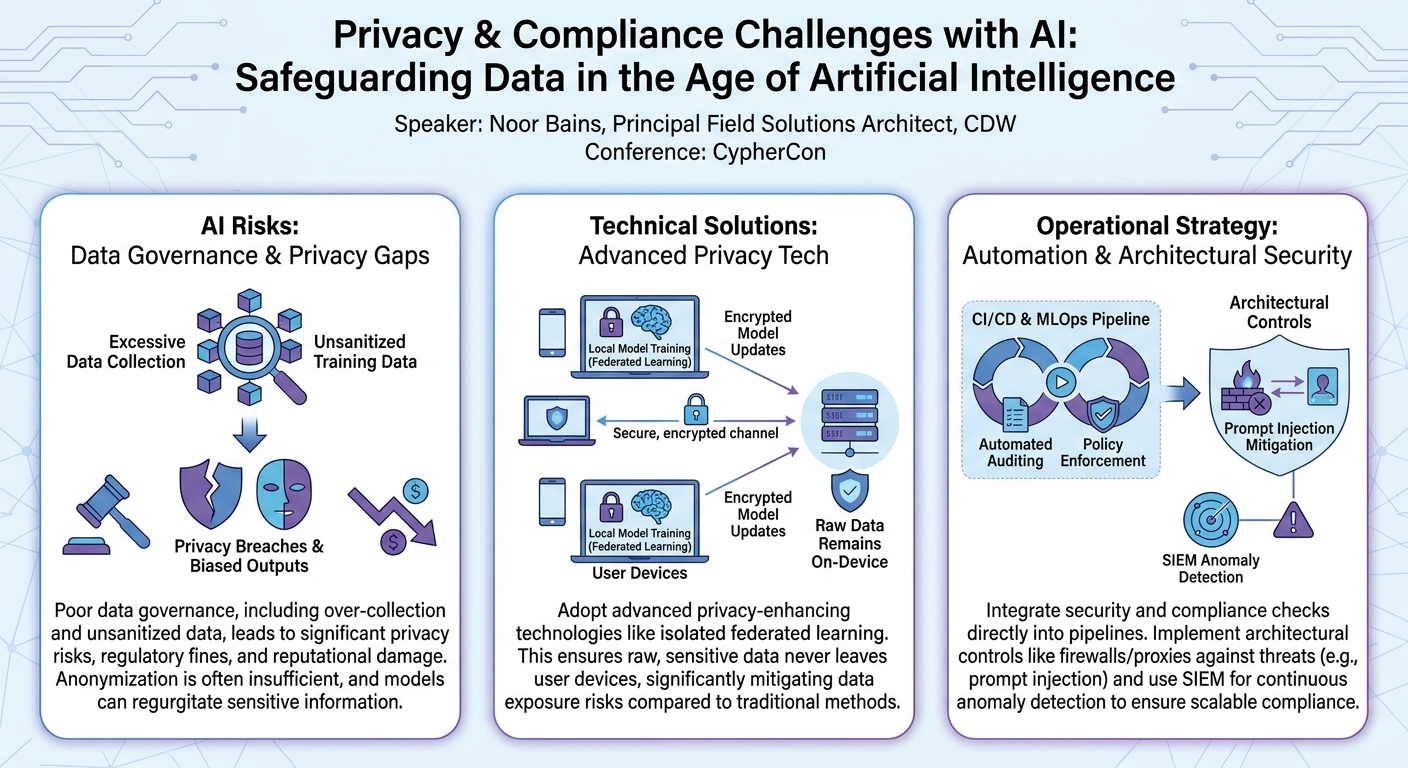
The talk meticulously dissects the core challenges and risks associated with AI in the context of privacy and compliance. A primary concern is excessive data collection, particularly of sensitive personal data like healthcare information, biometrics, and financial records. This over-collection leads to heightened risks of privacy breaches and exposes individuals to undue surveillance or exploitation. Bains notes that misconfigured AI models and insecure data pipelines are direct conduits for data leakage. A critical vulnerability highlighted is the potential for AI models to regurgitate proprietary or sensitive information verbatim in their outputs if the training data is not properly sanitized. This is not merely a hypothetical threat but a documented occurrence with serious consequences for intellectual property and confidential legal documents.
The financial and reputational stakes are substantial. Bains cites that 72% of S&P 500 companies have identified AI risk as a high priority in their risk portfolios. This elevated concern stems from the "double-edged sword" nature of AI: while it solves complex use cases, it also expands an organization's attack surface and exposure. The opacity of certain AI systems, where the decision-making process is unclear, can lead to inaccurate or "tone-deaf" outputs, particularly damaging in areas like marketing. Such missteps, in the age of rapid information dissemination, can result in immediate and severe negative impacts, including significant customer churn and brand damage.
The consequences of privacy violations are severe and multi-faceted: loss of customers, diminished revenue, ethical violations, substantial regulatory fines, and even complete business interruption. B The speaker illustrates this with several anonymized, yet Google-searchable, real-world incidents:
- Healthcare Data Breach: A major cloud provider's AI branch, collaborating with the UK's NHS, developed a health application that inadvertently collected data from 1.6 million users without their explicit consent. This resulted in significant fines and liabilities from the UK's data privacy commissioner, underscoring that even noble intentions do not absolve organizations from compliance failures.
- Biometric Data Exploitation: A biometric company collected the biometrics of millions of users worldwide from publicly available sources. This led to a business interruption, with the company being barred from selling services to private bodies in the US, and facing specific sales prohibitions in states like Illinois for five years. This demonstrates how privacy violations can directly impact market access and business operations.
- Algorithmic Bias in Hiring: Another prominent cloud provider utilized an AI model for hiring between 2018 and 2020 that exhibited a bias against women candidates. The model, trained on historical hiring data predominantly featuring male hires, perpetuated and amplified this bias. This incident resulted in fines and the eventual scrapping of the entire AI hiring system, illustrating the critical need for sanitized training data to prevent the hyperscaling of existing human biases.
Furthermore, Bains points out the inherent challenges with data anonymization, noting that even anonymized data can often be re-identified when correlated with other data sources. This vulnerability, combined with the complexity of managing consent across disparate global privacy regimes—where explicit consent in one region might not suffice in another, and where terms and conditions often obscure how data will actually be used—creates a perilous environment for AI deployment. The talk clearly establishes that the current pace of AI adoption far outstrips the development of adequate regulatory frameworks, leaving organizations in a reactive state unless they proactively implement robust privacy and compliance strategies.
Technical Deep Dive
▶ Watch: Real-world incidents: data breaches, business impact, bias (16:00)
The technical deep dive provided by Noor Bains emphasizes a privacy-first approach, advocating for the integration of privacy considerations across the entire AI lifecycle, from initial design to deployment and ongoing maintenance. This foundational principle is complemented by several critical technical strategies.
First, data minimization is paramount. Organizations should only ingest the absolute minimum amount of data required for a specific AI use case, and always with explicit user consent. This reduces the attack surface and the potential impact of a breach. Beyond mere data minimization, secure data processing is crucial. Bains highlights that traditional anonymization techniques are often insufficient, especially in sensitive sectors like healthcare, where even de-identified data can be re-correlated to sensitive personal information (PII) if other data points are available.
To address this, the talk introduces advanced privacy-enhancing technologies like isolated federated learning. In this paradigm, AI models are trained directly on individual user machines, meaning the raw, sensitive data never leaves the user's device. Instead, only the trained model parameters—an encrypted, aggregated representation of the learned patterns—are exported to a central server. This approach significantly mitigates the risk of model inverse attacks, where an attacker attempts to reconstruct the original training data from the model's outputs.
From a compliance perspective, the talk stresses the need for automation. As AI systems ingest data from diverse sources, they introduce new vectors for privacy risks and cybersecurity threats. Automation is essential for managing data access policies—determining who has access to what data, how that access can be revoked, and how data can be retrieved or deleted. Furthermore, continuous documentation is critical for auditability. This includes maintaining model cards, which provide metadata about AI models (e.g., intended use, training data, performance metrics), and detailed data lineage, tracking data origins, transformations, and destinations. The ability to provide explanatory frameworks for AI outputs is also emphasized, especially to explain any detected biases or anomalous decisions, ensuring transparency and accountability.
Bains further extends the concept of automation to auditing and monitoring within AI development and deployment. Leveraging modern DevOps practices, auditing should be integrated into CI/CD pipelines and MLOps workflows. This means that security and compliance checks are enforced at every stage of the AI development lifecycle, rather than being an afterthought. Continuous monitoring of deployed AI systems is also vital to detect anomalies or deviations from expected behavior, which could indicate a privacy breach, model drift, or malicious activity.
The architectural perspective presented aligns with frameworks like NIST, focusing on phases of protect, defend, respond, and recover.
- Protect: This begins with comprehensive visibility into all applications leveraging AI within an environment, including both known and shadow AI use cases (AI applications deployed without official approval). An agentless approach is recommended for discovering shadow AI, ensuring full capture of all AI-related activity. All this visibility data should be ingested into a data lake for centralized analysis.
- Assess: Once visibility is established, thorough assessment is needed. This involves penetration testing of AI use cases, particularly those developed from open-source components, to identify vulnerabilities. Posture model assessment focuses on identifying misconfigurations or insecure pipelines that could lead to data exposure.
- Controls: Implementing robust security controls is the next step. Bains suggests deploying firewalls or proxies in front of AI agents. For instance, if a user interacts with an AI agent, a firewall can mediate this communication. This is crucial for mitigating threats like prompt injection, which OWASP identifies as the number one breach for AI. A proxy can sanitize inputs and outputs, preventing malicious prompts from manipulating the AI or extracting sensitive information.
- Detect: The final architectural pillar involves continuous detection and response. This includes conducting proper risk assessments and meticulously documenting all findings and compliance adherence. Crucially, organizations should develop SIEM (Security Information and Event Management) use cases specifically designed to detect anomalies generated by AI applications. If an AI system produces an output deemed anomalous, the SIEM should alert a SOC analyst for immediate investigation, closing the loop on the security and compliance posture.
This comprehensive architectural approach, underpinned by automation and a privacy-first mindset, is presented as the cornerstone for building trust and ensuring the long-term success of AI initiatives.
Demo / Proof of Concept
▶ Watch: Remediation: privacy-first design and secure processing (20:00)
The talk focused on theoretical frameworks, real-world incidents, and strategic recommendations for privacy and compliance in AI. There was no specific demonstration or proof of concept presented during this session.
Defensive Implications
▶ Watch: AI architectural security: NIST, prompt injection mitigation (22:00)
Organizations must adopt a proactive and multi-layered defensive strategy to safeguard data in the age of AI. The insights from Noor Bains' talk translate into several critical implications for defenders:
- Embed Privacy-by-Design: Privacy and compliance considerations must be integrated into every stage of the AI development lifecycle, from initial conceptualization to deployment and retirement. This includes conducting Privacy Impact Assessments (PIAs) and Data Protection Impact Assessments (DPIAs) early and often.
- Strict Data Minimization and Consent Management: Implement policies to collect only the absolutely necessary data for AI models. Develop robust, transparent consent mechanisms that clearly articulate how data will be used, and enforce user rights for data access, correction, deletion, and portability, in compliance with regulations like GDPR and CCPA.
- Sanitize Training Data Rigorously: Prioritize the thorough sanitization of training datasets to eliminate biases and prevent the regurgitation of sensitive or proprietary information. This is crucial to avoid ethical violations, legal fines, and the generation of inaccurate or harmful outputs.
- Adopt Advanced Privacy-Enhancing Technologies: Move beyond basic anonymization, which is often insufficient. Explore and implement advanced techniques such as isolated federated learning to ensure raw data remains on user devices, protecting privacy while still enabling model training.
- Automate Compliance and Security in AI Pipelines: Integrate security and compliance checks directly into CI/CD and MLOps pipelines. This includes automated auditing of model cards, data lineage, and access controls. Continuous monitoring for anomalies in AI outputs and system behavior is essential, with alerts feeding into SIEM systems for immediate action.
- Implement Architectural Security Controls for AI Agents: Deploy firewalls or proxies in front of AI agents to act as a protective layer, mitigating threats like prompt injection—identified as a top OWASP AI vulnerability. These controls can sanitize inputs and outputs, preventing malicious data from reaching the AI or sensitive data from being extracted.
- Enhance Visibility into AI Ecosystems: Develop capabilities to discover and monitor all AI applications within the environment, including shadow AI. An agentless approach can help identify unauthorized or unknown AI deployments, bringing them under organizational governance and security control.
- Address Cross-Border Data Transfer Complexities: Develop clear policies and technical solutions for managing data transfers across different privacy regimes. Ensure compliance with specific national laws (e.g., India, China) and international agreements (e.g., BCRs for EU data transfers), understanding that requirements vary significantly.
- Continuous Risk Assessment and Regulatory Alignment: Given the rapid evolution of AI and the slower pace of regulation, organizations must maintain continuous risk assessment and gap analysis processes. These should be directly tied to emerging AI regulations and industry best practices, allowing for agile adaptation of security and compliance postures.
- Foster Explanatory AI (XAI): Strive for greater transparency in AI decision-making. Implement mechanisms to explain why an AI reached a particular output or decision, particularly in sensitive areas like hiring or lending. This helps build trust, identify biases, and meet emerging regulatory requirements for explainability.
By embracing these defensive implications, organizations can navigate the complex AI landscape more securely, building trust with users and mitigating significant legal, financial, and reputational risks.
Key Takeaways
- AI Adoption Outpaces Regulation: The rapid integration of AI across industries significantly outpaces the development of comprehensive regulatory frameworks, creating substantial privacy and compliance gaps that organizations must proactively address.
- Data Governance is Paramount: Poor data governance, including excessive data collection, insecure pipelines, and biased or unsanitized training data, is a primary source of AI-related privacy risks, leading to data leakage, ethical violations, and inaccurate outputs.
- Anonymization is Insufficient: Traditional data anonymization techniques are often inadequate for protecting privacy in AI, as de-identified data can still be re-correlated with other sources. Advanced methods like isolated federated learning are essential for sensitive data.
- Architectural Security is Crucial: A robust architectural approach, encompassing comprehensive visibility (including shadow AI), continuous assessment (e.g., penetration testing), proactive controls (e.g., firewalls/proxies against prompt injection), and anomaly detection via SIEM, is fundamental for securing AI deployments.
- Automation is Key for Scalable Compliance: Automating policy enforcement, auditing (especially in CI/CD/MLOps), and monitoring for anomalies is critical for managing AI privacy and compliance at scale, ensuring consistent security and accountability.
- Consequences are Severe: Organizations failing to prioritize AI privacy and compliance face significant repercussions, including hefty fines, loss of customer trust, severe reputational damage, and even direct business interruption, as demonstrated by real-world incidents.
About the Speaker(s)
Noor Bains is a Principal Field Solutions Architect for CDW, bringing approximately 15 years of extensive experience in the cybersecurity domain. His career journey has spanned various critical roles, including a SOC analyst, a professional services engineer, and a risk and compliance advisor for a government entity. For the past seven years, Bains has focused on his role as a security architect, where he assists companies in enhancing their overall security posture. His expertise covers a broad spectrum of cybersecurity challenges, with a particular focus on the strategic and architectural aspects of securing modern technological landscapes like artificial intelligence.
Reviews
Dr. Zero (Offensive Security Researcher) — HARD PASS
A CDW sales architect recites a Wikipedia summary of five-year-old AI controversies and calls it a threat briefing. The proposed solution to complex LLM vulnerabilities is to buy a proxy and pipe the logs to a SIEM. Total buzzword bingo with zero actionable signal for anyone who has been awake for the last three years.
Heather Calloway (CISO) — WEAK
This is a 101-level survey of AI privacy risks that substitutes generic best practices for operational clarity. It recycles years-old headlines about hiring bias without offering a net-new governance framework. Your board already knows AI is risky; they need to know exactly how to govern it, and this session won't get you there.