The Importance of Networking in the Cybersecurity Community
Michael Lenz
Overview
In an era defined by a perpetually evolving threat landscape, the ability to collaborate and share knowledge within the cybersecurity community is not merely beneficial—it is essential for collective defense and individual career advancement. Michael Lenz's talk at CypherCon, "The Importance of Networking in the Cybersecurity Community," underscores this critical imperative, arguing that robust professional networks are the bedrock of effective cybersecurity. Lenz articulates how fostering genuine connections and actively participating in the community empowers individuals and organizations to stay ahead of adversaries, accelerate incident response, and distribute best practices more efficiently.
Key moments
- 0:00 Introduction and background
- 2:00 Why networking matters in cybersecurity
- 5:10 'It's not what you know, it's who you know'
- 7:00 What to avoid when first networking
- 8:20 Actionable strategies for building your network
- 10:00 The power of community and belonging
- 12:10 Networking as a student: Just ask
- 15:00 Overcoming fear and learning by doing
The Importance of Networking in the Cybersecurity Community
Speakers: Michael Lenz
Conference: CypherCon
YouTube: https://www.youtube.com/watch?v=t_i_dI80npA
Overview
In an era defined by a perpetually evolving threat landscape, the ability to collaborate and share knowledge within the cybersecurity community is not merely beneficial—it is essential for collective defense and individual career advancement. Michael Lenz's talk at CypherCon, "The Importance of Networking in the Cybersecurity Community," underscores this critical imperative, arguing that robust professional networks are the bedrock of effective cybersecurity. Lenz articulates how fostering genuine connections and actively participating in the community empowers individuals and organizations to stay ahead of adversaries, accelerate incident response, and distribute best practices more efficiently.
This presentation delves into both the strategic "why" and the practical "how" of networking, moving beyond superficial interactions to advocate for authentic engagement and value creation. Lenz, drawing from his personal journey and experience building local cybersecurity communities, provides actionable insights for both newcomers and seasoned professionals. His core message resonates deeply: success in cybersecurity is not solely about technical prowess but profoundly influenced by the strength and breadth of one's professional connections, leading to enhanced security posture for all involved.
The talk emphasizes that true networking extends beyond mere contact exchange; it's about building trust, fostering mentorship, and creating a supportive ecosystem where knowledge flows freely. By highlighting the tangible benefits—from early warning systems against emerging threats to unlocking unadvertised career opportunities—Lenz positions networking as a fundamental skill that underpins both individual professional growth and the collective resilience of the cybersecurity industry.
Background
▶ Watch: Introduction and background (0:00)
The cybersecurity domain faces an inherent challenge: the adversaries are often highly collaborative, constantly sharing tactics, techniques, and procedures (TTPs) to exploit vulnerabilities. In contrast, defenders traditionally operated in more isolated silos, often reinventing solutions or discovering threats independently. This disparity creates a significant disadvantage for organizations striving to protect their assets. The problem is exacerbated by the rapid pace of technological change and the continuous emergence of new attack vectors, making it impossible for any single individual or team to possess all the necessary knowledge and resources.
Prior to the widespread recognition of networking's importance, information sharing was often ad-hoc, limited by organizational boundaries, or reactive. Incident response efforts could be slower, as teams lacked immediate access to external intelligence or collaborative support. Career progression might rely solely on formal job applications, overlooking a vast "hidden job market." Moreover, the distribution of best practices and the adoption of innovative defensive strategies were often fragmented, leading to inconsistent security postures across the industry.
Michael Lenz's talk directly addresses this historical gap, advocating for a proactive, community-centric approach. The "why this problem exists" is rooted in the sheer scale and complexity of modern cyber threats, coupled with the traditional tendency towards isolated defense. Networking emerges as the vital counter-measure, transforming a fragmented defensive landscape into a collaborative, resilient ecosystem. It's about shifting from an individualistic struggle against a collective adversary to a collective defense against a collective threat, leveraging the power of shared intelligence, diverse perspectives, and mutual support to overcome the inherent challenges of securing digital infrastructures.
Key Findings
▶ Watch: 'It's not what you know, it's who you know' (5:10)
Michael Lenz's presentation distills several key findings that underscore the transformative power of networking within the cybersecurity community. Foremost among these is the assertion that "it's not always what you know, it's who you know and are connected to." This foundational principle highlights that while technical skills are indispensable, access to information, opportunities, and support often hinges on one's network. Lenz cites direct experience where job opportunities were discovered and filled through personal connections, never having been formally published on company websites.
Another critical finding is the concept of collateral defense. Networking facilitates robust intelligence sharing across different teams and organizations, enabling faster identification and mitigation of threats. This collaborative approach means defenders don't have to "create it all over again" when confronting known threats, significantly improving efficiency. Closely related are the benefits of incident response coordination and early warning systems, where information about emerging threats or ongoing attacks can be rapidly disseminated, allowing other teams to prepare or react proactively. This collective vigilance enhances the overall security posture of the community.
Lenz also identifies the distribution of best practices as a key outcome of effective networking. By sharing successful strategies and lessons learned, the community collectively elevates its defensive capabilities and builds community reliance. For individuals, networking offers unparalleled career growth and mentorship opportunities. Lenz himself mentors a student and emphasizes the rewarding nature of sharing knowledge and guiding others. The talk highlights the importance of building trust across organizations, ensuring that shared intelligence and advice are valued and acted upon. This trust is cultivated through genuine engagement and consistent, value-driven interactions.
Finally, Lenz emphasizes the accessibility and welcoming nature of the cybersecurity community, particularly for newcomers. He notes that many experienced professionals and vendors are eager to help, stressing that "there's never any stupid questions." This finding encourages active participation, dismantling potential barriers for those new to the field and reinforcing the idea that the community thrives on mutual support and knowledge exchange.
Technical Deep Dive
▶ Watch: Actionable strategies for building your network (8:20)
While Michael Lenz's talk is not about specific exploits or technical vulnerabilities, it provides a deep dive into the methodologies and strategies for effective networking—a critical "technical skill" for navigating the cybersecurity landscape. These strategies are akin to architectural patterns for building robust professional relationships and community resilience.
Lenz outlines several practical approaches for engagement:
- Conference Participation and Volunteering: Attending professional conferences such as Def Con, Black Hat, BSides, CypherCon, and Cactus Con is a primary method. Beyond mere attendance, Lenz champions volunteering at conference villages, having personally contributed to the Red Team Village, Blue Team Village, and the New Village at CypherCon. This hands-on involvement not only provides access but also positions individuals as active contributors, fostering deeper connections.
- Interactive Learning Events: Participating in Capture the Flag (CTF) activities, workshops, and other training events offers structured opportunities for skill development and networking with like-minded individuals.
- Online Platforms: Leveraging digital spaces like Discord, LinkedIn, and Instagram allows for continuous engagement and connection beyond physical events. LinkedIn is favored for initial connections, while Discord groups (e.g., BurbSec, CypherCon's own server) are excellent for sustained involvement and real-time community interaction.
- Local Meetup Creation: Lenz exemplifies this by founding BurbSec Minneapolis five months prior to the talk, building a significant local group that fosters networking and collaboration. He notes similar groups like the SecKC group in Kansas City, emphasizing the value of localized, consistent gatherings.
After making an initial connection, Lenz details a structured follow-up process to cultivate meaningful relationships:
- Personalized Contact: Immediately send a contact message rather than a generic connection request.
- Profile Review and Engagement: Research their profile and work to understand their interests and contributions.
- Gradual Communication: Start with low-pressure communication, gradually moving into deeper conversations.
- Value-First Approach: Always strive to provide value before asking for something in return. This builds genuine rapport and trust. Lenz explicitly advises against asking for jobs, referrals, introductions, or pitching/selling early in a relationship. These outcomes often emerge naturally once trust is established.
- Relationship Management: Optionally, maintain a simple CRM-like database to track interactions, including who was met, what was discussed, and where the connection was made. This contextual information aids in future conversations.
Lenz also provides strategic principles for effective networking:
- Authenticity: Be genuine in interactions.
- Generosity: "Give in what you have before you get something back." This could be sharing knowledge, offering help, or simply listening.
- Visibility and Activity: Stay active and visible within the community.
- Consistent Follow-up: Follow up regularly, but avoid being pushy.
- Share Wins and Lessons Learned: Contributing insights, whether successes or failures, enriches the collective knowledge base.
To "build your networking today and take action," Lenz proposes concrete steps:
- Join a local cyber security meetup.
- Engage with the community on social media (LinkedIn, Discord).
- Attend at least one conference yearly.
- Mentor someone new, highlighting its rewarding nature.
- Share your knowledge publicly and offer resources.
These structured methodologies, from initial engagement points to ongoing relationship management, form a practical framework for individuals to actively construct and leverage their professional networks, thereby enhancing both personal career trajectories and the collective security posture of the cybersecurity community.
Demo / Proof of Concept
▶ Watch: The power of community and belonging (10:00)
This particular talk by Michael Lenz is a conceptual and strategic presentation focused on the principles and methodologies of networking within the cybersecurity community. As such, it did not include a live demonstration or a technical proof of concept. The content was delivered through direct advice, personal anecdotes, and actionable strategies rather than showcasing a specific tool, exploit, or architectural implementation.
Defensive Implications
▶ Watch: Overcoming fear and learning by doing (15:00)
The defensive implications of robust networking, as highlighted by Michael Lenz, are profound and multifaceted, extending far beyond individual career benefits to bolster the collective security posture of the entire cybersecurity ecosystem. At its core, networking fosters a collateral defense mechanism, where individual strengths are amplified through shared intelligence and coordinated action.
Firstly, intelligence sharing becomes significantly more efficient and proactive. When cybersecurity professionals from different organizations and teams connect, they can rapidly disseminate information about emerging threats, new attack vectors, and observed TTPs. This collective intelligence acts as an early warning system, allowing defenders to prepare for or preempt attacks that might otherwise catch them off guard. Instead of each organization independently discovering and analyzing the same threats, a networked community can pool resources, reducing redundant effort and accelerating response times.
Secondly, networking directly improves incident response coordination. In the event of a breach or a widespread attack, established connections enable rapid communication and collaboration. Teams can share insights into mitigation strategies, forensic findings, and containment techniques, leading to faster resolution and minimized damage. This coordination is crucial for complex, multi-stage attacks that often transcend single organizational boundaries.
Thirdly, the distribution of best practices is greatly enhanced. Through community interactions at conferences, meetups, and online forums, security professionals can learn from each other's successes and failures. This continuous exchange of knowledge ensures that effective defensive strategies and tools are widely adopted, raising the overall baseline of security across the industry. It builds community reliance and trust, which are foundational for collective defense against sophisticated adversaries.
Finally, by fostering a supportive and knowledgeable community, networking contributes to talent development and retention. Mentorship opportunities, facilitated by strong networks, help cultivate the next generation of cybersecurity professionals. A well-connected workforce is better equipped to adapt to new challenges, innovate defensive solutions, and collectively withstand the persistent pressure from threat actors, ultimately leading to a stronger, more resilient global cybersecurity defense.
Key Takeaways
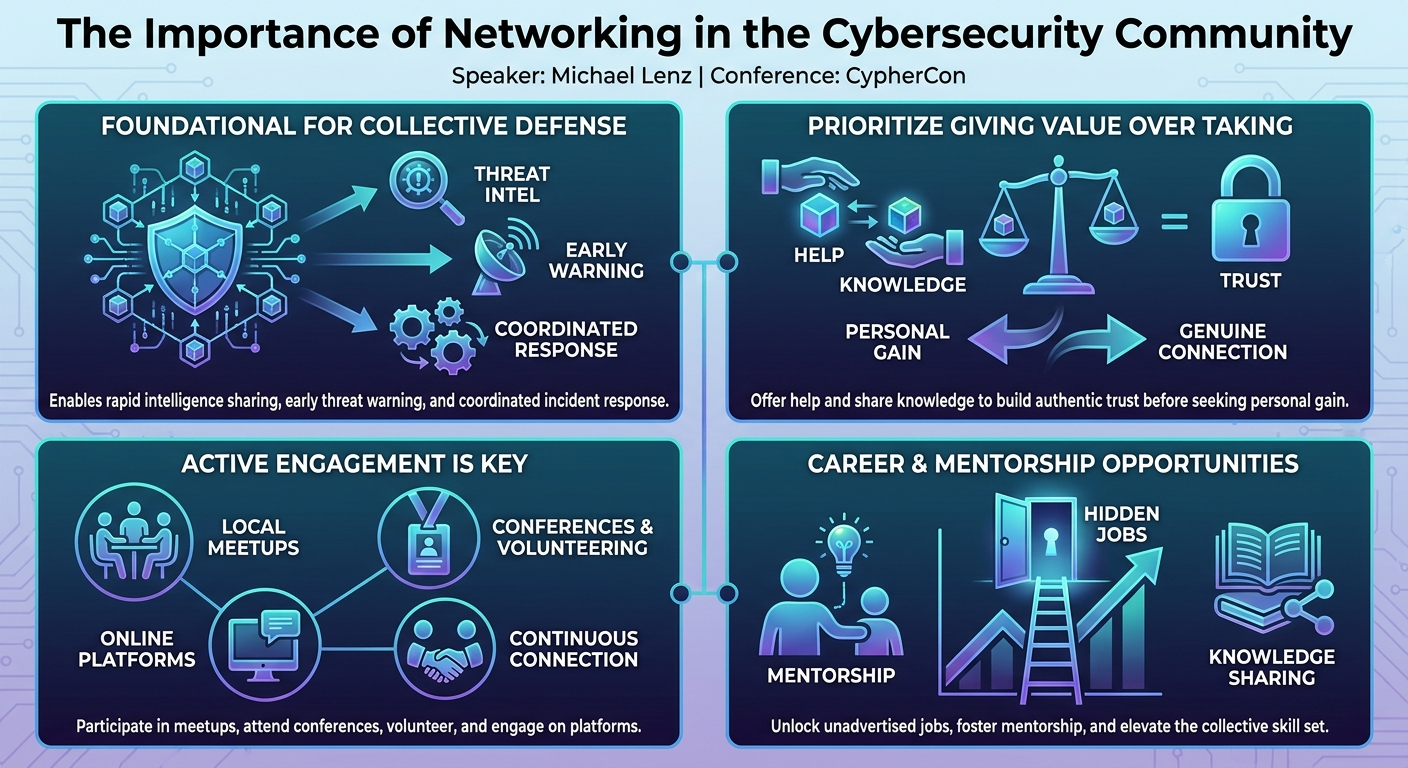
- Networking is Foundational for Collective Defense: Beyond individual career benefits, robust networks facilitate intelligence sharing, early warning systems, and coordinated incident response, leading to a stronger, more resilient cybersecurity community against evolving threats.
- Prioritize Giving Value Over Taking: Authentic networking involves offering help, sharing knowledge, and building trust before seeking personal gain. Avoid asking for jobs or referrals early in a relationship; these opportunities often emerge naturally from genuine connections.
- Active Engagement is Key: Participate in local meetups (e.g., BurbSec Minneapolis), attend conferences (Def Con, Black Hat, CypherCon), volunteer at villages, and engage on online platforms like Discord and LinkedIn to foster continuous connections.
- Authenticity and Consistency Build Trust: Be genuine in your interactions, follow up consistently but not pushily, and actively share your wins and lessons learned to establish credibility and deeper relationships within your network.
- Mentorship and Knowledge Sharing Empower the Community: Both giving and receiving mentorship, and openly sharing your knowledge and resources, are crucial for individual growth and for elevating the collective skill set and defensive capabilities of the entire cybersecurity field.
- It's Who You Know as Much as What You Know: While technical skills are vital, access to unadvertised job opportunities, critical intelligence, and diverse perspectives often comes through the strength and breadth of your professional network.
About the Speaker(s)
Michael Lenz is a dedicated and passionate advocate for community building and networking within the cybersecurity domain. He is the founder of BurbSec Minneapolis, a local meetup group he established approximately five months prior to this talk, which has rapidly grown into a significant community hub. Lenz is a highly active volunteer at major cybersecurity conferences, having contributed his time and expertise to various initiatives, including the Red Team Village, Blue Team Village, and the New Village at CypherCon.
His personal journey underscores his belief in the power of networking; he openly shares his transition from someone who initially didn't believe in networking to a fervent practitioner who actively seeks out and engages with diverse groups, from student communities to CISO dinners. Lenz is a strong proponent of mentorship, having taken on a student mentee and emphasizing the rewarding nature of guiding newcomers. He is known for his approachable demeanor and "zero fear" in engaging with anyone in the community, reflecting his commitment to fostering an inclusive and supportive environment where "nobody ever says anything dumb." His work exemplifies how individual initiative can profoundly impact collective defense and career development within the cybersecurity landscape.
Reviews
Dr. Zero (Offensive Security Researcher) — HARD PASS
This is a 45-minute LinkedIn post masquerading as a conference session. Rebranding basic human socialization as a 'collateral defense mechanism' is exactly the kind of hollow filler that pads out Sunday morning con schedules.
Heather Calloway (CISO) — SOLID
Competent career and community advice for junior staff navigating their first few conferences. It has zero bearing on enterprise risk, governance, or formal threat intelligence sharing, and is not for your leadership team.